
A complete issue · 16 pages · 1883
Life — September 13, 1883
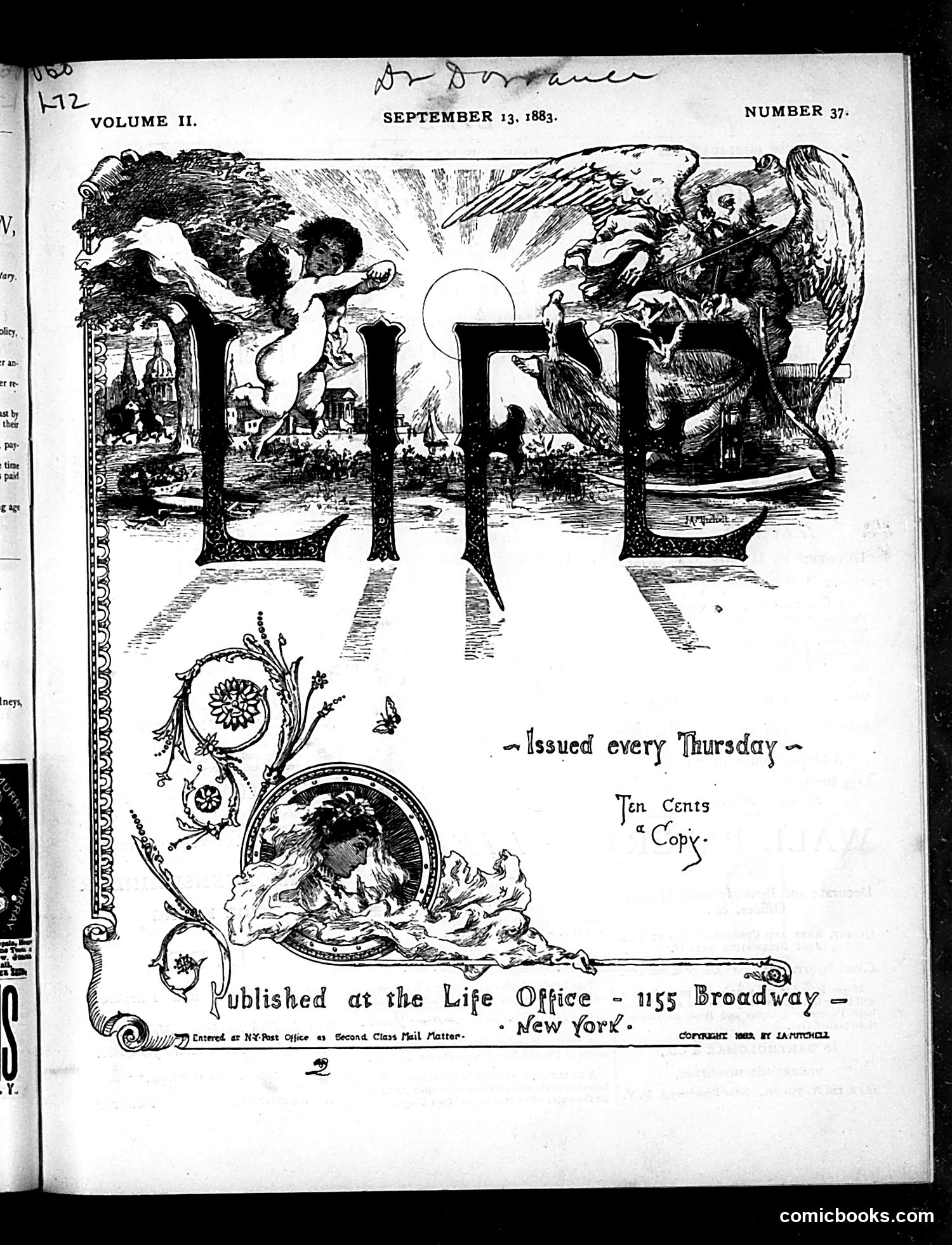
This is the cover of *Life* magazine, Volume II, Number 37, dated September 13, 1883. The large decorative letters "LIFE" dominate the center, framed by elaborate allegorical illustrations featuring classical and mythological figures—cherubs, winged beings, and a pastoral landscape with a distant city. The imagery appears purely decorative and ornamental rather than politically satirical. The ornate border design, floral motifs, and classical aesthetic reflect the magazine's artistic Victorian styling. The publication information indicates *Life* was issued weekly on Thursdays at ten cents per copy, published from the Life Office at 1155 Broadway, New York. This is primarily a cover design showcase rather than a substantive political cartoon or commentary page.
This page is primarily **advertising and publication notices**, not satirical content. It announces: - **New books** by Henry Holt & Co. (including works on Italian Renaissance and cooking) - **The Critic** magazine, a weekly literary review covering literature, fine arts, science, music, and drama - **Summer resort hotels** (Parker House in Boston, Hotel Netherwood in New Jersey, Fenimore in Cooperstown, Otsego Lake properties, Cooper House) - **Life magazine subscriptions** and a filing binder The page includes testimonial quotes praising *The Critic* as "the first literary journal in America" and *Life* as "the best humorous weekly publication ever published in America." **No political cartoons or satirical illustrations appear on this page.** It's a standard late-19th-century magazine advertisement section.
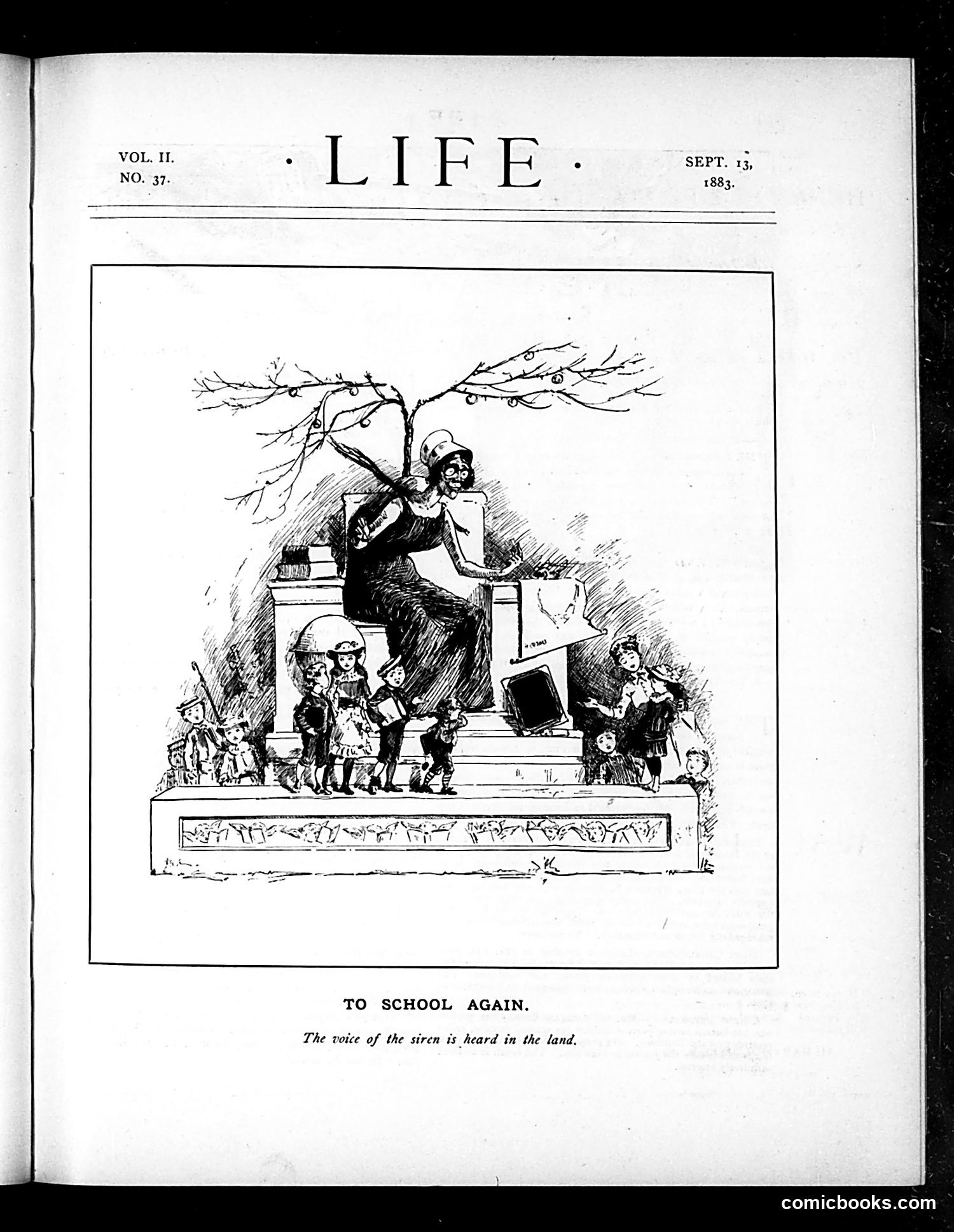
This cartoon satirizes the return to school season. A stern schoolmistress (likely representing Education or School Authority) stands elevated on a pedestal, wielding a rod or switch—the traditional instrument of corporal punishment. Below her, a procession of reluctant children trudges forward, appearing distressed or resigned. The caption quotes "The voice of the siren is heard in the land"—a classical allusion comparing the schoolmistress's call to the mythical Sirens who lured sailors to their doom. This darkly humorous comparison suggests 1880s Americans viewed mandatory schooling as an unwelcome or punitive experience for children, with the authority figure as an intimidating disciplinarian rather than an educator.
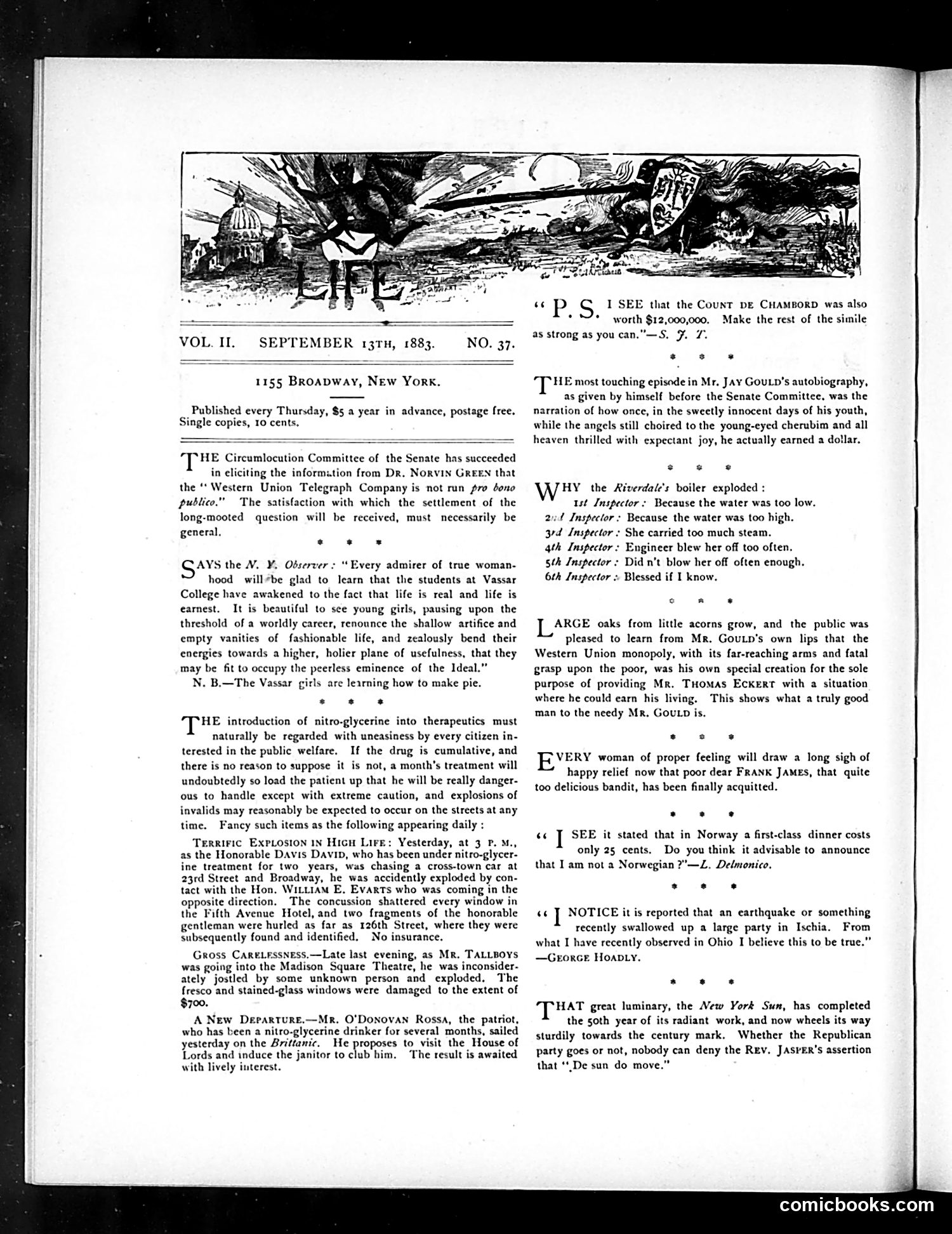
The decorative header illustration shows a nighttime landscape with a crescent moon and what appears to be industrial or architectural elements—likely generic satirical decoration rather than reference to a specific political figure. The page content consists primarily of **short satirical news items and commentary** rather than political cartoons. Topics include: - Senate committee actions regarding Western Union Telegraph - Commentary on women's education at Vassar College - Medical discussion of nitro-glycerine as therapeutic treatment - A terrific explosion in high life (society scandal) - Gossip about carelessness at Madison Square Theatre - Notes on various social figures **No identifiable political caricatures appear.** This is a **humor/gossip page** mixing social satire with news commentary typical of 1880s Life magazine's satirical approach to contemporary events and society.
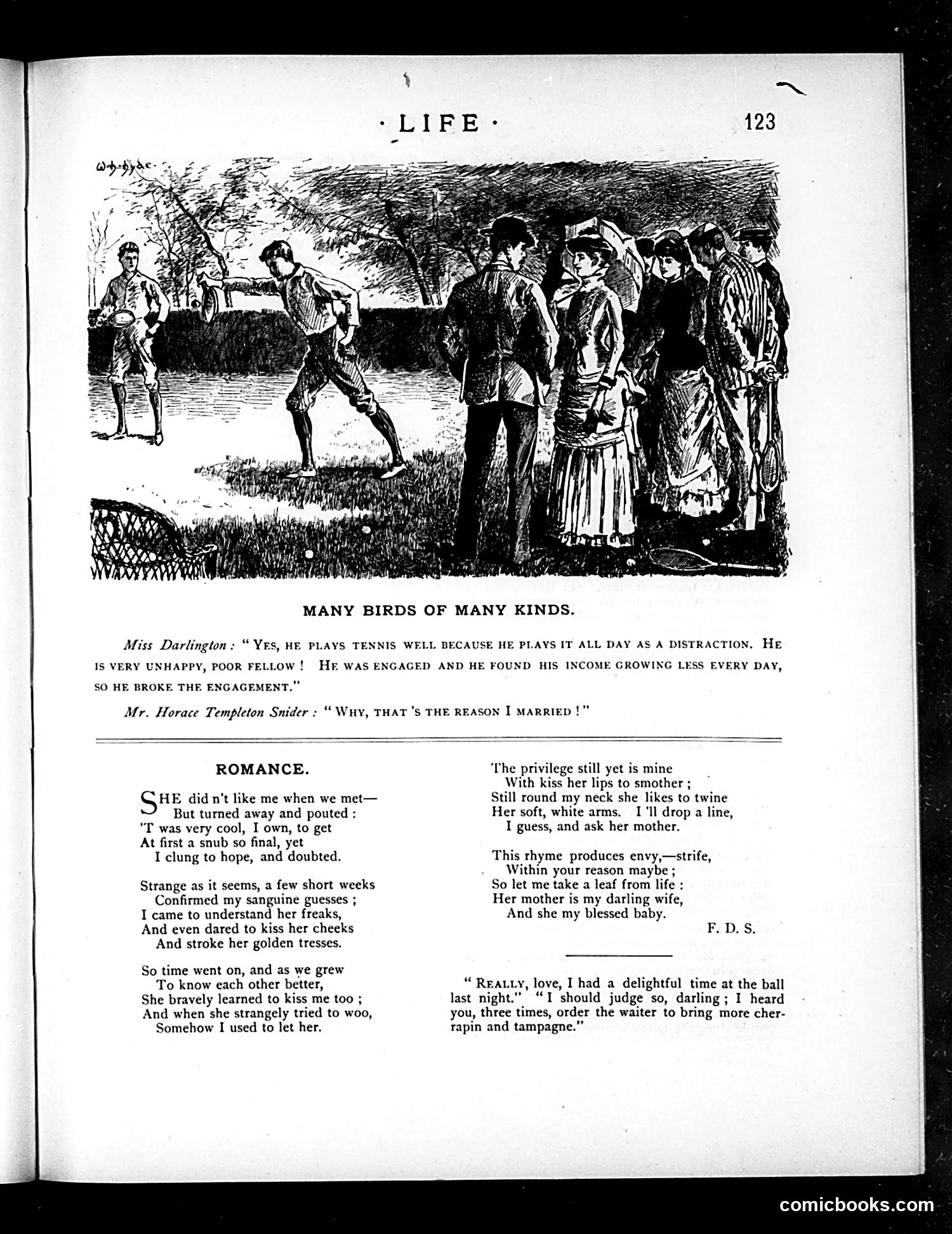
This page contains two distinct humor pieces: **"Many Birds of Many Kinds"** (top illustration): A social cartoon showing a tennis player being observed by onlookers. The joke critiques a man who plays tennis excessively as a distraction from unhappiness in his engagement. Miss Darlington notes he's "very unhappy" and plays "all day as a distraction"—his income decreases because he's so distracted. Mr. Horace Templeton Snider's response ("That's the reason I married!") suggests marriage itself is the real distraction from work. **"Romance"** (bottom section): A sentimental poem about courtship's progression from initial coldness to affection and marriage. The brief dialogue at the end humorously deflates this sentiment—a woman boasts about ordering expensive champagne repeatedly at a ball, reducing romance to materialistic consumption. Both pieces mock romantic idealization through practical, cynical observations about relationships.
This page from *Life* magazine consists primarily of **society reporting**, not political satire. The masthead "BOOKINGS OF THE SEASON" indicates it's a social column documenting high-society events in Hoboken and vicinity. The content records upper-class activities: a wedding of Miss Pinkie Smythe Robinson to a member of the Talkytalk Gimlet insurance company (capital $300,000), dinners, and train trips to Newport. The tone is satirical toward wealthy socialites—mocking their pretensions, excessive spending, and obsession with status markers like "The Blue Book." The cartoon at the top appears decorative rather than political commentary. This page exemplifies *Life*'s role as both satirist and chronicler of Gilded Age society.
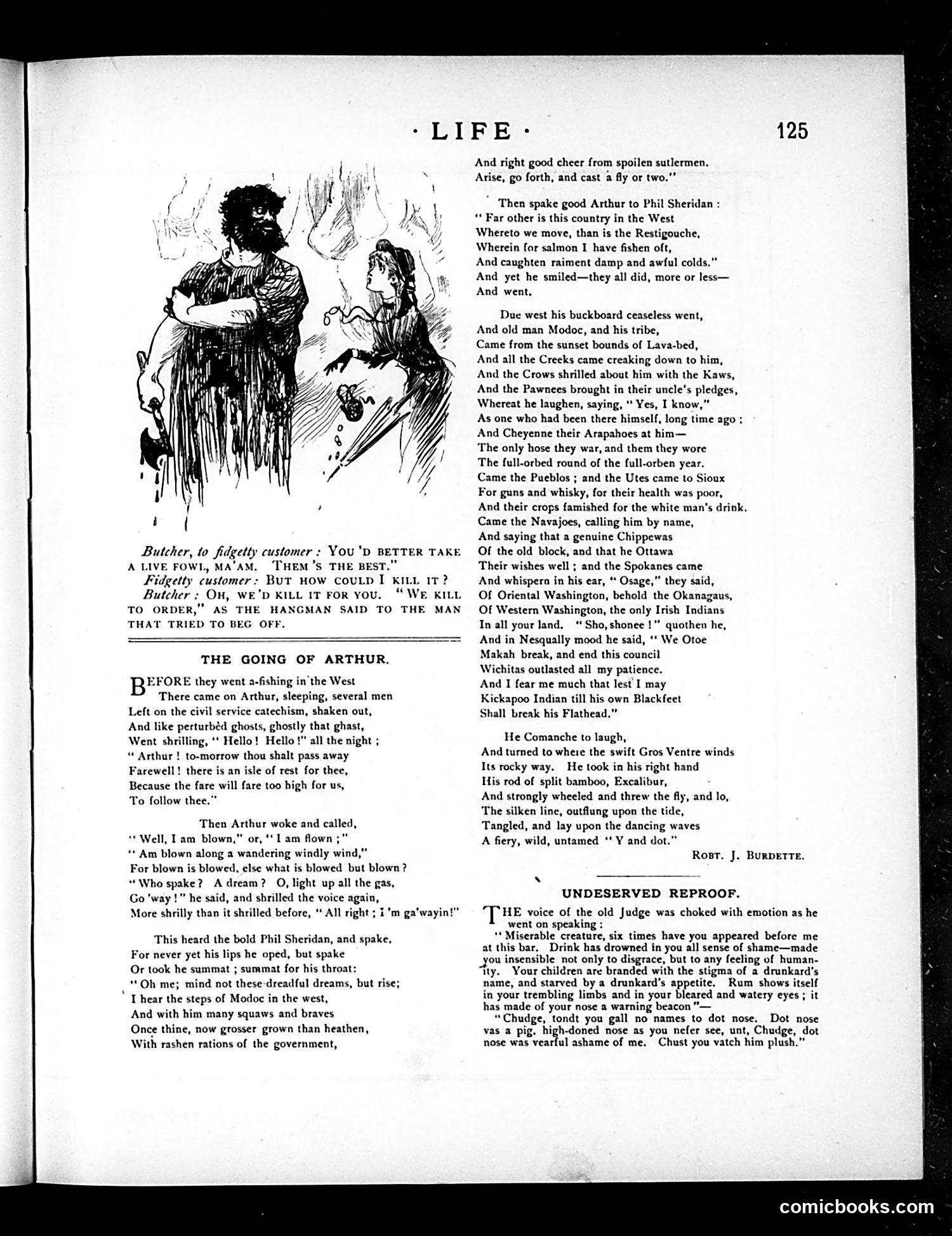
The small cartoon at top-left depicts a butcher and customer in a brief comedic exchange about killing a live fowl. The butcher jokes he'll kill it "for you" rather than the customer doing it themselves—a simple wordplay joke about butchering work, with no evident political content. The rest of the page contains poetry and literary content, not political satire. "The Going of Arthur" appears to be verse about Native American conflicts in the American West (referencing Modoc, Crow, Utes, Sioux, Navajo, Chippewa, and other tribes). "Undeserved Reproof" is a separate satirical poem mocking a judge for being harsh to a vagrant or drunk person. This is primarily **literary content**, not political cartooning.
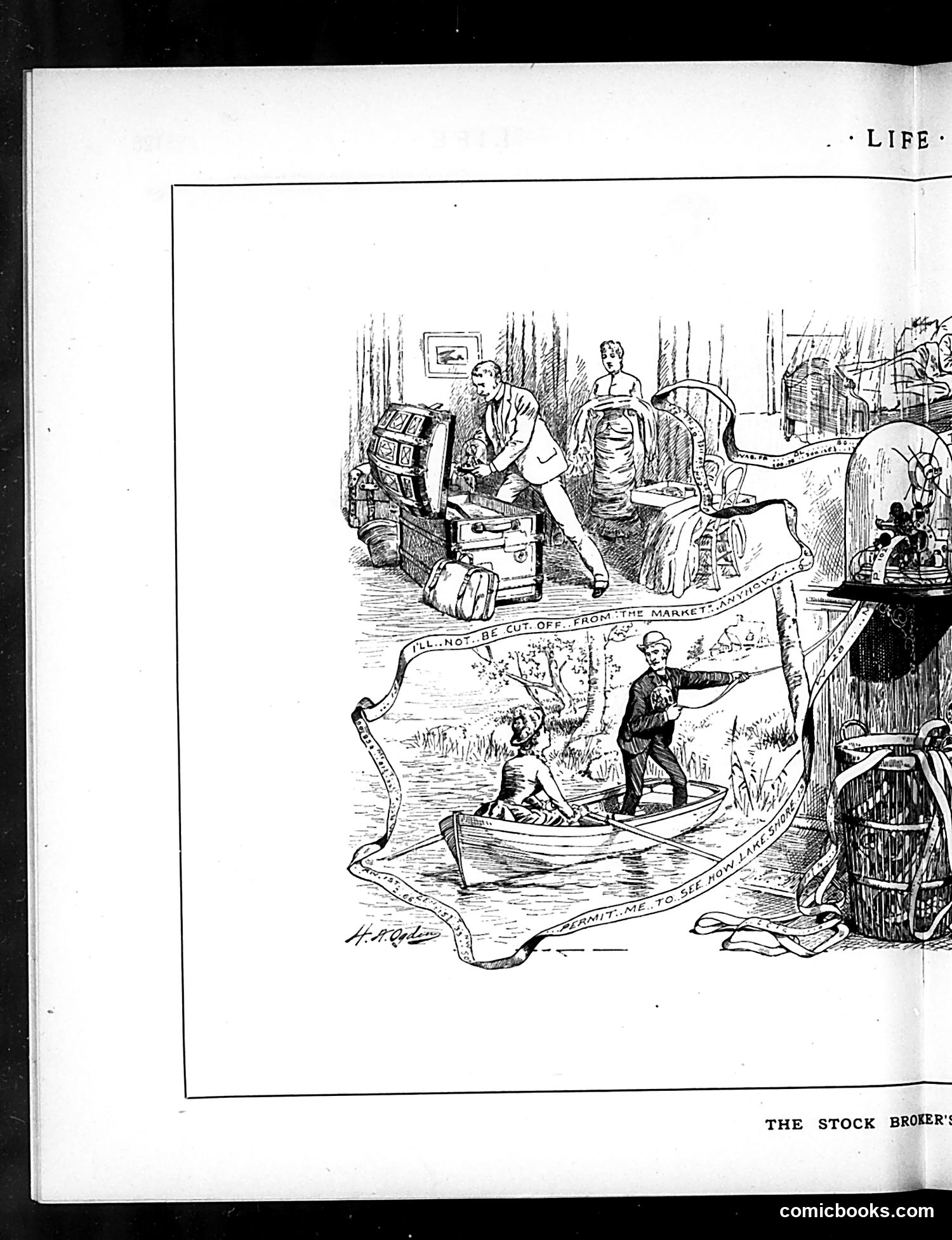
This Life magazine cartoon satirizes stock market speculation and financial greed. The upper scene shows a well-dressed broker at his office, surrounded by luggage and market materials—suggesting he's prepared to flee quickly with profits. The lower scene depicts the consequences: a man in a boat rowing away, labeled "Permit me to see you off to the poor farm," addressing someone who appears financially ruined. The snake-like ribbon connecting the scenes reads "I'll not be cut off from the market"—indicating the broker's obsession with financial gains regardless of others' losses. The satire critiques brokers' self-interest and the human toll of stock market manipulation, where ordinary people lose everything while brokers escape with their wealth.
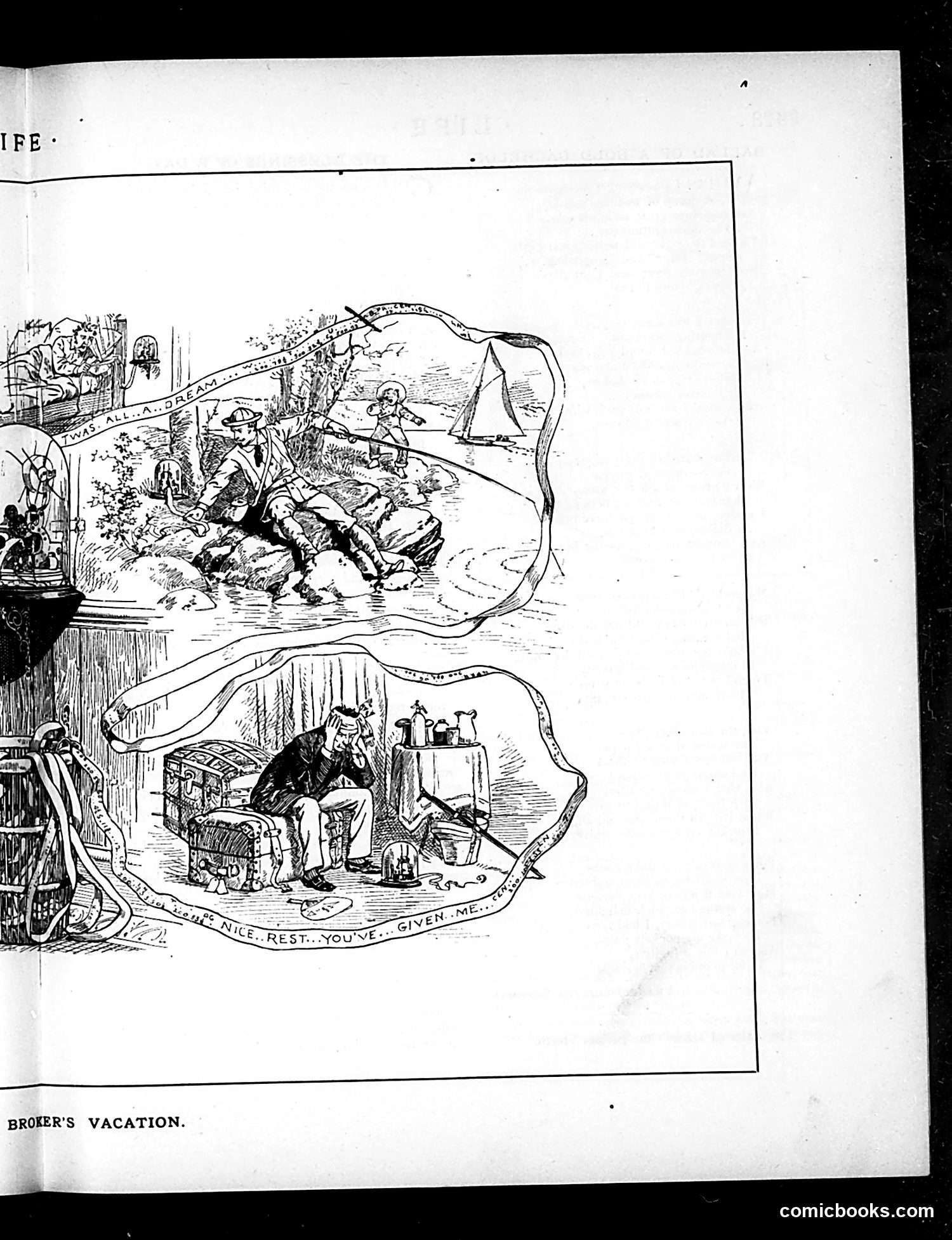
This two-panel satirical cartoon depicts contrasting visions of rest for a stockbroker or financial businessman. The upper panel shows an idealized vacation: a man fishing, sailing, and relaxing by water with companions—the leisure lifestyle presumably available to wealthy financiers. The lower panel shows reality: the same man sits anxiously indoors at a table with financial documents and ledgers scattered about, appearing stressed and unable to escape work even during supposed rest time. The caption reads "A NICE REST YOU'VE GIVEN ME"—suggesting his vacation has been anything but restful. The satire mocks the inability of wealthy business figures to truly disconnect from financial concerns, even when attempting leisure. It reflects period anxieties about the consuming nature of financial work and the gap between aspirational and actual relaxation.
This page contains two distinct pieces of satirical writing, typical of Life's early 20th-century humor: **"Ballad of a Bold Bachelor"** (left) — A comic poem by Frank Dempster Sherman about a young man who courted an affluent woman through extravagant romantic gestures (flowery letters, bouquets, expensive stationery). The satire targets his foolishness: he spent money he didn't have trying to impress someone motivated by wealth, not love. The ironic conclusion is that he escaped marriage and now enjoys "blessedness" as a single man—suggesting romantic pursuits are financially ruinous. **"The Blessings of a Day"** (right) — A humorous essay finding joy in petty office dynamics: arriving before coworker "Smith," discovering Smith is late, throwing things at an organ-grinder, and schadenfreude over Smith's hangovers and idleness. The satire mocks how workplace comfort derives from others' misfortune rather than genuine accomplishment. Both pieces reflect turn-of-century American attitudes about bachelor life, workplace culture, and romantic folly, delivered through gentle, class-conscious humor.
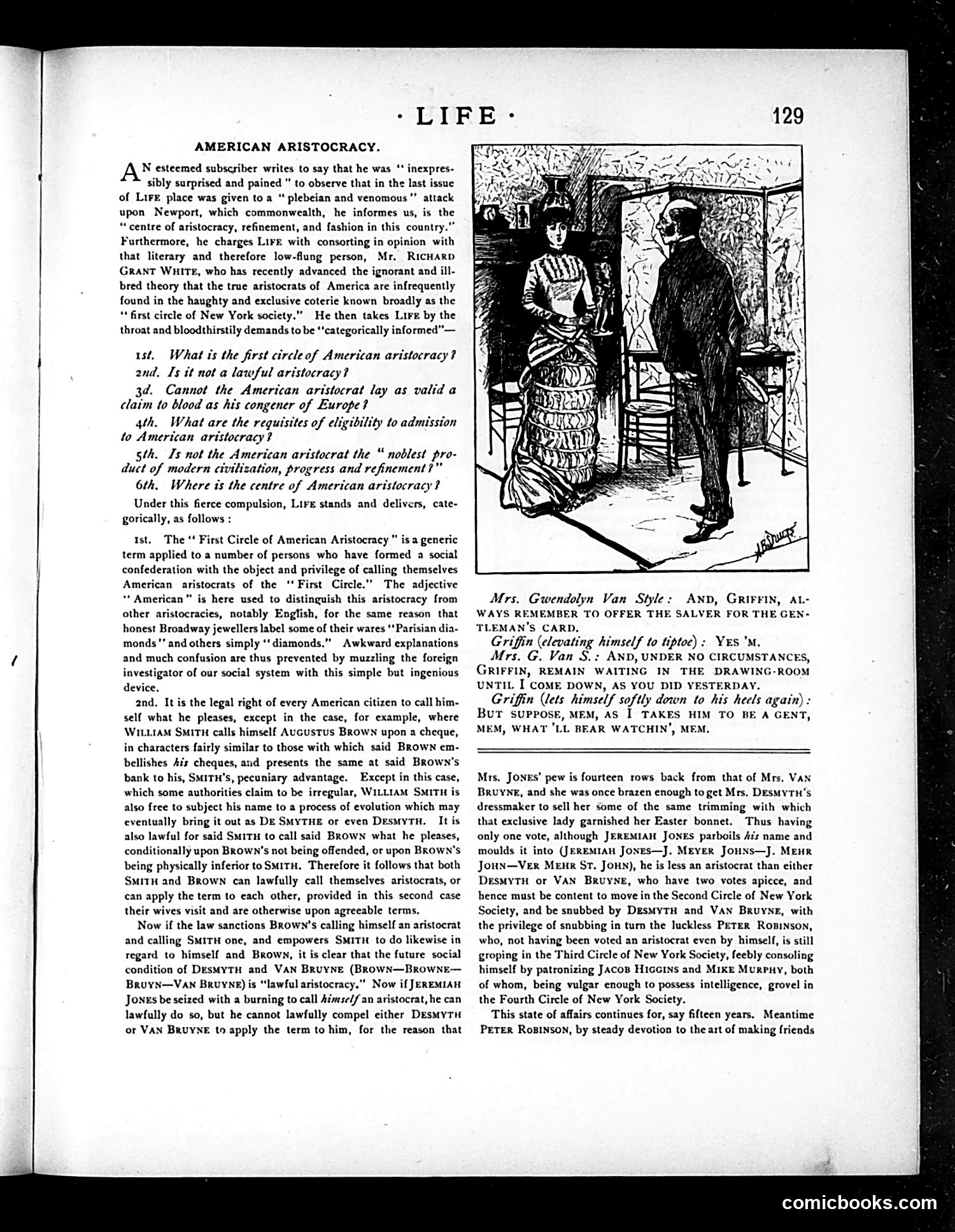
This page satirizes the pretensions of New York's "high society" aristocracy. A reader complained that *Life* had criticized Newport's elite, claiming they represented America's true aristocrats. *Life* responds with biting mockery through logical argument. The cartoon (top right) appears to show a servant presenting a calling card—illustrating the social conventions these self-styled aristocrats obsess over. *Life*'s six-point rebuttal systematically dismantles the claim to legitimate aristocracy. Key points: "First Circle" membership is merely self-designated; any American can call themselves aristocratic by law (like a man named Smith calling himself "De Smythe"); and American "aristocrats" lack the ancestral bloodline of European nobility—hence the sarcastic reference to fake "Parisian diamonds." The satire suggests these wealthy New Yorkers are social climbers with no legitimate claim to refinement or superiority, merely people who've adopted pretentious names and exclusionary practices. It's a direct attack on American class pretension and nouveau riche social snobbery.
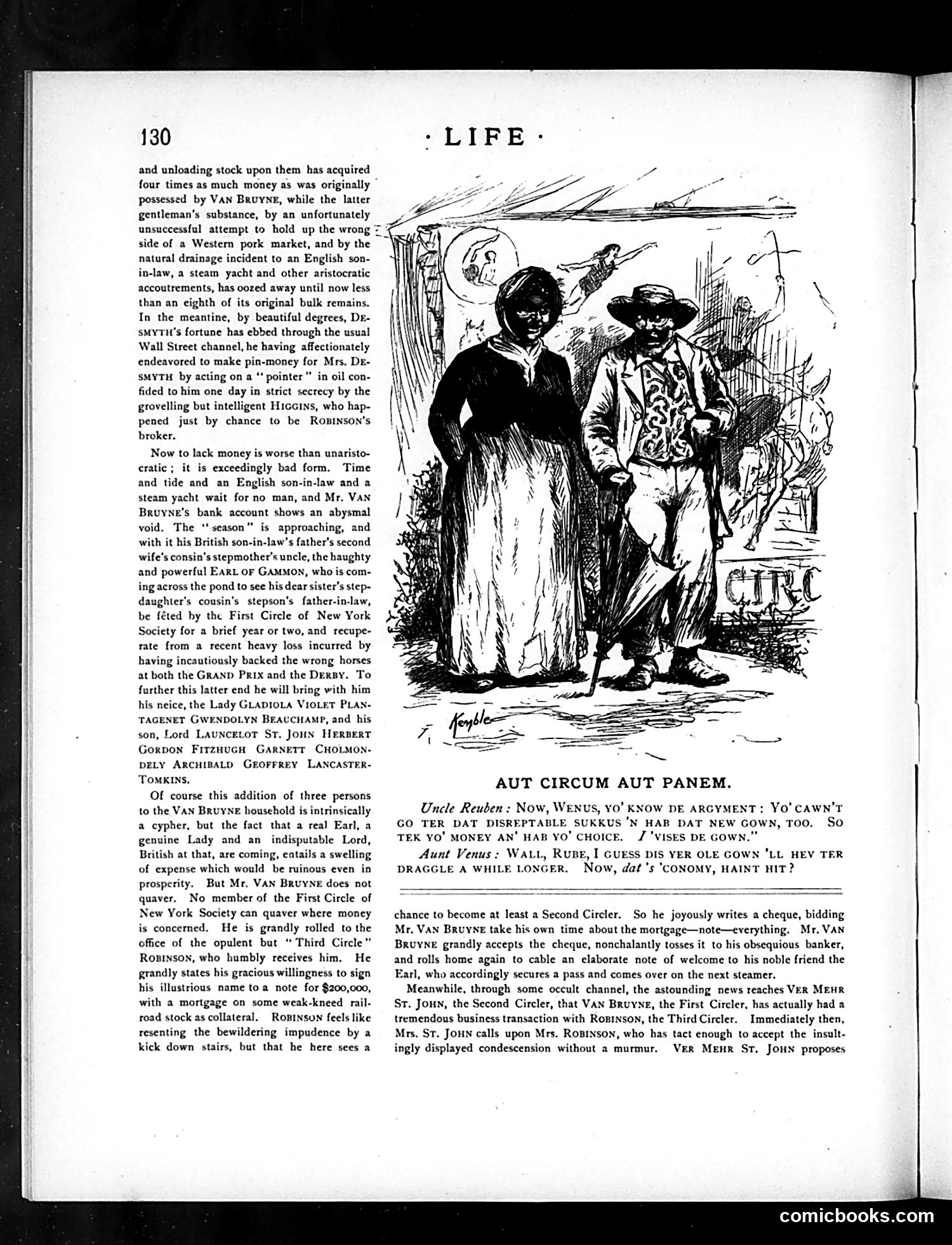
This page satirizes New York's rigid social hierarchy and financial pretense in the Gilded Age. The main narrative mocks wealthy families desperately maintaining "First Circle" (elite society) status despite financial ruin. **The central joke:** Van Bruyne, nearly bankrupt, needs a $200,000 loan to impress visiting British nobility (an Earl and Lady). Robinson, a "Third Circle" (lower-class) businessman, eagerly grants it—thrilled to touch aristocratic society even briefly. Van Bruyne treats this transaction as trivial ("grandly accepts"), maintaining aristocratic aloofness while desperate. **The satire:** Appearance and social rank matter more than actual wealth or honor. A respectable businessman would reject the impudent request, but social climbing corrupts judgment. The "Aut Circum Aut Panem" cartoon below (Latin: "either circus or bread") provides contrasting commentary on poor African Americans' genuine financial hardship versus the wealthy's artificial crises. The page exposes how 1890s American society—despite its democratic ideals—worshipped inherited British titles and maintained absurd class distinctions.
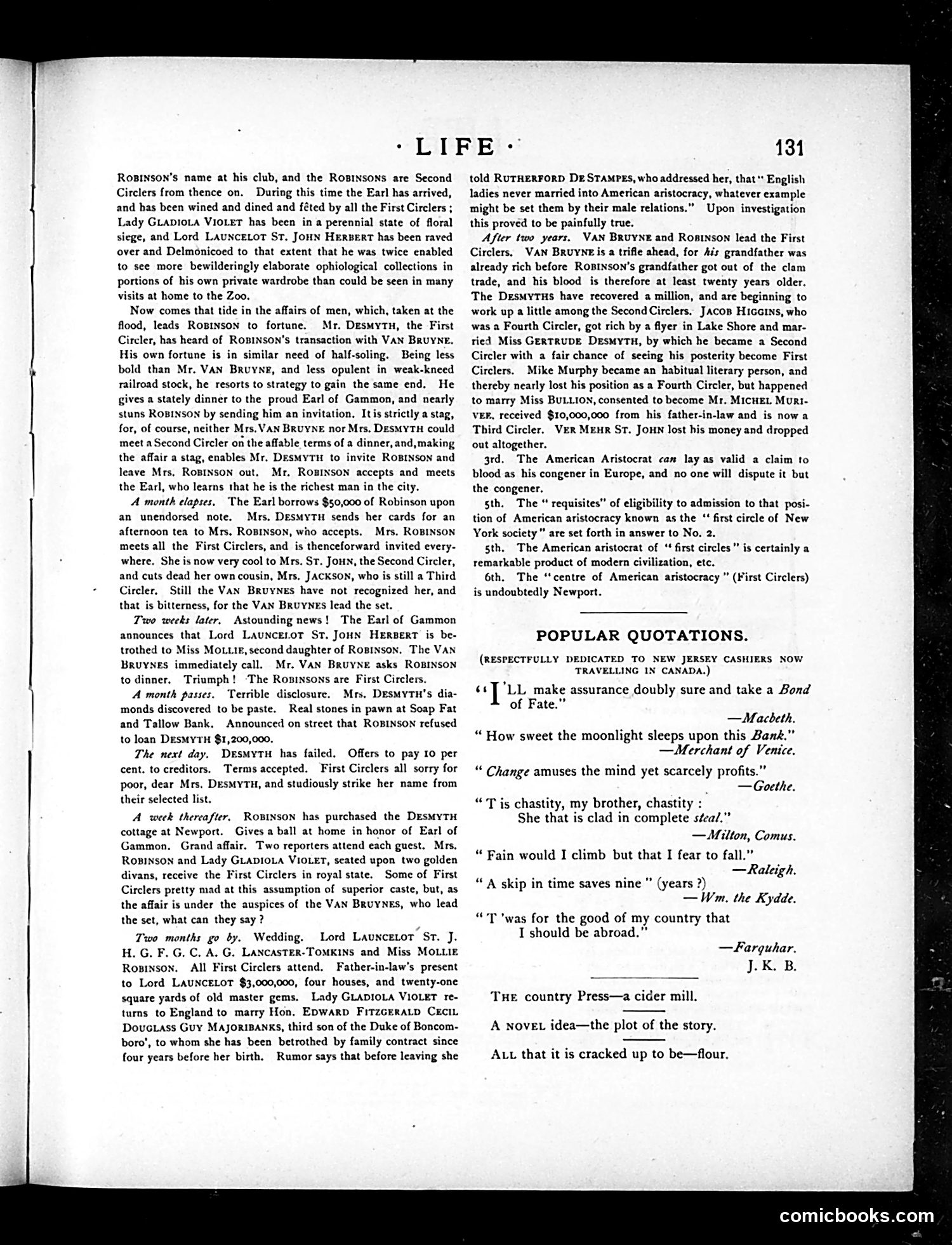
This satirical narrative traces the social climbing of the Robinson family in American high society, structured around hierarchical "circles" of social status. The piece mocks the artificial pretension and moral flexibility of the wealthy elite. The satire works through ironic reversals: Robinson, initially a "Second Circler," gains entry to the coveted "First Circle" not through breeding or virtue, but through shrewd financial manipulation. He exploits Van Bruyne's financial desperation, then benefits when an English Earl borrows money from him, making him suddenly desirable. The narrative emphasizes that American aristocracy is fundamentally mercenary—status follows money, not tradition. The climax reveals the hypocrisy: when Desymth (a First Circler) faces financial ruin, his former society friends coldly abandon him. Robinson's rise is cemented through a strategic marriage between his daughter and a titled Englishman, purchased with an extravagant dowry. The piece critiques how American wealth-holders mimicked European aristocratic structures while lacking any genuine values—status is purely transactional, friendship conditional on financial usefulness, and social "circles" are essentially exclusive clubs for the rich.
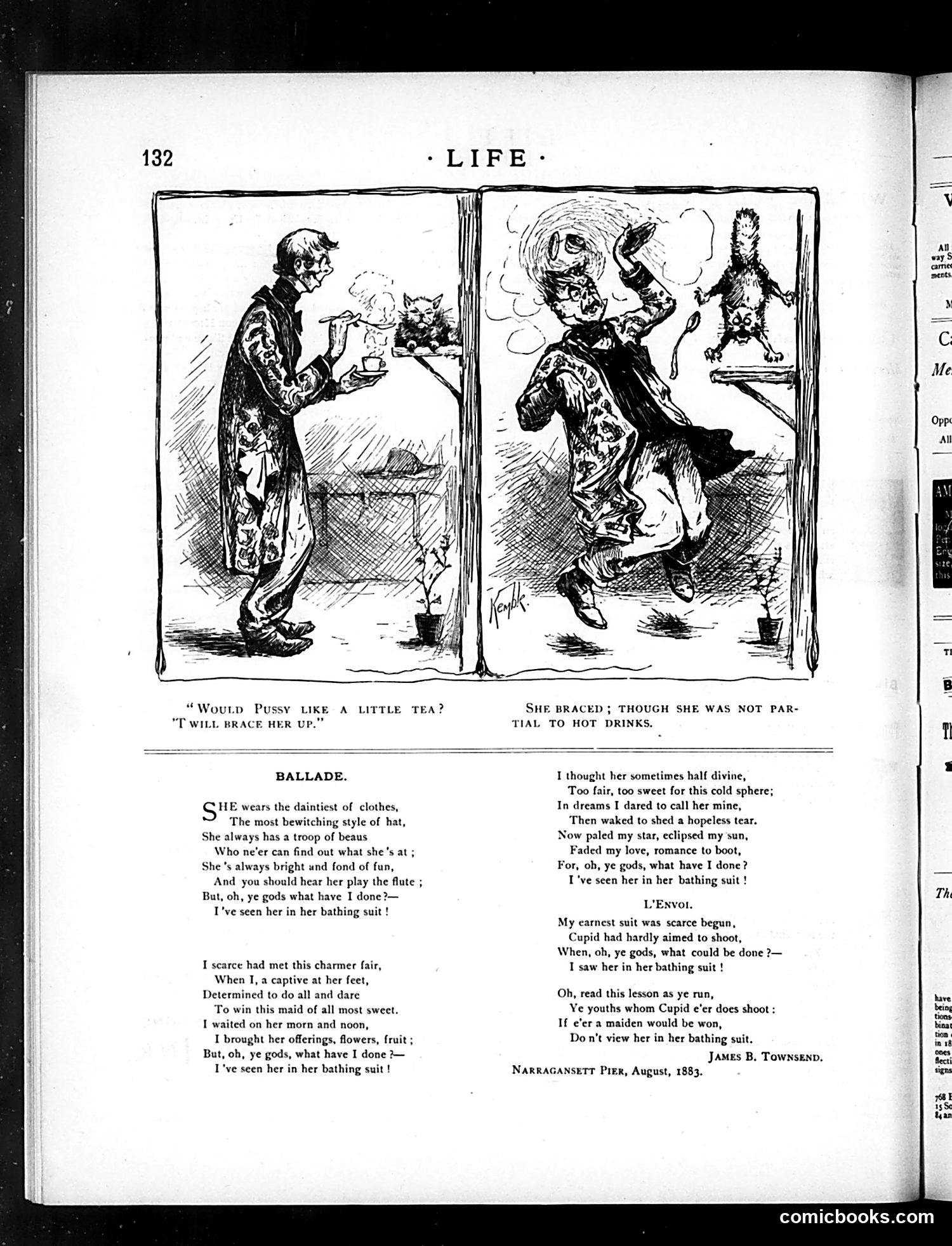
This page contains two elements: a two-panel cartoon and a humorous poem (ballade). **The Cartoon:** The left panel shows a man offering tea to a cat ("Pussy"), suggesting it will "brace her up." The right panel depicts the cat having consumed the tea and become wildly energized—jumping about, appearing almost possessed. This is a simple visual joke about the stimulating effects of caffeine on animals, playing on Victorian sensibilities about proper behavior. **The Poem:** The "Ballade" is a satirical take on romantic idealization. The narrator becomes infatuated with a beautiful, accomplished woman—until he sees her in a bathing suit, which apparently destroys his romantic illusions. The repeated refrain "I've seen her in her bathing suit!" suggests that viewing women in casual, undressed states reveals some unflattering physical reality that contradicts their carefully maintained public image. The satire mocks both male romantic fantasy and women's performative femininity in 1880s society. The poem is credited to James B. Townsend, dated August 1883, likely from Narragansett Pier, a fashionable resort.
This page is primarily a **advertisements and satirical notes section** from Life magazine (circa 1880s), not a political cartoon. The modest visual content consists of product illustrations for billiard tables and a fountain pen device called "The Fontograph." The bulk of the page features "Notes and Extracts"—brief satirical quips mocking contemporary American life. These jokes target easy targets: women (widows become "expensive"), regional stereotypes (Georgia ships watermelons north), incompetent government (the "star route" jury scandal—a real 1880s postal fraud case), and overwrought theater criticism. A parody epigraph falsely attributes a scissors joke to "St. Paul to the Fenians" (the Fenians being Irish revolutionaries), creating absurdist humor through mock-serious citation. The tone is lighthearted small-town gossip published alongside classified ads for bankers, merchant tailors, and whiskey distributors.
This is primarily an **advertising page** rather than editorial content with political cartoons. The page showcases late-19th-century consumer products and services. The illustrated advertisements include: - A **Breakfast Cocoa ad** featuring a woman in period dress - An **Esterbrook Steel Pens ad** with a cartoon showing two figures debating roller quality—a simple commercial joke about brand loyalty - **Columbia Bicycles**, positioned as "Rapid Transit Steeds," reflecting the bicycle craze of the 1890s The non-illustrated ads promote accident insurance, hats, umbrellas, walking sticks, and "Friedrichshall Natural Bitter-Water" (a laxative marketed with medical endorsements). **Context for modern readers**: This reflects how Life magazine supplemented satire with advertising revenue. The products—cocoa, pens, bicycles—were contemporary luxuries. The insurance ad emphasizes affordability, while the medical "cure-all" water exemplifies the unregulated patent medicine era. These ads reveal period consumer culture and marketing tactics.