
A complete issue · 16 pages · 1883
Life — September 6, 1883
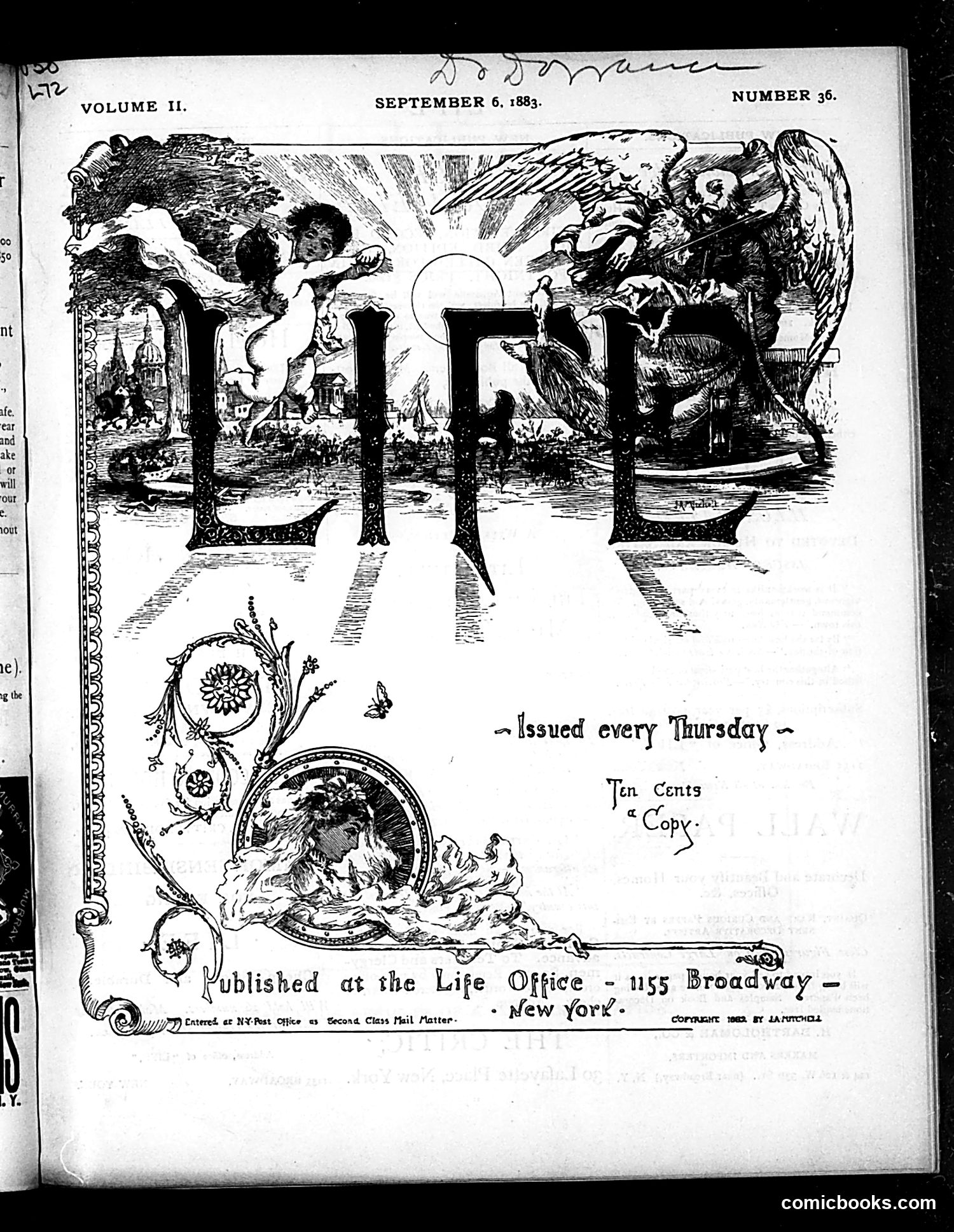
This is the cover of *Life* magazine, a satirical weekly publication. The large decorative letters "LIFE" frame an illustrated scene depicting cherubs or putti (classical baby figures) in a celestial or allegorical setting, with a cityscape and water visible below. The ornamental border includes floral designs and a portrait medallion. The image appears to be primarily decorative rather than depicting specific political figures or events. The classical artistic style and angelic imagery suggest the cover celebrates *Life* magazine itself—emphasizing its whimsical, artistic sensibility. This was typical for magazine mastheads of the era, serving as branding rather than commenting on particular news or scandals.
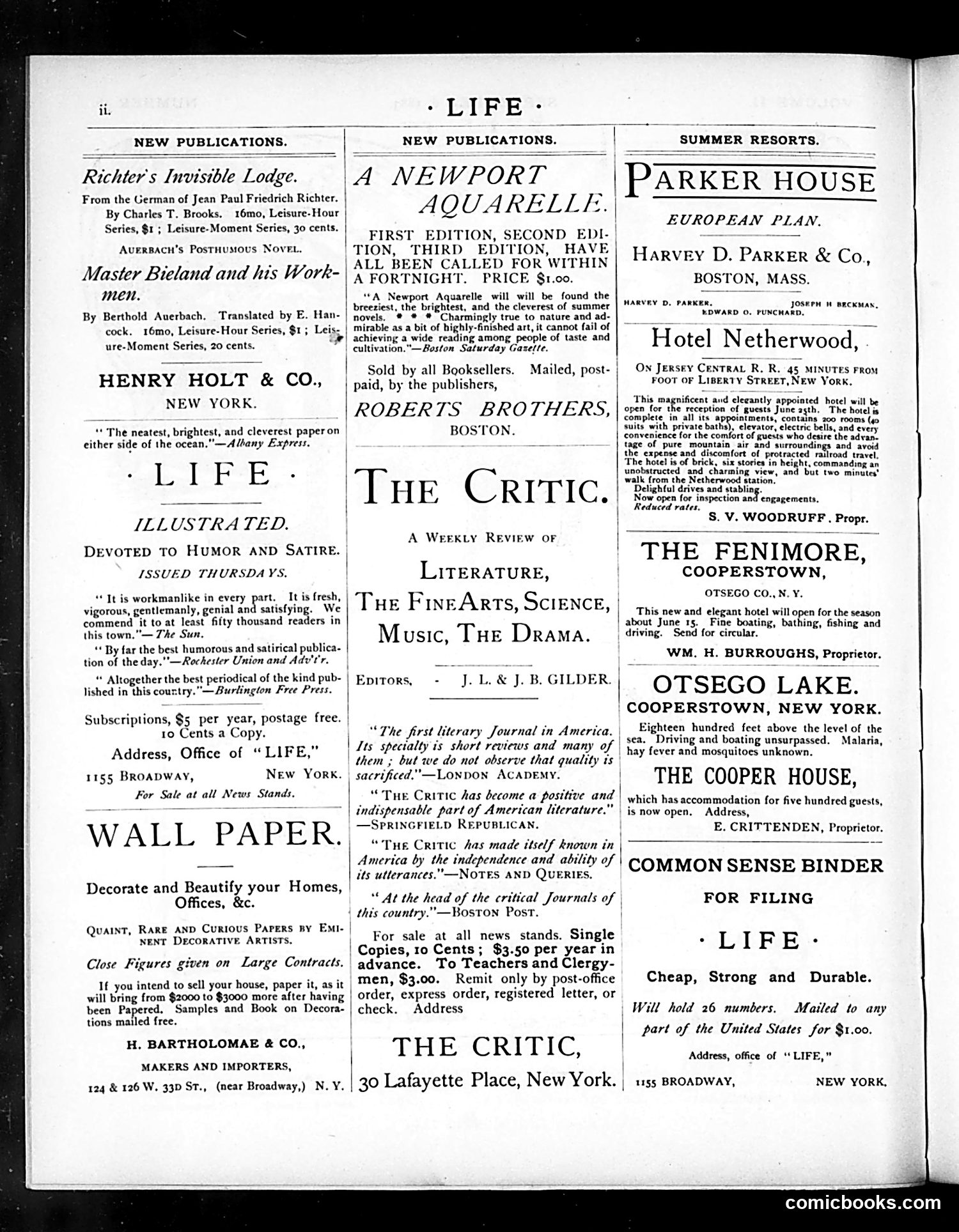
This page is primarily **advertising**, not satirical content. It contains announcements for: - **New publications**: German novels translated into English - **Life magazine itself**: Described as "the neatest, brightest, and cleverest paper" devoted to "humor and satire," issued Thursdays - **The Critic**: A weekly literary review journal covering literature, fine arts, science, music, and drama - **Summer resorts**: Hotels in Massachusetts and New York (Parker House, Hotel Netherwood, The Fenimore, Otsego Lake, The Cooper House) - **Wall paper** and **Common Sense Binder** products The page lacks political cartoons or caricatures. It represents typical late 19th-century magazine advertising practices, where publications promoted themselves and related cultural products to readers.
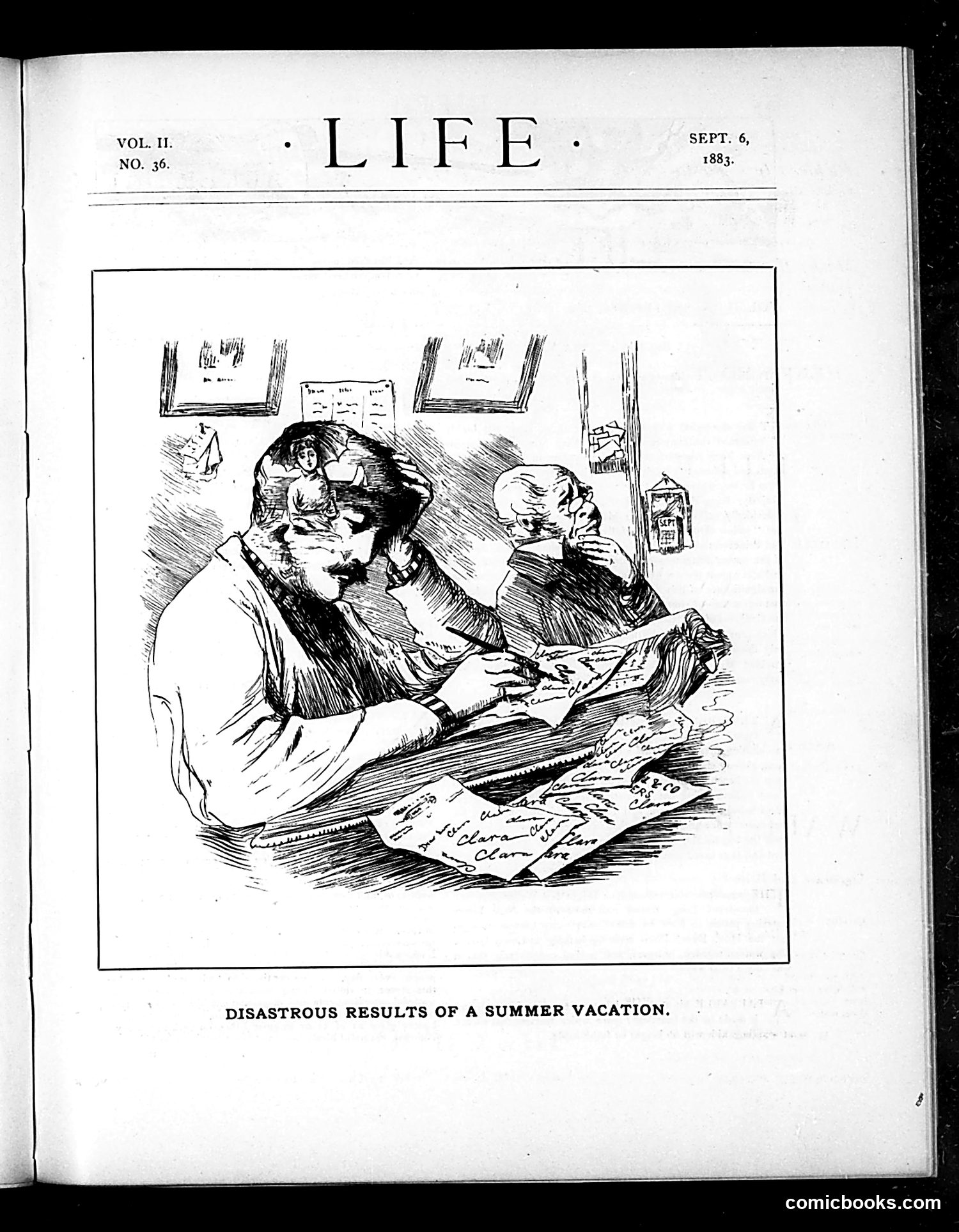
This 1883 *Life* magazine cartoon satirizes the consequences of summer travel. The sketch shows a disheveled, overwhelmed figure surrounded by scattered papers, sketches, and notes—appearing to document their vacation experiences. A second figure peers over their shoulder, seemingly amused or concerned at the chaos. The satire mocks the Victorian custom of keeping detailed travel journals and creating artistic records during summer holidays. What should be a leisurely escape becomes burdensome; the vacation itself generates mountains of paperwork and sketches requiring organization. The "disastrous results" joke suggests that documenting one's leisure time becomes as exhausting as work itself—a commentary on the compulsive record-keeping habits of the era's educated classes.
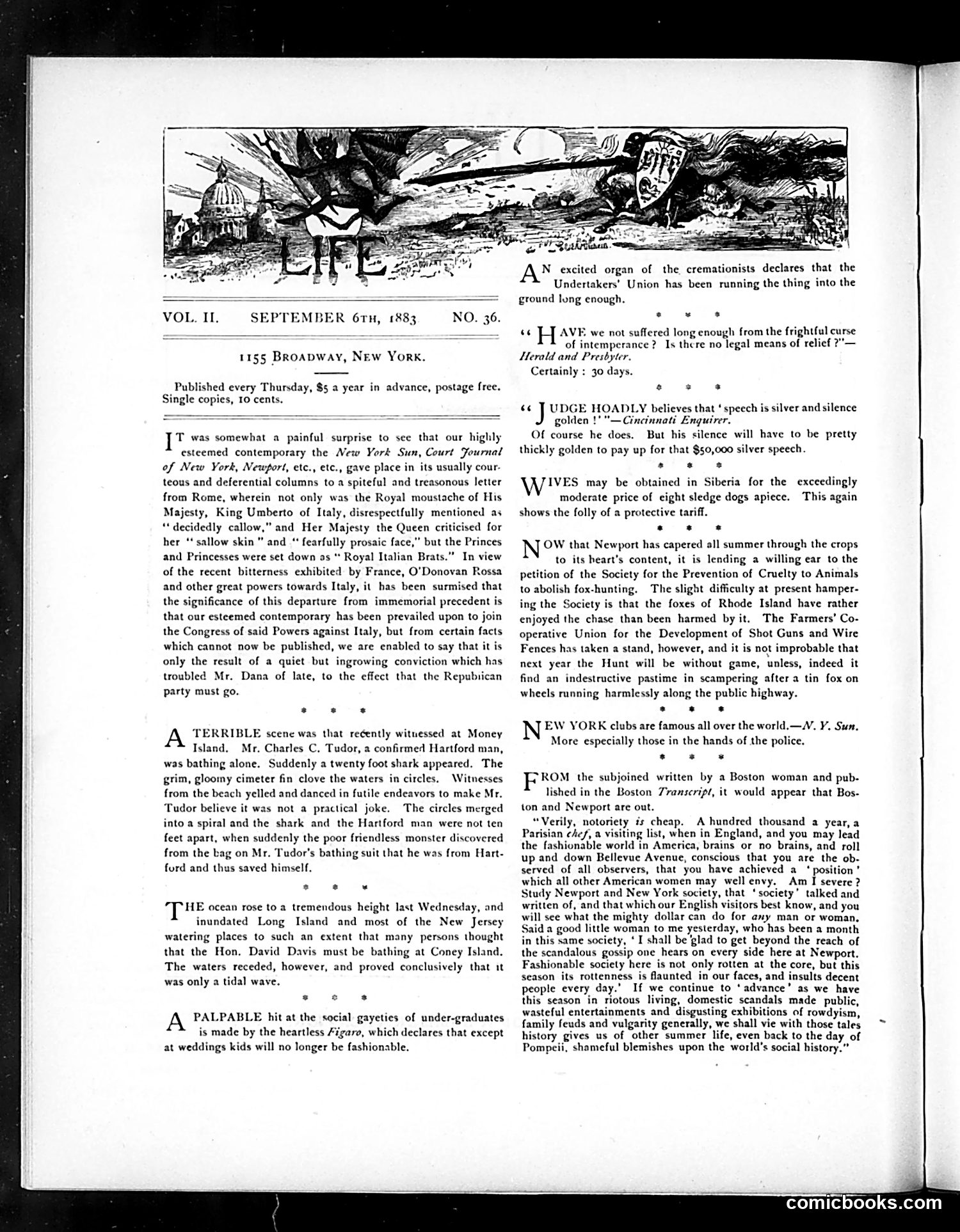
The masthead cartoon depicts a skeletal figure labeled "LIFE" sitting among gravestones and a crescent moon—a memento mori design suggesting mortality and dark humor typical of the publication's satirical brand. The text articles below are social commentary rather than political cartoons. They mock various contemporary absurdities: an undertakers' union complaint, debate over free speech costs, judicial pomposity about expensive litigation, a scheme to sell Siberian dogs, and particularly a lengthy critique of Boston society's pretensions. The Boston piece sarcastically attacks wealthy women who affect European sophistication while dismissing American culture as cheap, positioning this as hypocritical snobbery. The overall tone is satirical social criticism targeting class pretension, institutional excess, and cultural affectation of the Gilded Age.
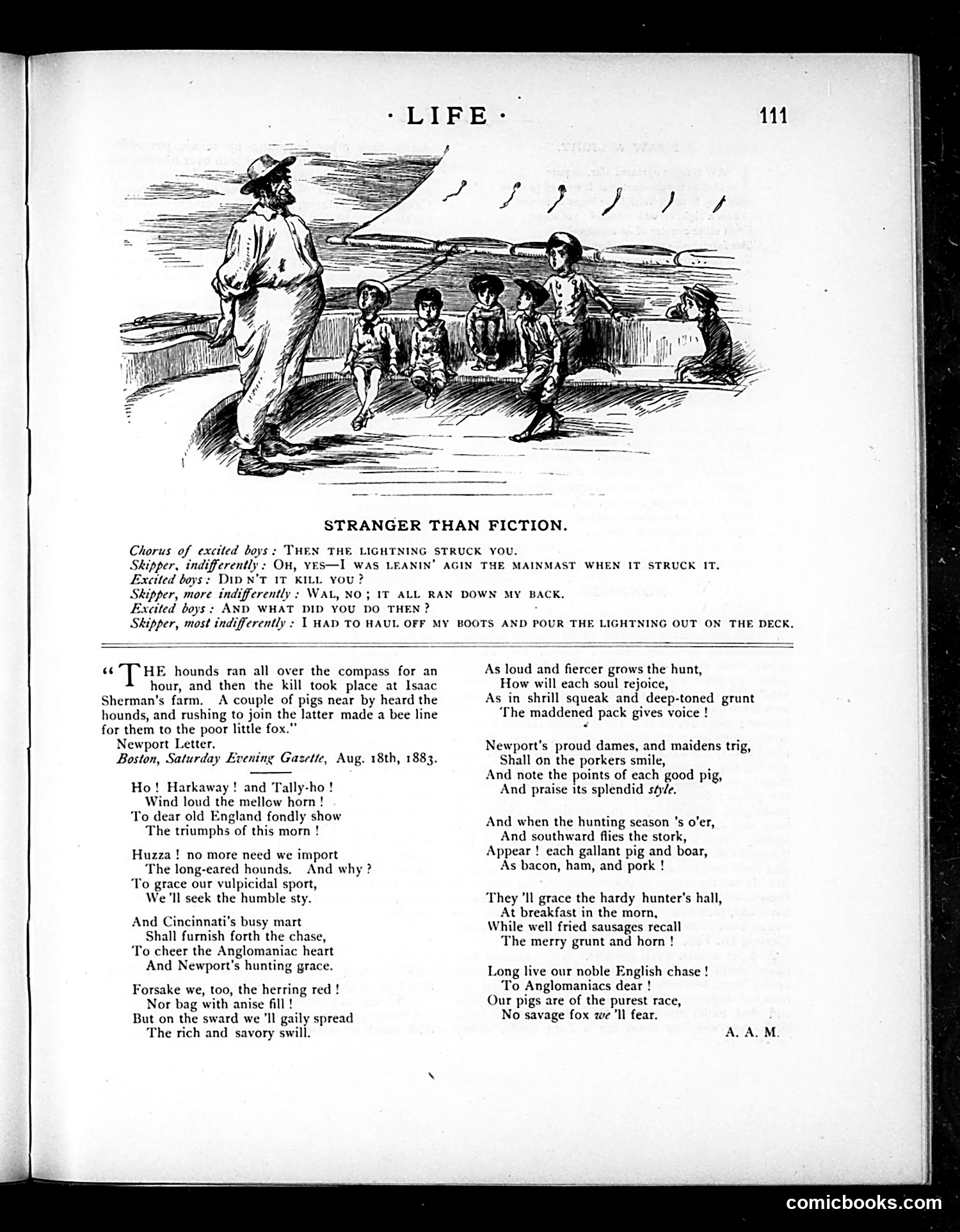
This page contains a humorous narrative sketch titled "Stranger Than Fiction" depicting a sailor recounting an incident to young boys. The skipper describes being struck by lightning while aboard ship and his unconventional response—hauling off his boots to pour the lightning out on deck. Below this is a poem celebrating pig hunting and English country sports, likely satirizing upper-class sporting traditions. References to "Cincinnati's busy mart" and "Anglomaniacs" suggest the poem mocks American attempts to adopt English hunting customs. The overall content appears to be light social satire about class pretensions and sporting culture rather than serious political commentary. The exaggerated sailor's tale and the somewhat absurd pig-hunting poem represent typical 1880s Life magazine humor—genteel mockery of contemporary American society's affectations.
This page contains satirical prose rather than cartoons. The main article, "BONNETS," by Harold Van Santvoord, mocks women's fashion obsession with bonnets through exaggerated social commentary. The satire criticizes: - Women's irrational dedication to bonnets as status symbols - The absurd expense (up to $150) for what is essentially a hat - The ridiculous trimming practices—feathers, ribbons, beads, flowers piled haphazardly on the head - The irony that men complain about bonnets blocking theater views, yet women persist The piece suggests bonnets serve no practical purpose and represent wasteful vanity, while simultaneously acknowledging that millinery remains women's domain of expertise and commerce. The humor derives from inflated description of trivial female concerns, typical of early 20th-century satirical magazine style.
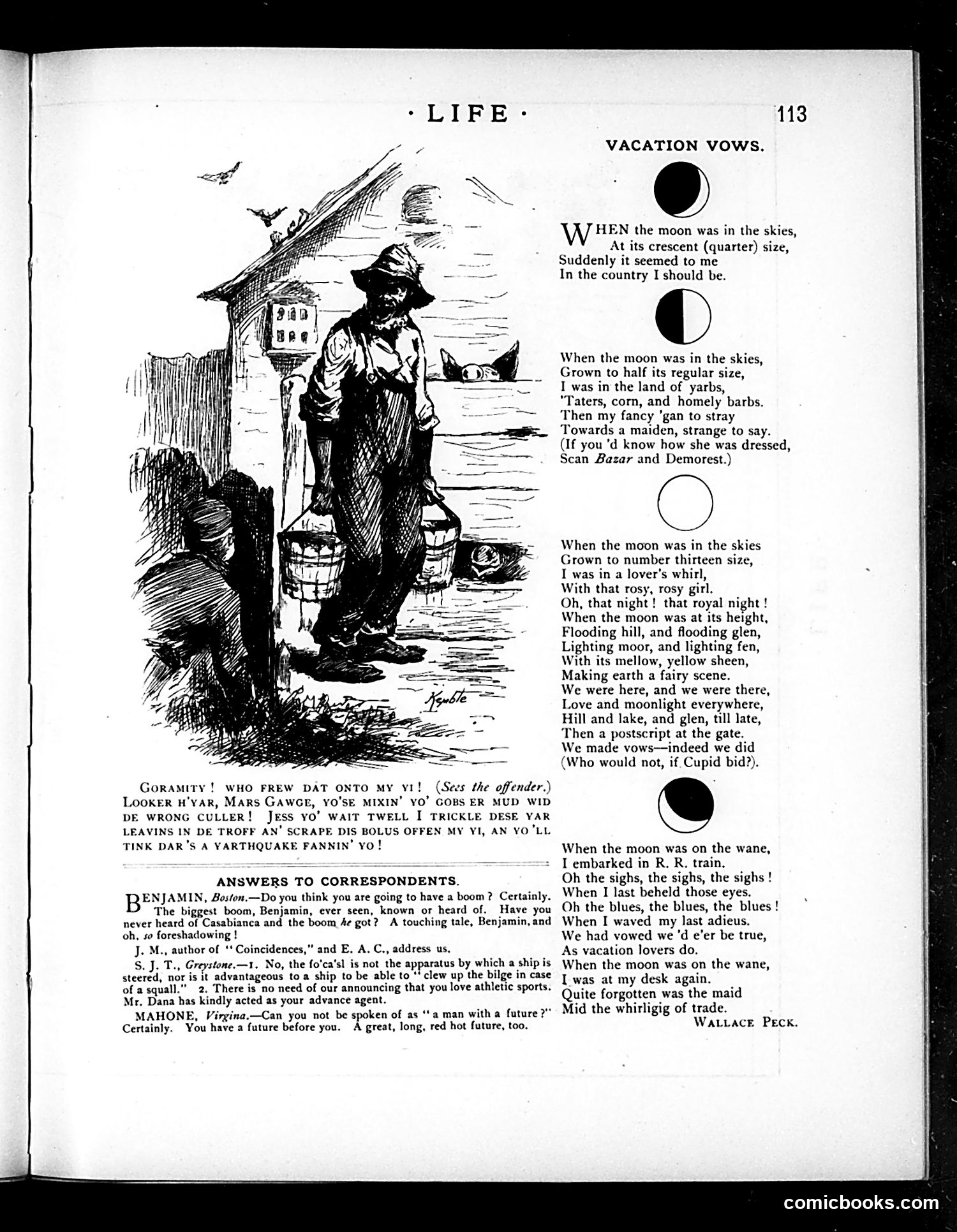
The main illustration depicts a rustic figure (likely a farmer or country laborer) carrying baskets, with a caption in heavy dialect mocking his speech: "Goramity! who frew dat onto my vi!" The exaggerated dialect and rough appearance represent rural, working-class "yokel" stereotypes common in early 20th-century American humor. The poem "Vacation Vows" by Wallace Peck, illustrated with moon phases, romantically describes a couple's moonlit countryside romance and subsequent vows—a sentimental counterpoint to the crude cartoon above. The "Answers to Correspondents" section provides humorous advice responses to reader letters about topics like athletics and future prospects. Overall, this page contrasts crude rural stereotyping with genteel romantic sentiment, reflecting period attitudes toward class and rural life.
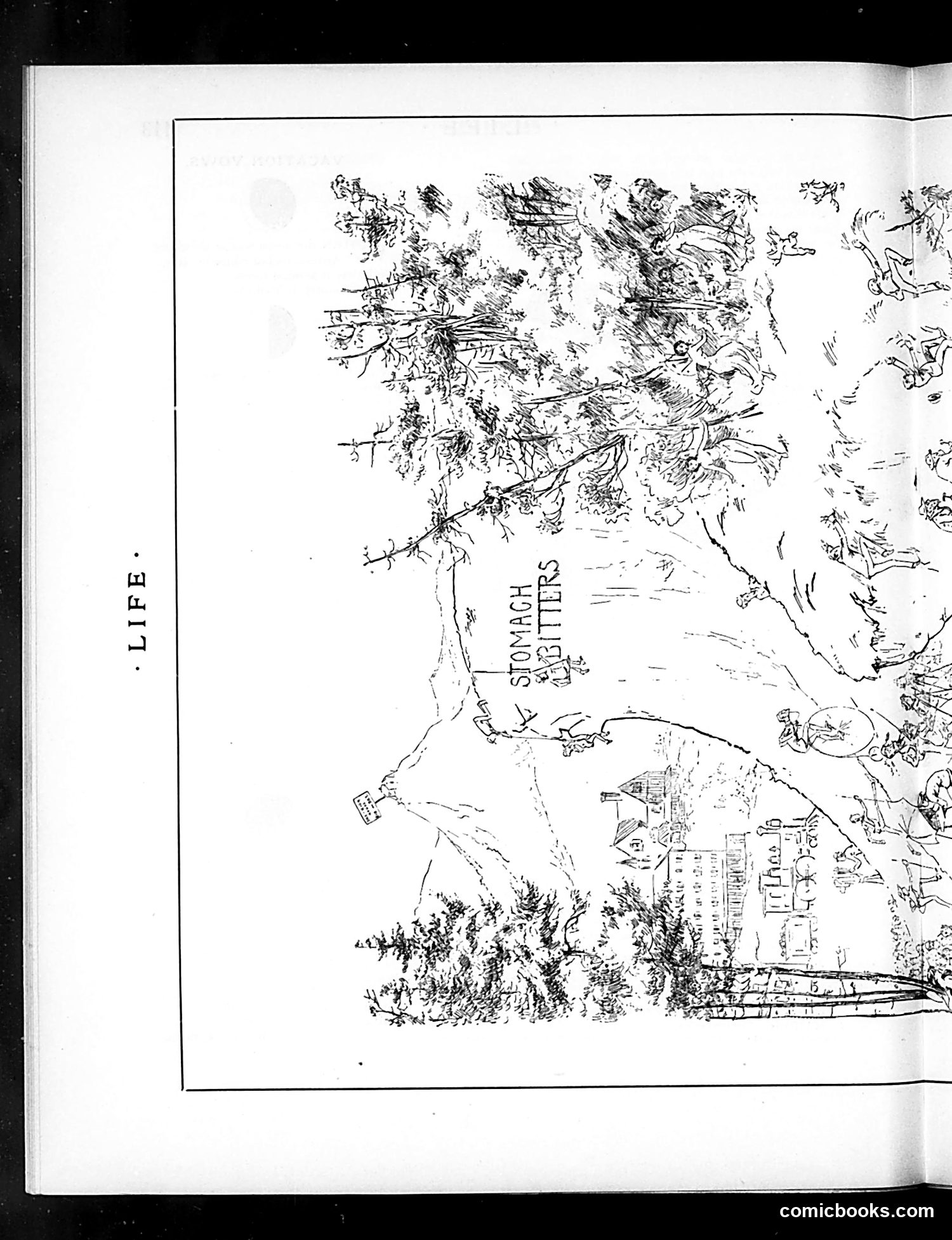
This page appears to be titled ".LIFE" on the left margin and shows "STOMACH BITTERS" text in the center of the illustration. The image itself is a satirical sketch depicting what appears to be a landscape or natural scene with various figures and a building structure. The drawing style is characteristic of 19th-century satirical illustration, rendered in ink with loose, expressive linework. Without clearer visibility of specific figures or more legible text in the image, I cannot definitively identify the particular political or social commentary this cartoon makes. The reference to "stomach bitters" suggests it may be satirizing patent medicines or health cure-alls that were common advertising subjects in Life magazine during that era, though the exact satirical point remains unclear from this reproduction.
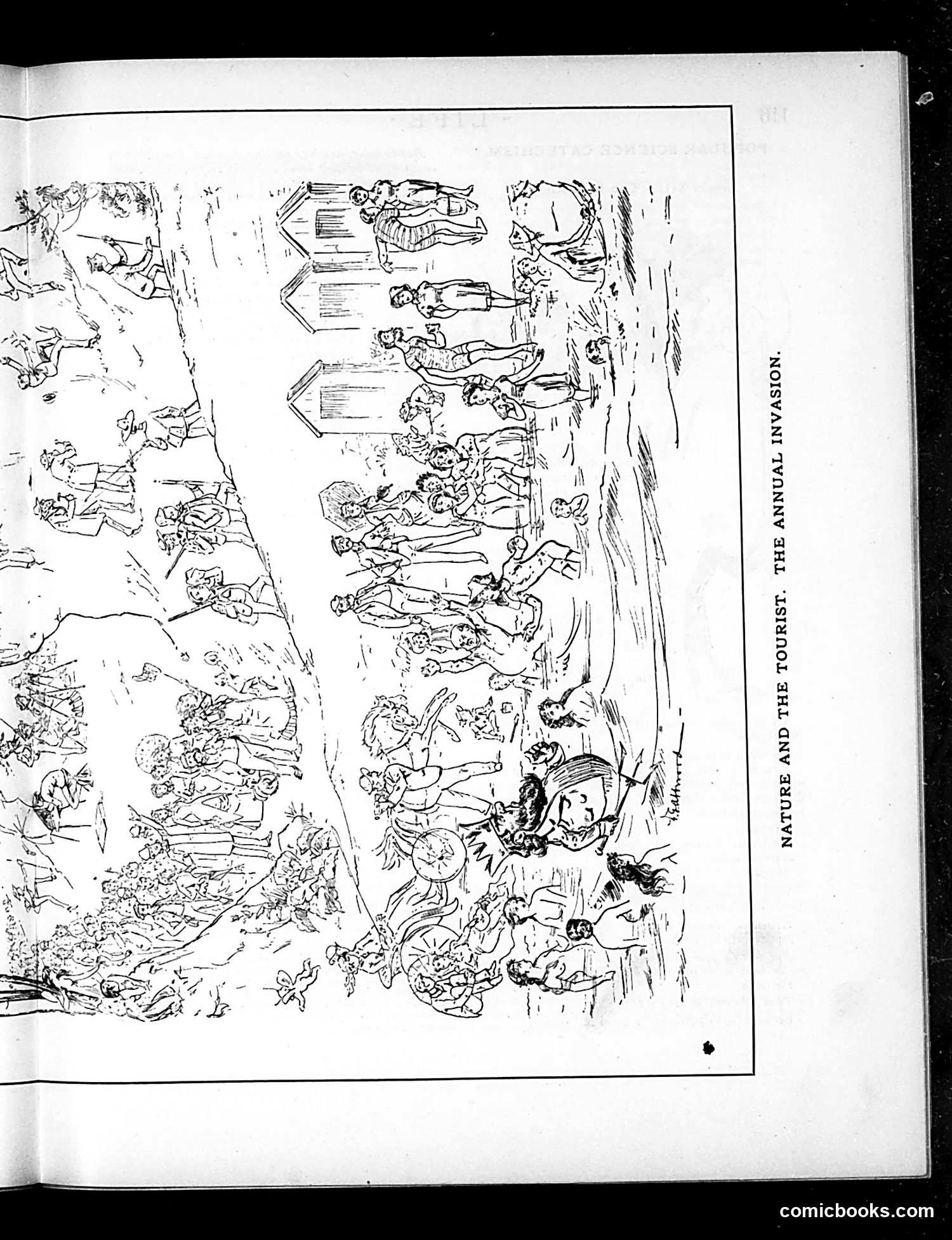
This page contains a single satirical illustration titled "MATURITY AND THE TOURIST: THE ANNUAL INVASION." The cartoon depicts a crowded seaside or beach scene during tourist season. The composition contrasts two groups: on the left, local residents or "mature" beach-goers appear relatively calm and established; on the right, a chaotic mass of tourists swarms the beach in various states of undress and activity. The satire critiques the annual summer tourist invasion—a perennial complaint about overcrowding at vacation destinations. The cartoon suggests tourists lack decorum and refinement compared to year-round residents, treating the beach as a chaotic free-for-all rather than a civilized space. This reflects early-to-mid 20th century anxieties about mass tourism and the tension between permanent residents and seasonal visitors to popular vacation spots.
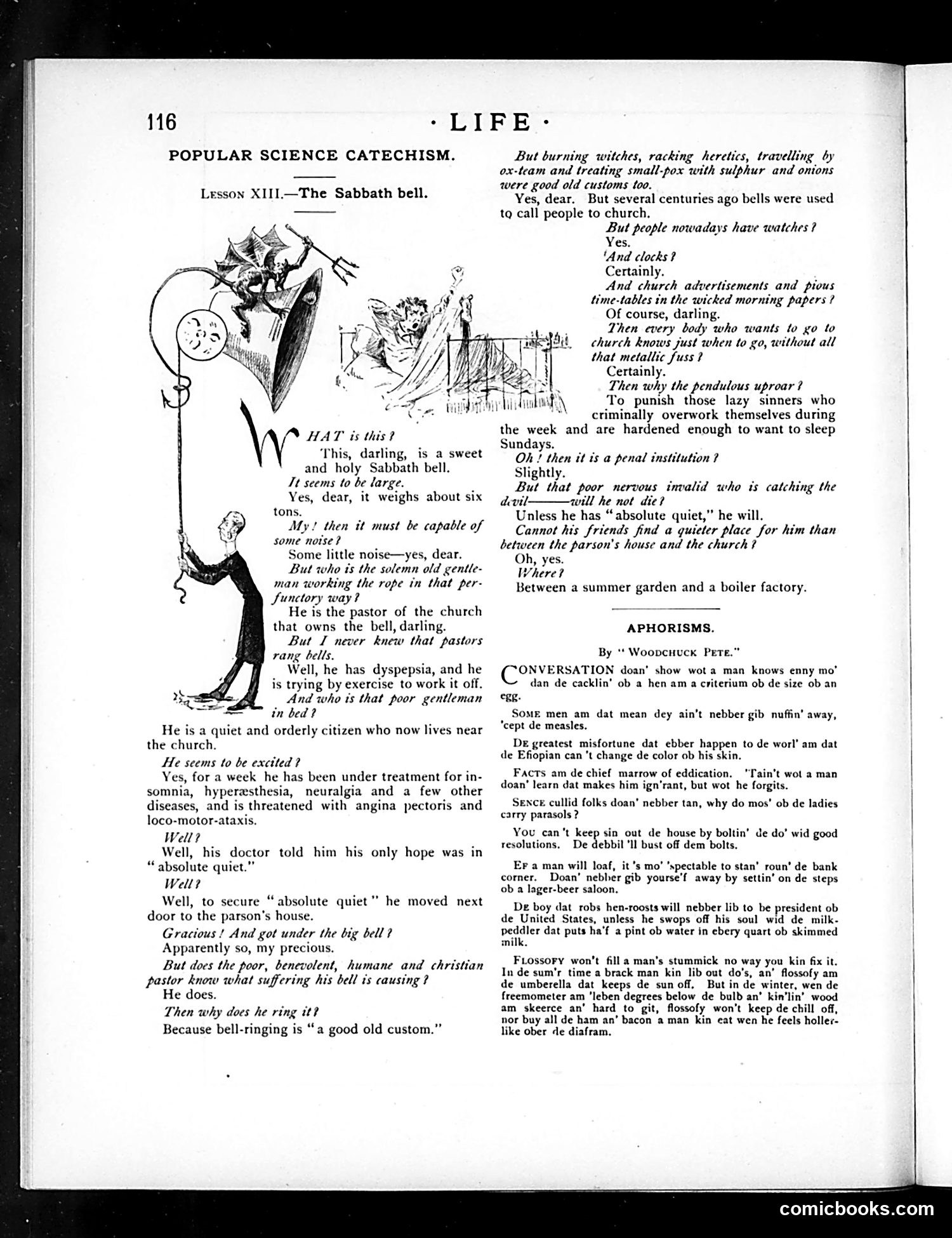
This satirical page attacks the hypocrisy of church bell-ringing through a dialogue format. A pastor rings a massive church bell as "good old custom," despite living next door to a sick man whose doctor prescribed "absolute quiet" for severe insomnia and neuralgia. The victim lies in bed suffering audibly from the noise. The satire's point: Religious institutions cling to outdated practices (bell-ringing) while causing genuine human suffering, then justify cruelty as tradition. The questioner exposes the absurdity—people now have watches and newspapers; the bell serves no practical purpose. The pastor's response ("penal institution") suggests churches use suffering to punish those they deem "lazy sinners." The lower section contains unrelated dialect aphorisms, likely reflecting period stereotypes. The cartoon critiques institutional callousness masked by religious conventionalism—a common Progressive Era target.
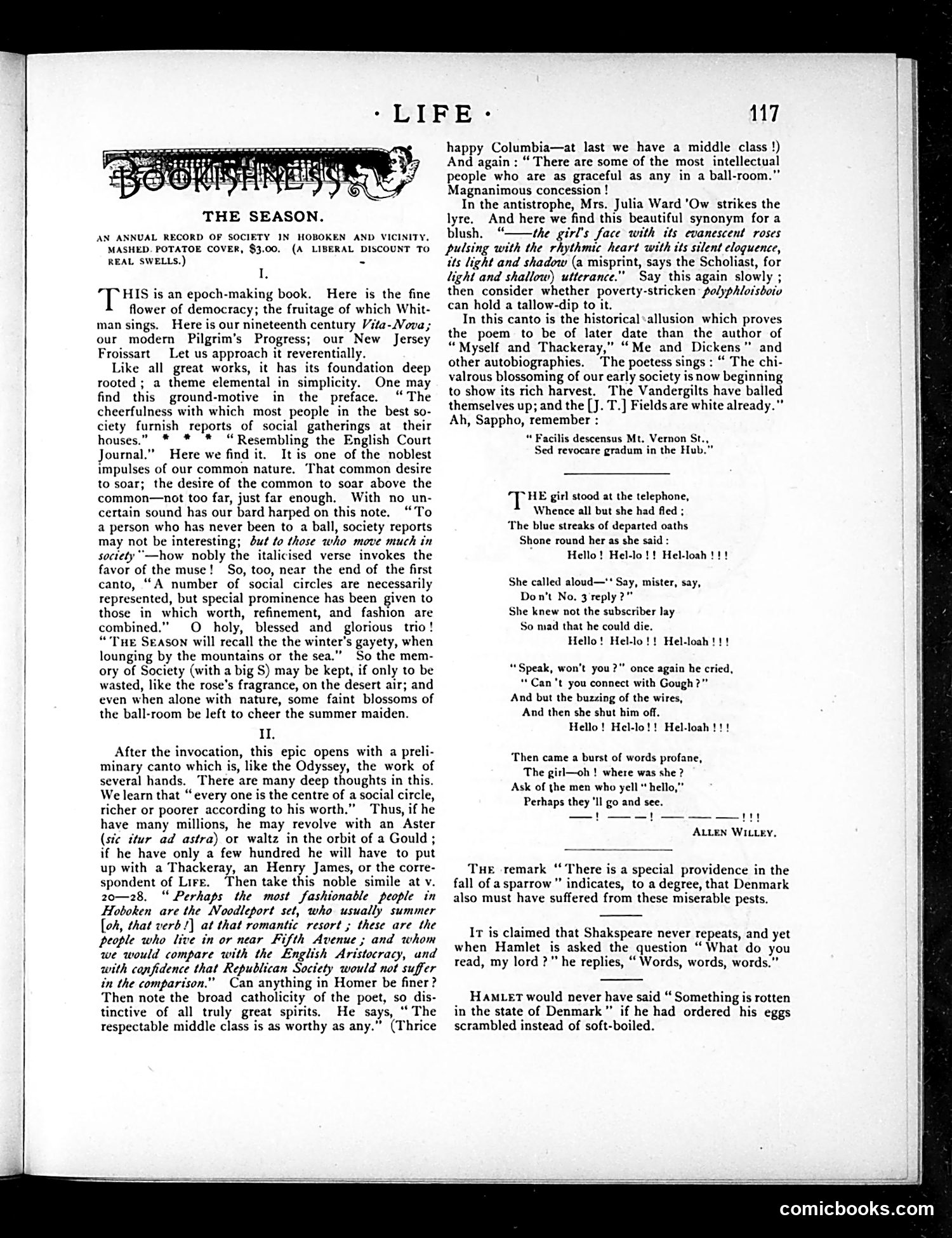
This is a scathing literary parody of "The Season," a Hoboken society register (a book documenting local high-society social events). The satirist mocks its pretentious tone by treating it as an "epic" comparable to Homer's *Odyssey*, using grandiose language ironically. The piece ridicules: 1. **Social climbing**: The critique that ordinary people desperately want to "soar above the common"—aspiring beyond their station 2. **Hollow class consciousness**: The absurd notion that wealth determines one's social circle, comparing the rich to celestial bodies (Gould, Astor) while the modestly wealthy must "put up with a Thackeray, an Henry James" 3. **False egalitarianism**: The register's patronizing claim that middle-class people and intellectuals are "as worthy as any," which the satirist labels a "magnanimous concession" 4. **Overwrought prose**: The mockery of Mrs. Julia Ward Howe's flowery description of a blush as "evanescent roses pulsing with rhythmic heart" The satire exposes how society registers commodify human worth through wealth and status while maintaining a veneer of democratic respectability.
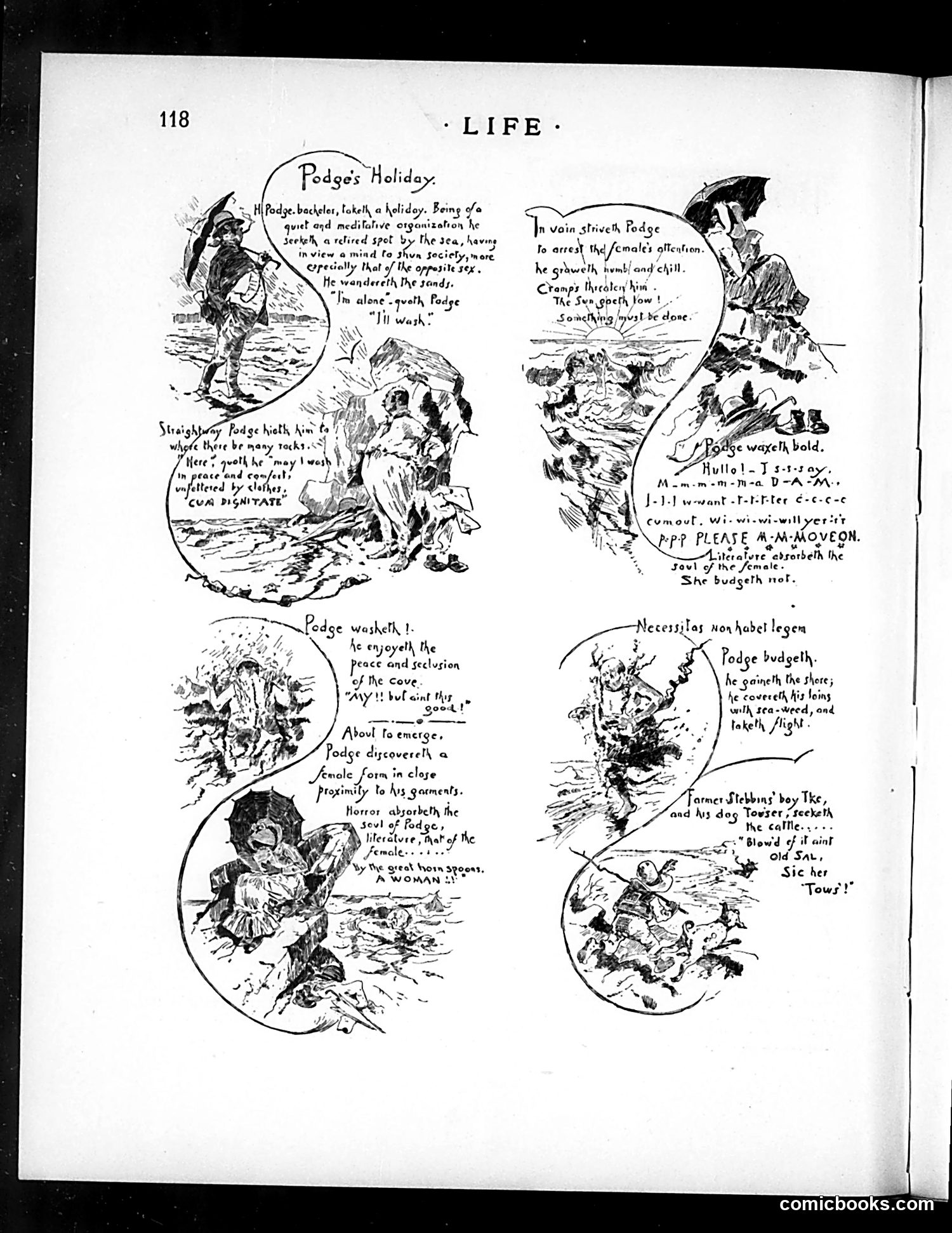
This is a multi-panel comic strip satirizing Victorian social anxieties, particularly male embarrassment around the opposite sex. "Podge," a bashful bachelor seeking seaside solitude, encounters a woman at the beach. When she appears, he panics—apparently having lost his clothes or left them behind. The humor relies on Victorian propriety: Podge's frantic attempts to communicate ("M-m-m-m-a D-A-M") and hide his predicament using seaweed, his desperate pleas for the woman to leave ("PLEASE M-M-MOVEON"), and his ultimate flight from the scene. The comic mocks both male prudishness and the social terror of impropriety. The Latin phrase "CUM DIGNITATE" (with dignity) underscores the irony—Podge's complete loss of composure.
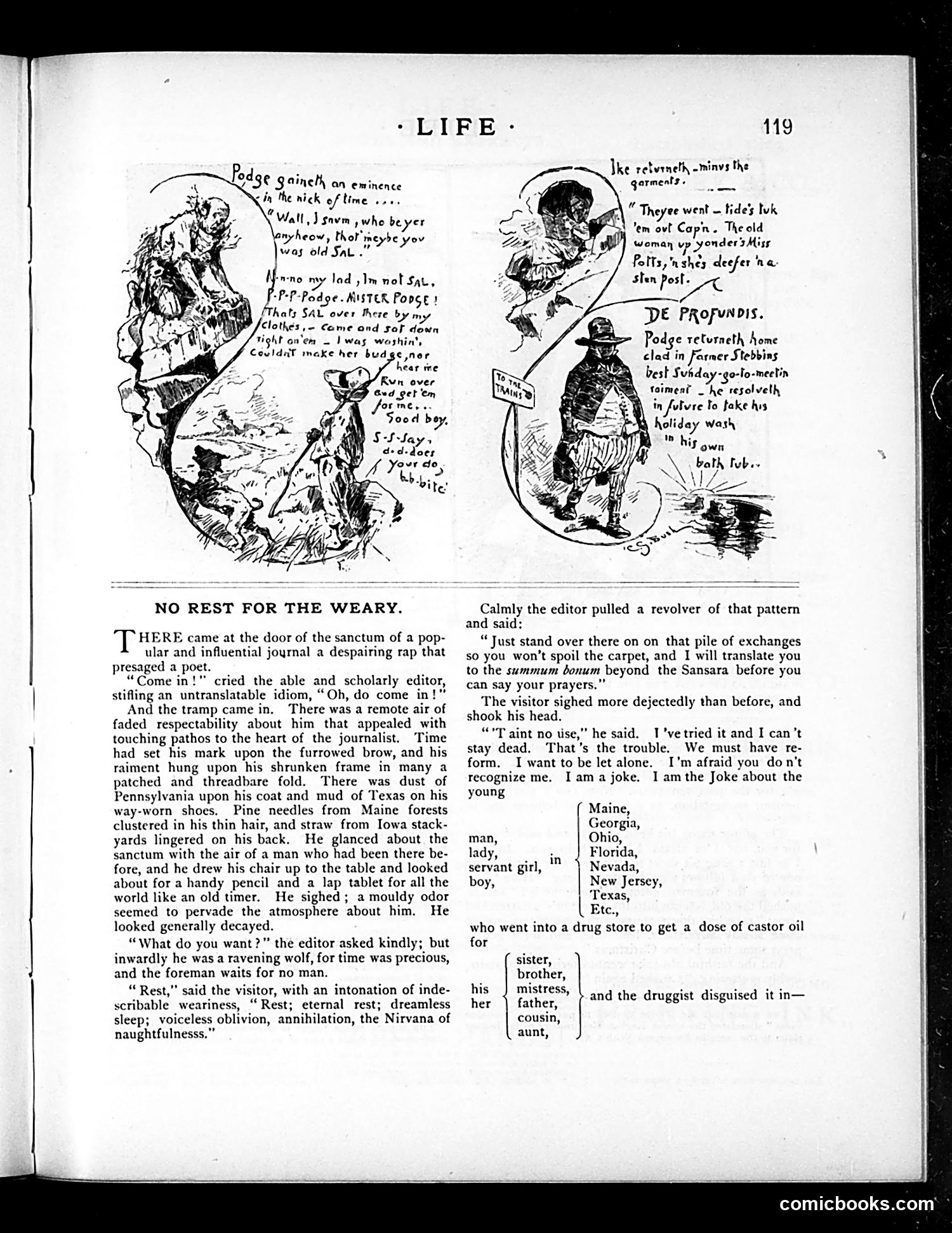
This satirical piece mocks the persistent "traveling joke" — a tired, worn-out anecdote that appears in newspapers nationwide. The disheveled visitor embodies this joke itself, literally traveling from state to state (Maine, Georgia, Ohio, Florida, Nevada, New Jersey, Texas), accumulating dust and debris as evidence of his journey. The joke he represents is the hackneyed setup: someone enters a drugstore seeking castor oil for a relative (sister, brother, mistress, father, cousin, aunt), which the druggist disguises — a predictable punchline about deception and bodily functions. The satire targets both the joke's immortality (the visitor "can't stay dead") and editors' exhaustion with recycled material. The editor's threat to shoot him reflects the frustration of journalism gatekeepers forced to encounter the same worn-out content repeatedly. The cartoons at page-top show a character named "Podge" in similar travails, reinforcing the theme of weary repetition in popular culture.
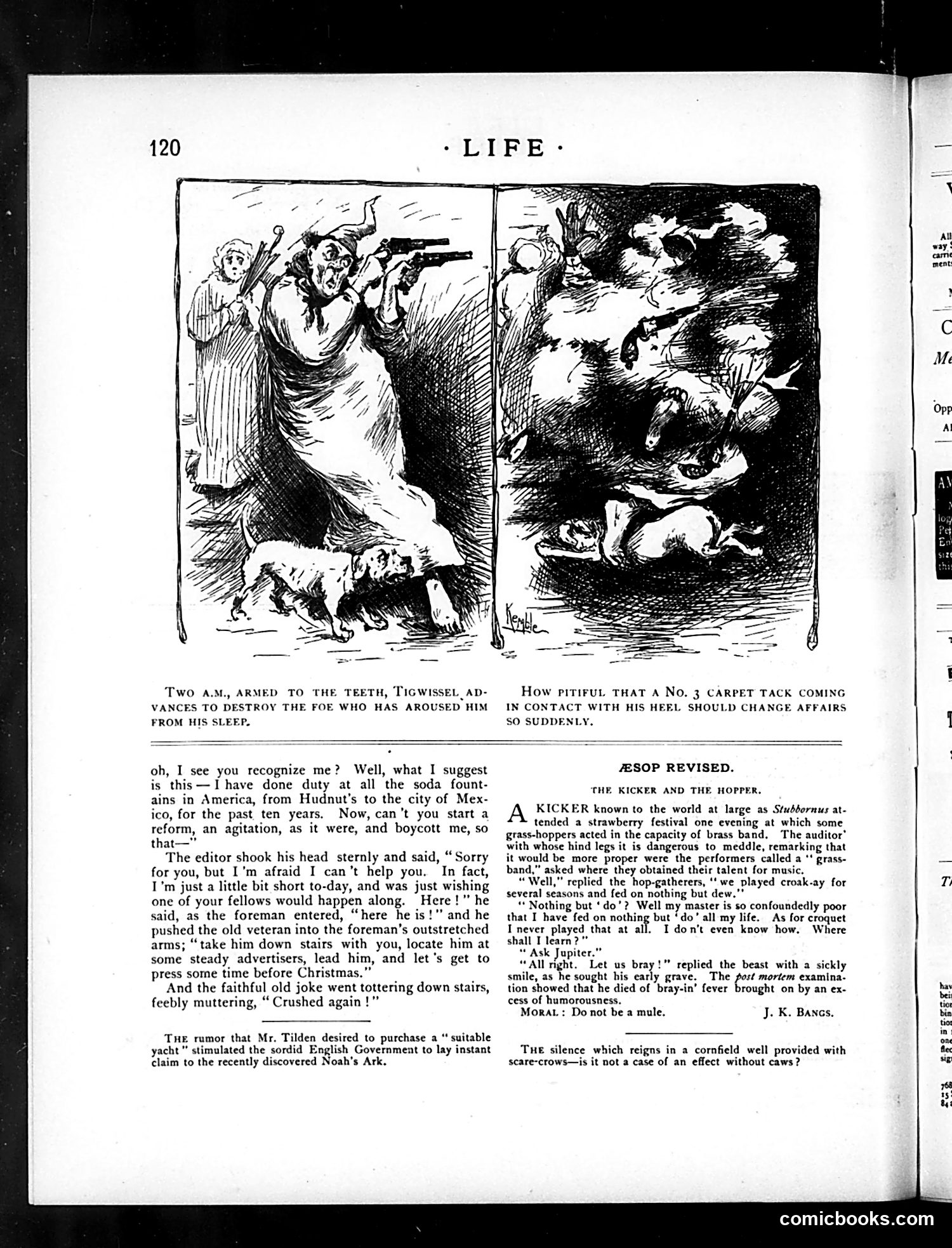
The page contains two satirical pieces mocking American institutions and society: **Top cartoon:** Shows a man with a telescope/gun being startled by a carpet tack. The caption suggests sudden, absurd reversals of fortune—satirizing how trivial accidents can derail important plans. **Middle story:** A tired old joke personified visits a Life magazine editor seeking a boycott to retire with dignity. The editor dismisses him, pushing him toward advertisers instead. This mocks **Life's own dependence on advertising revenue** and satirizes how commercial interests override editorial integrity. The joke "goes tottering down stairs, feebly muttering, 'Crushed again!'"—a self-aware jab at how the magazine recycles worn material. **"Aesop Revised" section:** Fables with morals, including "The Kicker and the Hopper," which uses animal characters to satirize social pretension and stubbornness. The final line—a pun about scarecrows and "caws"—is typical period wordplay. The page reflects *Life's* editorial voice: mocking commercialism, worn-out cultural forms, and human folly through humor and allegory.
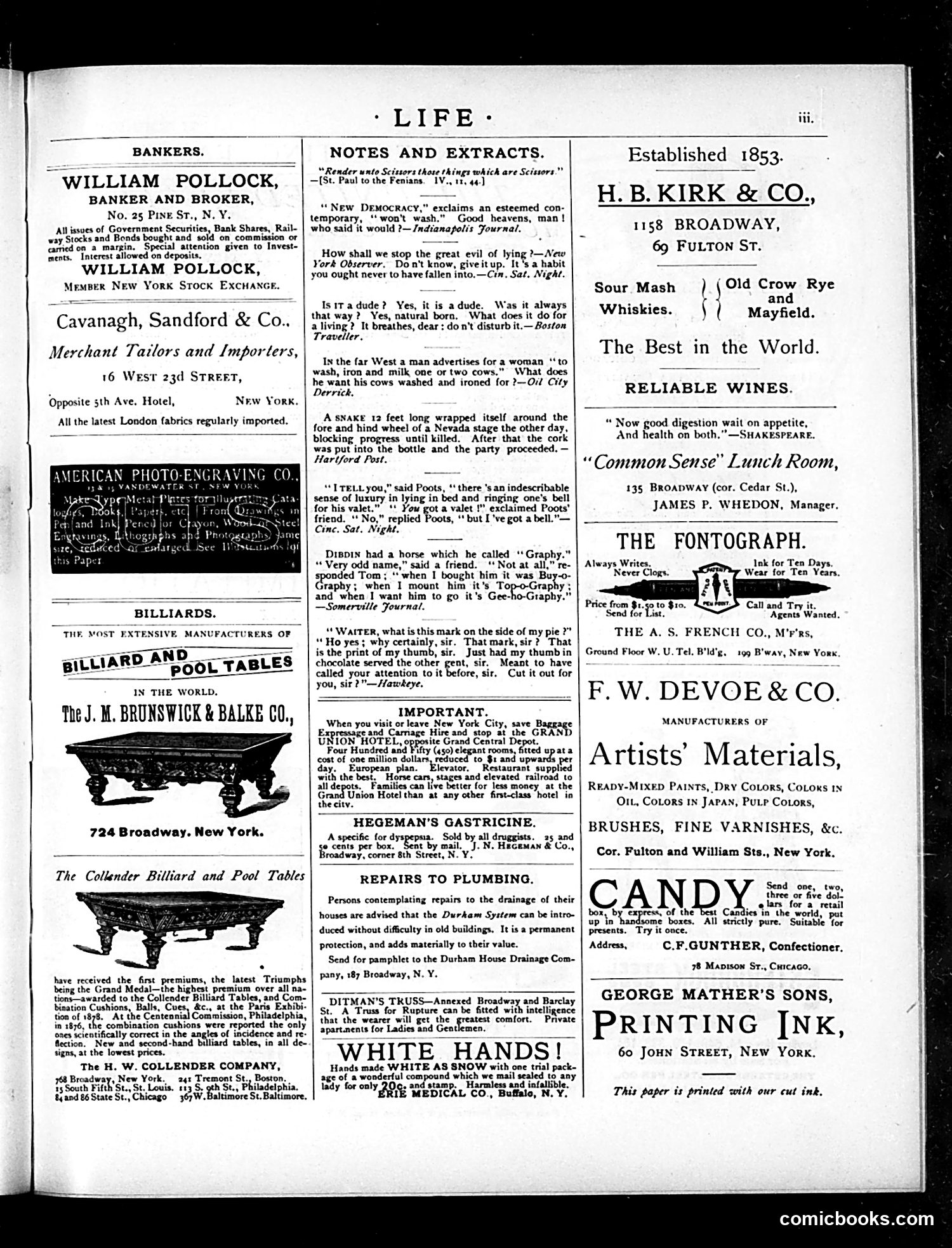
This page is **primarily advertising** with a "Notes and Extracts" section featuring brief satirical jokes and quips—typical of Life magazine's format. The "Notes and Extracts" section contains short, disconnected humorous observations rather than a unified political cartoon. The jokes target: - **Lying as a social problem** (mocking a newspaper's earnest question about stopping dishonesty) - **Urban eccentricity** (a dude described simply as someone who "breathes") - **Absurd rural logic** (a farmer wanting to wash and iron cows) - **Servant class incompetence** (a waiter's thumb-print on a customer's pie) - **Pretentious horse naming** (wordplay on "Biography") These are mild, domestic humor pieces without sharp political bite. The satire targets everyday American social oddities and human folly rather than specific political figures or events. The page's main purpose is advertising—billiard tables, banking services, tailoring—with humorous filler content to engage readers between ads.
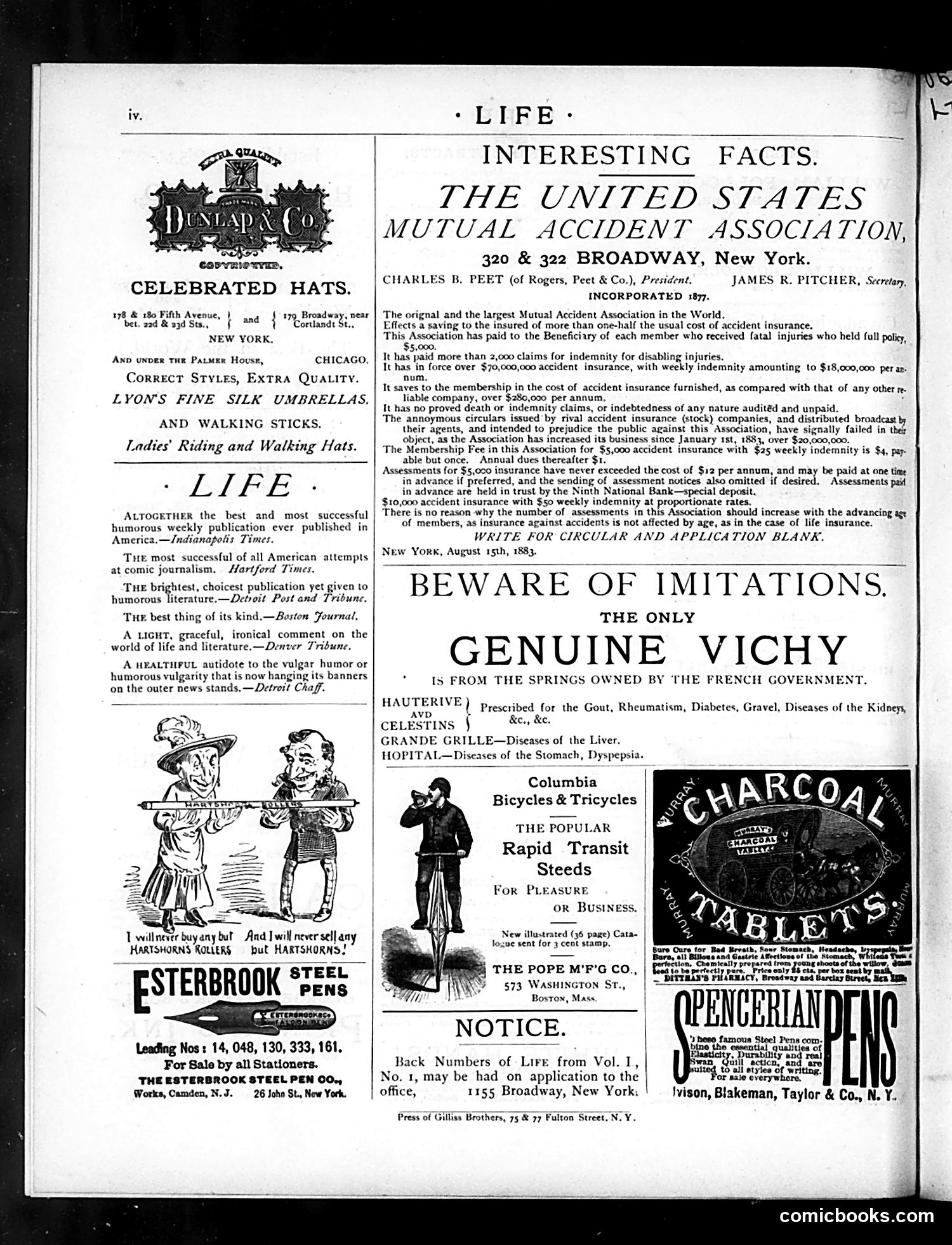
The main cartoon on this page depicts a simple commercial dispute rendered as satire. Two figures—apparently a woman (left) and man (right)—are shown in confrontation, each making opposing declarations about **Hartshorns Rollers** (a product for curling hair). The woman declares she will never buy anything *but* Hartshorns Rollers, while the man insists he will never *sell* anything but Hartshorns. The joke appears to be a play on stubbornness or brand loyalty—both parties are absolutes in their positions, creating an absurd deadlock. This is primarily an **advertisement disguised as humor**, typical of Life magazine's advertising-driven content. The satire is gentle and product-focused rather than political or socially critical. The cartoon mocks neither a person nor a policy, but rather exaggerates consumer devotion to a specific brand for comedic effect, encouraging readers to adopt the same loyalty.