
Life, 1883-09-06 · page 11 of 16
Life — September 6, 1883 — page 11: what you’re looking at
What you’re looking at
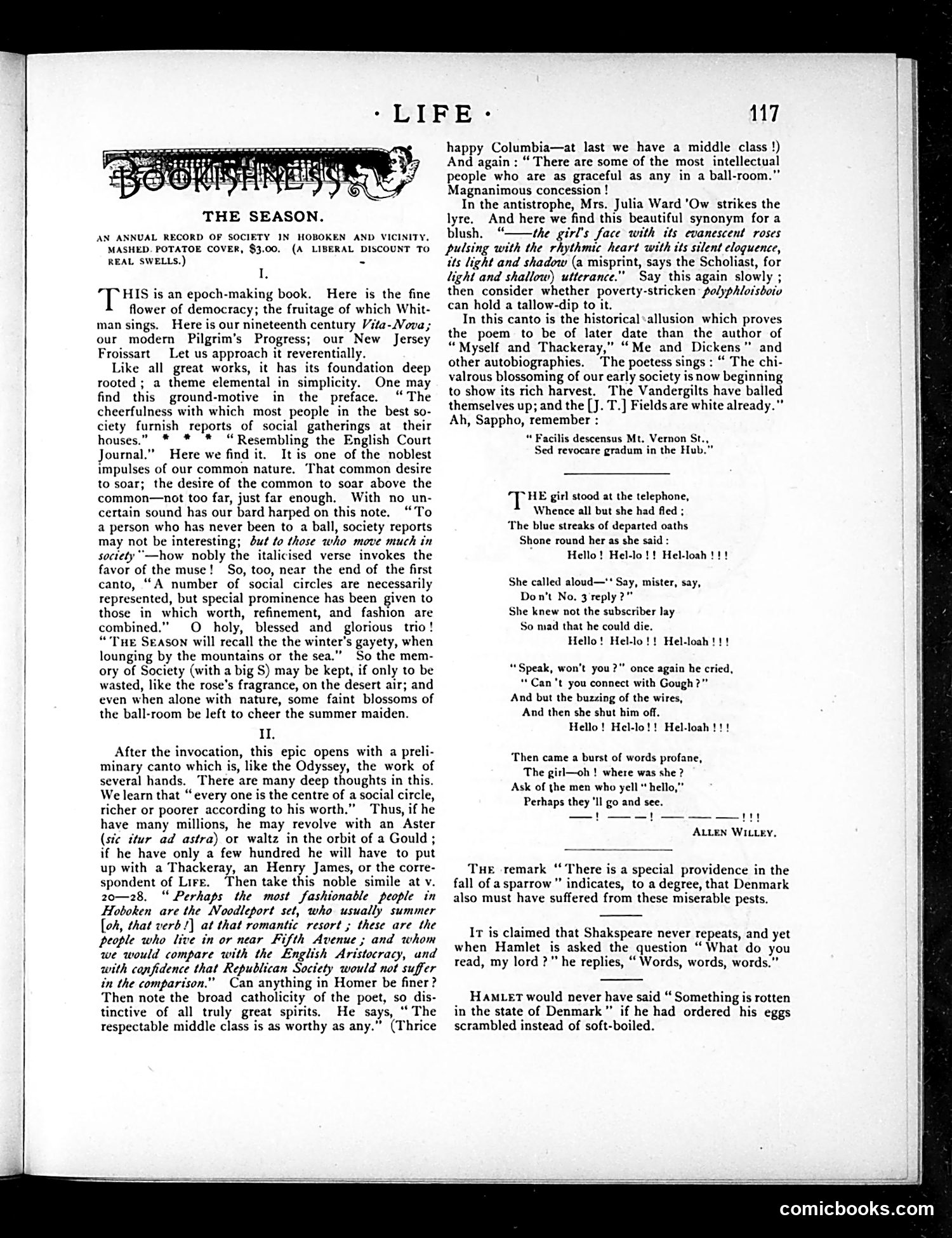
This is a scathing literary parody of "The Season," a Hoboken society register (a book documenting local high-society social events). The satirist mocks its pretentious tone by treating it as an "epic" comparable to Homer's *Odyssey*, using grandiose language ironically. The piece ridicules: 1. **Social climbing**: The critique that ordinary people desperately want to "soar above the common"—aspiring beyond their station 2. **Hollow class consciousness**: The absurd notion that wealth determines one's social circle, comparing the rich to celestial bodies (Gould, Astor) while the modestly wealthy must "put up with a Thackeray, an Henry James" 3. **False egalitarianism**: The register's patronizing claim that middle-class people and intellectuals are "as worthy as any," which the satirist labels a "magnanimous concession" 4. **Overwrought prose**: The mockery of Mrs. Julia Ward Howe's flowery description of a blush as "evanescent roses pulsing with rhythmic heart" The satire exposes how society registers commodify human worth through wealth and status while maintaining a veneer of democratic respectability.
📄 Transcribed text from this page (OCR, searchable)
Machine-transcribed from the original scan — historical spelling and the odd misread are preserved.
THE SEASON. AN ANNUAL RECORD OF SOCIETY IN HOBOKEN AND VICINITY. MASHED. POTATOE COVER, $3.00. (A LIBERAL DISCOUNT TO REAL SWELLS.) J I, THs is an epoch-making book. Here is the fine flower of democracy; the fruitage of which Whit- man sings. Here is our nineteenth century Vita-Nova; our modern Pilgrim’s Progress; our New Jersey Froissart Let us approach it reverentially. Like all great works, it has its foundation deep rooted ; a theme elemental in simplicity. One may find this ground-motive in the preface. “The cheerfulness with which most people in the best so- ciety furnish reports of social gatherings at their houses.” * * * “Resembling the English Court Journal.” Here we find it. It is one of the noblest impulses of our common nature. That common desire to soar; the desire of the common to soar above the common—not too far, just far enough. With no un- certain sound has our bard harped on this note. “To a person who has never been to a ball, society reports may not be interesting; but fo those who move much in society °—how nobly the italicised verse invokes the favor of the muse! So, too, near the end of the first canto, “A number of social circles are necessarily represented, but special prominence has been given to those in which worth, refinement, and fashion are combined.” O holy, blessed and glorious trio! “THE SEASON will recall the the winter's gayety, when lounging by the mountains or the sea." So the mem- ory of Society (with a big S) may be kept, if only to be wasted, like the rose’s fragrance, on the desert air; and even when alone with nature, some faint blossoms of the ball-room be left to cheer the summer maiden. II. After the invocation, this epic opens with a preli- minary canto which is, like the Odyssey, the work of several hands. There are many deep thoughts in this. We learn that “every one is the centre of a social circle, richer or poorer according to his worth.” Thus, if he have many millions, he may revolve with an Aster (sie itur ad astra) or waltz in the orbit of a Gould ; if he have only a few hundred he will have to put up with a Thackeray, an Henry James, or the corre- spondent of Lire. Then take this noble simile at v. 20—28. “ Perhaps the most fashionable people in Hoboken are the Noodleport set, who usually summer [oA, that verb!) at that romantic resort ; these are the people who live in or near Fifth Avenue ; and whom we would compare with the English Aristocracy, and with confidence that Republican Society would not suffer in the comparison.” Can anything in Homer be finer? Then note the broad catholicity of the poet, so dis- tinctive of all truly great spirits. He says, ‘ The respectable middle class is as worthy as any.” (Thrice > LIFE: 117 happy Columbia—at last we have a middle class !) And again: “ There are some of the most intellectual people who are as graceful as any in a ball-room.” Magnanimous concession ! In the antistrophe, Mrs. Julia Ward 'Ow strikes the lyre. And here we find this beautiful synonym for a blush. “——the girl's face with its evanescent roses pulsing with the rhythmic heart with its silent eloquence, its light and shadow (a misprint, says the Scholiast, for light and shallow) utterance." Say this again slowly ; then consider whether poverty-stricken polyphlotsboio can hold a tallow-dip to it. In this canto is the historical ‘allusion which proves the poem to be of later date than the author of “Myself and Thackeray,” “Me and Dickens” and other autobiographies. The poetess sings : “‘ The chi- valrous blossoming of our early society is now beginning to show its rich harvest. The Vandergilts have balled themselves up; and the [J. T.] Fields are white already." Ah, Sappho, remember : “ Facilis descensus Mt. Vernon St., Sed revocare gradum in the Hub.” THE git stood at the telephone, Whence all but she had fled ; The blue streaks of departed oaths Shone round her as she said : Hello! Hel-lo!! Hel-loah !!! She called aloud—'* Say, mister, say, Don't No. 3 reply 2” She knew not the subscriber lay So mad that he could die. Hello! Hel-lo!! Hel-loah!!! “Speak, won't you?" once again he cried, “Can't you connect with Gough?” And but the buzzing of the wires, And then she shut him off. Hello! Hel-lo!! Hel-loah !!! Then came a burst of words profane, The girl—oh ! where was she ? Ask of the men who yell " hello,” Perhaps they ‘Il go and see. ES ee ee Ea ALLEN WILLEY. Tue remark “There is a special providence in the fall of asparrow” indicates, to a degree, that Denmark also must have suffered from these miserable pests. Ir is claimed that Shakspeare never repeats, and yet when Hamlet is asked the question “What do you read, my lord?" he replies, “‘ Words, words, words.” HAMLET would never have said “ Something is rotten in the state of Denmark” if he had ordered his eggs scrambled instead of soft-boiled. comicbooks.com