
Life, 1883-09-06 · page 6 of 16
Life — September 6, 1883 — page 6: what you’re looking at
What you’re looking at
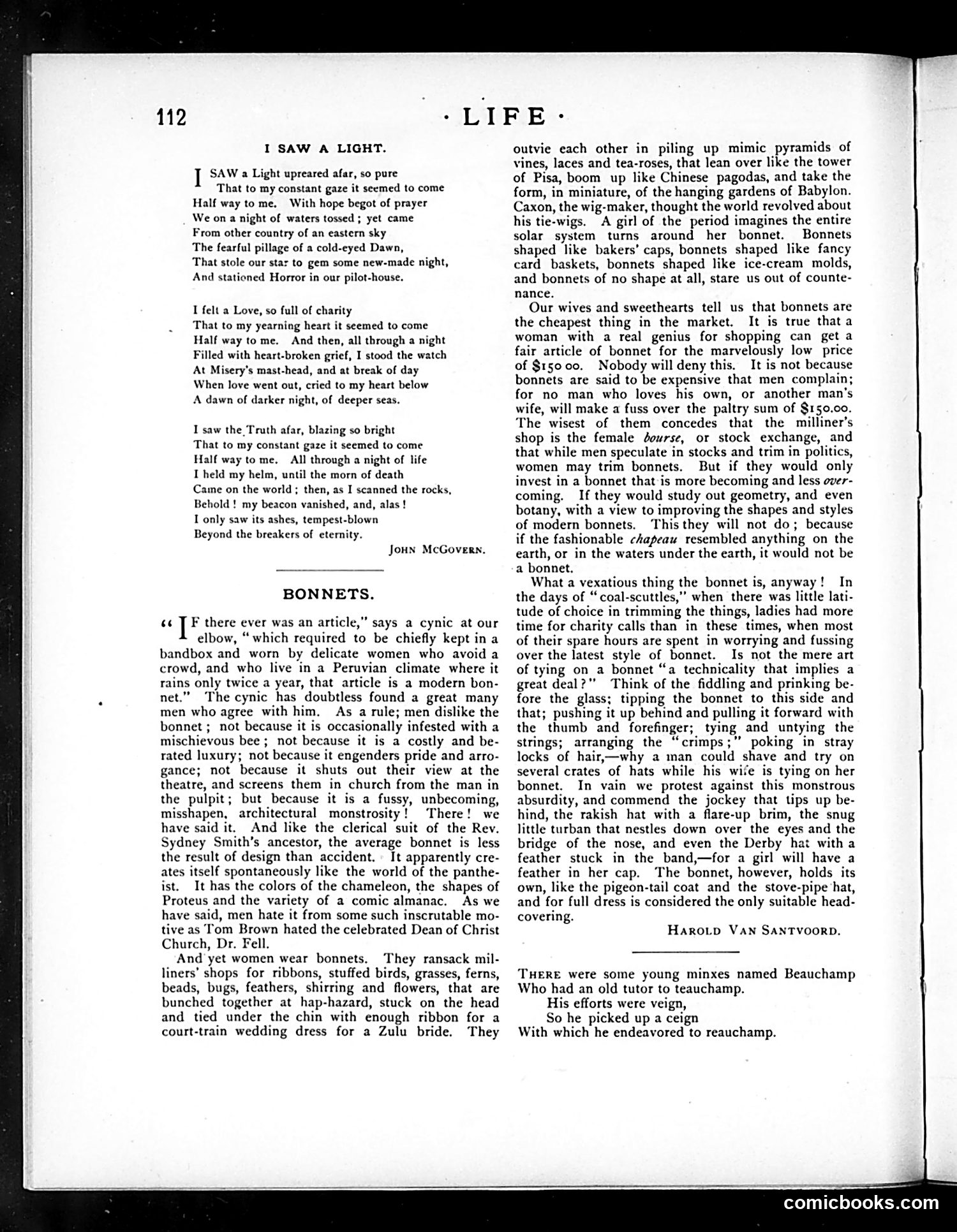
This page contains satirical prose rather than cartoons. The main article, "BONNETS," by Harold Van Santvoord, mocks women's fashion obsession with bonnets through exaggerated social commentary. The satire criticizes: - Women's irrational dedication to bonnets as status symbols - The absurd expense (up to $150) for what is essentially a hat - The ridiculous trimming practices—feathers, ribbons, beads, flowers piled haphazardly on the head - The irony that men complain about bonnets blocking theater views, yet women persist The piece suggests bonnets serve no practical purpose and represent wasteful vanity, while simultaneously acknowledging that millinery remains women's domain of expertise and commerce. The humor derives from inflated description of trivial female concerns, typical of early 20th-century satirical magazine style.
📄 Transcribed text from this page (OCR, searchable)
Machine-transcribed from the original scan — historical spelling and the odd misread are preserved.
112 I SAW A LIGHT. ] SAW Light upreared afar, so pure That to my constant gaze it seemed to come Half way to me, With hope begot of prayer We on a night of waters tossed; yet came From other country of an eastern sky The fearful pillage of a cold-eyed Dawn, That stole our star to gem some new-made night, And stationed Horror in our pilot-house. I felt a Love, so full of charity That to my yearning heart it seemed to come Half way to me. And then, all through a night Filled with heart-broken grief, I stood the watch At Misery’s mast-head, and at break of day When love went out, cried to my heart below A dawn of darker night, of deeper seas. I saw the, Truth afar, blazing so bright That to my constant gaze it seemed to come Half way tome, All through a night of life I held my helm, until the morn of death Came on the world ; then, as I scanned the rocks, Behold ! my beacon vanished, and, alas! I only saw its ashes, tempest-blown Beyond the breakers of eternity. JoHN McGovern. BONNETS. 66 ] F there ever was an article,” says a cynic at our elbow, “which required to be chiefly kept in a bandbox and worn by delicate women who avoid a crowd, and who live in a Peruvian climate where it rains only twice a year, that article is a modern bon- net.” The cynic has doubtless found a great many men who agree with him. As a rule; men dislike the bonnet ; not because it is occasionally infested with a mischievous bee ; not because it is a costly and be- rated luxury; not because it engenders pride and arro- gance; not because it shuts out their view at the theatre, and screens them in church from the man in the pulpit; but because it is a fussy, unbecoming, misshapen, architectural monstrosity! There! we have said it. And like the clerical suit of the Rev. Sydney Smith’s ancestor, the average bonnet is less the result of design than accident. It apparently cre- ates itself spontaneously like the world of the panthe- ist. It has the colors of the chameleon, the shapes of Proteus and the variety of a comic almanac. As we have said, men hate it from some such inscrutable mo- tive as Tom Brown hated the celebrated Dean of Christ Church, Dr. Fell. And yet women wear bonnets. They ransack mil- liners’ shops for ribbons, stuffed birds, grasses, ferns, beads, bugs, feathers, shirring and flowers, that are bunched together at hap-hazard, stuck on the head and tied under the chin with enough ribbon for a court-train wedding dress for a Zulu bride. They -LIFE- outvie cach other in piling up mimic pyramids of vines, laces and tea-roses, that lean over like the tower of Pisa, boom up like Chinese pagodas, and take the form, in miniature, of the hanging gardens of Babylon. Caxon, the wig-maker, thought the world revolved about his tie-wigs. A girl of the period imagines the entire solar system turns around her bonnet. Bonnets shaped like bakers’ caps, bonnets shaped like fancy card baskets, bonnets shaped like ice-cream molds, and bonnets of no shape at all, stare us out of counte- nance. Our wives and sweethearts tell us that bonnets are the cheapest thing in the market. It is true thata woman with a real genius for shopping can get a fair article of bonnet for the marvelously low price of $150.00. Nobody will deny this. It is not because bonnets are said to be expensive that men complain; for no man who loves his own, or another man's wife, will make a fuss over the paltry sum of $150.00. The wisest of them concedes that the milliner’s shop is the female dourse, or stock exchange, and that while men speculate in stocks and trim in politics, women may trim bonnets. But if they would only invest in a bonnet that is more becoming and less over- coming. If they would study out geometry, and even botany, with a view to improving the shapes and styles of modern bonnets. This they will not do; because if the fashionable chapeau resembled anything on the earth, or in the waters under the earth, it would not be a bonnet. What a vexatious thing the bonnet is, anyway! In the days of “coal-scuttles,”” when there was little lati- tude of choice in trimming the things, ladies had more time for charity calls than in these times, when most of their spare hours are spent in worrying and fussing over the latest style of bonnet. Is not the mere art of tying on a bonnet “a technicality that implies a great deal?" Think of the fiddling and prinking be- fore the glass; tipping the bonnet to this side and that; pushing it up behind and pulling it forward with the thumb and forefinger; tying and untying the strings; arranging the “crimps;” poking in stray locks of hair,—why a man could shave and try on several crates of hats while his wife is tying on her bonnet. In vain we protest against this monstrous absurdity, and commend the jockey that tips up be- hind, the rakish hat with a flare-up brim, the snug little turban that nestles down over the eyes and the bridge of the nose, and even the Derby hat witha feather stuck in the band,—for a girl will have a feather in her cap. The bonnet, however, holds its own, like the pigeon-tail coat and the stove-pipe hat, and for full dress is considered the only suitable head- covering. Haroip Van SANntTvoorD. THERE were some young minxes named Beauchamp Who had an old tutor to teauchamp. His efforts were veign, So he picked up a ceign With which he endeavored to reauchamp. comicbo: oks.com