
A complete issue · 16 pages · 1883
Life — August 16, 1883
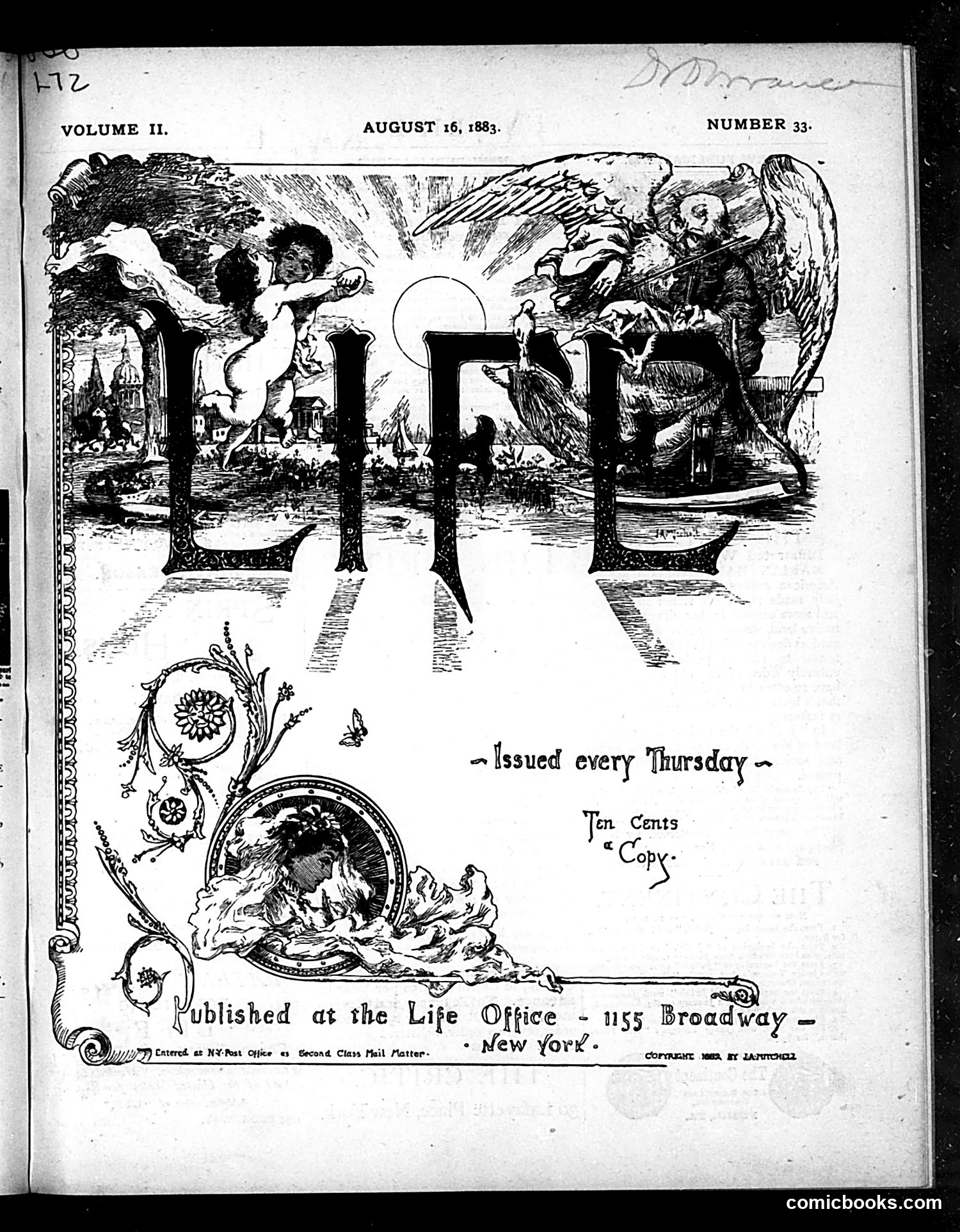
**August 16, 1883** This is the cover of *Life*, a weekly satirical magazine published in New York. The large decorative letters "LIFE" dominate the center, framed by an elaborate allegorical illustration featuring cherubs, classical figures, and architectural elements suggesting a cityscape or theatrical scene. The imagery appears to reference classical or mythological themes common to 19th-century satirical publications. Without clearer text identifying specific figures or events, the exact satirical target remains unclear. The ornate Art Nouveau-style decorative border and cherub illustrations were typical design elements for *Life* during this period. The magazine cost ten cents per copy and was issued weekly on Thursdays.
This page is **primarily advertising and editorial content**, not political cartoons. It consists of: **Left column:** Book advertisements (Richter's *Invisible Lodge*, Auerbach's *Master Bieland*, Harland's *Judith*) **Center:** Publication announcements for *The Season* (a society chronicle of New York, Brooklyn, and suburbs) and *The Critic* (a literary journal reviewing literature, fine arts, science, music, and drama) **Right column:** Summer resort hotel advertisements (Parker House in Boston, Hotel Netherwood in New Jersey, Spring House in Richfield Springs, and The Fenimore in Cooperstown) The page shows no political cartoons or satirical illustrations. It reflects late 19th-century *Life* magazine's mix of literary content and upscale consumer advertising targeting educated, affluent readers.
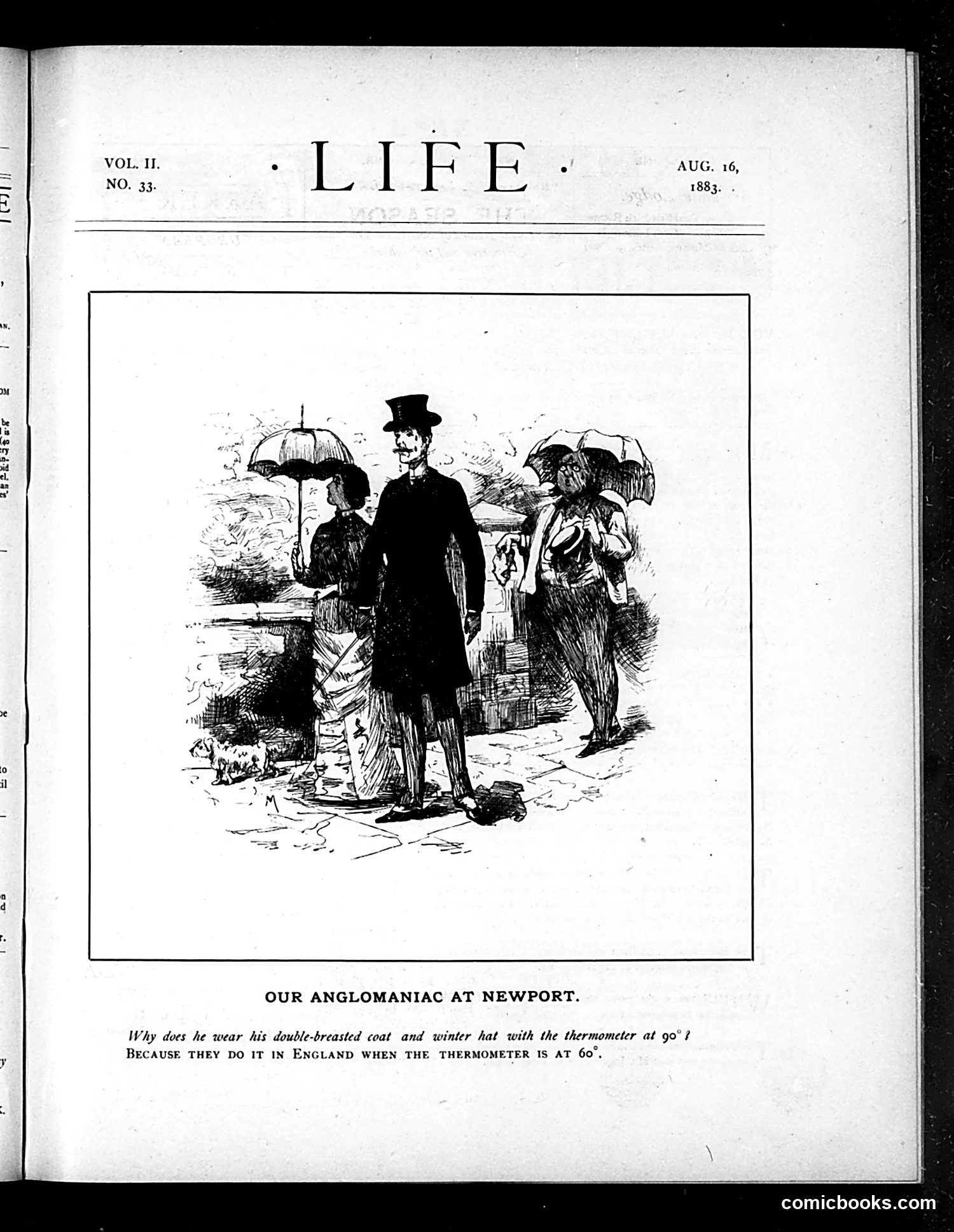
This satirical cartoon from *Life* magazine (August 16, 1883) mocks an American man at Newport, Rhode Island—then the premier summer resort for wealthy Americans—who imitates English fashion and customs. The caption jokes that he wears a double-breasted coat and winter hat despite the thermometer reading 90°F, "Because they do it in England when the thermometer is at 60°." The cartoon ridicules American "Anglomaniacs"—wealthy individuals who slavishly copied English upper-class styles and behaviors, regardless of practical sense or local climate. The umbrella-carrying figure in formal dress represents this absurd affectation: prioritizing fashionable conformity to English standards over comfort or rationality. This reflects late-19th-century tensions between American and English culture among the American elite.
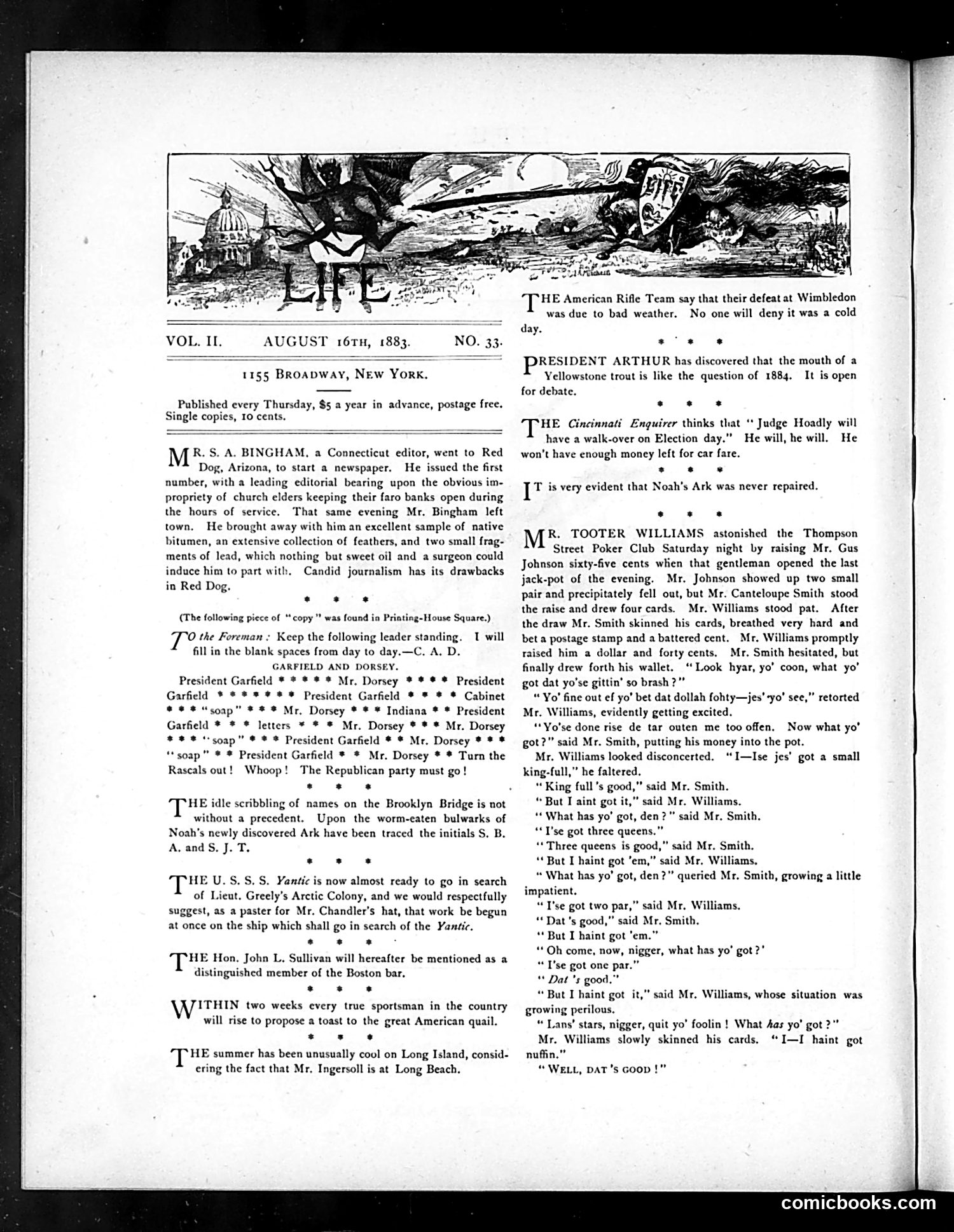
The page's main illustration depicts a skeletal Death figure seated at a desk or table in a landscape, with classical architecture visible in the background. This appears to be memento mori imagery—a traditional reminder of mortality. The text below contains short news items and social commentary typical of Life's satirical format. References include: - The American Rifle Team's poor performance at Wimbledon (blamed on weather) - President Arthur and the "question of 1884" (upcoming election) - Judge Hoadly's finances - A humorous anecdote about a poker game where Mr. Tooter Williams loses to Mr. Cantaloup Smith The content reflects 1880s American political gossip and social humor, mixing legitimate news with lighthearted mockery of public figures and ordinary situations.
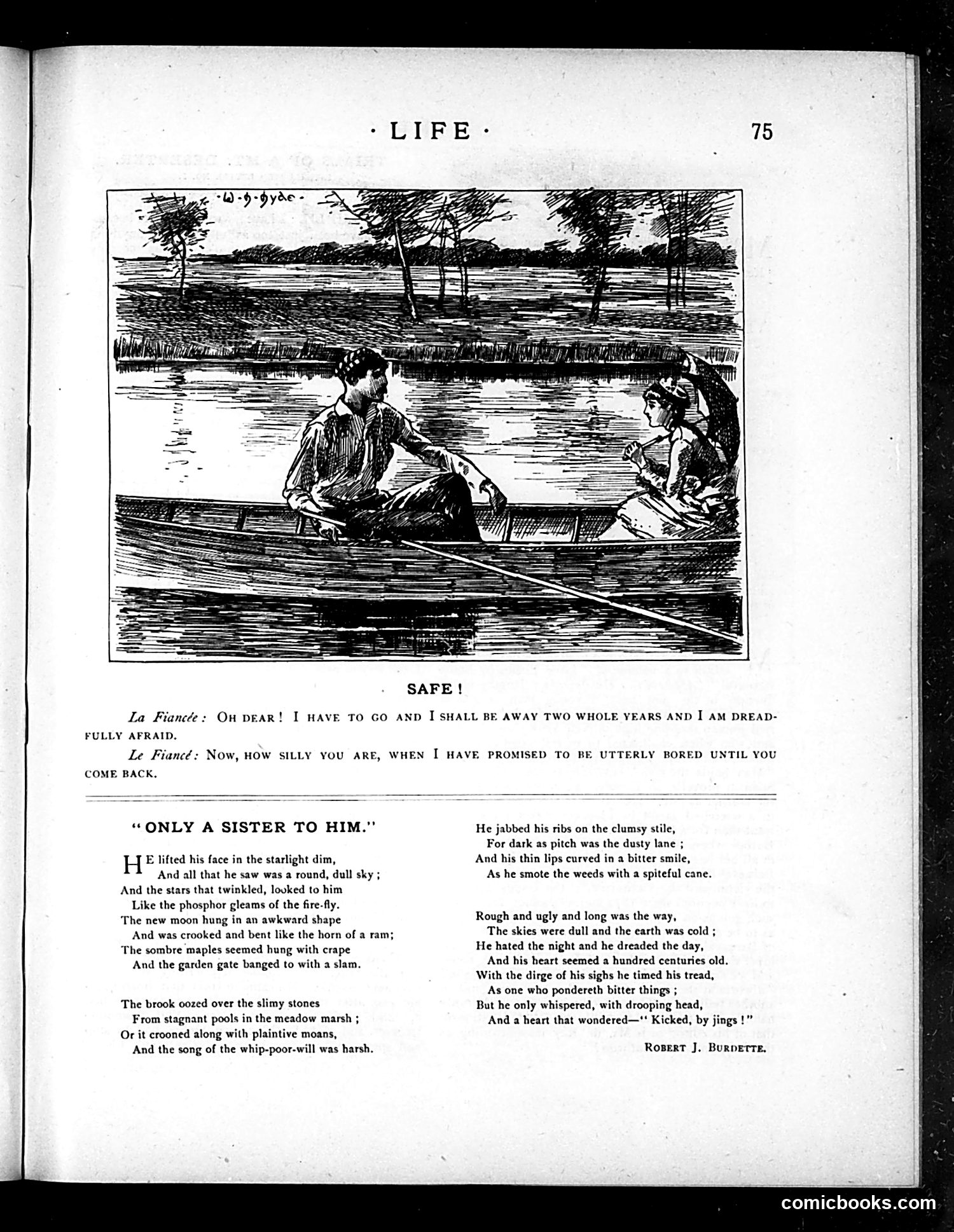
**Visual Content:** A wood-engraved illustration shows two people in a rowboat on a river, with trees and marshland visible in the background. **Text Content:** The section titled "SAFE!" presents dialogue between "La Fiancée" (The Fiancée) characters. One expresses dread about a two-year separation; the other sarcastically responds that she shouldn't be bored given his promises. Below this appears a poem titled "Only a Sister to Him" by Robert J. Burdette, describing a man's nighttime emotional turmoil—he appears tormented, with imagery of darkness and self-recrimination, ending with the line "Kicked by jings!" **Interpretation:** The page likely satirizes romantic relationships and broken promises, juxtaposing the couple's banter with the poem's darker exploration of male emotional distress. The specific historical context and whether these reference particular social anxieties of the era remains unclear without additional publication date context.
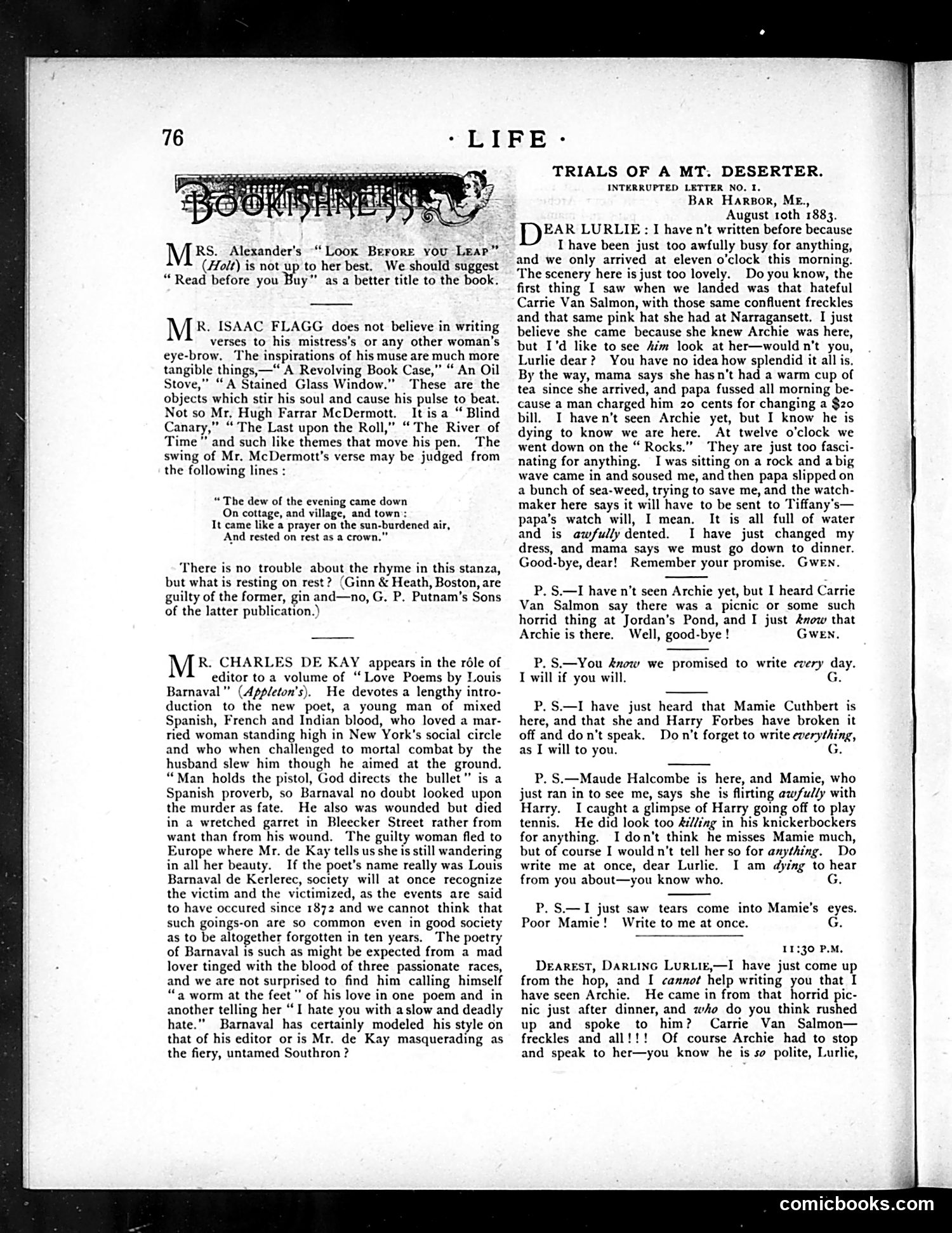
This page contains **book reviews and literary commentary** rather than political cartoons. The "Book Shelf" section critiques recent publications: 1. **Mrs. Alexander's "Look Before You Leap"** — a domestic novel recommended for readers 2. **Mr. Isaac Flagg's poetry** — dismissed as inferior to prose; the reviewer prefers his practical works like "A Revolving Book Case" and "A Stained Glass Window" 3. **Mr. Charles de Kay** — reviewed as editor of "Love Poems by Louis Barnaval," with commentary on the poet's controversial reputation in New York society The page also features **"Trials of a Mt. Deserter,"** an interrupted letter column from Bar Harbor, Maine, containing gossip about summer visitors and social drama among the wealthy elite. This reflects *Life* magazine's role as both satirical publication and literary arbiter for educated American audiences.
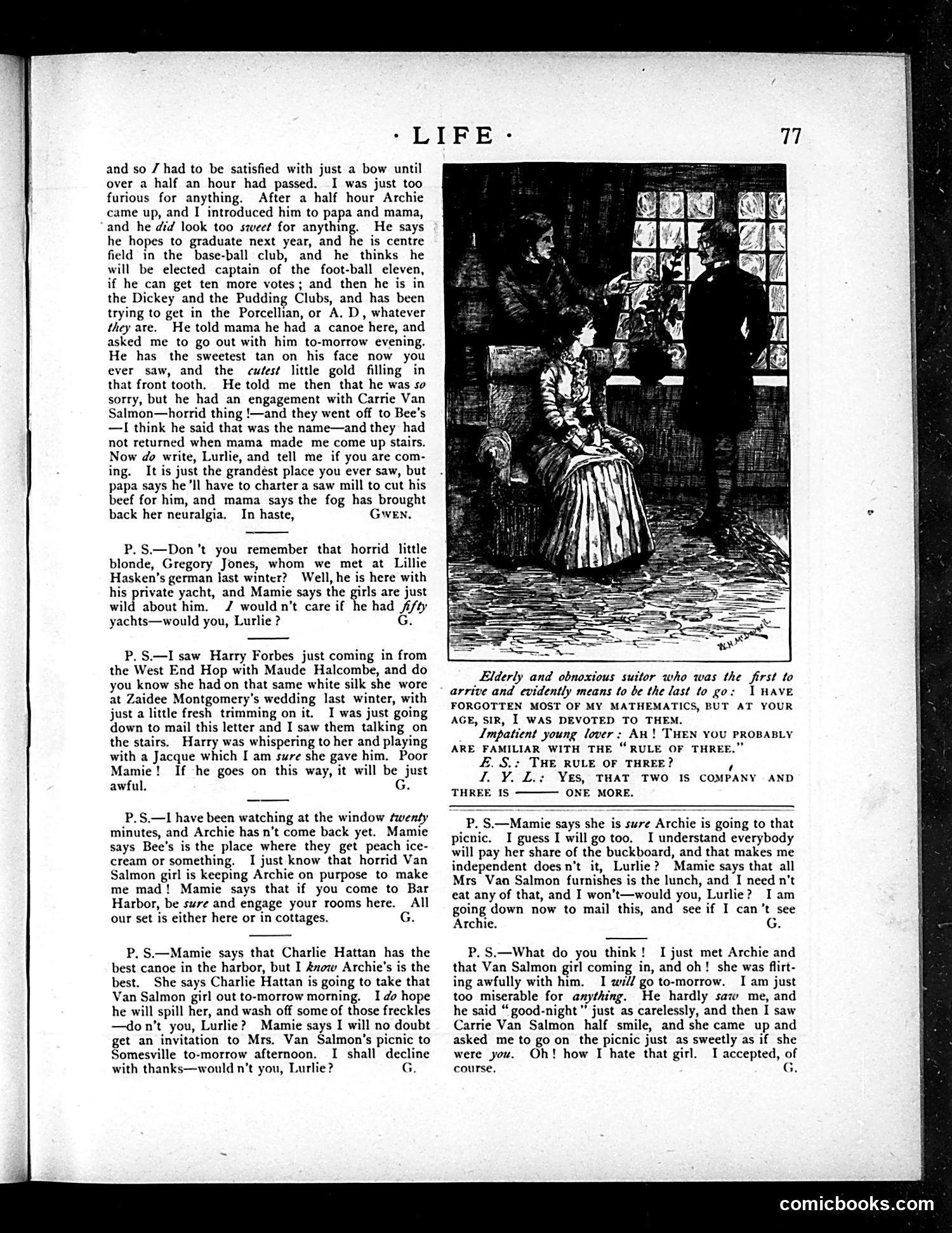
The main illustration depicts an elderly man and young woman in an interior setting, likely from a serialized story rather than political commentary. The figure appears to be illustrating romantic or social drama among the upper classes. The text consists primarily of personal correspondence ("P.S." notes) discussing social gossip: mentions of Gregory Jones, Harry Forbes, Charlie Hattan, and various social activities like picnics and yacht outings. References to "the Van Salmon girl" and invitations to social events indicate this is **society column gossip** rather than political satire. The cartoon serves as illustration for what appears to be **serialized fiction or gossip column content** typical of Life magazine's satirical commentary on wealthy social circles and their romantic entanglements during this era.
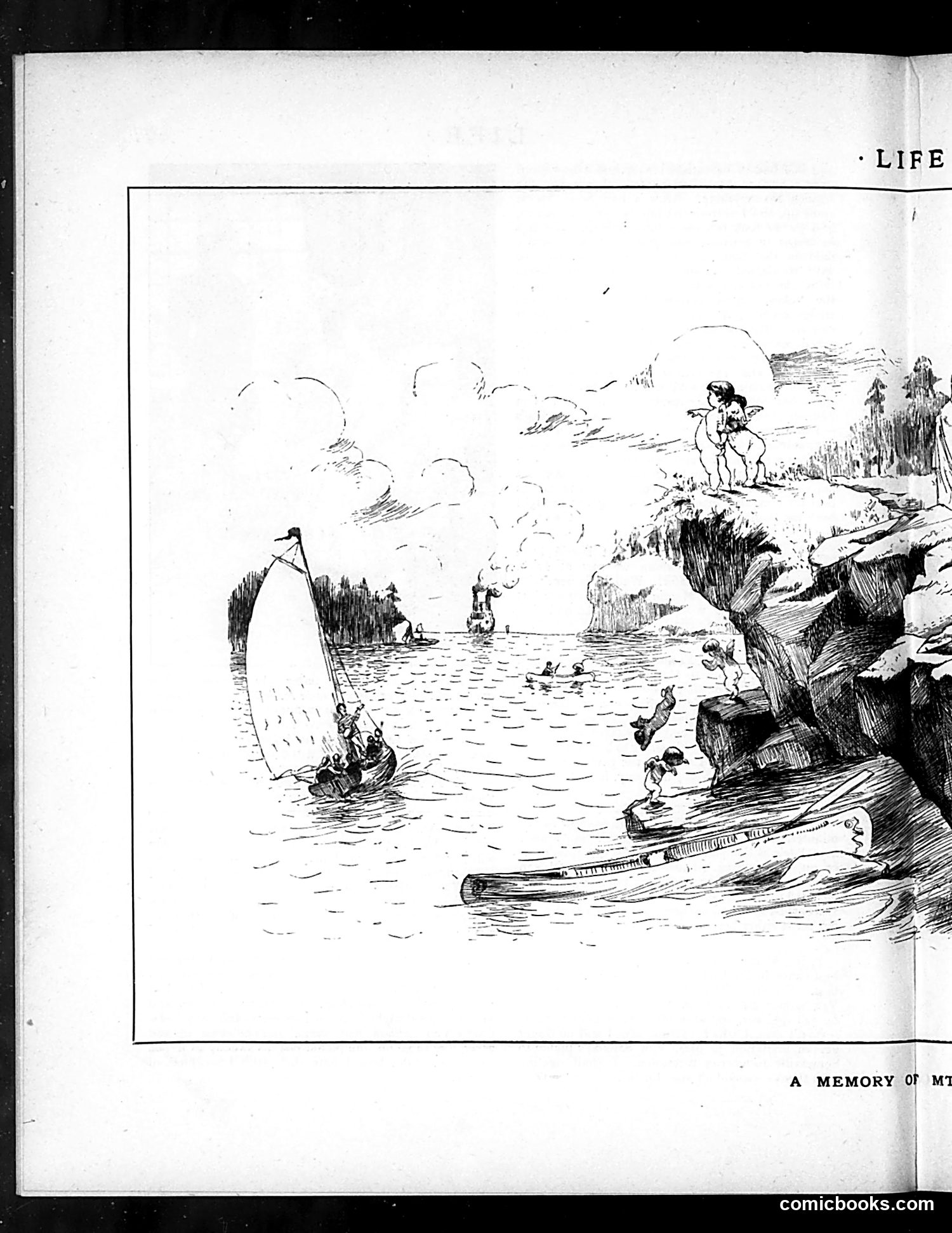
This illustration appears to be from *Life* magazine and depicts a seaside recreational scene. The sketch shows several figures engaged in water activities—notably a small sailboat on the left and people swimming or wading on the right shore. There are also figures on elevated rocks or cliffs observing the scene. The partial caption reads "A MEMORY OF M[...]" (text cut off), suggesting this may be nostalgic or commemorative in nature. Without the complete caption or title visible, the specific satirical point is unclear. However, the scene's composition—contrasting the active waterside leisure with observers on high ground—might critique class distinctions in recreational access, a common *Life* magazine theme. The illustration's style and subject matter suggest early 20th-century American social commentary, but the exact reference remains uncertain without the full text.
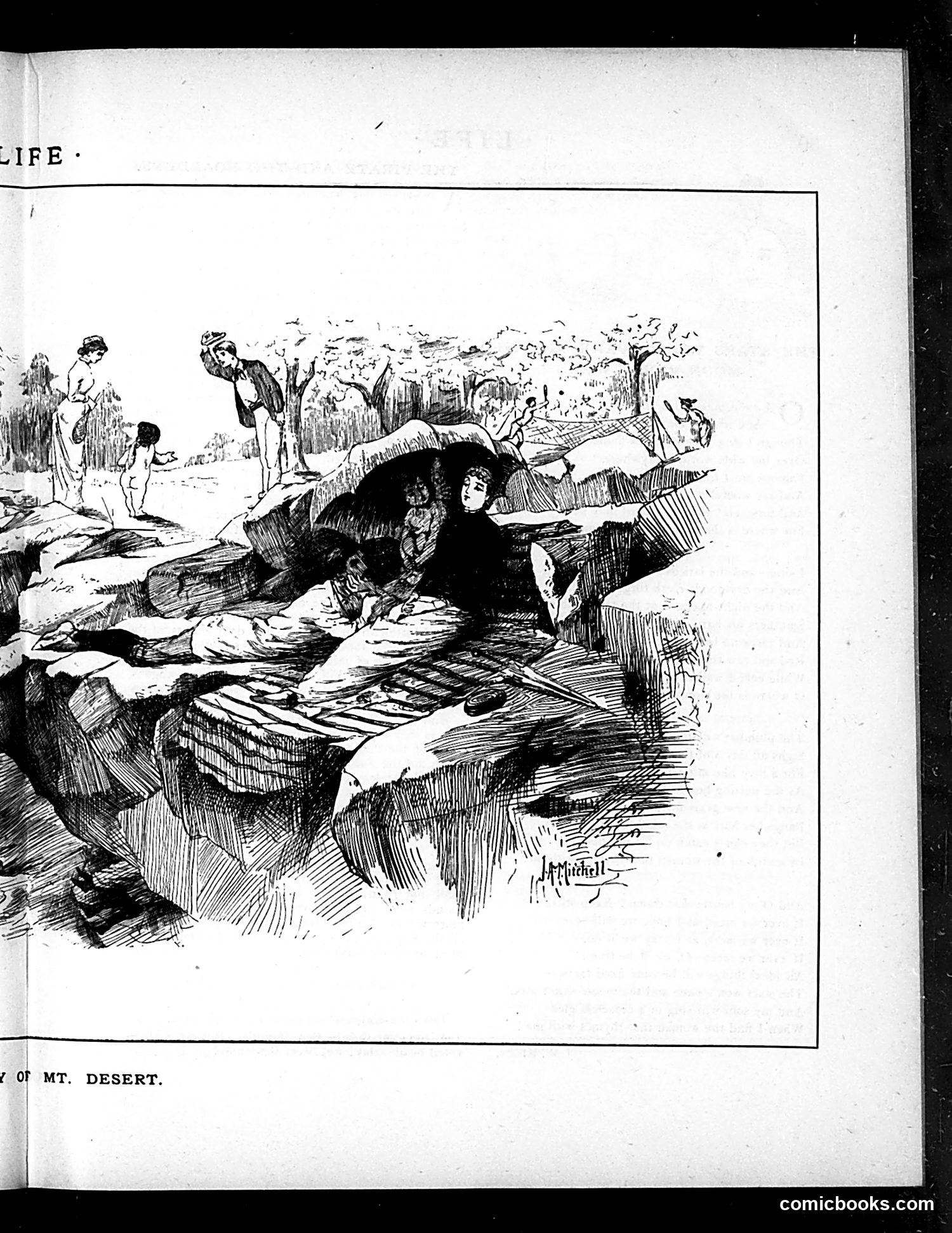
This appears to be a satirical illustration showing a picnic or outdoor gathering scene. In the foreground, two figures recline together under an umbrella, while numerous other people are depicted in the background enjoying various leisure activities in what appears to be a pastoral landscape. The caption references "MT. DESERT" (likely Mount Desert, a fashionable vacation destination). The illustration is signed by what appears to be the artist's name (possibly "Schindell" or similar). The satire likely mocks leisure activities, social pretension, or romantic behavior among the upper classes during an era when such outings were markers of social status. Without additional context about the specific issue date, the precise satirical target remains unclear, though the detailed rendering suggests commentary on Victorian or Gilded Age social customs.
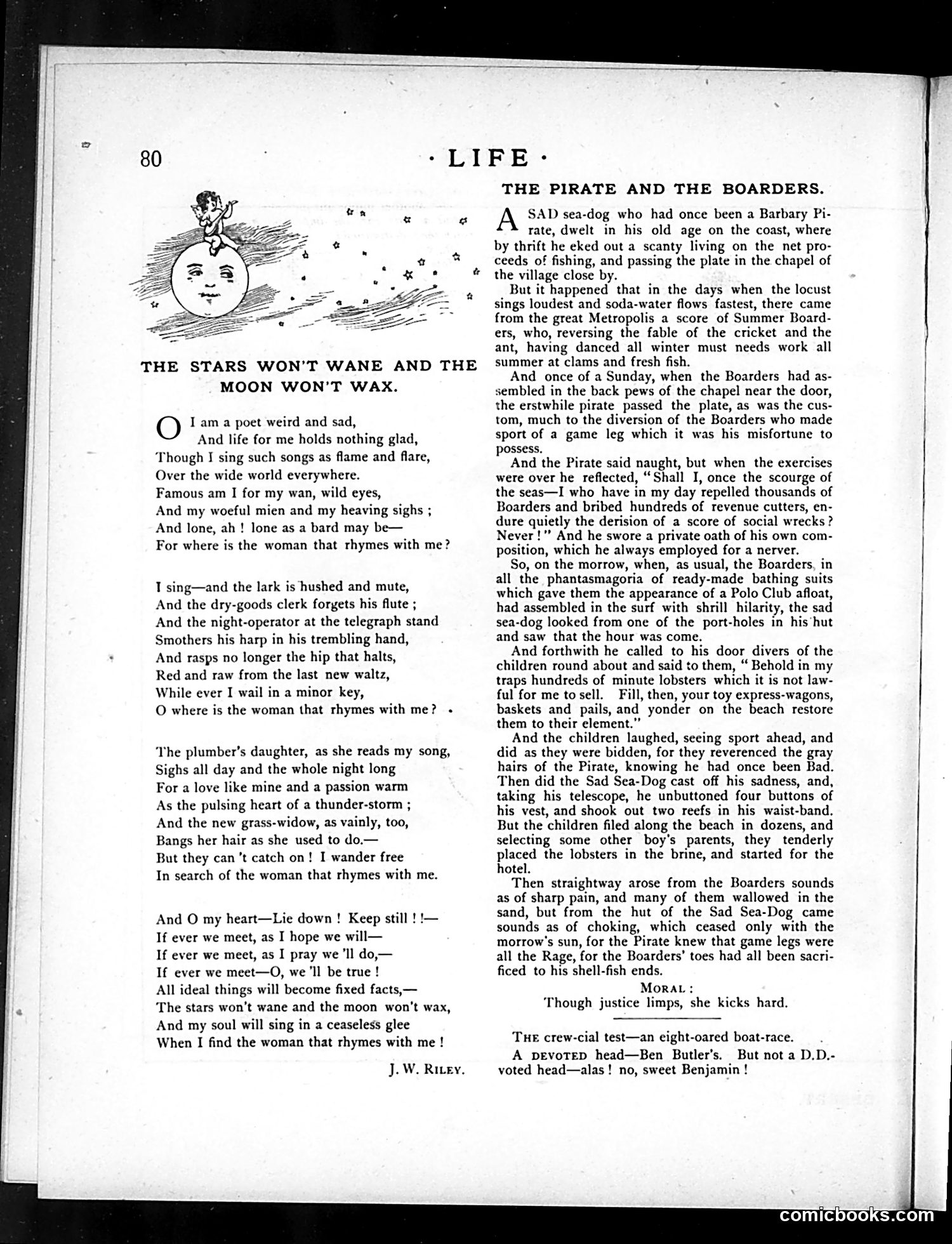
This page contains two distinct pieces from *Life* magazine's satirical content: **"The Stars Won't Wane and the Moon Won't Wax"** (poem by J.W. Riley): A romantic parody mocking the melodramatic, self-pitying "tortured poet" archetype. The speaker is a melancholic bard searching desperately for a woman who "rhymes" with him—playing on how overwrought Romantic-era poetry treated love as cosmic destiny. The joke targets both sentimental poetry and the absurdity of expecting one perfect soulmate. **"The Pirate and the Boarders"** (story): A humorous tale of class revenge. A reformed pirate living humbly on the coast is mocked by wealthy summer tourists (city people vacationing by the shore) during church. Rather than fight, he cunningly releases tiny lobsters onto the beach where the boarders swim, forcing them to abandon their bathing—a gentlemanly revenge. The satire critiques both the arrogant tourists and celebrates the clever dignity of the working-class protagonist. Both pieces use humor to deflate pretension—whether romantic affectation or urban snobbery.
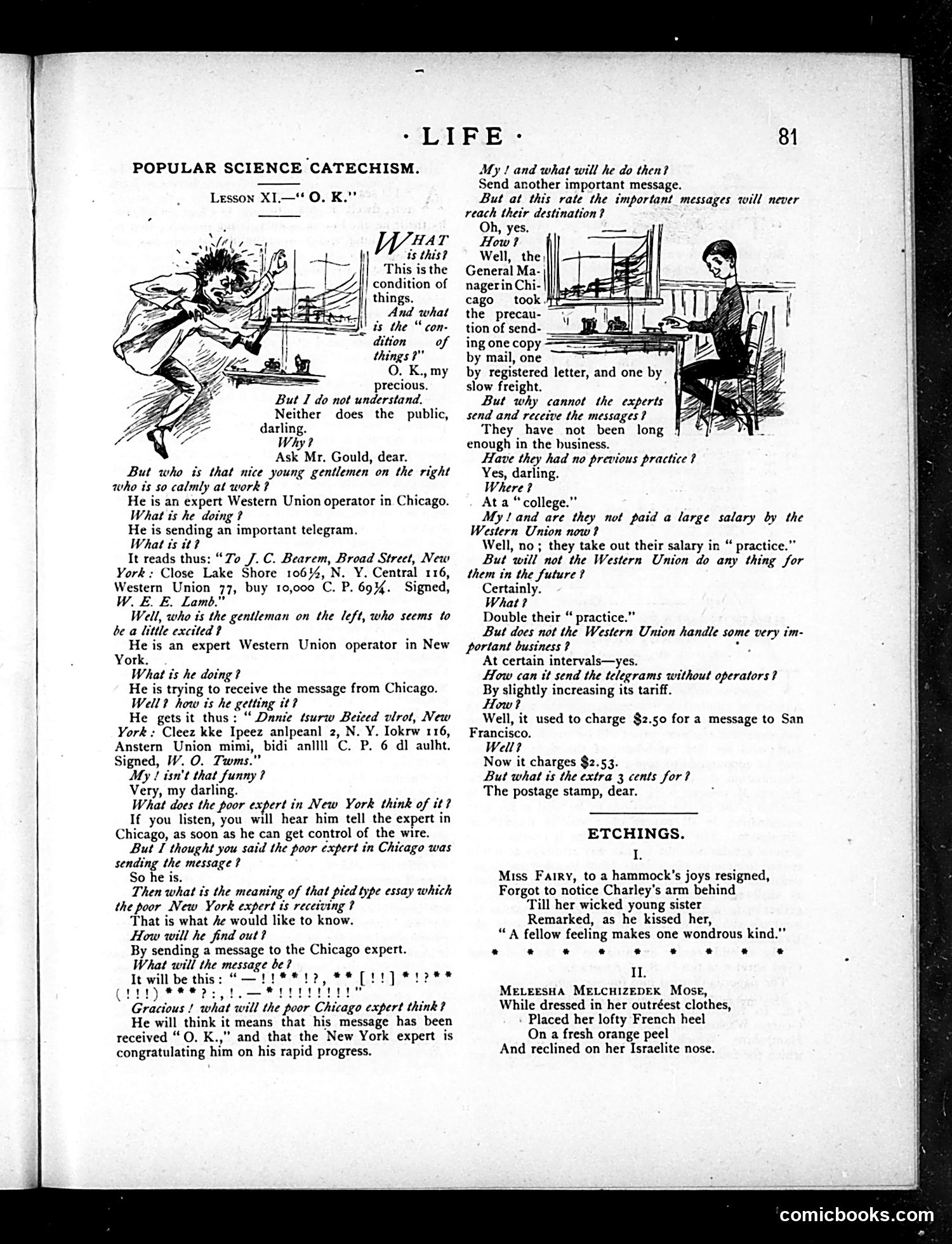
This "Popular Science Catechism" mocks the incompetence of Western Union telegraph operators circa the 1880s-90s. The joke: an expert Chicago operator sends a stock market message to New York, but the New York operator receives complete gibberish due to technical failure or operator error. The satire exposes that despite being paid professionals, these "experts" lack practical training—they studied at "college" but work for minimal salary while gaining unpaid "practice." The solution? Western Union doesn't improve service; instead, it raises rates by 3 cents and covers the cost with a postage stamp. The cartoon's absurdist conclusion—that important messages never reach destinations, yet telegraph companies thrive by slightly raising fees—critiques both operator incompetence and corporate indifference to customer service. The message "O.K." becomes ironic: nothing is actually okay.
This page contains two distinct satirical pieces from Life magazine (1883). **"The Errand"** is a brief comic dialogue mocking the disconnect between a wife's request and a shop girl's literal interpretation. The husband asks for a net "like your moustache" (matching its shade). The shop girl deliberately misunderstands, fetching an "invisible net"—a joke playing on the absurdity of the initial request and feminine wit. **"Headquarters Civil Service Reform"** is sharper political satire. It mocks the Civil Service Reform Board's newly implemented exam system by presenting deliberately absurd, unanswerable test questions—mixing trivial comparisons (Adam vs. George Washington), nonsensical geography ("Discord, Mass."), and absurd loyalty tests ("Do you love the Dear Old Party?"). The satire targets the reform effort itself as corrupt and meaningless, suggesting the board publishes questions in advance to Republican newspapers and allows candidates to answer whenever convenient—exposing the reform as theater rather than genuine meritocratic improvement.
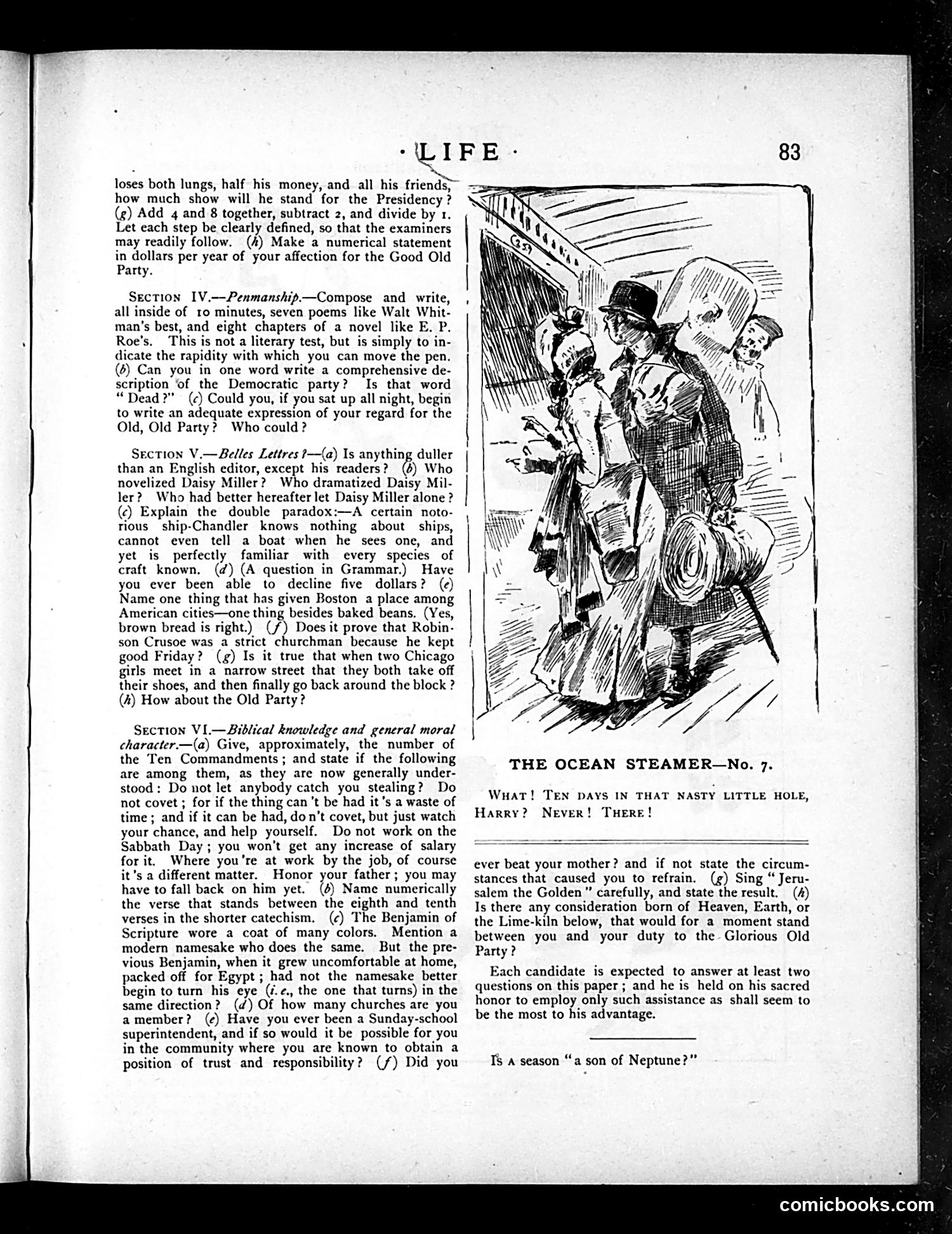
This page satirizes late-19th-century American political party loyalty through a mock examination. The text presents absurdist test questions supposedly required to prove fitness for political office or party membership. The satire ridicules: **Republican Party dogmatism**: Questions demand absolute devotion to "the Good Old Party" (the Republican Party), asking candidates to quantify their "affection" in dollars and write tributes regardless of the party's actual failings. **Corrupt patronage system**: The exam mocks how political positions were awarded based on party loyalty rather than competence—note the ship-chandler who knows nothing about ships, suggesting unqualified party loyalists received government jobs. **Moral hypocrisy**: Sections on biblical knowledge and ethics are designed to expose how politicians claimed moral authority while practicing graft, theft, and self-dealing—rewritten commandments permit stealing "if you watch your chance." The cartoon (right) shows well-dressed men crowded uncomfortably in a ship's cabin, illustrating the satirical critique of political discomfort in "that nasty little hole"—suggesting the cramped, corrupt reality behind dignified appearances.
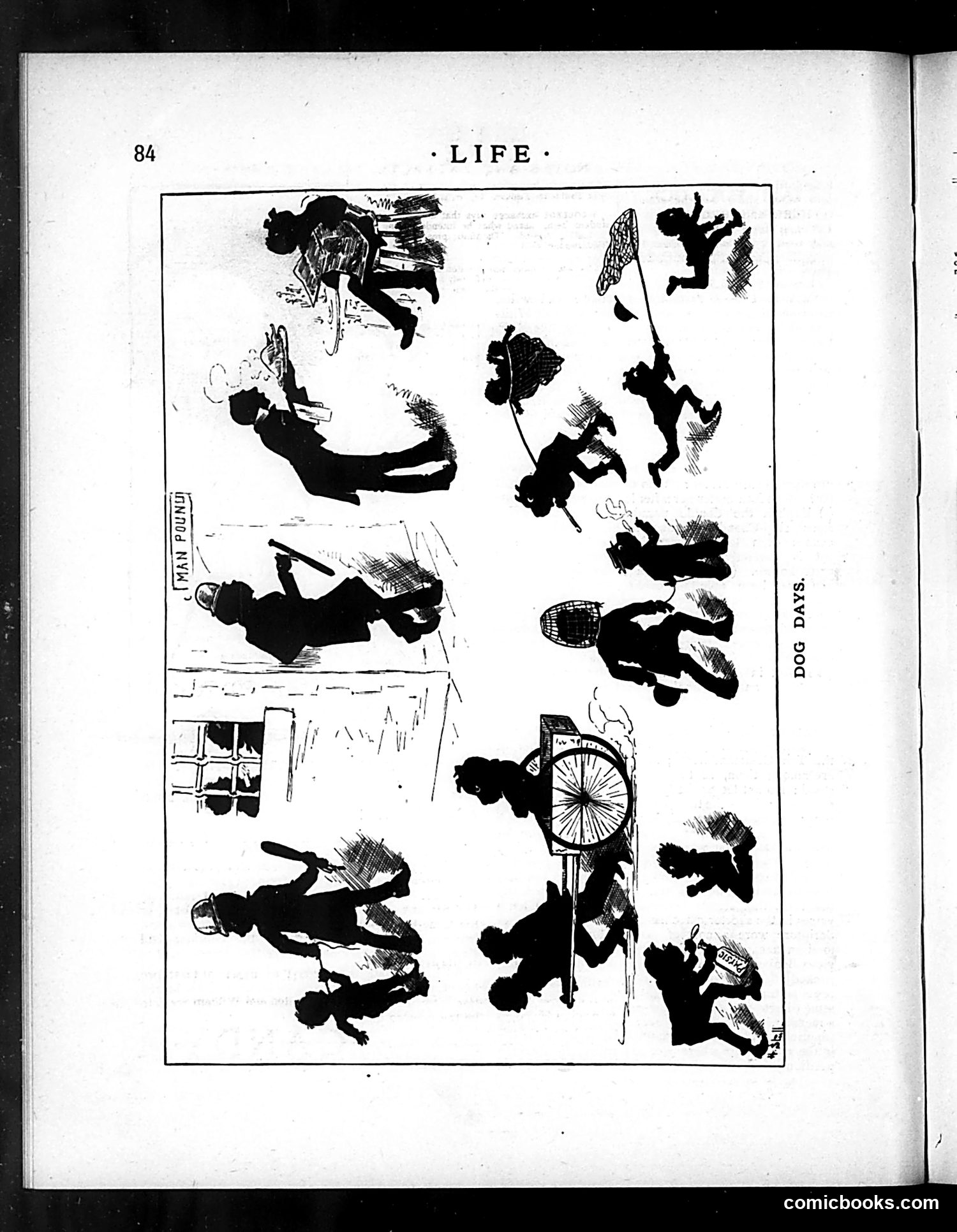
This page from *Life* magazine presents a series of silhouette vignettes titled "Dog Days," showing various people engaged in summer activities. The cartoons appear to be humorous observations of leisure and outdoor pursuits during hot weather—figures are depicted flying kites, lounging, riding bicycles, playing tennis, and generally enjoying recreational activities in warm-weather conditions. The "dog days" reference alludes to the hottest period of summer (traditionally associated with the star Sirius). The silhouette style was a popular illustration technique of the era, allowing quick visual gags through exaggerated postures and scenarios. The humor derives from capturing human behavior and physical comedy through simplified black shapes—people's clumsy or awkward movements while trying to enjoy themselves in the heat.
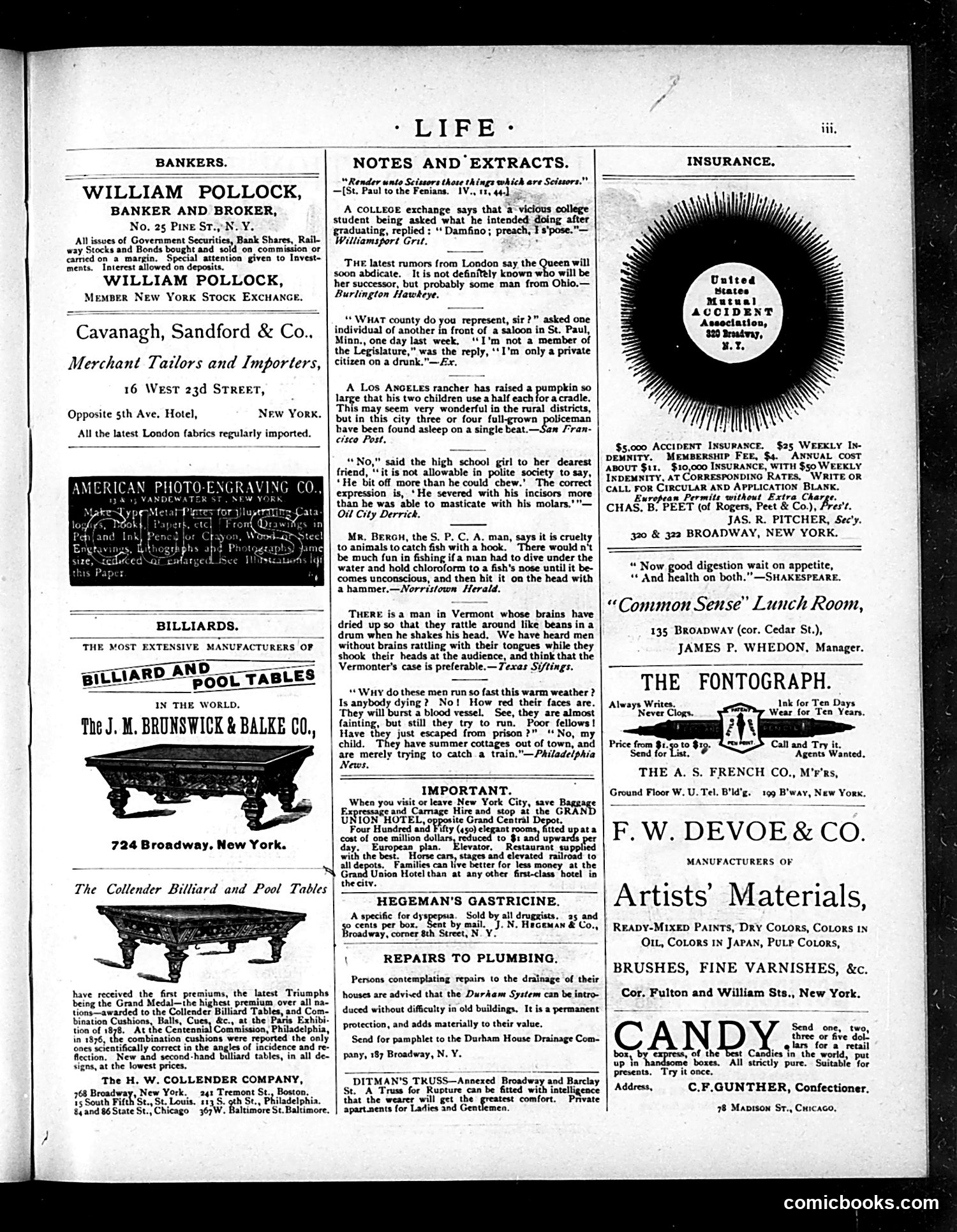
This page is primarily **advertisements** for financial services, billiard tables, and artists' materials, with a "Notes and Extracts" humor section. The humor section collects **satirical quips** from various American newspapers, poking fun at contemporary life: - A college student's indifference to his future - Rumors about Queen Victoria abdicating (suggesting an American, possibly from Ohio, might succeed her—likely mocking American pretensions) - A drunk claiming to be merely a "private citizen on a drunk" rather than a legislator - A Los Angeles pumpkin so large children use it as a cradle - High school girls correcting crude language into overly formal speech - Criticism of animal-cruelty activists as impractical - A Vermont man whose brain has literally dried up and rattles These are gentle, observational humor pieces typical of 19th-century satirical magazines—poking at social pretension, regional oddities, and human folly without targeting specific politicians or events.
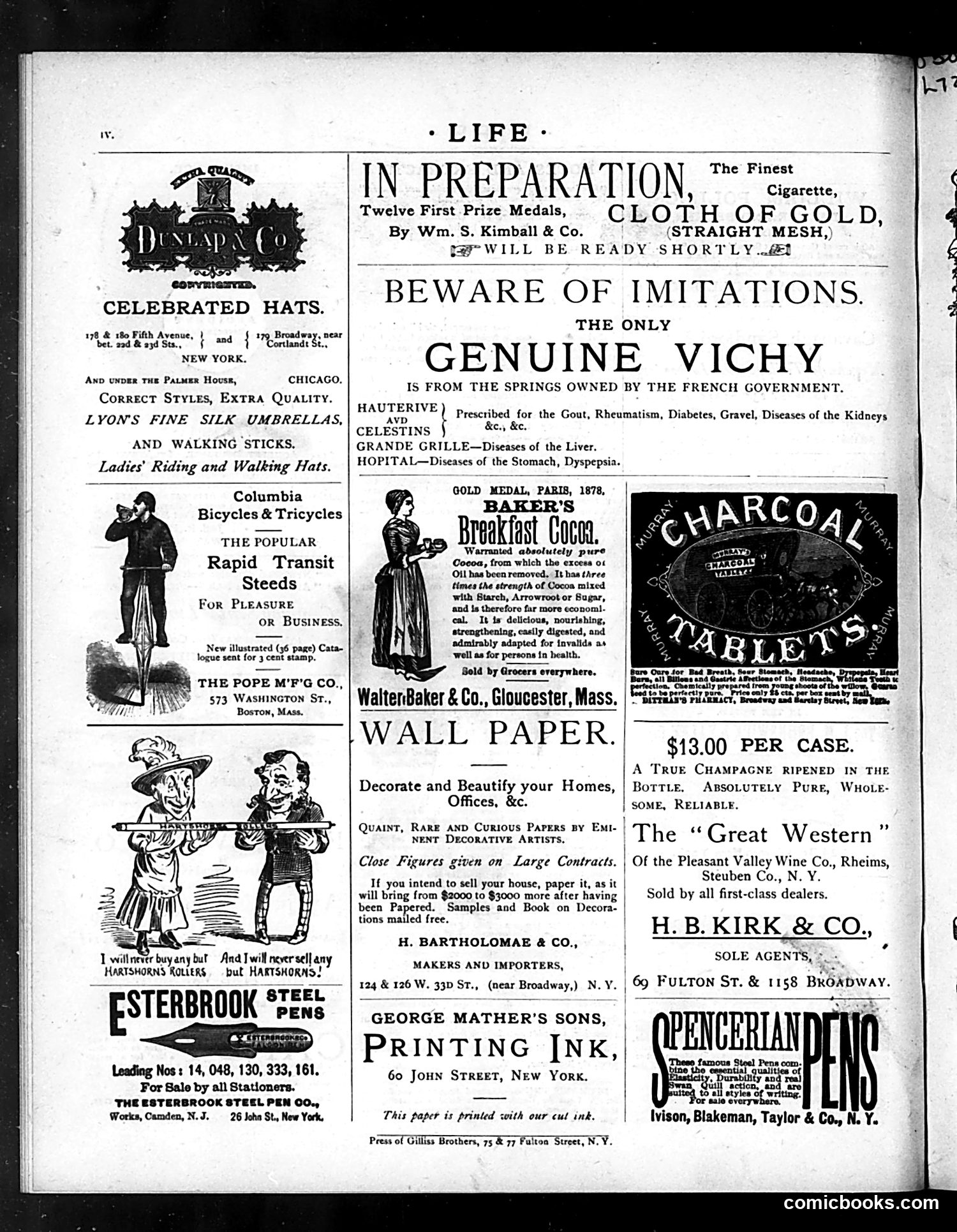
This is primarily an **advertising page** from Life magazine, not a satirical cartoon page. The only visual satire appears in a small cartoon showing two figures carrying a pole between them, with dialogue: "I will never buy any but HARTSHORNS ROLLERS" / "And I will never sell any but HARTSHORNS!" This is a **self-deprecating advertisement joke**: the two characters represent opposing positions (buyer and seller) who refuse to compromise—yet both insist on the same product (Hartshorns Rollers, a window shade). The humor lies in their stubbornness being pointless since they already agree, satirizing the absurdity of partisan loyalty to brands. The rest of the page features standard period advertisements for bicycles, pens, hats, cocoa, champagne, and wallpaper—typical of 1880s American commercial messaging. These ads reflect the consumer goods and luxuries marketed to middle and upper-class readers of Life magazine during this era.