
Life, 1883-08-16 · page 12 of 16
Life — August 16, 1883 — page 12: what you’re looking at
What you’re looking at
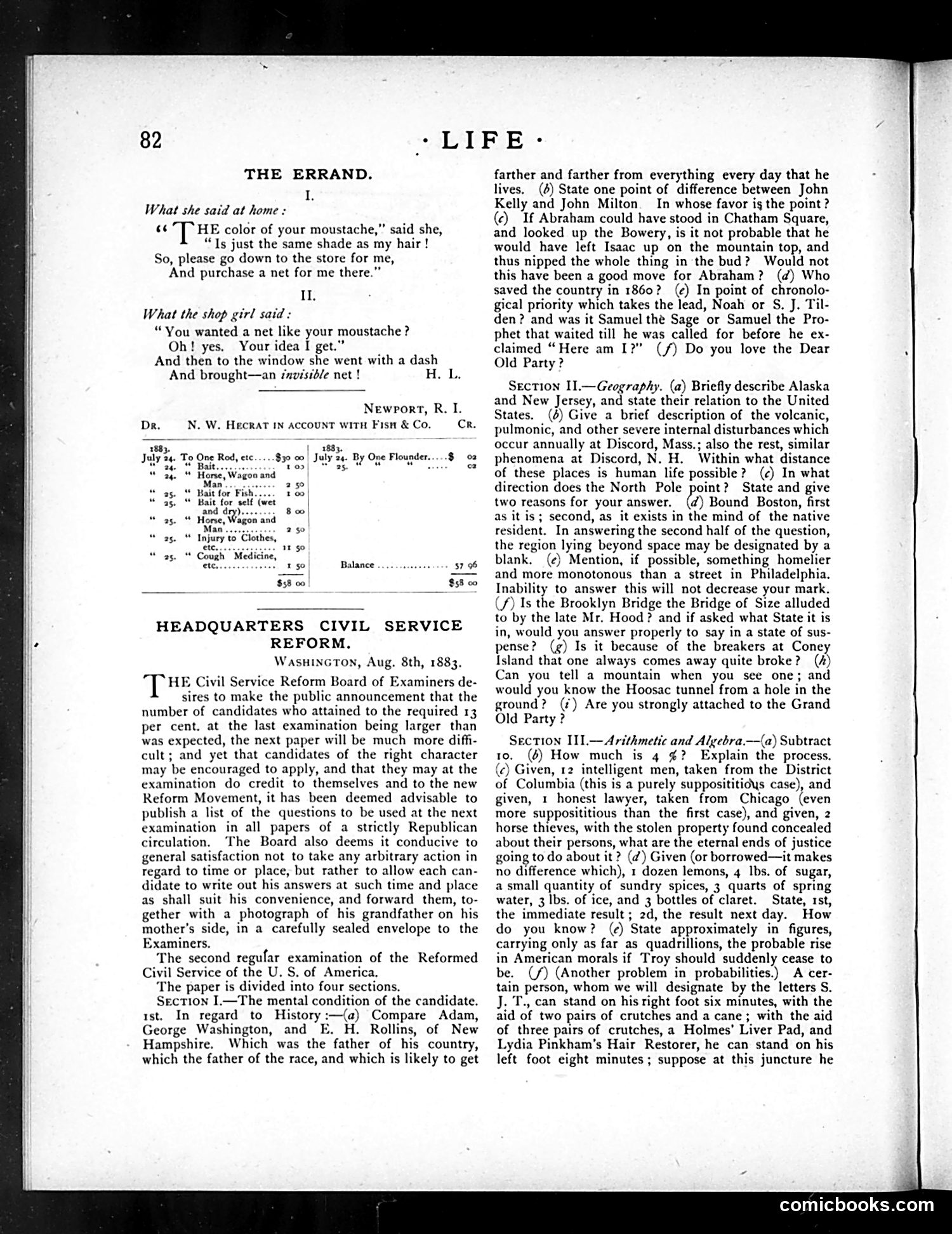
This page contains two distinct satirical pieces from Life magazine (1883). **"The Errand"** is a brief comic dialogue mocking the disconnect between a wife's request and a shop girl's literal interpretation. The husband asks for a net "like your moustache" (matching its shade). The shop girl deliberately misunderstands, fetching an "invisible net"—a joke playing on the absurdity of the initial request and feminine wit. **"Headquarters Civil Service Reform"** is sharper political satire. It mocks the Civil Service Reform Board's newly implemented exam system by presenting deliberately absurd, unanswerable test questions—mixing trivial comparisons (Adam vs. George Washington), nonsensical geography ("Discord, Mass."), and absurd loyalty tests ("Do you love the Dear Old Party?"). The satire targets the reform effort itself as corrupt and meaningless, suggesting the board publishes questions in advance to Republican newspapers and allows candidates to answer whenever convenient—exposing the reform as theater rather than genuine meritocratic improvement.
📄 Transcribed text from this page (OCR, searchable)
Machine-transcribed from the original scan — historical spelling and the odd misread are preserved.
82 THE ERRAND. lL What she said at home: “ce THE color of your moustache,” said she, “Ts just the same shade as my hair! So, please go down to the store for me, And purchase a net for me there.” Il. What the shop girl said: “You wanted a net like your moustache ? Oh! yes. Your idea I get.” And then to the window she went with a dash And brought—an invisible net ! H Newport, R. I. N. W. Hecrat in Account witu Fisn & Co. Cr. 14. To One Rod, etc. “ Bait.... |, 1883. $30 00 | July 24. By One Flounder.....$ 02 . “ Horse, Wagon and M > poy Man sss igo Bait for Fish!.... 1 09 * Bait for self (wet and dry)...-..+, Hone, Wagon and Man sos2ss) “ Injury to ‘Clothes, 8 00 250 11 $0 ¥ 50 $58 00 Balance : $58 co HEADQUARTERS CIVIL SERVICE REFORM. WasuinGTon, Aug. 8th, 1883. HE Civil Service Reform Board of Examiners de- sires to make the public announcement that the number of candidates who attained to the required 13 per cent, at the last examination being larger than was expected, the next paper will be much more diffi- cult; and yet that candidates of the right character may be encouraged to apply, and that they may at the examination do credit to themselves and to the new Reform Movement, it has been deemed advisable to publish a list of the questions to be used at the next examination in all papers of a strictly Republican circulation. The Board also deems it conducive to general satisfaction not to take any arbitrary action in regard to time or place, but rather to allow each can- didate to write out his answers at such time and place as shall suit his convenience, and forward them, to- gether with a photograph of his grandfather on his mother’s side, in a carefully sealed envelope to the Examiners. The second regufar examination of the Reformed Civil Service of the U. S. of America. The paper is divided into four sections. Section I.—The mental condition of the candidate. 1st. In regard to History :—(a) Compare Adam, George Washington, and E. H. Rollins, of New Hampshire. Which was the father of his country, which the father of the race, and which is likely to get + LIFE: farther and farther from everything every day that he lives, (6) State one point of difference between John Kelly and John Milton. In whose favor is the point? () If Abraham could have stood in Chatham Square, and looked up the Bowery, is it not probable that he would have left Isaac up on the mountain top, and thus nipped the whole thing in the bud? Would not this have been a good move for Abraham? (d¢) Who saved the country in 1860? (e) In point of chronolo- gical priority which takes the lead, Noah or S. J. Til- den? and was it Samuel the Sage or Samuel the Pro- phet that waited till he was called for before he ex- claimed “Here am 1?” (/) Do you love the Dear Old Party? Section II.—Geography. (a) Briefly describe Alaska and New Jersey, and state their relation to the United States. (6) Give a brief description of the volcanic, pulmonic, and other severe internal disturbances which occur annually at Discord, Mass.; also the rest, similar phenomena at Discord, N. H. Within what distance of these places is human life possible? (¢) In what direction does the North Pole point? State and give two reasons for your answer. (¢) Bound Boston, first as it is; second, as it exists in the mind of the native resident. In answering the second half of the question, the region lying beyond space may be designated by a blank. (¢) Mention, if possible, something homelier and more monotonous than a street in Philadelphia. Inability to answer this will not decrease your mark. (/) Is the Brooklyn Bridge the Bridge of Size alluded to by the late Mr. Hood? and if asked what State it is in, would you answer properly to say in a state of sus- pense? (g) Is it because of the breakers at Coney Island that one always comes away quite broke? (A) Can you tell a mountain when you see one; and would you know the Hoosac tunnel from a hole in the ground? (#) Are you strongly attached to the Grand Old Party ? Section III.—Arithmetic and Algebra.—(a) Subtract 1o. (6) How much is 4 ¢? Explain the process. (c) Given, 12 intelligent men, taken from the District of Columbia (this is a purely supposititidys case), and given, 1 honest lawyer, taken from Chicago (even more supposititious than the first case), and given, 2 horse thieves, with the stolen property found concealed about their persons, what are the eternal ends of justice going to do about it? (¢) Given (or borrowed—it makes no difference which), 1 dozen lemons, 4 Ibs. of sugar, a small quantity of sundry spices, 3 quarts of spring water, 3 Ibs. of ice, and 3 bottles of claret. State, 1st, the immediate result ; 2d, the result next day. How do you know? (¢) State approximately in figures, carrying only as far as quadrillions, the probable rise in American morals if Troy should suddenly cease to be. (/) (Another problem in probabilities.) A cer- tain person, whom we will designate by the letters S. J. T., can stand on his right foot six minutes, with the aid of two pairs of crutches and a cane; with the aid of three pairs of crutches, a Holmes’ Liver Pad, and Lydia Pinkham’s Hair Restorer, he can stand on his left foot eight minutes; suppose at this juncture he comicbooks.com