
Life, 1883-08-16 · page 10 of 16
Life — August 16, 1883 — page 10: what you’re looking at
What you’re looking at
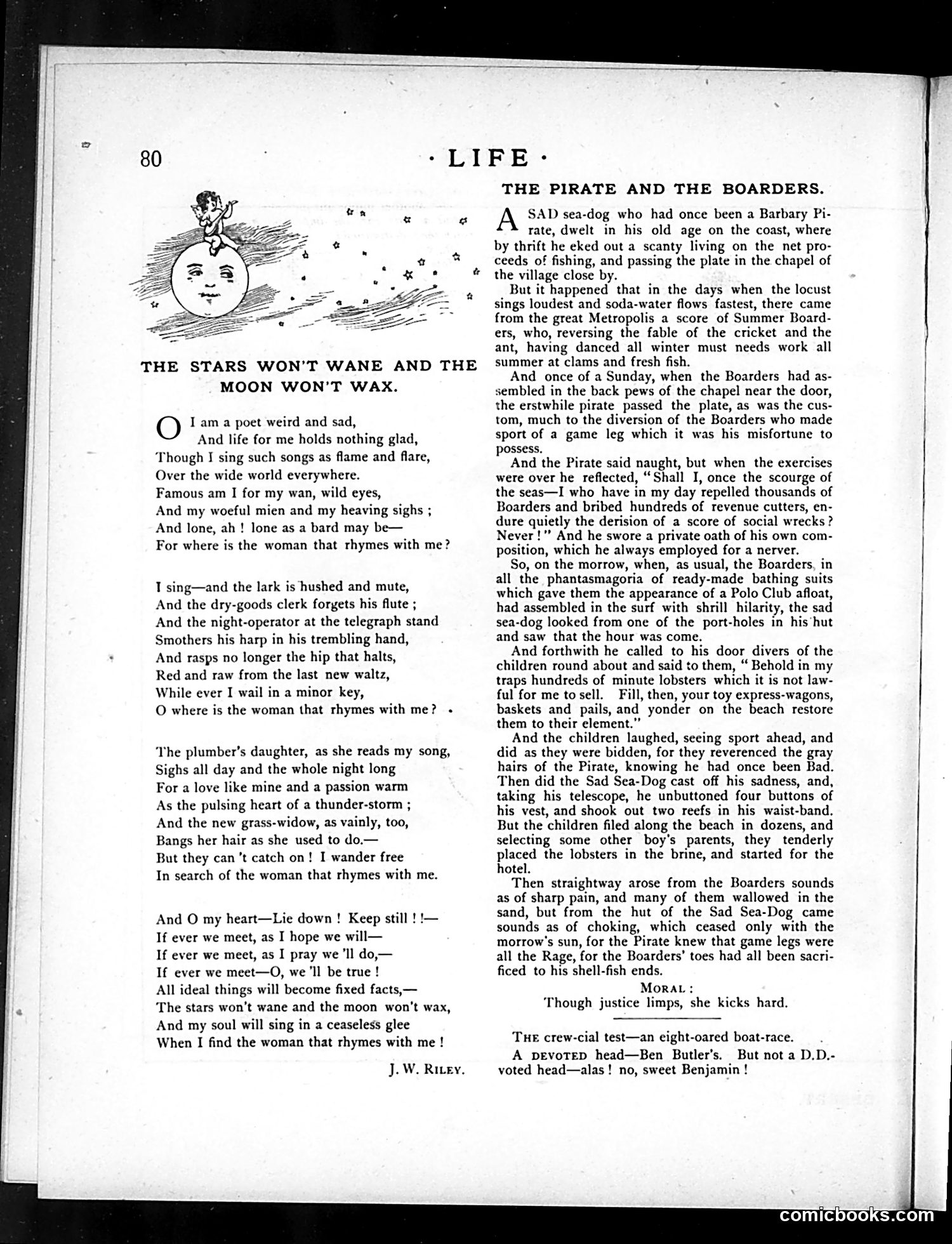
This page contains two distinct pieces from *Life* magazine's satirical content: **"The Stars Won't Wane and the Moon Won't Wax"** (poem by J.W. Riley): A romantic parody mocking the melodramatic, self-pitying "tortured poet" archetype. The speaker is a melancholic bard searching desperately for a woman who "rhymes" with him—playing on how overwrought Romantic-era poetry treated love as cosmic destiny. The joke targets both sentimental poetry and the absurdity of expecting one perfect soulmate. **"The Pirate and the Boarders"** (story): A humorous tale of class revenge. A reformed pirate living humbly on the coast is mocked by wealthy summer tourists (city people vacationing by the shore) during church. Rather than fight, he cunningly releases tiny lobsters onto the beach where the boarders swim, forcing them to abandon their bathing—a gentlemanly revenge. The satire critiques both the arrogant tourists and celebrates the clever dignity of the working-class protagonist. Both pieces use humor to deflate pretension—whether romantic affectation or urban snobbery.
📄 Transcribed text from this page (OCR, searchable)
Machine-transcribed from the original scan — historical spelling and the odd misread are preserved.
THE STARS WON'T WANE AND THE MOON WON'T WAX. O I am a poet weird and sad, And life for me holds nothing glad, Though I sing such songs as flame and flare, Over the wide world everywhere. Famous am I for my wan, wild eyes, And my woeful mien and my heaving sighs ; And lone, ah ! lone as a bard may be— For where is the woman that rhymes with me? T sing—and the lark is hushed and mute, And the dry-goods clerk forgets his flute ; And the night-operator at the telegraph stand Smothers his harp in his trembling hand, And rasps no longer the hip that halts, Red and raw from the last new waltz, While ever I wail in a minor key, O where is the woman that rhymes with me? - The plumber’s daughter, as she reads my song, Sighs all day and the whole night long For a love like mine and a passion warm As the pulsing heart of a thunder-storm ; And the new grass-widow, as vainly, too, Bangs her hair as she used to do.— But they can’t catch on! I wander free In search of the woman that rhymes with me. And O my heart—Lie down ! Keep still ! !— If ever we meet, as I hope we will— If ever we meet, as I pray we ‘ll do,— If ever we meet—O, we'll be true ! All ideal things will become fixed facts,— ‘The stars won’t wane and the moon won't wax, And my soul will sing in a ceaseless glee When I find the woman that rhymes with me ! J. W. Ritey. - LIFE: THE PIRATE AND THE BOARDERS. A SAD sea-dog who had once been a Barbary Pi- rate, dwelt in his old age on the coast, where by thrift he eked out a scanty living on the net pro- ceeds of fishing, and passing the plate in the chapel of the village close by. But it happened that in the days when the locust sings loudest and soda-water flows fastest, there came from the great Metropolis a score of Summer Board- ers, who, reversing the fable of the cricket and the ant, having danced all winter must needs work all summer at clams and fresh fish. And once of a Sunday, when the Boarders had as- sembled in the back pews of the chapel near the door, the erstwhile pirate passed the plate, as was the cus- tom, much to the diversion of the Boarders who made sport of a game leg which it was his misfortune to possess. And the Pirate said naught, but when the exercises were over he reflected, “Shall I, once the scourge of the seas—I who have in my day repelled thousands of Boarders and bribed hundreds of revenue cutters, en- dure quietly the derision of a score of social wrecks ? Never!" And he swore a private oath of his own com- position, which he always employed for a nerver. So, on the morrow, when, as usual, the Boarders, in all the phantasmagoria of ready-made bathing suits which gave them the appearance of a Polo Club afloat, had assembled in the surf with shrill hilarity, the sad sea-dog looked from one of the port-holes in his hut and saw that the hour was come. And forthwith he called to his door divers of the children round about and said to them, “ Behold in my traps hundreds of minute lobsters which it is not law- ful for me to sell. Fill, then, your toy express-wagons, baskets and pails, and yonder on the beach restore them to their element.” And the children laughed, seeing sport ahead, and did as they were bidden, for they reverenced the gray hairs of the Pirate, knowing he had once been Bad. Then did the Sad Sea-Dog cast off his sadness, and, taking his telescope, he unbuttoned four buttons of his vest, and shook out two reefs in his waist-band. But the children filed along the beach in dozens, and selecting some other boy's parents, they tenderly placed the lobsters in the brine, and started for the hotel. Then straightway arose from the Boarders sounds as of sharp pain, and many of them wallowed in the sand, but from the hut of the Sad Sea-Dog came sounds as of choking, which ceased only with the morrow’s sun, for the Pirate knew that game legs were all the Rage, for the Boarders’ toes had all been sacri- ficed to his shell-fish ends. Mora: Though justice limps, she kicks hard. THe crew-cial test—an eight-oared boat-race. A pevoTeD head—Ben Butler's. But not a D.D.- voted head—alas! no, sweet Benjamin !