
A complete issue · 16 pages · 1883
Life — May 31, 1883
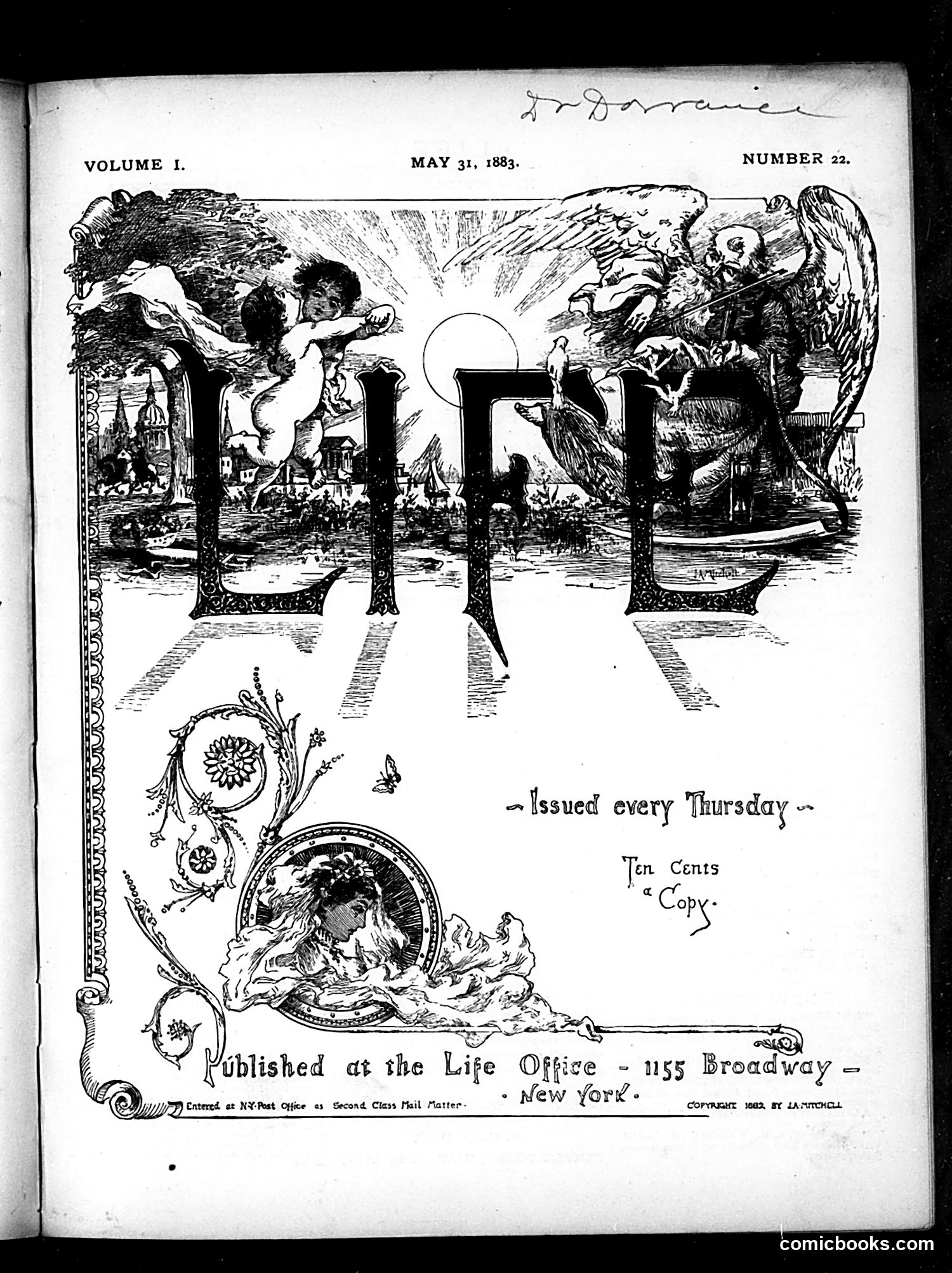
This is the cover/title page for Life magazine's first volume, number 22. The large decorative letters "LIFE" dominate the center, framed by elaborate Victorian-era illustrations featuring cherubs, classical figures, and allegorical imagery—typical of 1880s aesthetic design. The specific satirical content of this particular issue is unclear from this page alone, as it primarily serves as a title/masthead. The ornamental border and classical imagery reflect the magazine's positioning as sophisticated humor for educated readers. Published at 1155 Broadway in New York, Life sold for ten cents per copy and appeared weekly on Thursdays. This appears to be an early issue from the magazine's first volume.
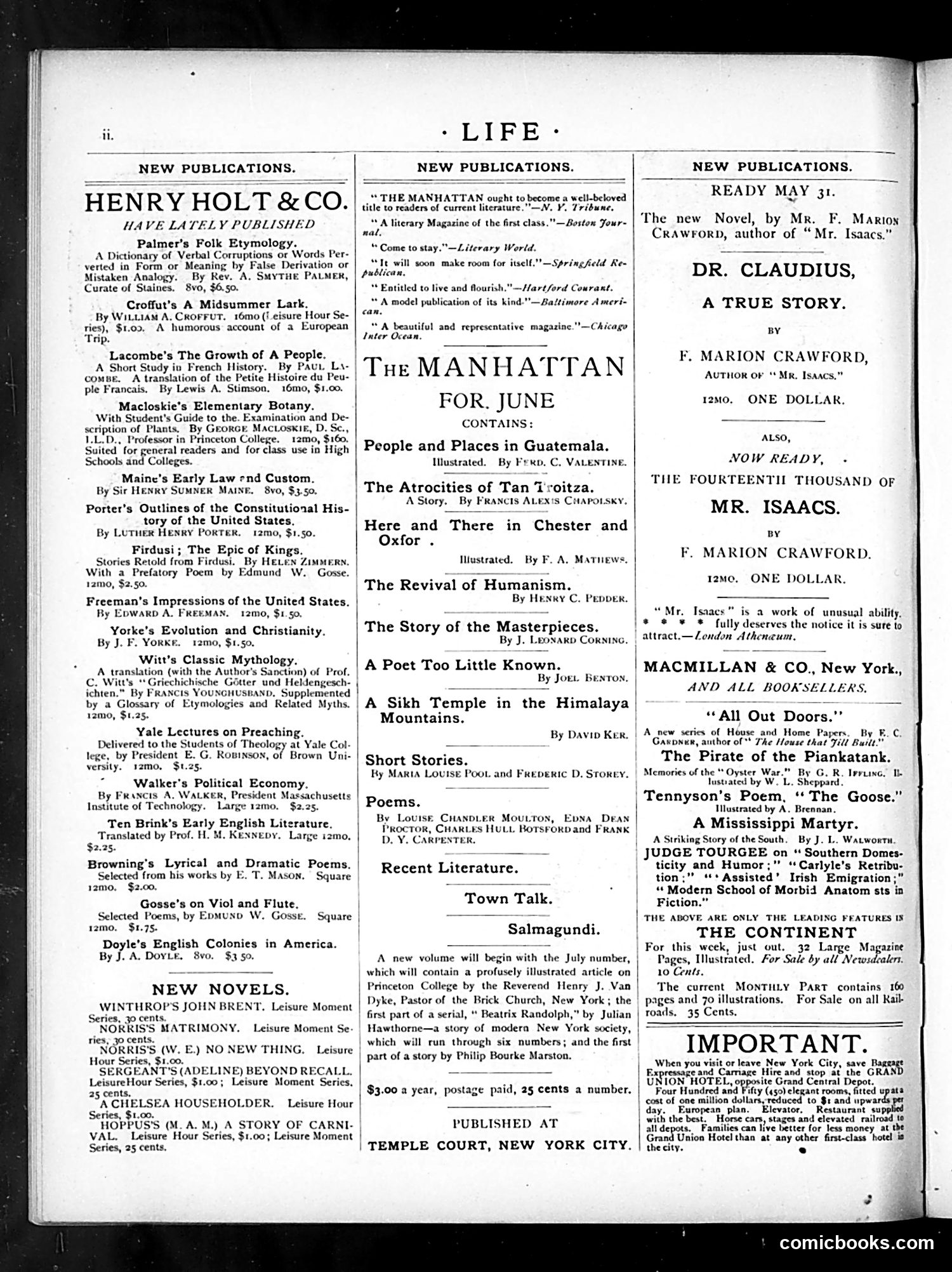
This page is primarily **book advertisements and literary announcements** rather than political cartoons or satire. The content consists of three columns listing new publications from Henry Holt & Co. and other publishers, including titles like "The Manhattan for June," "Dr. Claudius" by F. Marion Crawford, and "Mr. Isaac" by the same author. There are also announcements for various novels, poetry collections, and educational texts on topics ranging from botany to constitutional history. The only substantive editorial content is a brief mention of "The Continental" magazine's features and pricing information at the bottom. **No political cartoons or satirical illustrations are visible on this page.** It functions as a publishing industry advertisement section typical of period magazines.
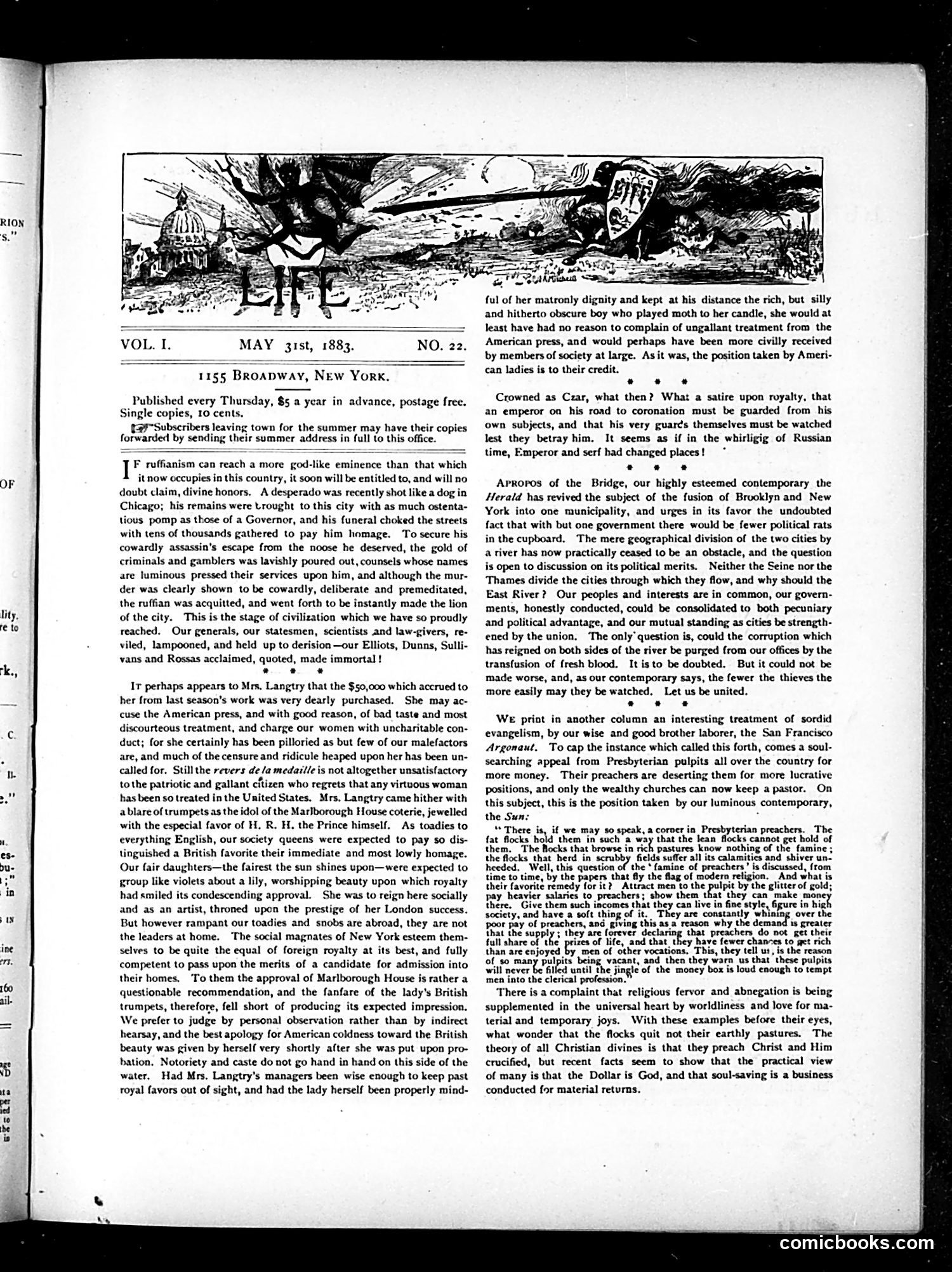
The header illustration depicts what appears to be a satirical scene with figures in 19th-century dress positioned near a large tree and architectural elements. However, the specific cartoon narrative is unclear from the image alone. The text discusses American press treatment of a wealthy but "silly" boy who played with candles—a critique of how American society and newspapers handled such trivial scandals. The page also contains editorial commentary on Russian imperial succession ("Crowned as Czar") and a discussion about consolidating Brooklyn and New York into one municipality, debating whether geographic division should determine city governance. The overall tone reflects *Life*'s satirical approach to contemporary American social pretension and institutional debates of the 1880s.
This page contains satirical prose sketches rather than cartoon illustrations. The main piece, "Direct from Moscow," mocks the Russian Tsar's coronation (scheduled for May 27, 1883). The satire portrays two men in a Moscow hotel discussing the ceremony. One complains that despite the grand coronation, nothing has changed—the Tsar still cannot prevent basic problems like the sun being "over the yard-arm" (slang for drinking time). The joke suggests that coronations are ceremonial theater masking the Tsar's actual powerlessness. The piece appears to critique Russian autocracy as impotent spectacle. A secondary article, "Dr. Autocrat," uses similar wordplay, treating autocracy itself as a failed "doctor" unable to cure social problems. The humor relies on 1880s readers' awareness of Russian imperial limitations and political instability.
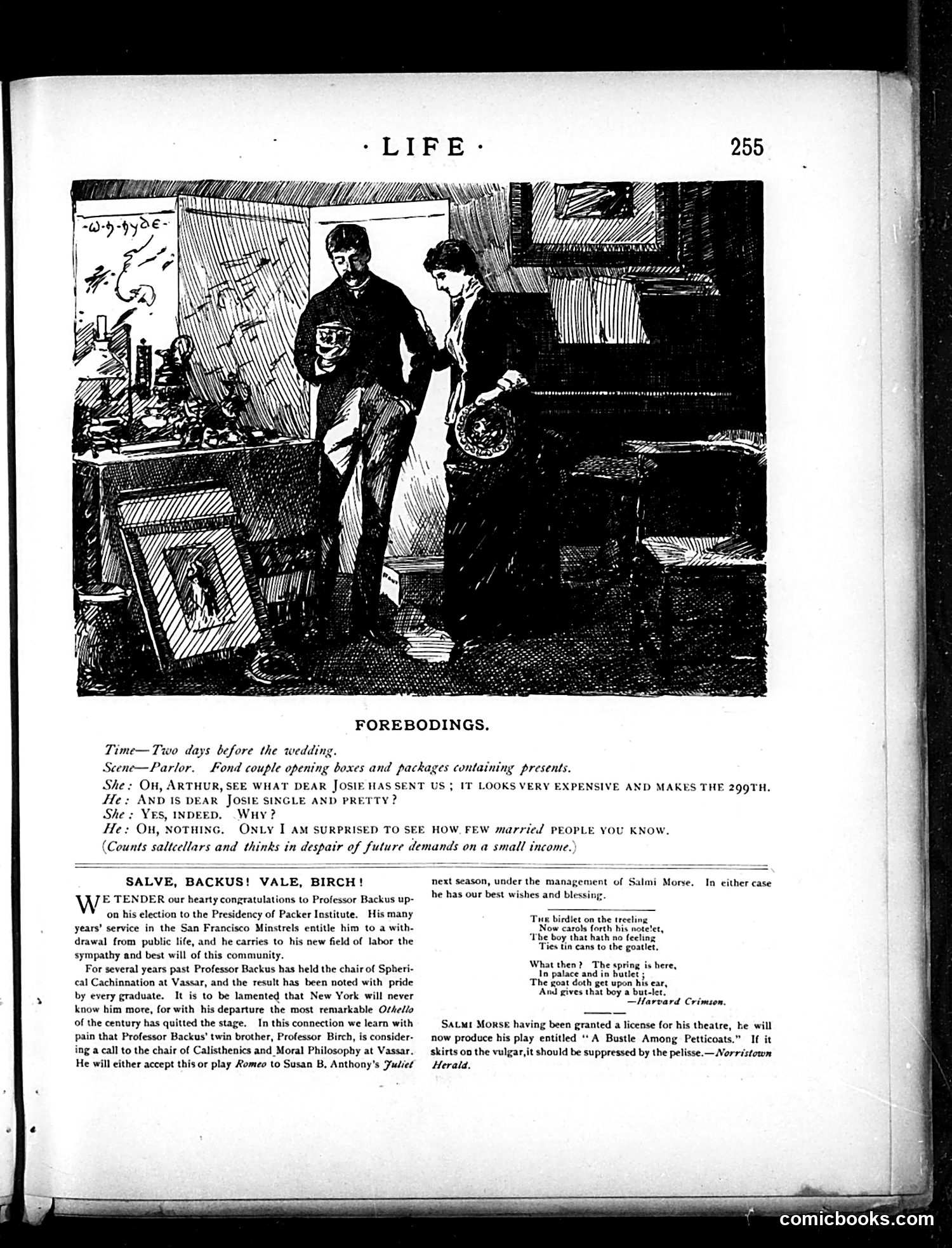
This page from *Life* magazine depicts a comedic domestic scene titled "Forebodings," set two days before a wedding. A couple examines expensive wedding gifts, with the woman remarking that the quantity of presents surprises her—noting they only know 299 married people, implying most gifts come from relatives rather than friends. The humor targets Victorian-era wedding customs and anxieties about modest incomes. The man's worried expression ("Counts salesclerk and thinks in despair of future demands on a small income") satirizes the financial burden expensive gift-giving and wedding obligations placed on middle-class couples. The lower section congratulates Professor Backus's appointment and mentions theatrical news about Salmi Morse—content typical of *Life's* mix of social commentary and entertainment updates.
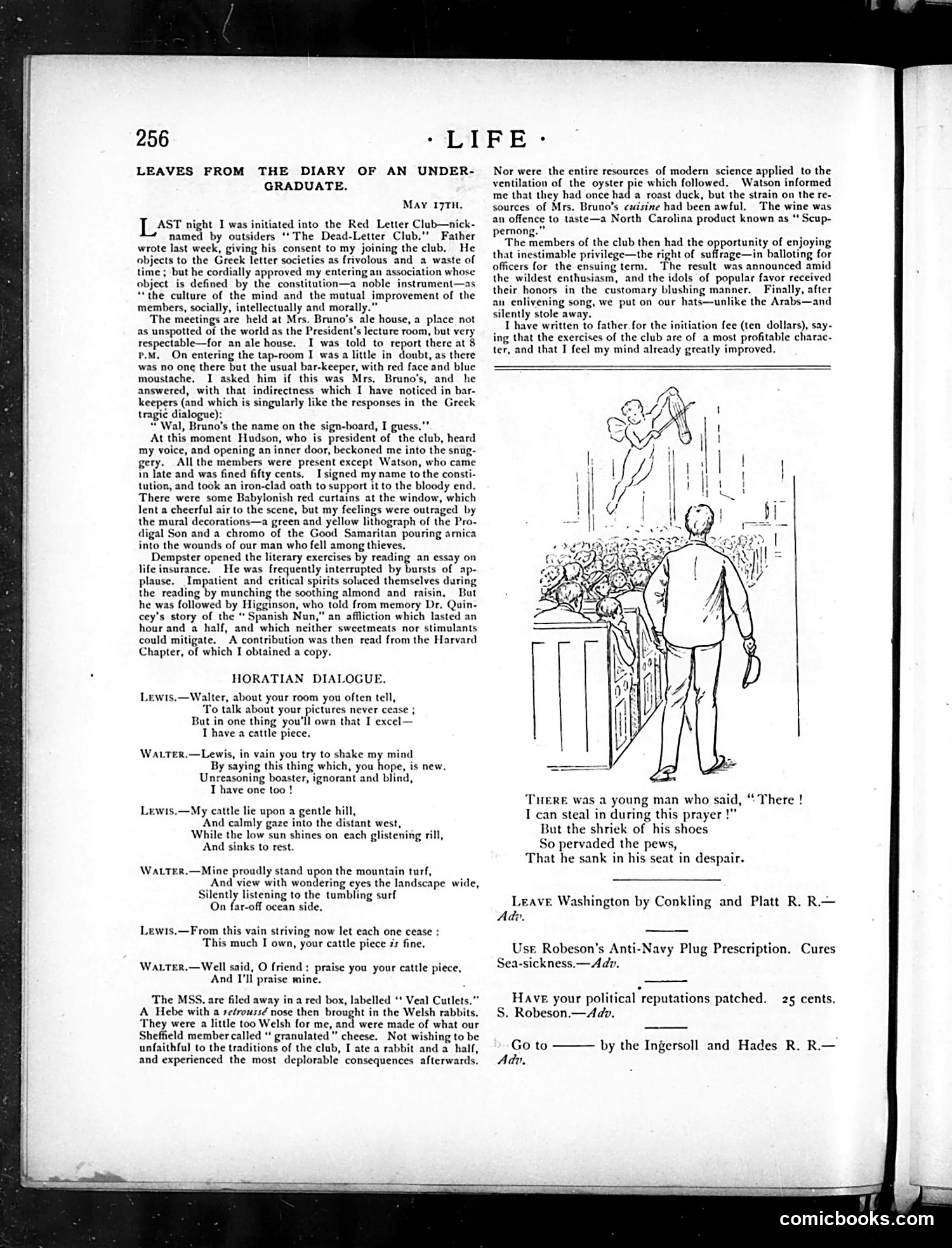
The page primarily contains literary content—"Leaves from the Diary of an Undergraduate" and a "Horatian Dialogue" between characters Lewis and Walter discussing art and cattle. The cartoon illustration shows a young man stealing shoes during prayer, depicting the humorous poem below it: "There was a young man who said, 'There! I can steal in during this prayer!'" The joke satirizes irreverent behavior in religious settings—specifically someone committing petty theft while others pray. The remainder of the page consists of advertisements for books and remedies, including S. Robeson's political reputation patching service (25 cents) and Robeson's Anti-Navy Plug Prescription for seasickness. The content is primarily satirical humor rather than political commentary.
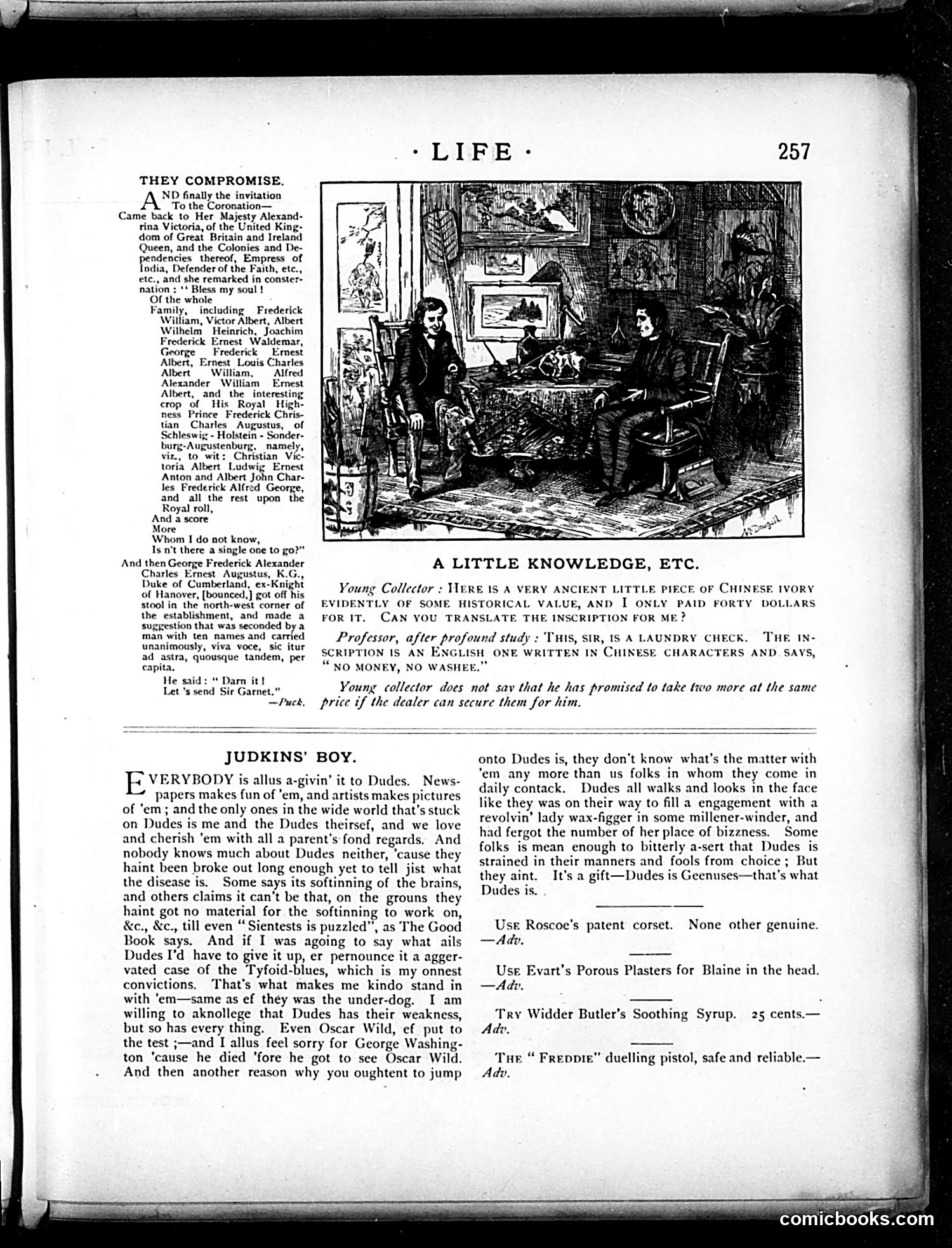
The main illustration depicts three men in what appears to be a Victorian-era parlor examining a Chinese artifact. The accompanying text "A Little Knowledge, Etc." presents a humorous dialogue between a "Young Collector" and a "Professor" about an ancient piece of Chinese ivory with an English inscription in Chinese characters. The satire mocks pretentious collectors and experts: the "Professor" confidently identifies the item as historically valuable, but the joke reveals the inscription is merely English laundry instructions written in Chinese characters—a practical joke rather than genuine antiquity. Below, "Judkins' Boy" discusses character flaws in young men named Dudes, suggesting social commentary on idle, affected wealthy youth of the period. The page also contains period advertisements for various patent medicines and products.
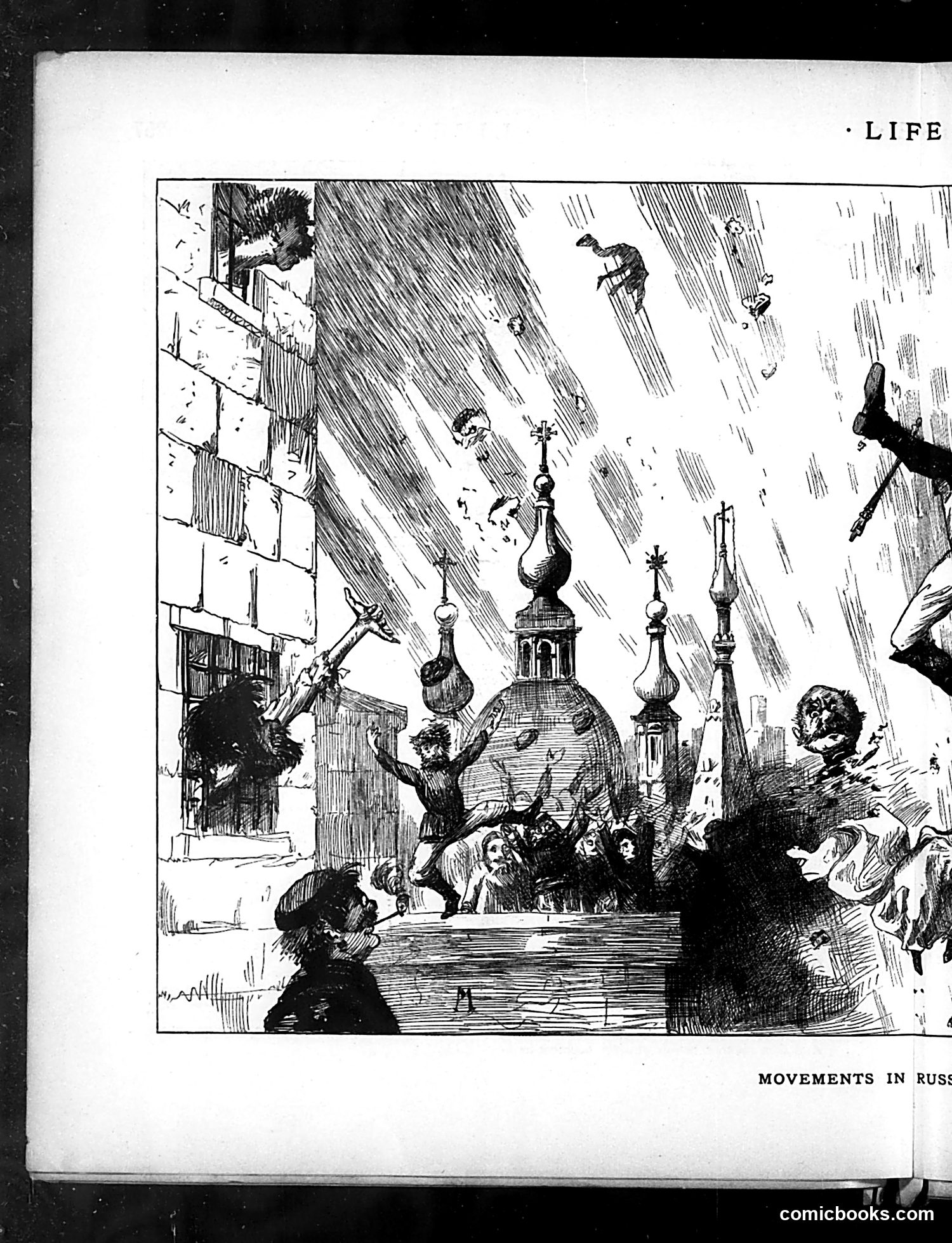
This political cartoon depicts chaos and upheaval in Russia, showing figures in turbulent action around Orthodox churches (identifiable by their distinctive onion domes). People appear to be rioting or revolting—some climbing buildings, others gesturing wildly, with heavy diagonal shading suggesting violence or turmoil. The caption "MOVEMENTS IN RUSSIA" likely references early 20th-century Russian revolutionary activity or civil unrest. The prominent religious architecture suggests satire about the relationship between the church and political upheaval during this period. Without a precise date visible, this appears to reflect American satirical commentary on Russian instability, possibly during the 1917 Russian Revolution or surrounding revolutionary period, when American publications frequently depicted Russian events with dramatic imagery emphasizing chaos and social disorder.
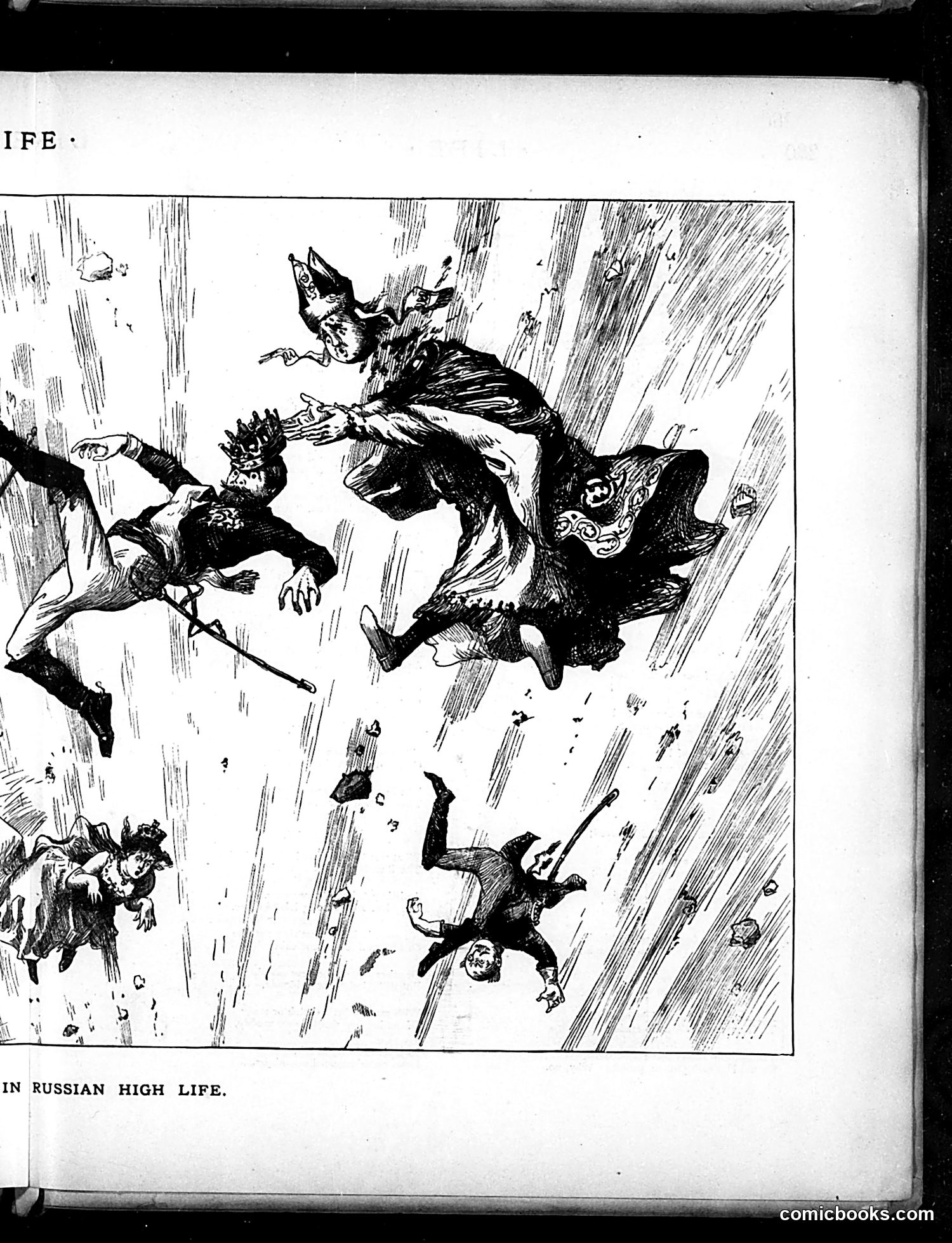
This satirical cartoon depicts aristocratic Russian figures in an exaggerated, chaotic scene suggesting violent upheaval or instability. The title "In Russian High Life" implies commentary on the Russian elite and their precarious social position. The figures appear to be nobility or aristocrats—identifiable by their elaborate clothing and decorative elements—shown tumbling or falling through diagonal lines suggesting rapid descent or chaos. The composition conveys instability and loss of control among the upper classes. Without a specific date visible, this likely references Russian political turmoil of the late 19th or early 20th century, possibly the revolutionary period when traditional aristocratic power was threatened. The satire mocks the vulnerability of the Russian ruling class during this period of social upheaval.
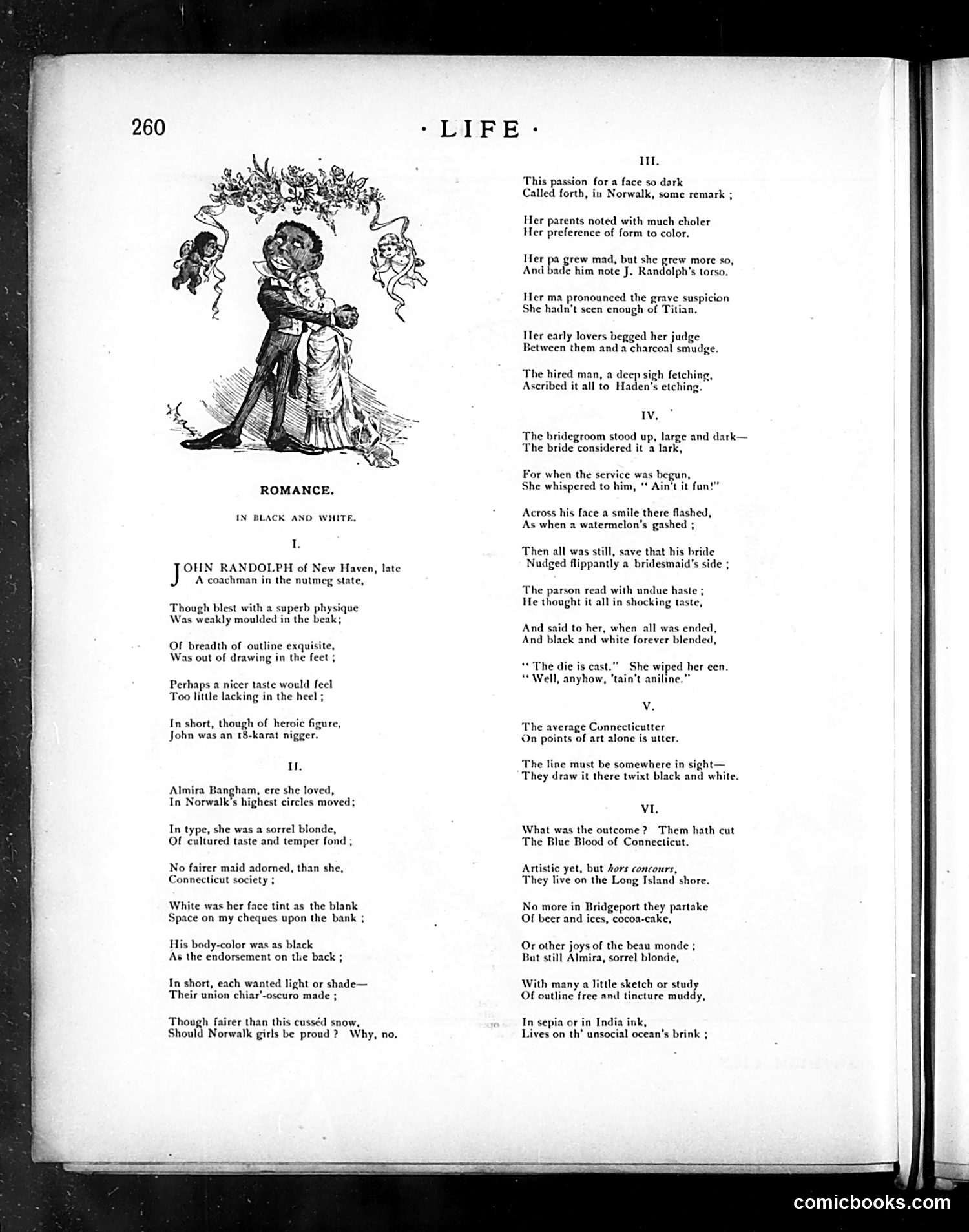
This satirical poem mocks Connecticut society's horror at an interracial romance between John Randolph, a Black former coachman, and Almira Bangham, a white woman from an elite family. The satire operates on multiple levels: it uses art terminology (chiaroscuro, Titian, Haden's etching) to intellectualize the couple's "contrast," while depicting the community's visceral racism. The poem lampoons the shallow aestheticism Norwalk society uses to justify prejudice—treating race as merely a compositional element rather than confronting their actual bigotry. The outcome reveals the satire's target: despite the couple's marriage, they're exiled to Long Island, socially ostracized. The final image of Almira creating sketches in "sepia" and "India ink" suggests she's literally reduced to rendering shades of brown—a bitter irony on how the society that objectified her as an artistic curiosity has destroyed her life. The piece attacks both interracial prejudice *and* upper-class pretension that masks racism with cultural rhetoric.
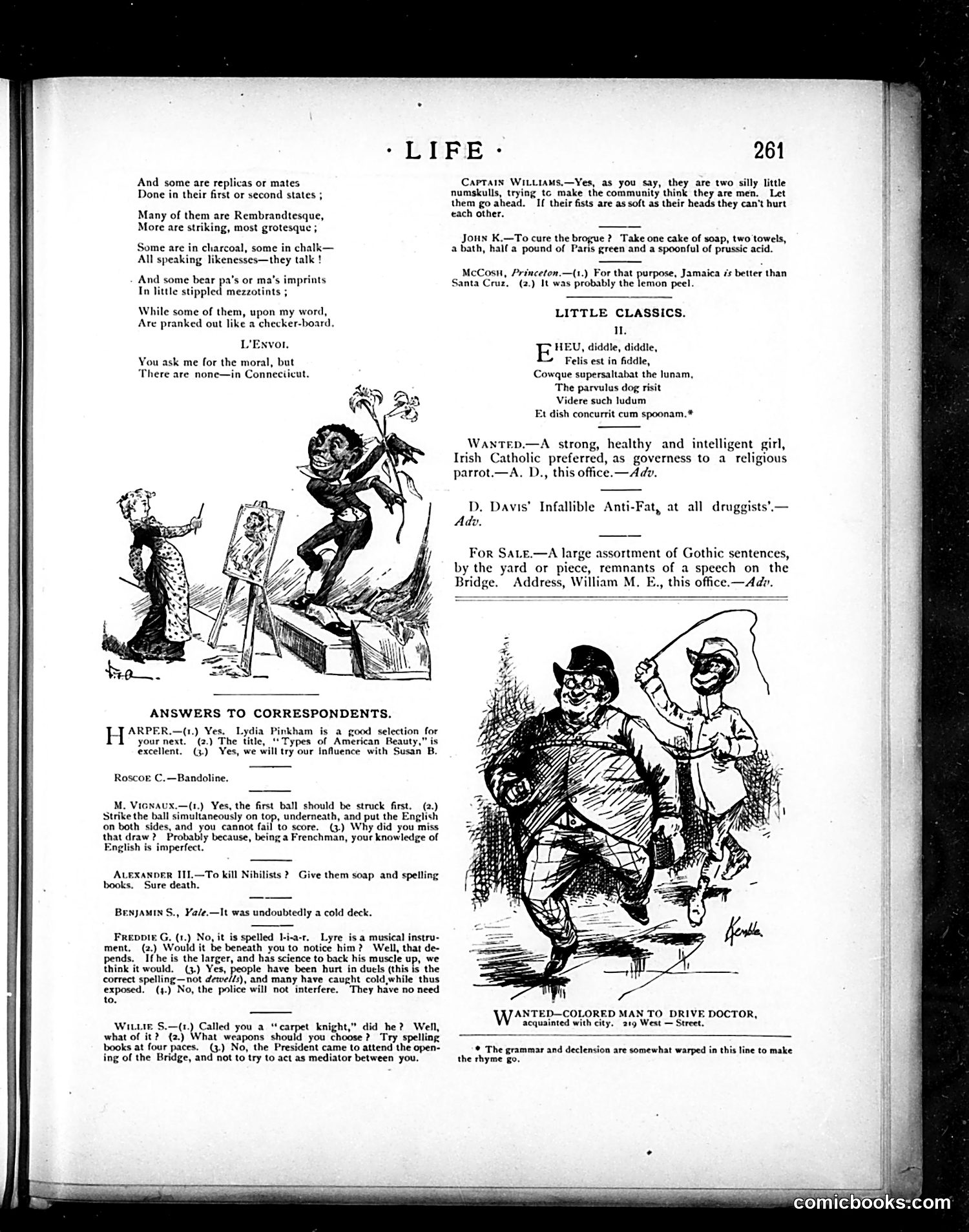
This page from Life magazine combines reader correspondence with satirical advertisements and mock-classical poetry. The "Answers to Correspondents" section uses absurdist humor to mock reader questions—offering deliberately unhelpful or darkly comic advice (e.g., suggesting prussic acid to cure an Irish brogue, recommending "soap and spelling books" to kill Nihilists). The cartoon illustrations appear to depict caricatured figures in exaggerated poses, likely mocking contemporary social types or behaviors, though specific identities aren't clearly labeled. "Little Classics II" parodies children's nursery rhymes in pseudo-Latin, humorously mangling the original "Hey Diddle Diddle" with macaronic language and a footnote acknowledging intentional grammatical errors "to make the rhyme go." The fake advertisements mock various contemporary products and social concerns—including anti-fat remedies and job postings seeking domestic workers. The overall tone is satirical commentary on American society, advertising, and intellectual pretension, typical of Life's irreverent humor in this era.
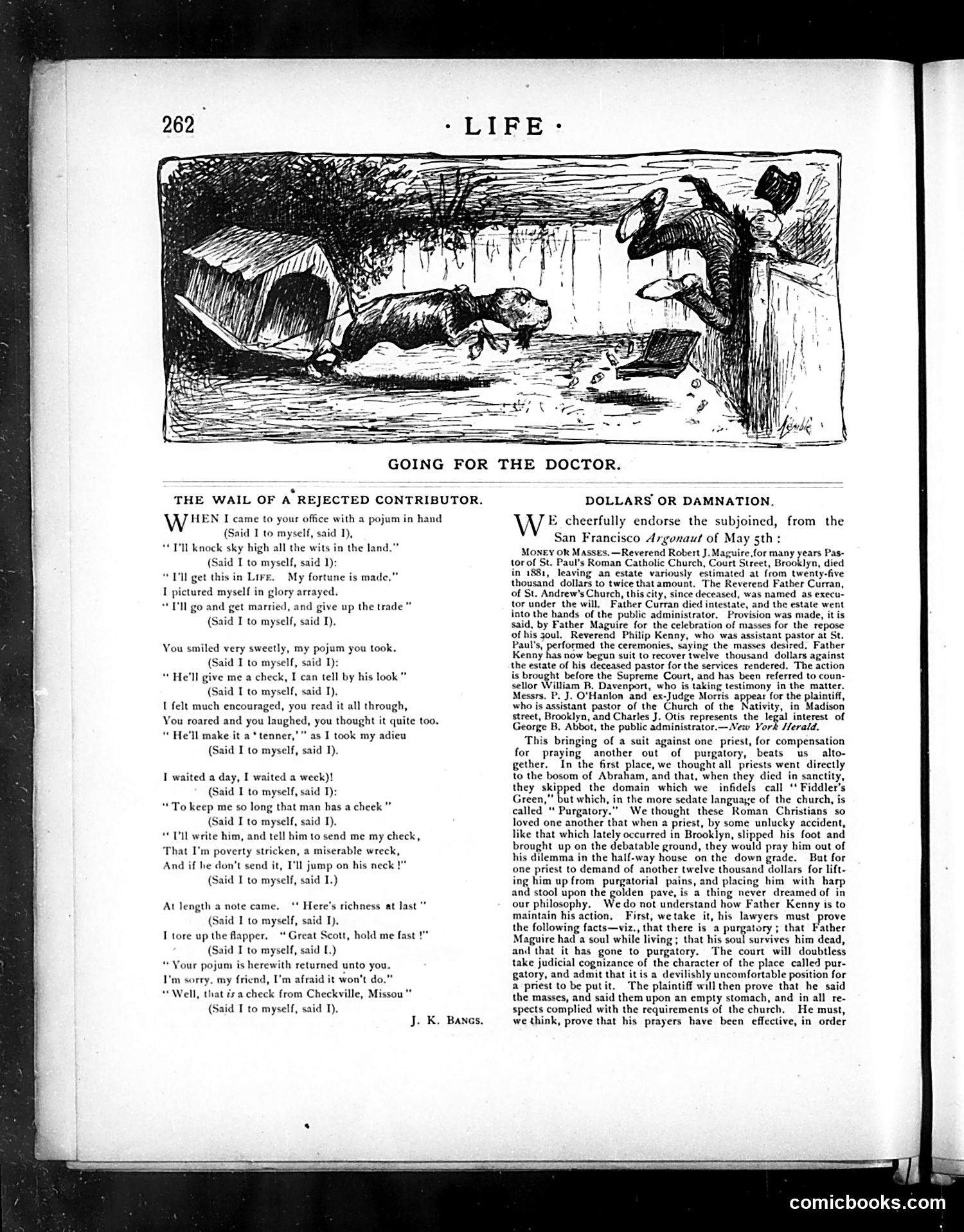
## "Going for the Doctor" (Top Cartoon) The sketch depicts a man chasing a dog with a cane or stick while another figure (likely a doctor, given the title) observes. This is a humorous visual gag—the man appears to be pursuing the dog to "go for the doctor" literally, rather than sending someone to fetch medical help. It's visual wordplay on the idiom. ## "The Wail of a Rejected Contributor" (Left Column) A satirical poem by J.K. Bangs mocking the experience of submitting work to *Life* magazine. A hopeful writer brings his "pojum" (poem), expecting quick acceptance, payment, and success. Instead, the editor smiles sweetly, reads it, but ultimately rejects it with a form letter. The repeated refrain "Said I to myself, said I" emphasizes the contributor's deflating internal dialogue as hopes crumble. ## "Dollars or Damnation" (Right Column) This satirizes a lawsuit where a Catholic priest sued for $12,000, claiming he performed masses for another deceased priest's soul. *Life* ridicules the absurdity: priests supposedly go directly to heaven, so why charge for purgatory services? The piece attacks the commercialization of Catholic spiritual practices.
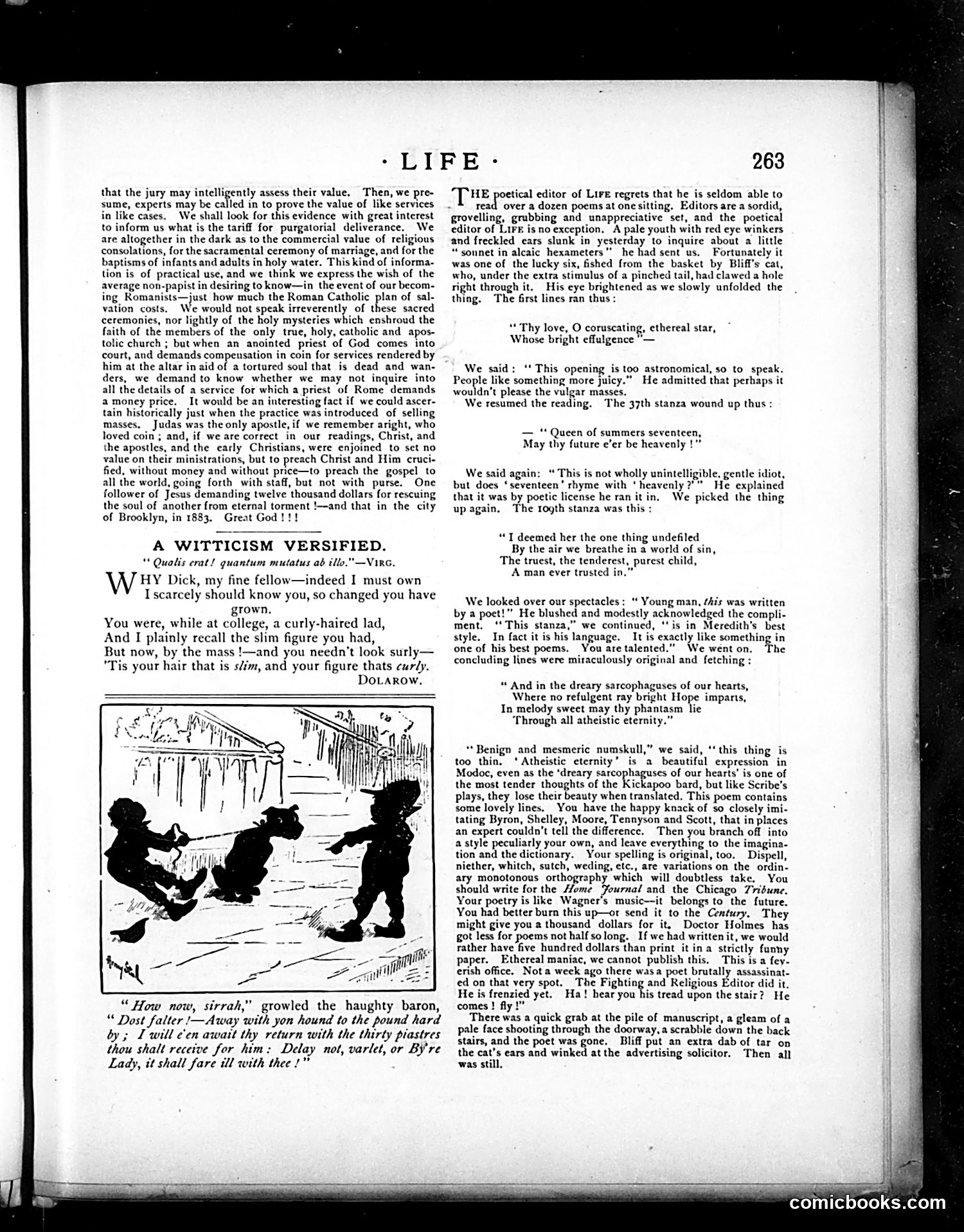
The page contains two main pieces of satire: **1. The Religious Services Pricing Critique:** The lengthy editorial attacks Catholic priests charging money for masses and sacraments in Brooklyn (1883). Life sardonically questions the "commercial value" of religious consolations—demanding to know the exact tariff for salvation services. The piece argues this contradicts Christ's teachings that apostles should preach "without money and without price," making the practice of selling masses fundamentally hypocritical. **2. The Poetry Submission Cartoon/Story:** The illustrated vignette shows a young poet's rejection. Life mocks amateur poets submitting overly ornate, obscure work ("alcaic hexameters," astronomical imagery). The editor's cat accidentally tears the manuscript—a visual joke suggesting even accidental destruction improves bad poetry. The piece ridicules both pretentious poets and Life's own editors' impatience with submissions. Both segments exemplify Life's satirical mission: attacking hypocrisy (religious and literary) through sharp wit and illustrated humor.
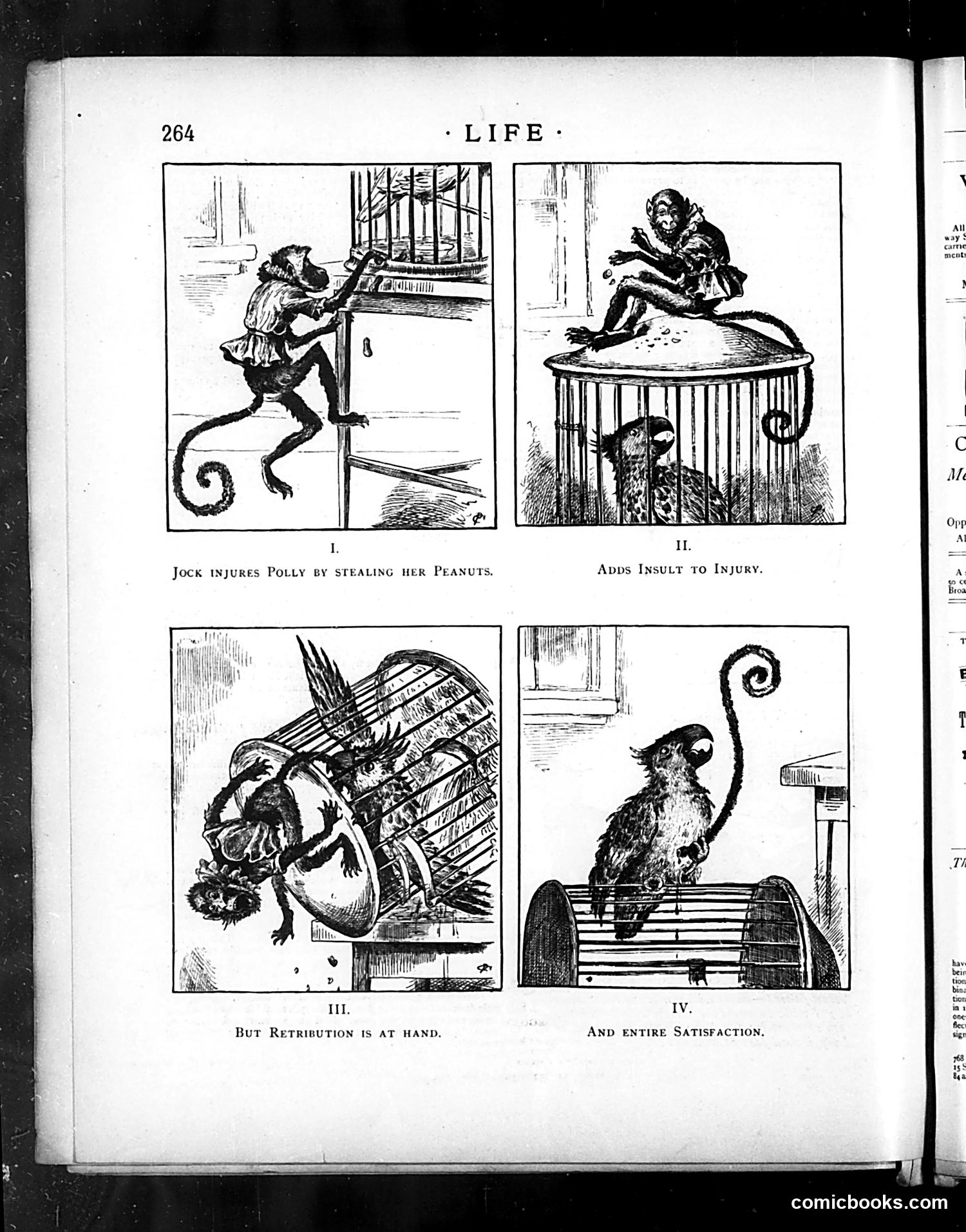
This is a four-panel satirical comic strip depicting monkeys mistreating each other, told as a narrative sequence: **Panel I:** A monkey steals peanuts from "Polly" (likely a parrot), injuring her. **Panel II:** Another monkey adds insult by mocking the injured bird in a cage. **Panel III:** The first monkey faces consequences—"retribution is at hand"—depicted being trapped or crushed. **Panel IV:** The second monkey achieves "entire satisfaction," sitting contentedly. The strip appears to be social satire using animal characters to illustrate a moral lesson about wrongdoing and comeuppance. Without additional context about *Life* magazine's specific concerns at publication, the exact human figures or situations being lampooned remain unclear. The anthropomorphized animals likely represent recognizable contemporary figures or social groups.
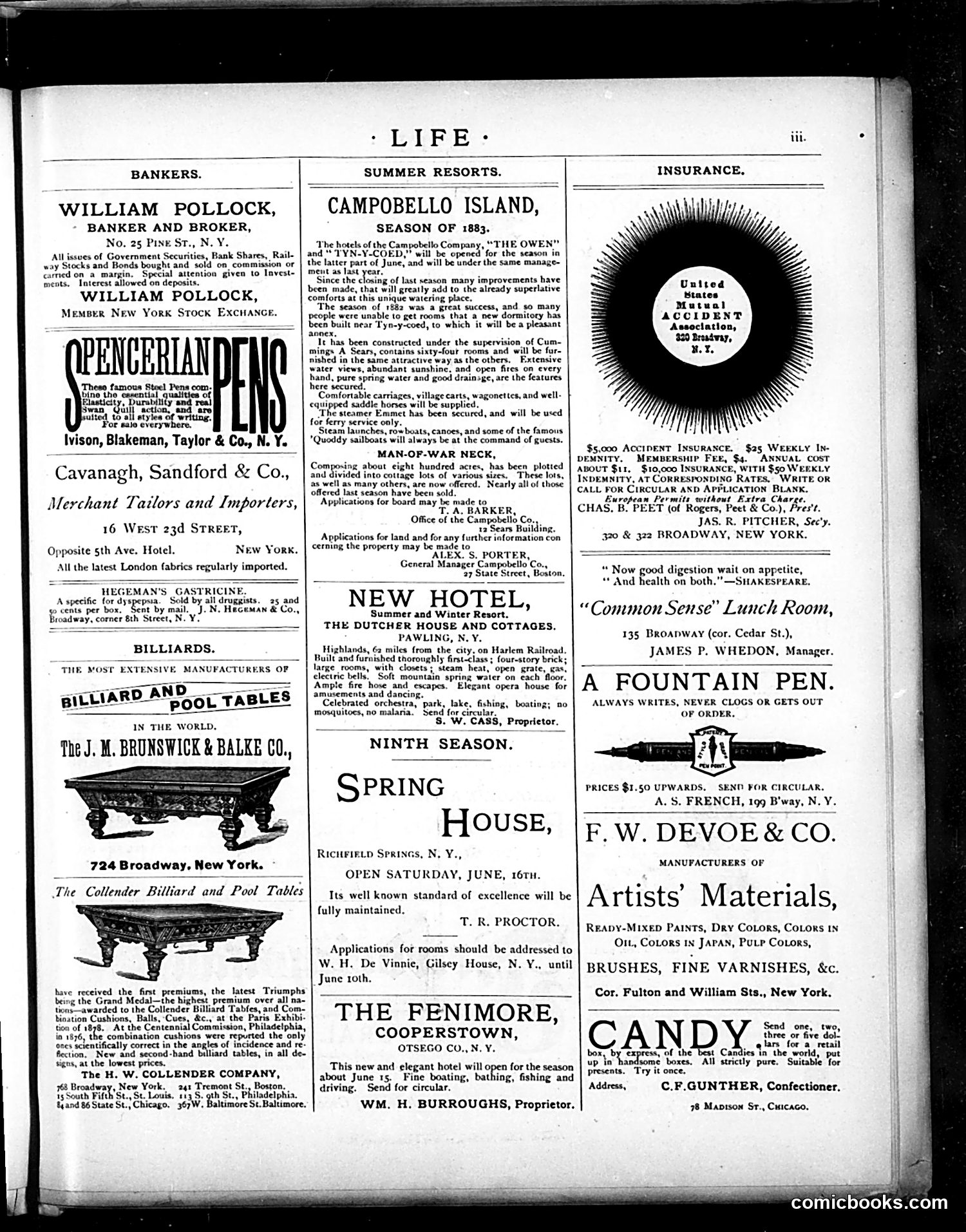
This is page iii of *Life* magazine, consisting almost entirely of advertisements—not editorial content or cartoons. There are no political cartoons or satirical illustrations with meaningful commentary visible. The ads promote: banking services (William Pollock), merchant tailoring (Cavanagh, Sandford & Co.), summer resort hotels (Campobello Island, Spring House, The Fenimore, New Hotel), billiard tables, fountain pens, artists' materials, candy, and patent medicines (Hegeman's Gastricine for dyspepsia). The only visual elements are product illustrations: a fountain pen, billiard tables, and a circular logo for the United States Accident Association (insurance). **Conclusion:** This is a commercial page with no satirical content to analyze. It reflects late 19th-century American consumer culture and leisure industry advertising.
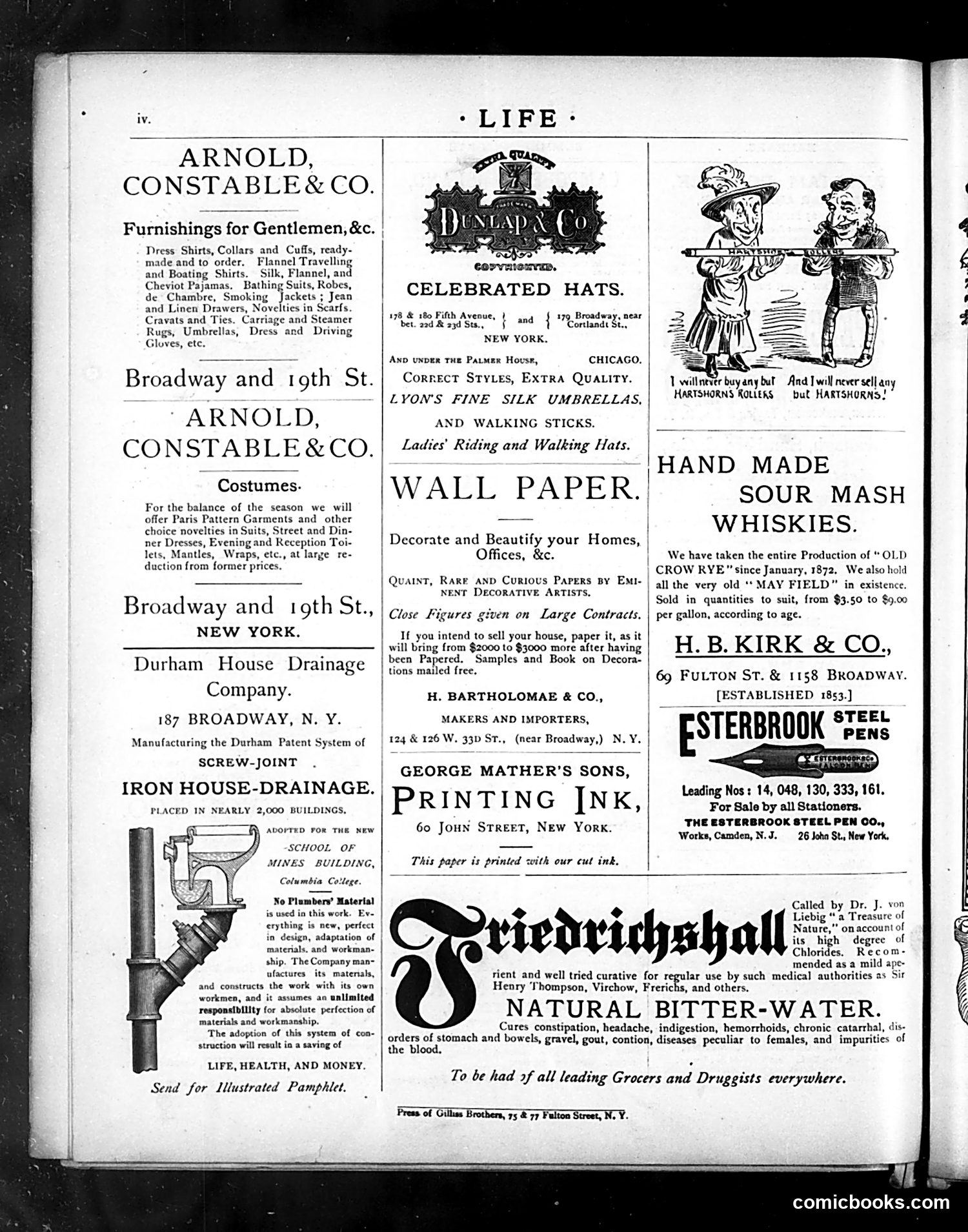
This page is predominantly **advertisements** with one small satirical cartoon in the upper right. ## The Cartoon The cartoon depicts two figures arguing over **Hartshorn's Rollers**—a printing supply product. One figure declares "I will never buy any but Hartshorn's Rollers" while the other counters "And I will never sell any but Hartshorn's!" **The satire:** This is a humorous endorsement joke, likely mocking exaggerated product loyalty and competitive boasting. Both parties claim absolute allegiance to this mundane printing roller brand, treating it with the fervor typically reserved for important matters. The joke satirizes commercial culture and the absurdity of marketing claims through this over-the-top commitment to an unremarkable product. ## The Advertisements The page contains typical 1870s-80s consumer goods: gentleman's furnishings, wall paper, printing ink, whiskey, pens, drainage systems, and patent medicines (including "Friedrichshall Natural Bitter-Water" claiming to cure numerous ailments—typical of the era's dubious medicinal marketing).