
Life, 1883-05-31 · page 3 of 16
Life — May 31, 1883 — page 3: what you’re looking at
What you’re looking at
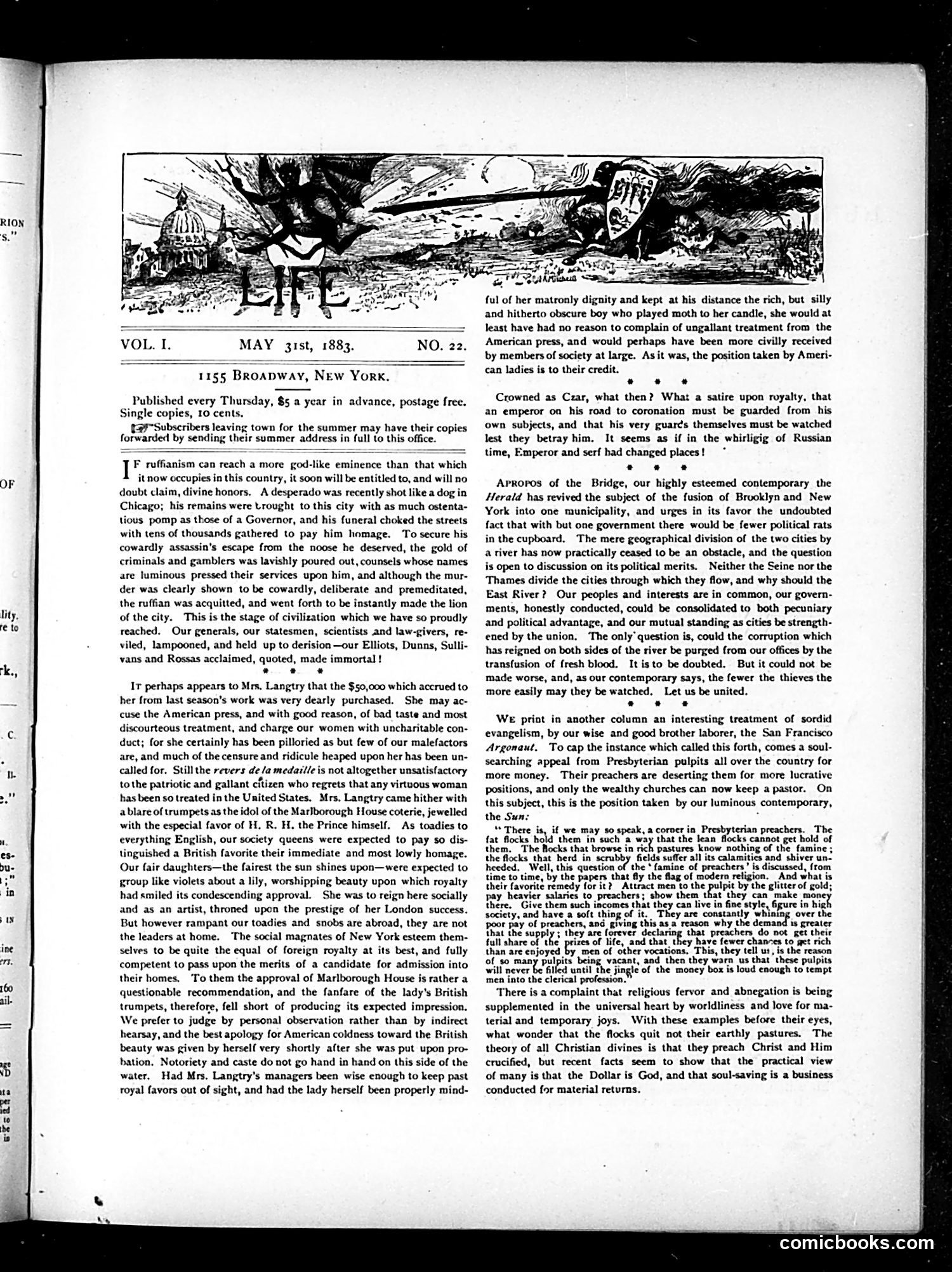
The header illustration depicts what appears to be a satirical scene with figures in 19th-century dress positioned near a large tree and architectural elements. However, the specific cartoon narrative is unclear from the image alone. The text discusses American press treatment of a wealthy but "silly" boy who played with candles—a critique of how American society and newspapers handled such trivial scandals. The page also contains editorial commentary on Russian imperial succession ("Crowned as Czar") and a discussion about consolidating Brooklyn and New York into one municipality, debating whether geographic division should determine city governance. The overall tone reflects *Life*'s satirical approach to contemporary American social pretension and institutional debates of the 1880s.
📄 Transcribed text from this page (OCR, searchable)
Machine-transcribed from the original scan — historical spelling and the odd misread are preserved.
MAY 31st, 1883. 1155 BrRoapway, New York. Published every Thursday, $5 a ycar in advance, postage free. Single copies, 10 cents, [aF-Subscribers leaving town for the summer may have their copies forwarded by sending their summer address in full to this office. F ruffianism can reach a more god-like eminence than that which it now occupies in this country, it soon will be entitled to, and will no doubt claim, divine honors, A desperado was recently shot like a dog in Chicago; his remains were Lrovught to this city with as much ostenta- tious pomp as those of a Governor, and his funeral choked the streets with tens of thousands gathered to pay him homage. To secure his cowardly assassin’s escape from the noose he deserved, the gold of criminals and gamblers was lavishly poured out, counsels whose names are luminous pressed their services upon him, and although the mur- der was clearly shown to be cowardly, deliberate and premeditated, the ruffian was acquitted, and went forth to be instantly made the lion of the city. This is the stage of civilization which we have so proudly reached. Our generals, our statesmen, scientists and law-givers, viled, lampooned, and held up to derision —our Elliots, Dunns, Sul vans and Rossas acclaimed, quoted, made immortal ! * 8 «@ Ir perhaps appears to Mrs. Langtry that the $50,000 which accrued to her from last season's work was very dearly purchased. She may ac- cuse the American press, and with good reason, of bad taste and most discourteous treatment, and charge our women with uncharitable con- duct; for she certainly has been pilloried as but few of our malefactors are, and much of the censure and ridicule heaped upon her has been un- called for. Stillthe revers de /a medaitle is not altogether unsatisfactory tothe patriotic and gallant citizen who regrets that any virtuous woman has been so treated in the United States. Mrs. Langtry came hither with ablare of trumpets as the idol of the Marlborough House coterie, jewelled with the especial favor of H. R. H. the Prince himself. As toadies to everything English, our society queens were expected to pay so dis- tinguished a British favorite their immediate and most lowly homage. Our fair daughters—the fairest the sun shines upon—were expected to group like violets about a lily, worshipping beauty upon which royalty had smiled its condescending approval. She was to reign here socially and as an artist, throned upon the prestige of her London success. But however rampant our toadies and snobs are abroad, they are not the leaders at home. The social magnates of New York esteem them- selves to be quite the equal of foreign royalty at its best, and fully competent to pass upon the merits of a candidate for admission into their homes, To them the approval of Marlborough House is rather a questionable recommendation, and the fanfare of the lady's British trumpets, therefore, fell short of producing its expected impression. We prefer to judge by personal observation rather than by indirect hearsay, and the best apology for American coldness toward the British beauty was given by herself very shortly after she was put upon pro- bation. Notoriety and caste do not go hand in hand on this side of the water. Had Mrs. Langtry’s managers been wise enough to keep past royal favors out of sight, and had the lady herself been properly mind- ful of her matronly dignity and kept at his distance the rich, but silly and hitherto obscure boy who played moth to her candle, she would at least have had no reason to complain of ungallant treatment from the American press, and would perhaps have been more civilly received by members of society at large. As it was, the position taken by Ameri- can ladies is to their credit. * 8 « Crowned as Czar, what then? What a satire upon royalty, that an emperor on his road to coronation must be guarded from his own subjects, and that his very guares themselves must be watched lest they betray him. It seems as if in the whirligig of Russian time, Emperor and serf had changed places! eo 8 «8 Apropos of the Bridge, our highly esteemed contemporary the Herald has revived the subject of the fusion of Bruoklyn and New York into one municipality, and urges in its favor the undoubted fact that with but one government there would be fewer political rats in the cupboard. The mere geographical division of the two cities by a river has now practically ceased to be an obstacle, and the question is open to discussion on its political merits. Neither the Seine nor the ‘Thames divide the cities through which they flow, and why should the East River? Our peoples and interests are in common, our govern- ments, honestly conducted, could be consolidated to both pecuniary and political advantage, and our mutual standing as cities be strength- ened by the union. ‘The only’ question is, could the corruption which has reigned on both sides of the river be purged from our offices by the transfusion of fresh blood. It isto be doubted. But it could not be made worse, and, as our contemporary says, the fewer the thieves the more easily may they be watched. Let us be united. o 8 @ We priot in another column an interesting treatment of sordid evangelism, by our wise and good brother laborer, the San Francisco Argonaut, To cap the instance which called this forth, comes a soul- searching appeal from Presbyterian pulpits all over the country for more money. Their preachers are deserting them for more lucrative positions, and only the wealthy churches can now keep a pastor. On this subject, this is the position taken by our luminous contemporary, the Sun: 3 “There is, if we may so speak, a corner in Presbyterian preachers. The fat flocks hold them in such a way that the lean flocks cannot get hold of them. The Rocks that browse in eh pastures know nothing of the famine ; the flocks that herd in scrubby fields suffer all its calamities and shiver un- heeded, Well, this question of the ‘famine of preachers’ is discussed, {rom time to time, by the papers that fly the flag of modern religion. And what is their favorite remedy for it? Attract men to the pulpit by the glitter of gold; pay heavier salaries to preachers; show them that they can make mon there. Give them such incomes that they can live in fine style, figure in hig! society, and have a soft of it, They are constantly whining over the poor pay of preachers, and giving this as a reason why the demand is greater that the supply ; they are forever declaring that preachers do not get their full share of the izes of life, and that have fewer chances to get rich than are enjoyed by men of other vocations. This, they tell ut, is the reason of so many pulpits being vacant, and then they warn us that ‘these pulpits will never te filled until the jingle of the moncy box is loud enough to tempt men into the clerical profession. ‘There is a complaint that religious fervor and abnegation is being supplemented in the universal heart by worldliness and love for ma- terial and temporary joys. With these examples before their eyes, what wonder that the flocks quit not their earthly pastures. The theory of all Christian divines is that they preach Christ and Him crucified, but recent facts seem to show that the practical view of many is that the Dollar is God, and that soul-saving is a business conducted for material returns. comicbooks.com