
Life, 1883-05-31 · page 10 of 16
Life — May 31, 1883 — page 10: what you’re looking at
What you’re looking at
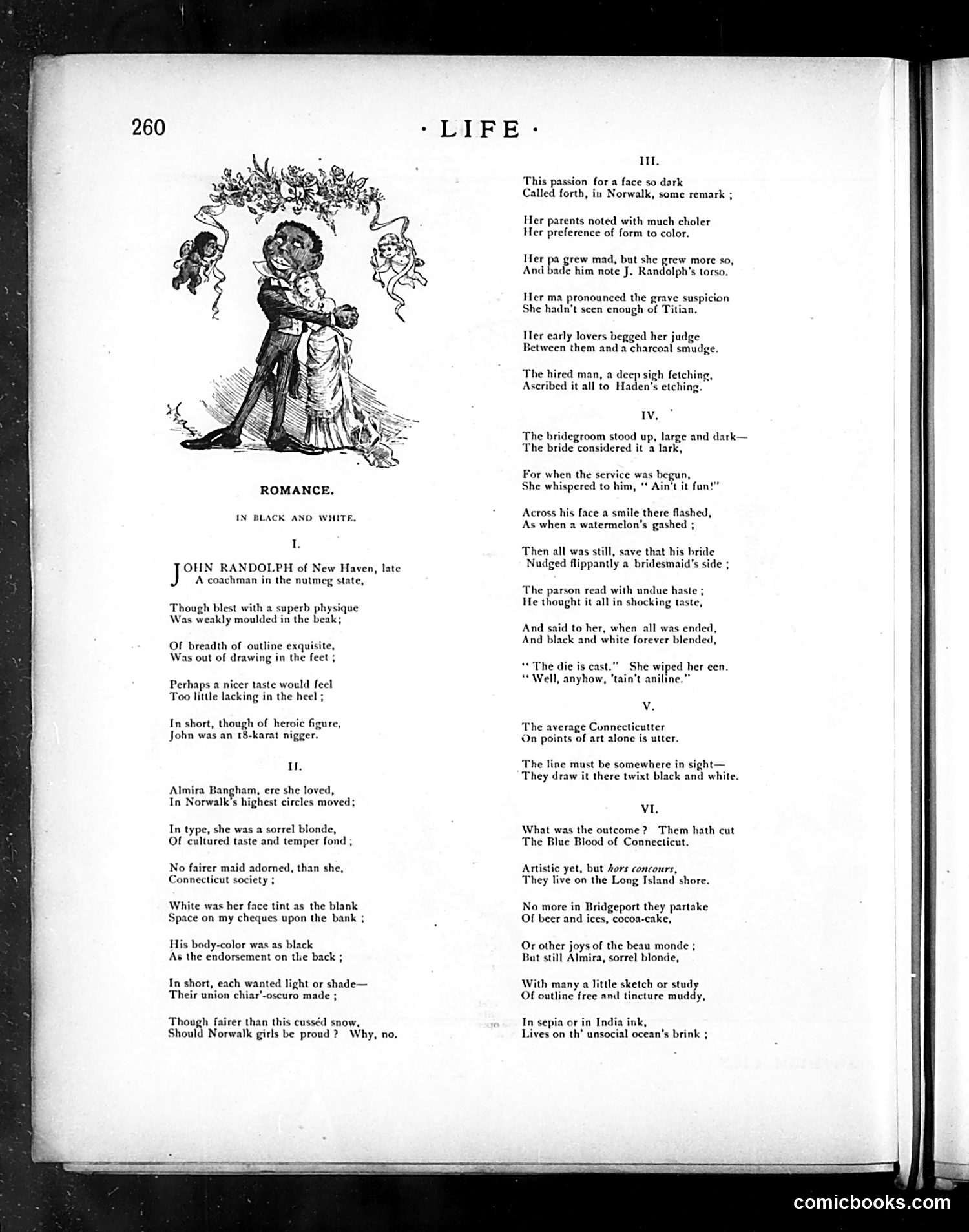
This satirical poem mocks Connecticut society's horror at an interracial romance between John Randolph, a Black former coachman, and Almira Bangham, a white woman from an elite family. The satire operates on multiple levels: it uses art terminology (chiaroscuro, Titian, Haden's etching) to intellectualize the couple's "contrast," while depicting the community's visceral racism. The poem lampoons the shallow aestheticism Norwalk society uses to justify prejudice—treating race as merely a compositional element rather than confronting their actual bigotry. The outcome reveals the satire's target: despite the couple's marriage, they're exiled to Long Island, socially ostracized. The final image of Almira creating sketches in "sepia" and "India ink" suggests she's literally reduced to rendering shades of brown—a bitter irony on how the society that objectified her as an artistic curiosity has destroyed her life. The piece attacks both interracial prejudice *and* upper-class pretension that masks racism with cultural rhetoric.
📄 Transcribed text from this page (OCR, searchable)
Machine-transcribed from the original scan — historical spelling and the odd misread are preserved.
ROMANCE, IN BLACK AND WHITE, I. OHN RANDOLPH of New Haven, late A coachman in the nutmeg state, Though blest with a superb physique Was weakly moulded in the beak; Of breadth of outline exquisite, Was out of drawing in the feet ; Perhaps a nicer taste would feel Too little lacking in the heel ; In short, though of heroic figure, John was an 18-karat nigger. i. Almira Bangham, ere she loved, In Norwalk’s highest circles moved; In type, she was a sorrel blonde, Of cultured taste and temper fond ; No fairer maid adorned, than she, Connecticut society ; White was her face tint as the blank Space on my cheques upon the bank ; His body-color was as black As the endorsement on the back ; In short, each wanted light or shade— Their union chiar’-oscuro made ; Though fairer than this cusséd snow, Should Norwalk girls be proud? Why, no. *> LIFE: Il. This passion for a face so dark Called forth, in Norwalk, some remark ; Her parents noted with much choler Her preference of form to color. er pa grew mad, but she grew more so, And bade him note J. Randolph's torso. Her ma pronounced the grave suspicion She hadn't seen enough of Titian. Her early lovers begged her judge Between them and a charcoal smudge. The hired man, a deep sigh fetching, Ascribed it all to Haden’s etching. Iv. The bridegroom stood up, large and dark— The bride considered it a lark, For when the service was begun, She whispered to him, “ Ain't it fan!” Across his face a smile there flashed, As when a watermelon’s gashed ; Then all was still, save that his bride Nudged flippantly a bridesmaid’s side ; ‘The parson read with undue haste ; He thought it all in shocking taste, And said to her, when all was ended, And black and white forever blended, ** The die is ca: She wiped her een. “Well, anyhow, ‘tain’t aniline.” Vv. The average Cunnecticutter On points of art alone is utter. The line must be somewhere in sight— They draw it there twixt black and white. VI. What was the outcome? Them hath cut The Blue Blood of Connecticut. Artistic yet, but hors concours, They live on the Long Island shore. No more in Bridgeport they partake Of beer and ices, cocoa-cake, Or other joys of the beau monde ; Bat still Almira, sorrel blonde, With many a little sketch or study Of outline free and tincture muddy, In sepia or in India ink, Lives on th’ unsocial ocean's brink ; comicbooks.com