
A complete issue · 16 pages · 1883
Life — May 10, 1883
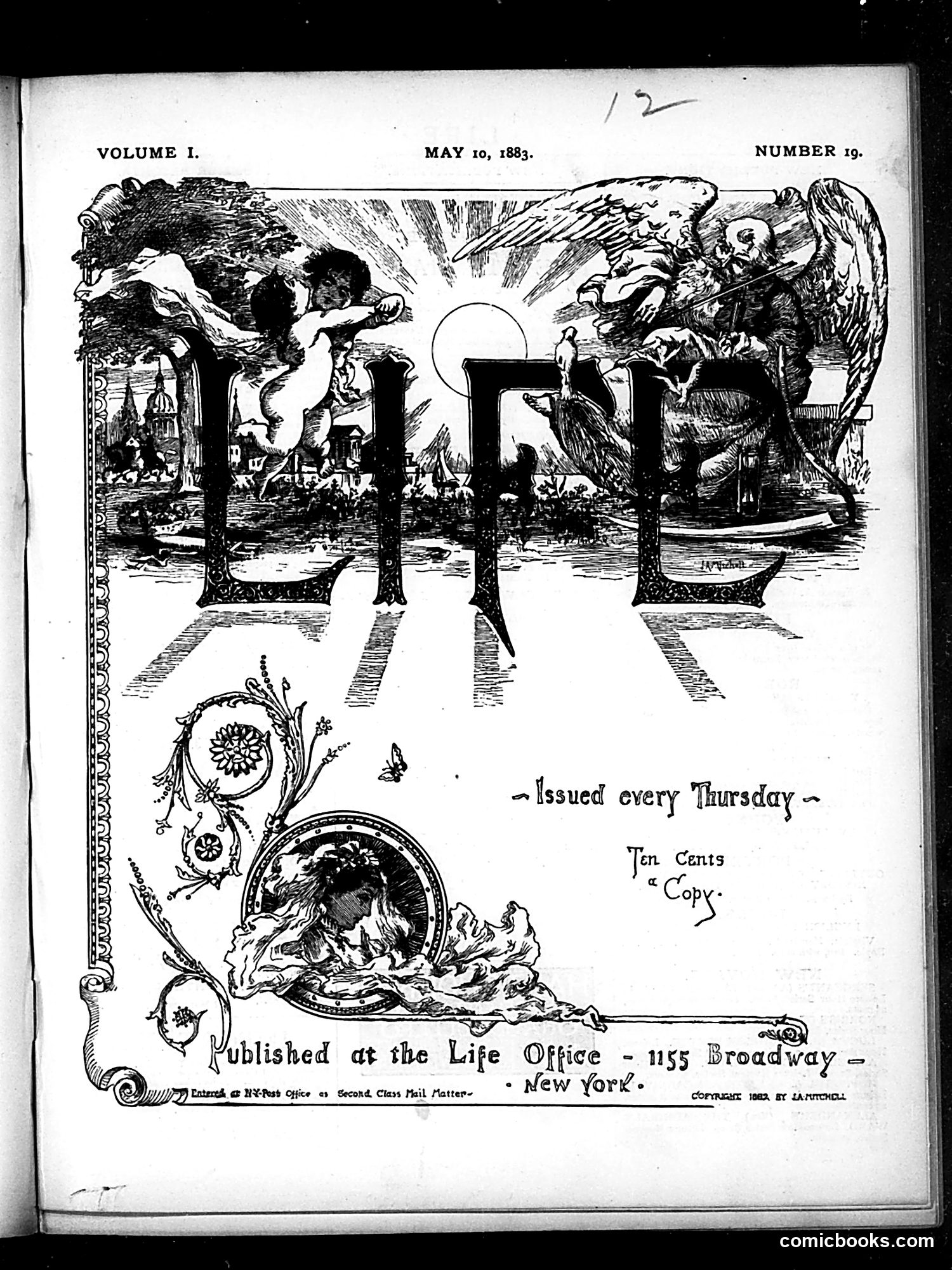
This is the May 10, 1883 cover of Life magazine, a satirical weekly costing ten cents. The large "LIFE" letters form the composition's frame, containing a dramatic nighttime scene with supernatural or allegorical figures—possibly representing death, fate, or moral forces—looming over a cityscape. The ornate decorative borders and classical imagery suggest fin-de-siècle artistic sensibilities. Without additional context from the issue's contents, the specific satirical target is unclear. The dramatic imagery likely commented on contemporary social, political, or moral issues of 1883, but identifying the particular figures or events requires information beyond what the cover alone provides. Published at Life Office, 1155 Broadway, New York.
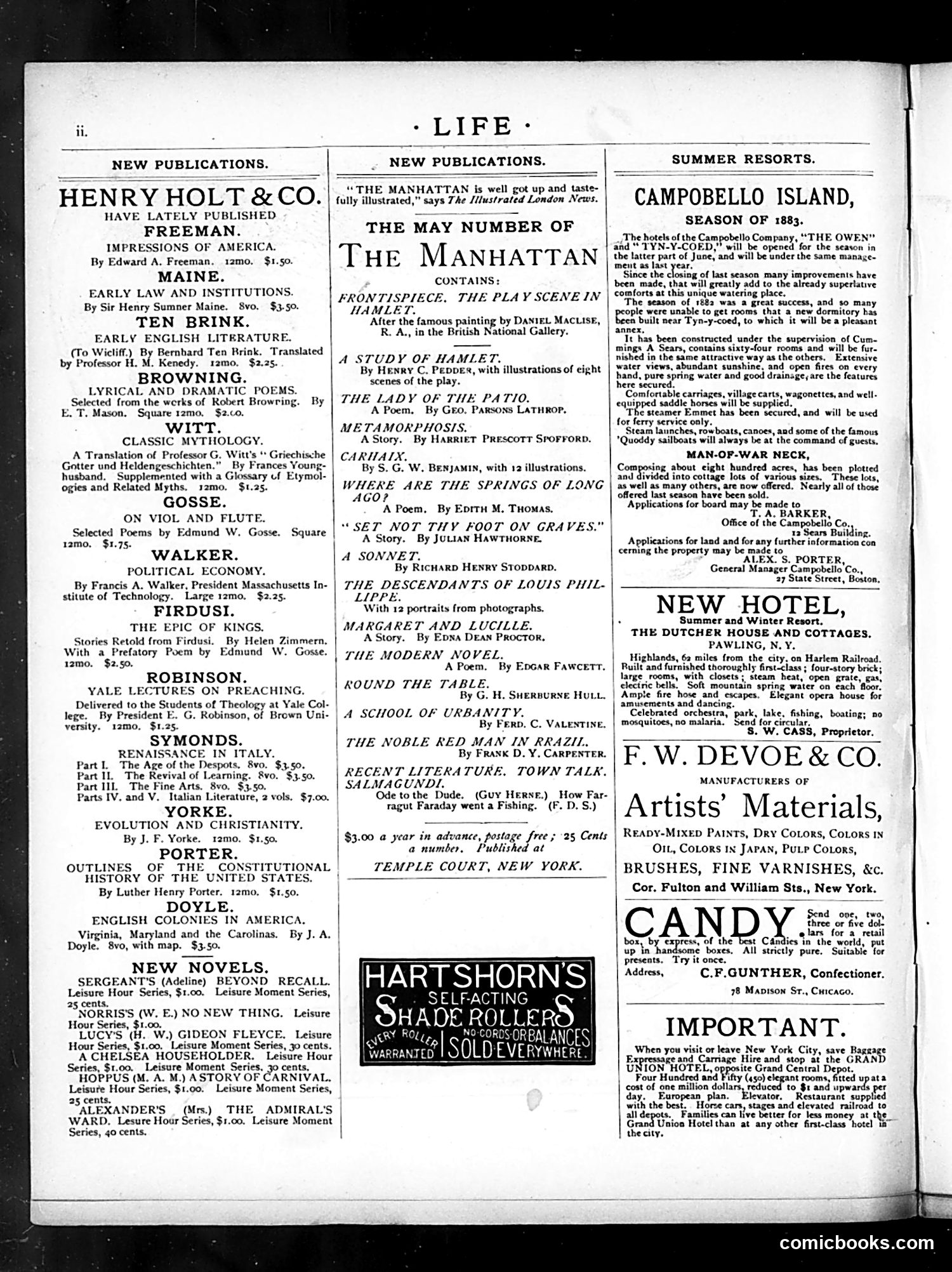
This page is primarily **advertising and book listings**, not satirical content. The left and center columns contain new book publications from Henry Holt & Co. and other publishers, listing titles like "The Manhattan," "A Study of Hamlet," and "The Lady of the Patio." The right side features advertisements for summer resorts (Campobello Island, a new hotel in Pawling, NY) and commercial products (F.W. Devoe & Co.'s artists' materials, Hartshorn's Shade Rollers, and C.P. Gunther's candy). There is **no visible cartoon or satirical content** on this page. It represents the typical commercial revenue model of *Life* magazine, which relied heavily on advertisements to fund its publication.
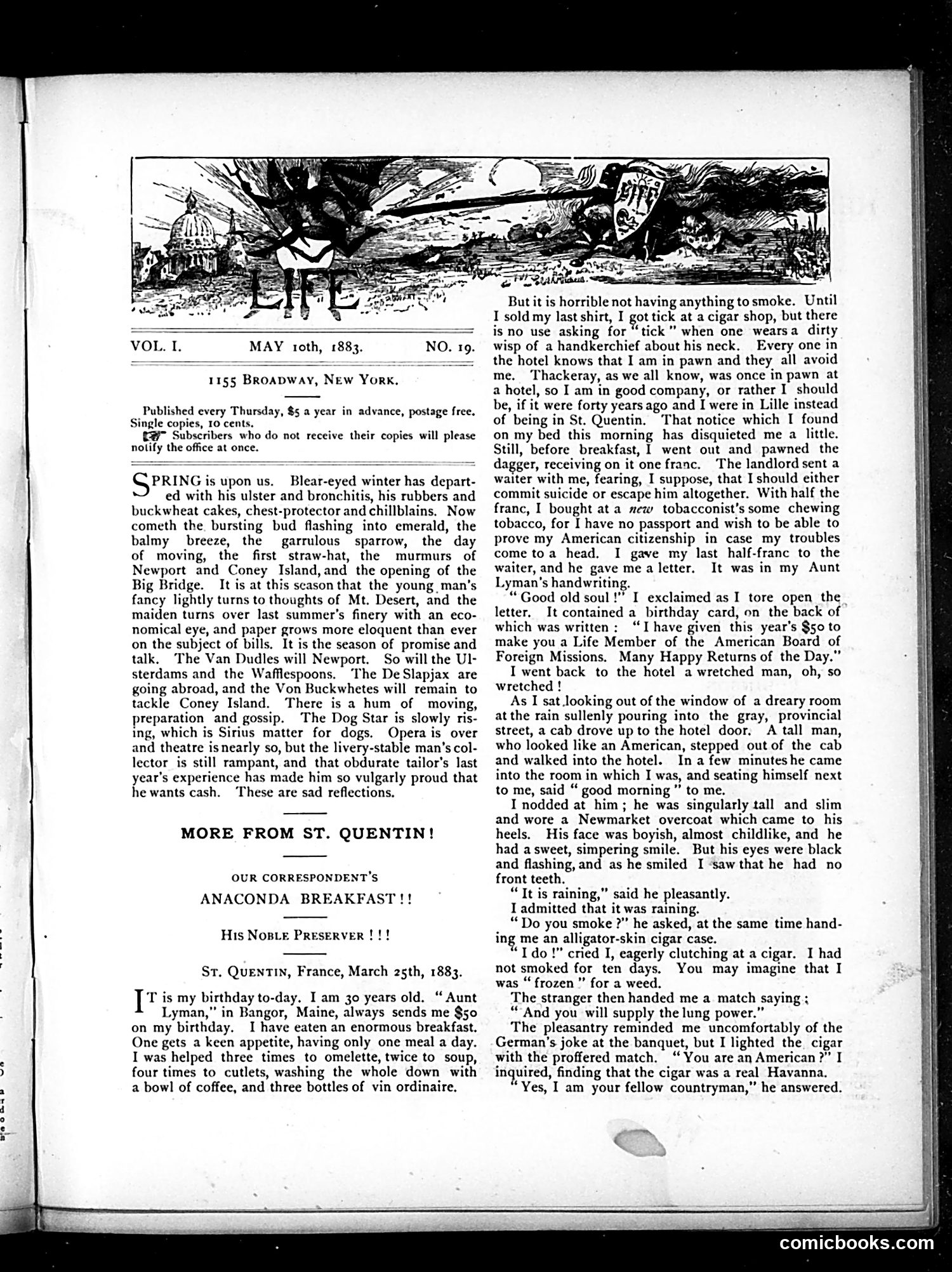
The page contains a satirical narrative titled "More from St. Quentin!" rather than a political cartoon. The story describes an impoverished American in France on his birthday, reduced to pawning possessions and receiving charity from relatives. The satire targets genteel poverty and American pretension abroad. The protagonist's encounter with a well-dressed stranger who turns out to be a fellow American serves as the joke's pivot—both men are equally destitute despite maintaining appearances. The final exchange about smoking a Havana cigar appears to mock both men's attempts to preserve dignity and status markers (the expensive cigar) despite their desperate financial circumstances. The humor derives from the gap between appearance and reality, a common theme in 1880s American humor about social class and economic struggle.
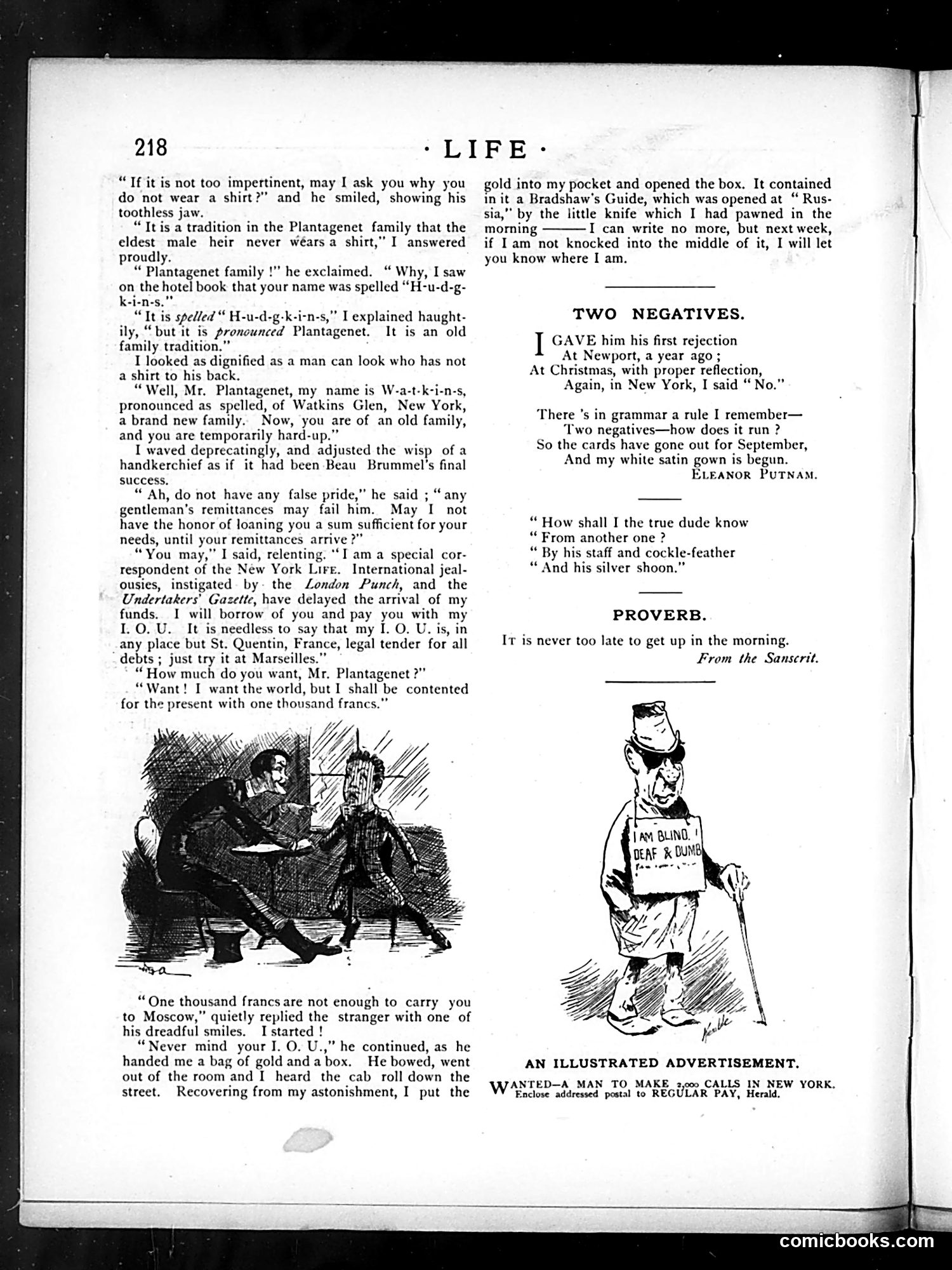
This page contains a story about a man named Plantagenet and an illustration satirizing con artists or fraudsters. The main cartoon depicts two figures in what appears to be a shabby room—likely representing a scam scenario where money exchanges hands. The accompanying text describes the stranger borrowing money with promises of repayment through international banking channels (I.O.U.s via St. Quentin, France, and Marseilles), a classic con-artist setup. The bottom section includes "An Illustrated Advertisement" showing a figure wearing a sign reading "I'M BLIND DEAF & DUMB," satirizing deceptive begging or fraud schemes. The ad parodies want-ads seeking "a man to make" such calls in New York. The satire targets financial schemes and street-level fraud common in the era.
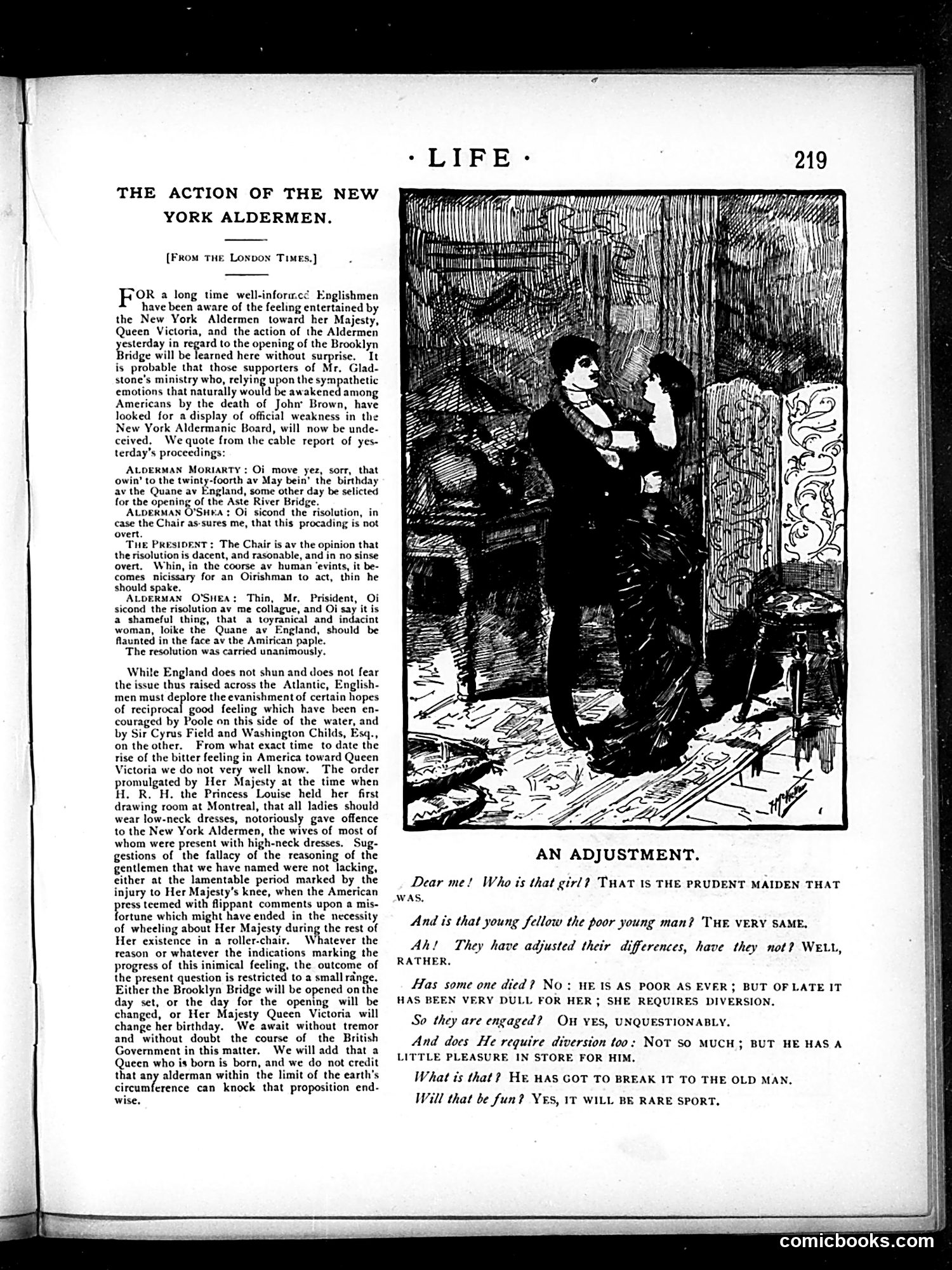
The left column discusses the New York Aldermen's action regarding the Brooklyn Bridge opening, referencing Queen Victoria and tensions between American and British sentiment. The aldermen passed resolutions criticizing British conduct. The right illustration, titled "An Adjustment," depicts a dialogue between a well-dressed couple and what appears to be a working-class man. The conversation—presented in capitalized dramatic dialogue—involves a young woman and man whose "difference" needs adjustment, apparently regarding class status. The man is described as "poor as ever" but willing to break with "the old man" for entertainment. The satire appears to mock class tensions and romantic entanglements across social boundaries, likely commentary on contemporary marriage/relationship debates. The specific individuals remain unclear without additional context, though the illustration satirizes attitudes toward class mobility and courtship in Gilded Age America.
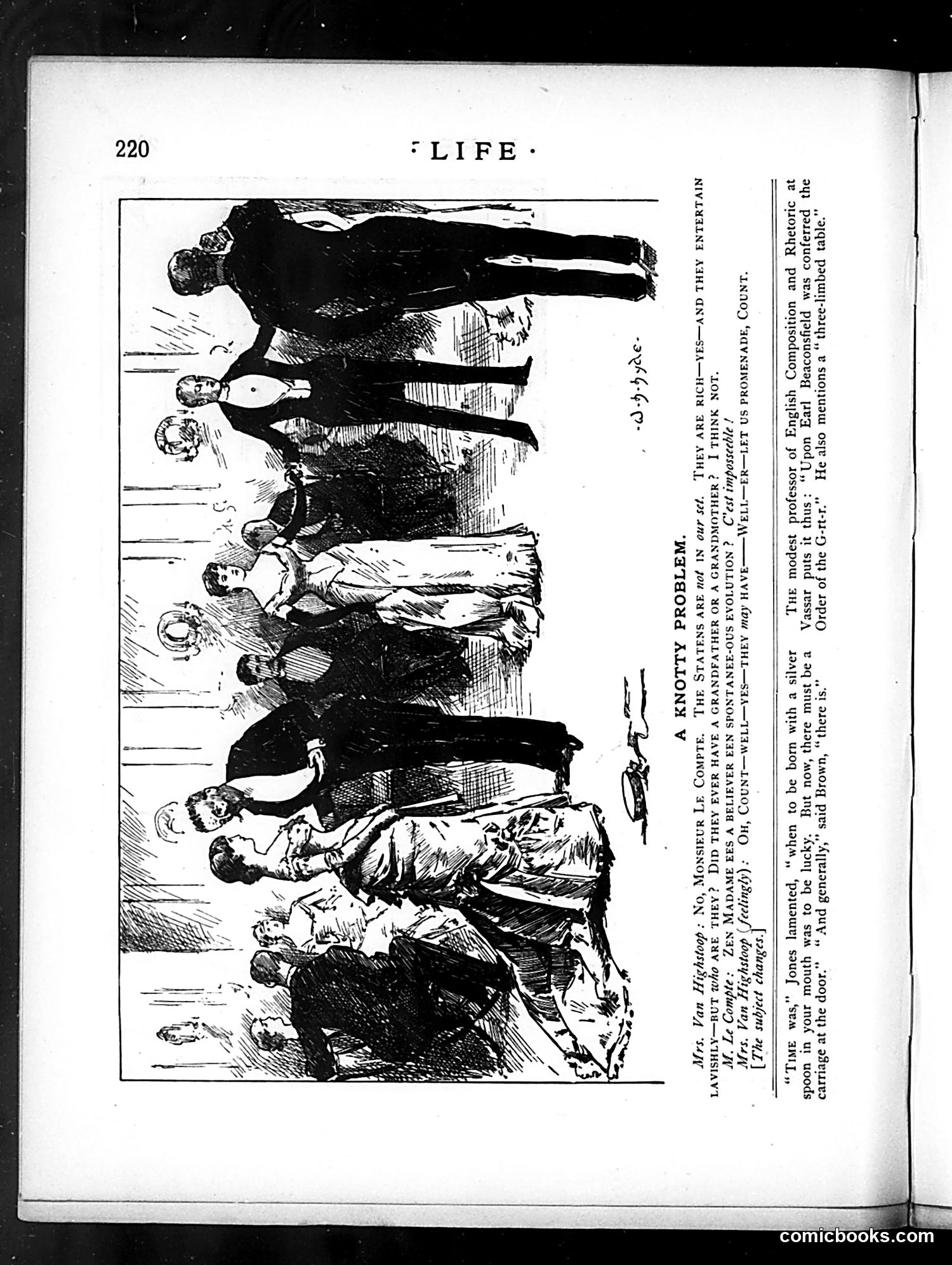
This satirical cartoon depicts what appears to be a formal dinner or social gathering with multiple figures arranged vertically (the image is rotated 90 degrees). The caption "A Knotty Problem" suggests these dignitaries face some complicated diplomatic or social situation. The text references "Mr. Evesham" and mentions "The Stratis" and issues involving "water or grain-supplier" negotiations, suggesting this relates to trade disputes or international relations. The figures shown in formal dress and the ornate setting indicate this mocks high-society or governmental negotiations. Without clearer identification of the specific historical moment, the cartoon appears to satirize the awkwardness or difficulty of resolving some formal dispute among prominent men—the "knot" being the knotty problem they cannot easily untangle.
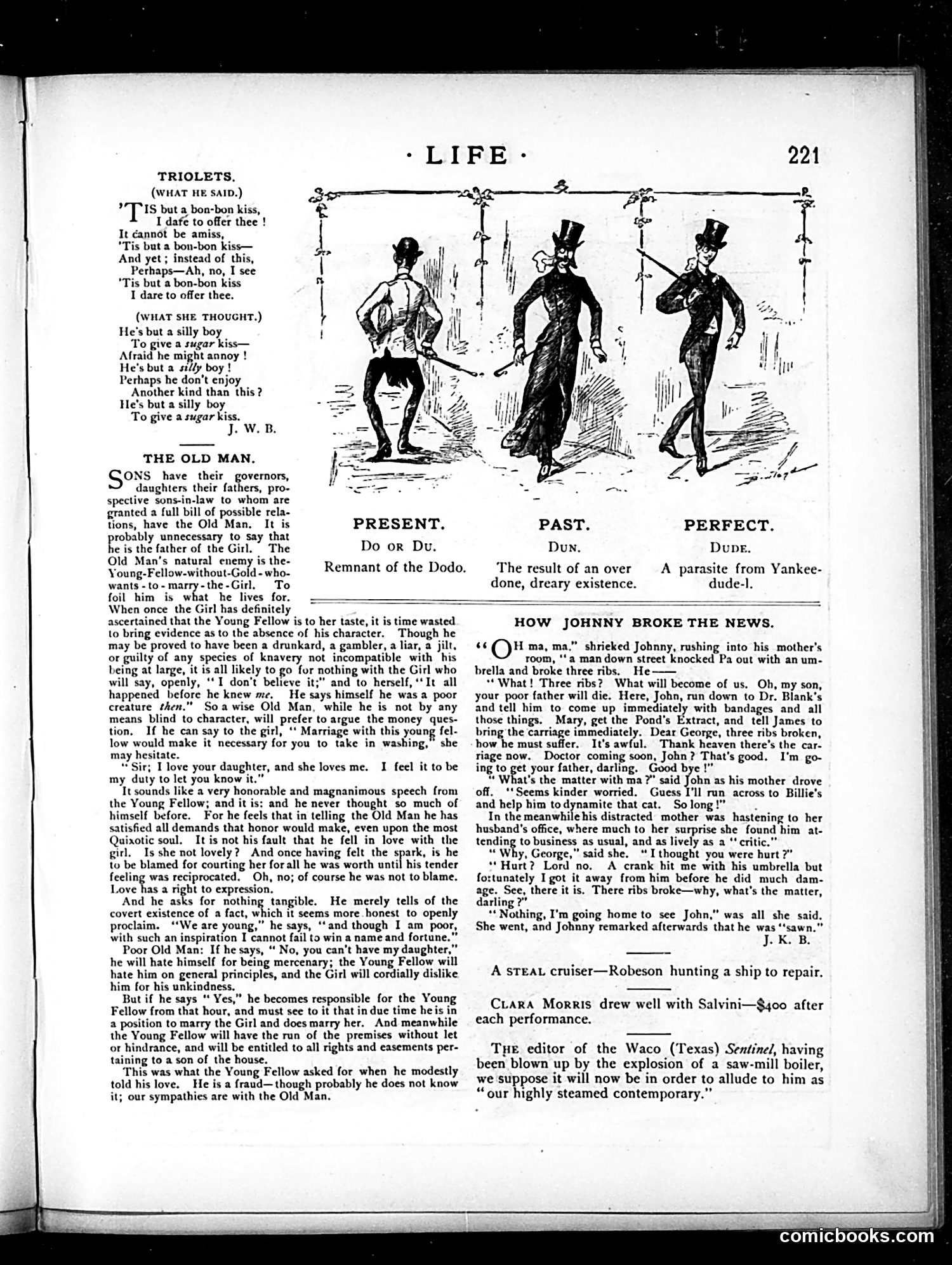
The page contains three distinct sections: **"Triolets" (Poetry):** Humorous verses about a "bon-bon kiss"—wordplay on the French candy and romantic kissing. **"The Old Man" (Essay):** Social commentary about generational conflict. The author argues an older man has valid wisdom in criticizing a "Young Fellow" suitor, defending his paternal concerns about the man's character flaws (possible drunkard, gambler, liar). **"How Johnny Broke the News" (Story):** A narrative about a boy rushing home to inform his mother of his father's carriage accident, told in colloquial dialect. **Grammar Diagram Cartoon:** Three figures labeled "Present" (Do/Du—remnant Dodo), "Past" (Dun), and "Perfect" (Dude)—a linguistic satire comparing grammar conjugations to social types, with the "dude" characterized as a parasitic "Yankee-dude." The page reflects Victorian-era concerns about morality, class, and proper English usage.
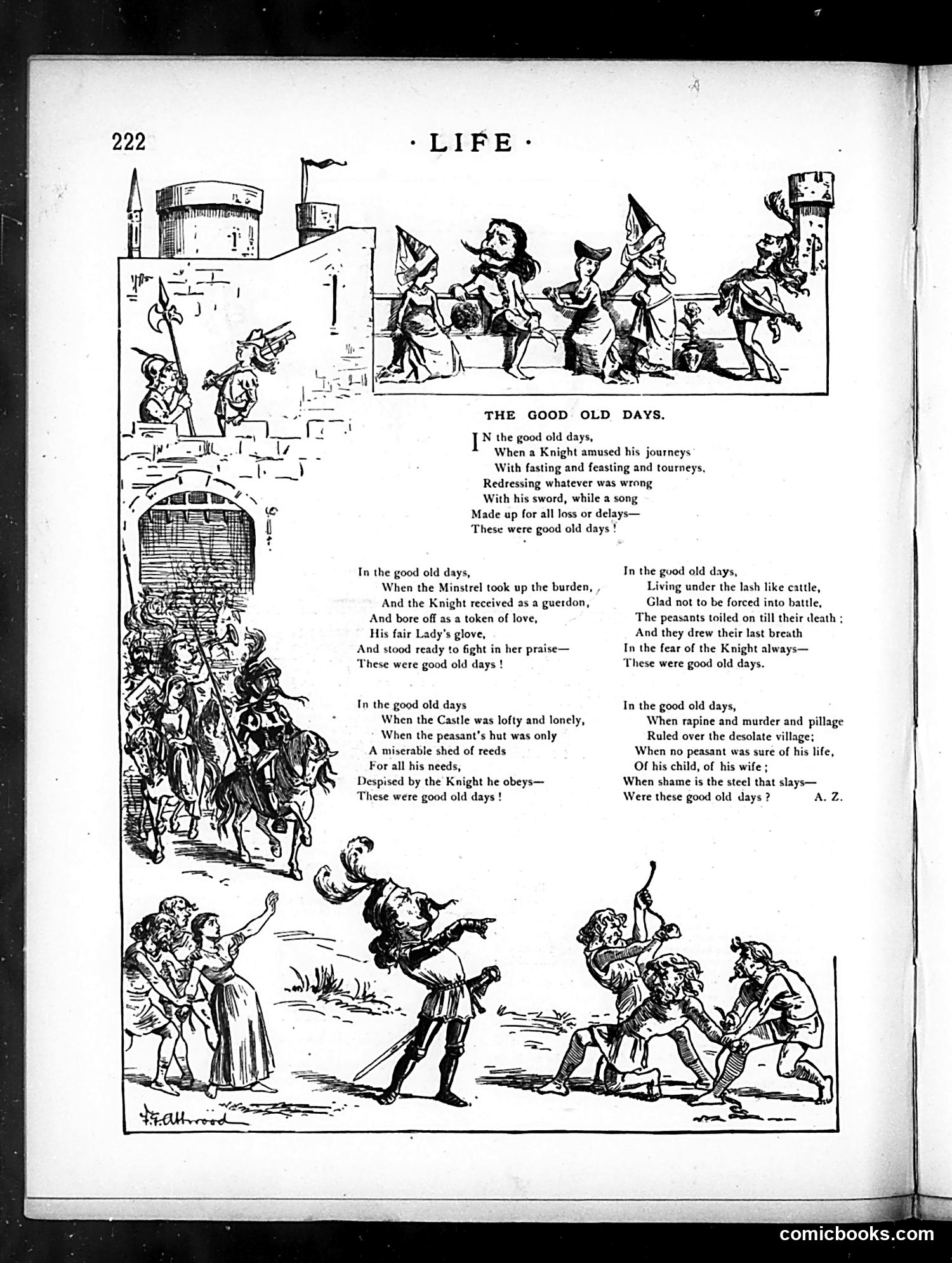
This page from *Life* magazine satirizes romanticized nostalgia for medieval times. The poem "The Good Old Days" ironically contrasts popular imagination with historical reality. The top illustration shows a fantasy castle scene with knights and ladies in idealized pageantry. Below, the poem systematically dismantles this romance: while knights supposedly fought honorably and minstrels entertained, the actual medieval reality involved peasants as "living cattle," forced into battle, toiling until death, and suffering under tyrannical lords committing "murder and pillage." The lower cartoons depict crude medieval life—peasants engaged in physical labor and conflict, far from the genteel fantasy above. The satire targets Victorian-era nostalgia for the "chivalric age," exposing the brutal conditions ordinary people endured while the privileged few enjoyed the romanticized pageantry.
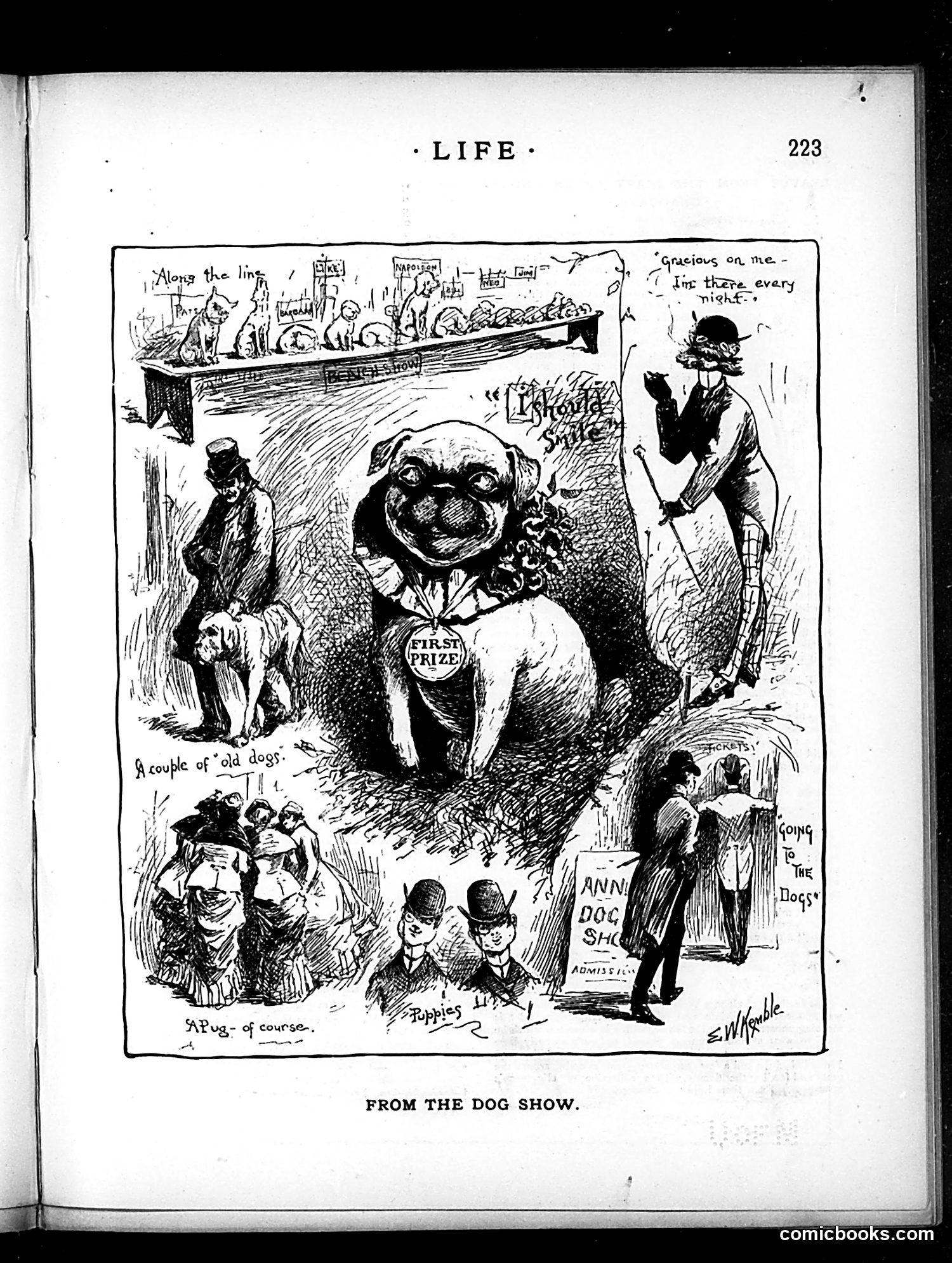
This is a satirical cartoon about a dog show, but uses dogs as stand-ins for human society commentary. The central figure is an enormous, prize-winning dog wearing a "FIRST PRIZE" ribbon—appearing grotesquely ugly despite winning top honors. This likely satirizes how dog shows reward artificial breeding standards that prioritize pedigree over actual health or appearance quality. The surrounding scenes show various dog show attendees and activities: "old dogs," puppies, people heading "to the Dogs," and a dog show admission sign. The joke appears to be mocking both the absurdity of competitive dog breeding and, by extension, human vanity in celebrating superficial distinctions and breeding practices. The exaggerated ugliness of the prize-winner underscores the satire's critique of misplaced values.
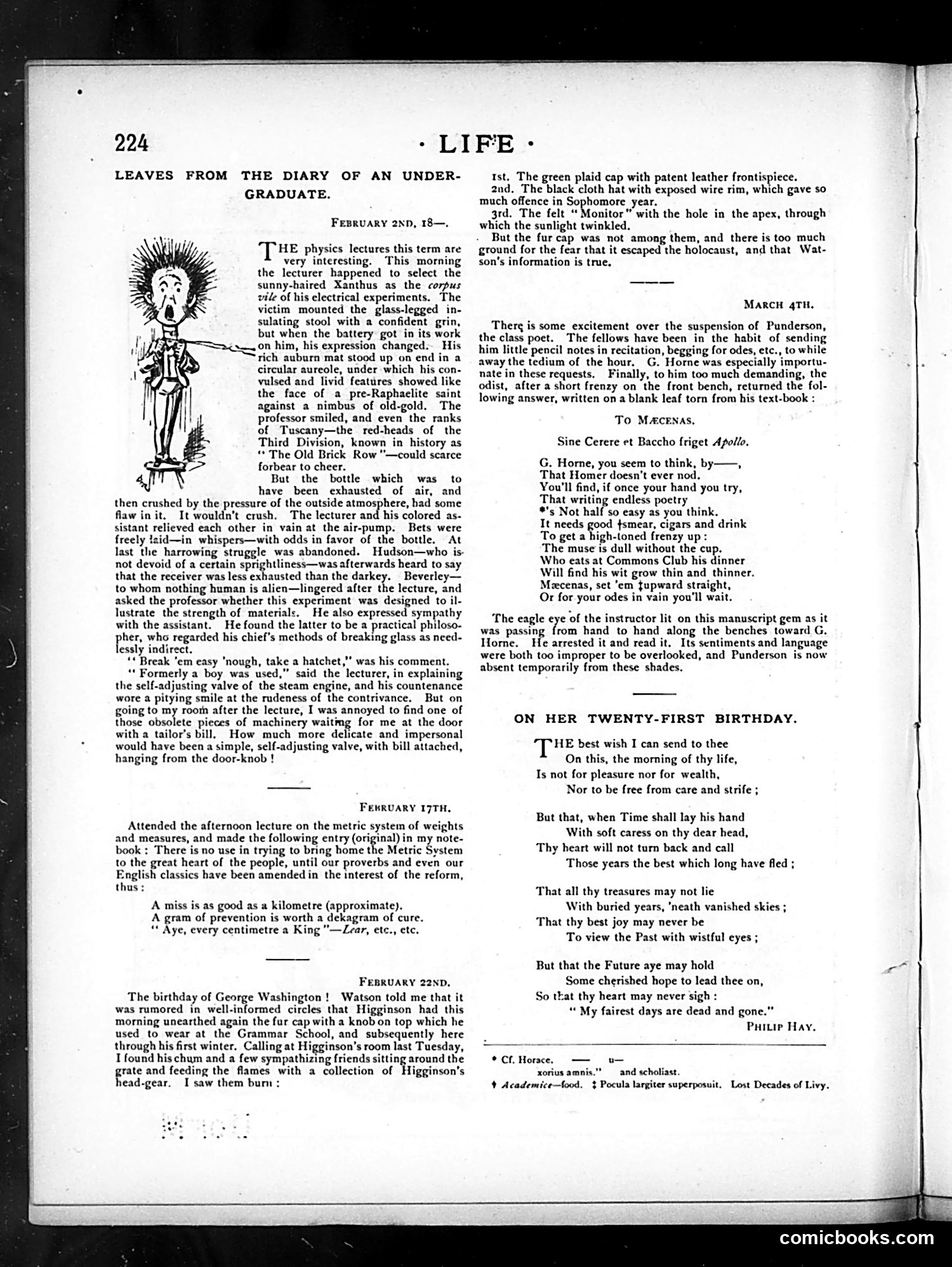
This page satirizes college life through fictionalized diary entries. The cartoon depicts a student ("Xanthus") being electrocuted during a physics lecture—his hair stands on end comically. The accompanying text mocks both the experiment and student reactions, including a racist joke about the professor's "colored assistant." Other entries ridicule academic pretense: a professor replacing an outdated "boy" valve with modern machinery (paralleling the tailor's bill awaiting the diarist), and a lecture on adopting the metric system met with dry wit about revising English proverbs and classics. The final entry jokes about burning old hats in celebration of Washington's birthday—implying the hats were so ugly their destruction was celebratory. The humor targets pompous professors, student absurdities, and academic follies typical of 1880s college satire.
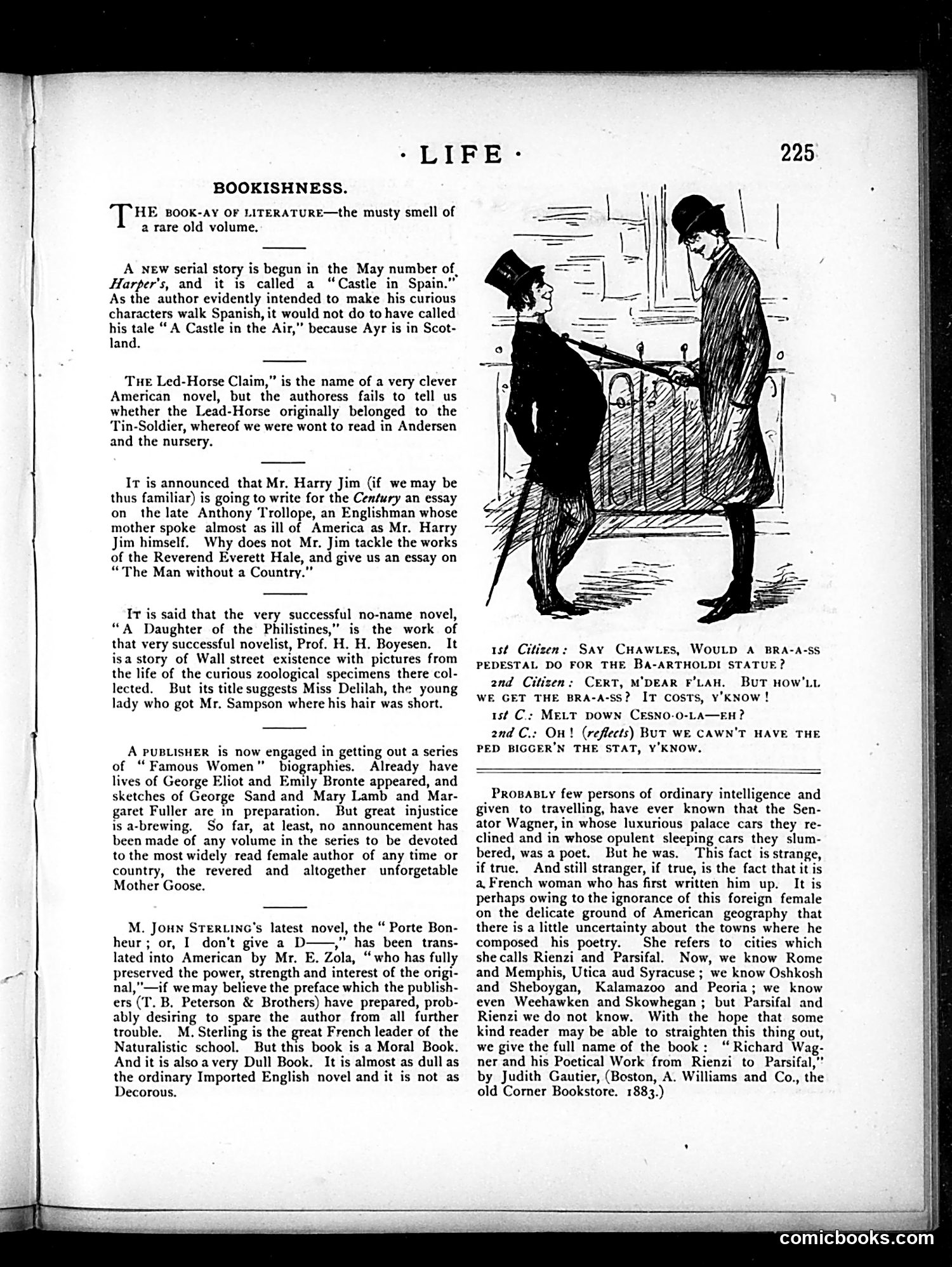
This satirical cartoon mocks New York's working-class Irish immigrants discussing the Bartholdi Statue (the Statue of Liberty, under construction). The two men, depicted with exaggerated Irish accents and dialect ("CHAWLES," "M'DEAR F'LAH"), propose melting down the Seneca (a steamship) to fund the statue's brass pedestal—a financially absurd suggestion. The satire targets both the immigrants' comic incomprehension of civic projects and the actual funding difficulties of the statue's pedestal. The Life article below uses the phrase "ped bigger'n the stat," referencing the real problem: the pedestal cost exceeded available funds. The accompanying "Bookishness" section is literary criticism mocking contemporary authors, including Prof. H.H. Boyesen's novel and the omission of Mother Goose from a "Famous Women" biography series—satire suggesting popular writers were overlooked by serious literary establishments.
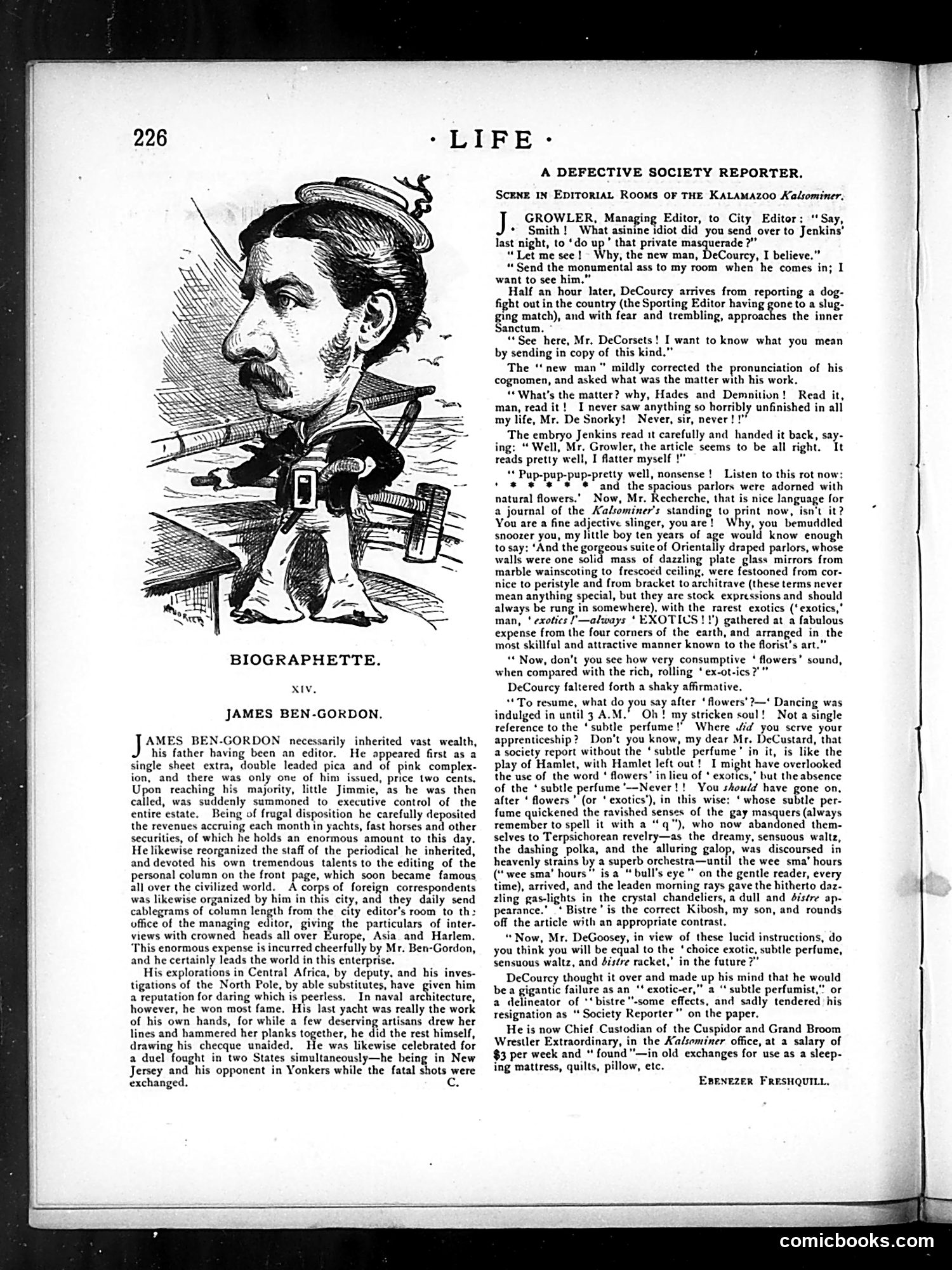
This page satirizes incompetent newspaper journalism through two pieces: **"Biographette: James Ben-Gordon"** (left) mocks a wealthy newspaper heir through absurdist humor. Ben-Gordon inherits a publishing fortune and wastes money on frivolous exploits—yachts, African expeditions, polar investigations—all conducted through hired substitutes while he personally contributes only his signature on checks. The joke: he's celebrated for daring and achievement despite doing nothing himself, embodying the vapid leisure-class newspaper owner. **"A Defective Society Reporter"** (right) depicts an editor brutally criticizing a new reporter's work. The managing editor ridicules DeCourcy's society column for using "natural flowers" instead of grandiose language like "gorgeous suite of Orientally draped parlors...festooned from cornice to peristyle." The satire targets pretentious newspaper writing—the overwrought, absurdly ornate descriptions endemic to Gilded Age society journalism. Together, these pieces mock both incompetent newspaper ownership and the ridiculous stylistic conventions of contemporary society reporting.
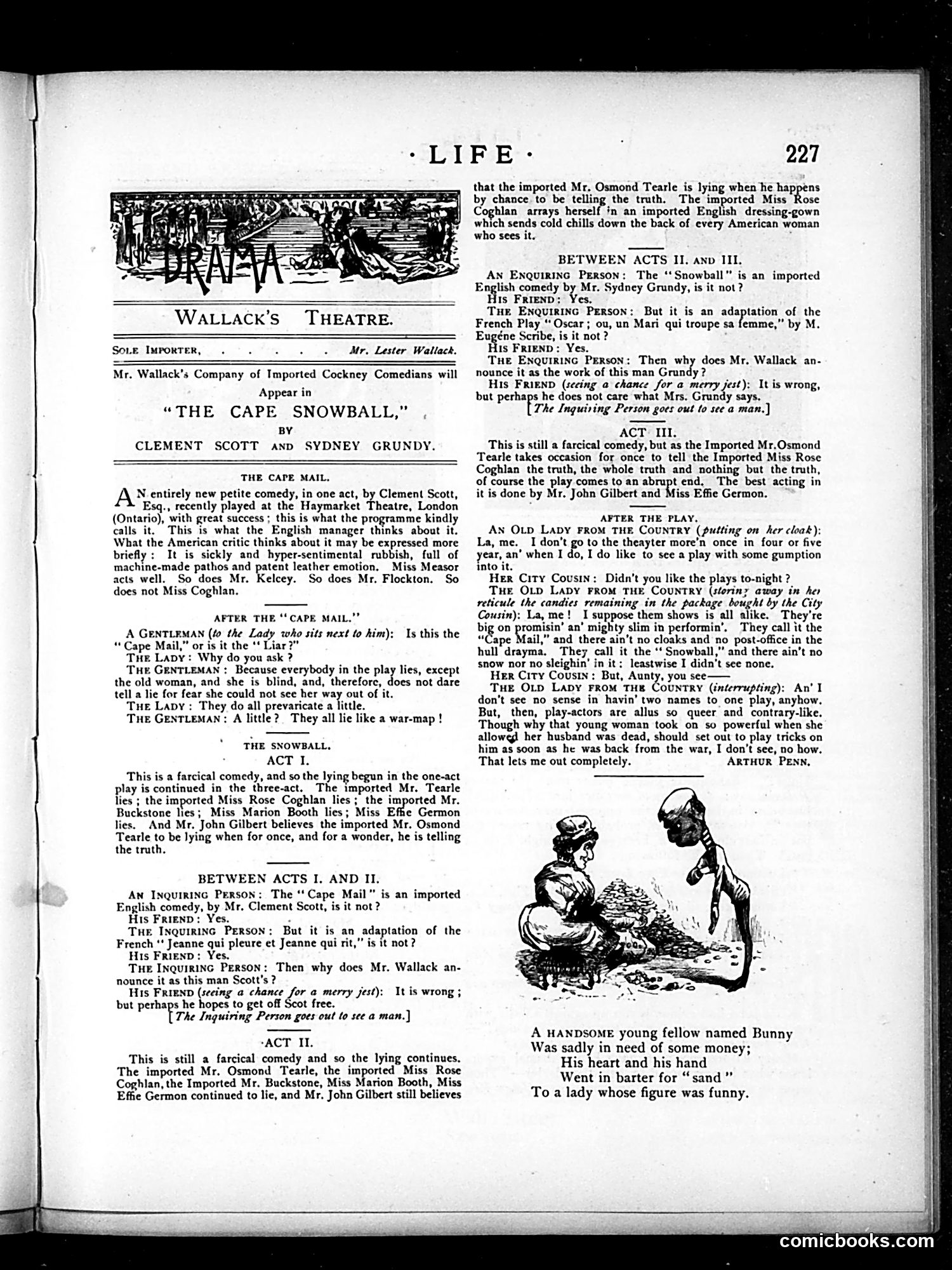
This page satirizes the theatrical practice of presenting foreign plays as original works. The satire targets theater manager Lester Wallack, who stages English comedies ("The Cape Snowball," "The Cape Mail") while crediting them to contemporary playwrights like Clement Scott and Sydney Grundy—when they are actually adaptations of French plays by established authors like Eugène Scribe. The repeated joke structure—an "Inquiring Person" questioning the attributions—exposes Wallack's dishonesty. The phrase "perhaps he does not care what Mrs. Grundy says" is a pun, since "Mrs. Grundy" was period slang for prudish propriety. The review also mocks the plays themselves as sentimental rubbish filled with unconvincing lies and "patent leather emotion." The cartoons accompanying the text show physical comedy typical of farces. This represents American critics' frustration with imported theatrical mediocrity presented as serious drama.
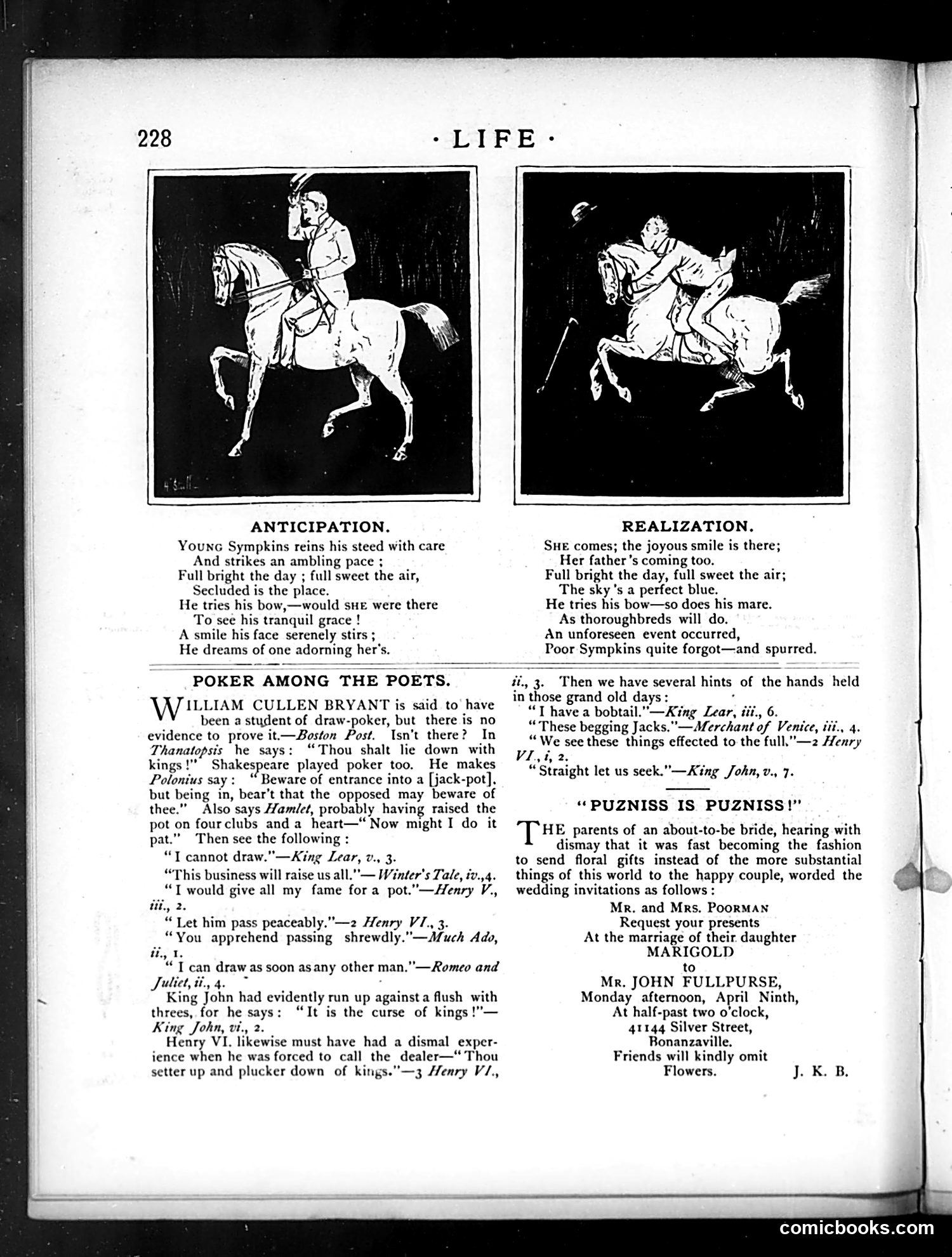
**Top Illustrations: "Anticipation" and "Realization"** Two sequential cartoon panels satirizing romantic courtship. Young Sympkins carefully prepares to meet his beloved—grooming himself and his horse. But when she arrives with her father (as propriety demanded), his horse panics and bolts, ruining the encounter. The joke targets the contrast between idealized romantic expectations and clumsy reality, particularly the awkwardness of chaperoned courtship. **"Poker Among the Poets"** Satirical commentary proposing that famous Shakespeare and classical poets played draw-poker, "proving" this by cherry-picking theatrical quotes that could reference poker hands and betting ("I cannot draw," "these begging Jacks"). This is humorous wordplay exploiting double meanings in classical literature. **"Puzniss is Puzniss!"** A wedding invitation joke: Poor parents of the bride, frustrated that fashionable guests send flowers instead of cash gifts, directly request presents while explicitly requesting guests "omit Flowers." The satire targets both changing wedding customs and the tension between maintaining appearances and addressing financial realities.
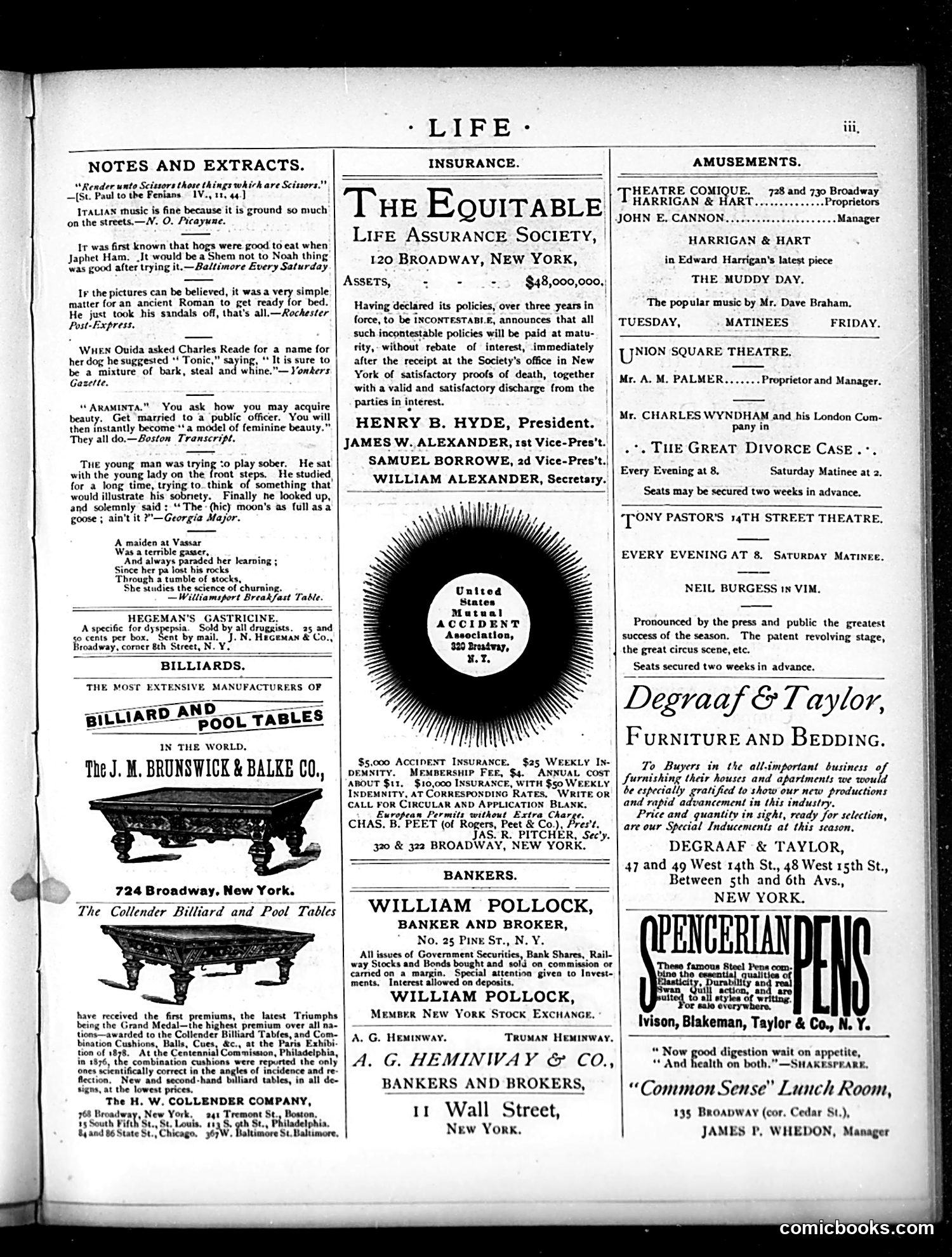
This page is **primarily advertising and business notices**, with minimal editorial content. The top section contains brief humorous "Notes and Extracts"—short satirical quips and jokes typical of 19th-century magazines. These rely on wordplay and social observation rather than political cartooning: - Jokes mock Italian street musicians, Roman fashion, and a woman from Vassar whose family lost wealth in stock speculation but now studies "churning" (domestic work)—a dig at fallen gentility - A quip attributes Charles Reade's suggested dog name "Tonic" to qualities (bark, steal, whine) resembling the man himself **The large circular emblem** is the United States Mutual Accident Association's logo, not a political cartoon. The remainder consists of advertisements for billiard tables, life insurance, banking, and theaters. This appears to be a **business/financial page** rather than an editorial or satirical one, with humor serving mainly as filler content.
This page is **entirely advertising**—there are no cartoons or satirical content to analyze. It's a commercial section from an early American *Life* magazine featuring late 19th-century product advertisements. The ads showcase typical merchandise of the era: high-end clothing (Arnold, Constable & Co.), hats (Dunlap & Co.), wallpaper, champagne and brandy, printing ink, steel pens, plumbing systems, and patent medicine ("Friedrichshall Natural Bitter-Water," endorsed by Dr. Liebig as a digestive cure). The page reflects the magazine's business model—advertising revenue from retailers and manufacturers targeting middle and upper-class readers. The advertisements emphasize quality, imported goods, and modern innovations (like the patented drainage system). The only noteworthy element is the patent medicine ad, which represents the era's largely unregulated medical marketing before FDA oversight. This is a straightforward commercial page, not satirical content.