
Life, 1883-05-10 · page 11 of 16
Life — May 10, 1883 — page 11: what you’re looking at
What you’re looking at
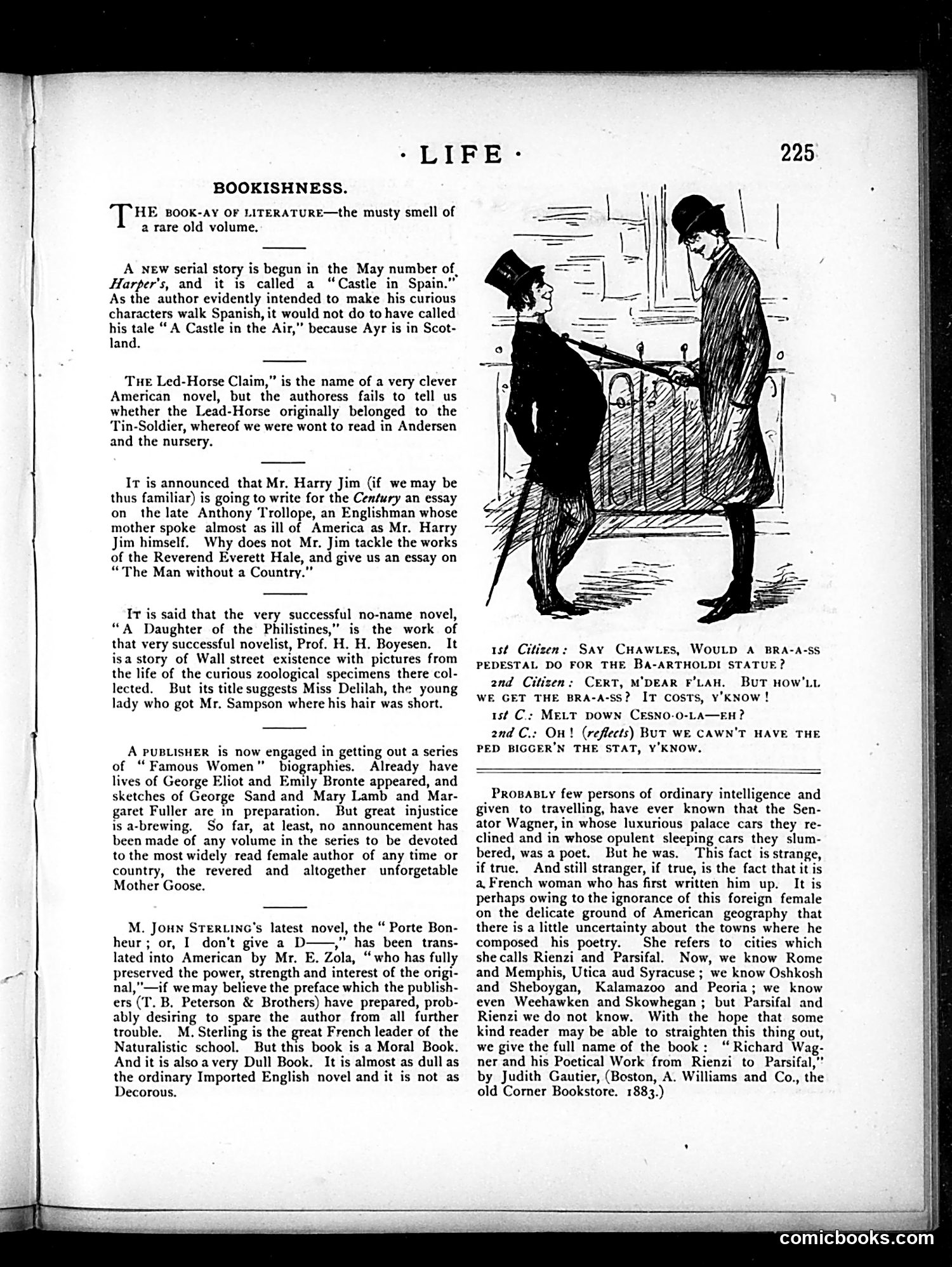
This satirical cartoon mocks New York's working-class Irish immigrants discussing the Bartholdi Statue (the Statue of Liberty, under construction). The two men, depicted with exaggerated Irish accents and dialect ("CHAWLES," "M'DEAR F'LAH"), propose melting down the Seneca (a steamship) to fund the statue's brass pedestal—a financially absurd suggestion. The satire targets both the immigrants' comic incomprehension of civic projects and the actual funding difficulties of the statue's pedestal. The Life article below uses the phrase "ped bigger'n the stat," referencing the real problem: the pedestal cost exceeded available funds. The accompanying "Bookishness" section is literary criticism mocking contemporary authors, including Prof. H.H. Boyesen's novel and the omission of Mother Goose from a "Famous Women" biography series—satire suggesting popular writers were overlooked by serious literary establishments.
📄 Transcribed text from this page (OCR, searchable)
Machine-transcribed from the original scan — historical spelling and the odd misread are preserved.
BOOKISHNESS. HE B00K-aY OF LITERATURE—the musty smell of a rare old volume. A New serial story is begun in the May number of, Harper's, and it is called a “Castle in Spain.” As the author evidently intended to make his curious characters walk Spanish, it would not do to have called his tale “A Castle in the Air,” because Ayr is in Scot- land. Tue Led-Horse Claim,” is the name of a very clever American novel, but the authoress fails to tell us whether the Lead-Horse originally belonged to the Tin-Soldier, whereof we were wont to read in Andersen and the nursery. Ir is announced that Mr. Harry Jim (if we may be thus familiar) is going to write for the Century an essay on the late Anthony Trollope, an Englishman whose mother spoke almost as ill of America as Mr. Harry Jim himself. Why does not Mr. Jim tackle the works of the Reverend Everett Hale, and give us an essay on “The Man without a Country.” Ir is said that the very successful no-name novel, “A Daughter of the Philistines,” is the work of that very successful novelist, Prof. H. H. Boyesen. It isa story of Wall street existence with pictures from the life of the curious zoological specimens there col- lected. But its title suggests Miss Delilah, the young lady who got Mr. Sampson where his hair was short. A PUBLISHER is now engaged in getting out a series of “Famous Women" biographies. Already have lives of George Eliot and Emily Bronte appeared, and sketches of George Sand and Mary Lamb and Mar- garet Fuller are in preparation. But great injustice is a-brewing. So far, at least, no announcement has been made of any volume in the series to be devoted to the most widely read female author of any time or country, the revered and altogether unforgetable Mother Goose. M. Joun STERLING'S latest novel, the “ Porte Bon- heur ; or, I don't give a D——,” has been trans- lated into American by Mr. E. Zola, “ who has full preserved the power, strength and interest of the origi- nal,"—if we may believe the preface which the publish- ers (T. B, Peterson & Brothers) have prepared, prob- ably desiring to spare the author from all further trouble. M. Sterling is the great French leader of the Naturalistic school. But this book is a Moral Book. And it is alsoavery Dull Book. It is almost as dull as the ordinary Imported English novel and it is not as Decorous. - LIFE: Z OUANRSTENNN \s XN \\ 1st Citizen: Say CHAWLES, WOULD A BRA-A-SS PEDESTAL DO FOR THE BA-ARTHOLDI STATUE? 2nd Citizen: CERT, M'DEAR F’LAH. But HOW’LL WE GET THE BRA-A-SS? IT Costs, Y'KNOW! 1st C.: MELT DowN CESNO-0-LA—EH? 2nd C.: OH! (reflects) BUT WE CAWN'T HAVE THE PED BIGGER’N THE STAT, Y'KNOW. Prosasty few persons of ordinary intelligence and given to travelling, have ever known that the Sen- ator Wagner, in whose luxurious palace cars they re- clined and in whose opulent sleeping cars they slum- bered, was a poet. But he was. This fact is strange, if true. And still stranger, if true, is the fact that it is a, French woman who has first written him up. It is perhaps owing to the ignorance of this foreign female on the delicate ground of American geography that there is a little uncertainty about the towns where he composed his poetry. She refers to cities which she calls Rienzi and Parsifal. Now, we know Rome and Memphis, Utica aud Syracuse ; we know Oshkosh and Sheboygan, Kalamazoo and Peoria; we know even Weehawken and Skowhegan ; but Parsifal and Rienzi we do not know. With the hope that some kind reader may be able to straighten this thing out, we give the full name of the book: “Richard Wag- ner and his Poetical Work from Rienzi to Parsifal,”’ by Judith Gautier, (Boston, A. Williams and Co., the old Corner Bookstore. 1883.) comicbooks.com