
Life, 1883-05-10 · page 10 of 16
Life — May 10, 1883 — page 10: what you’re looking at
What you’re looking at
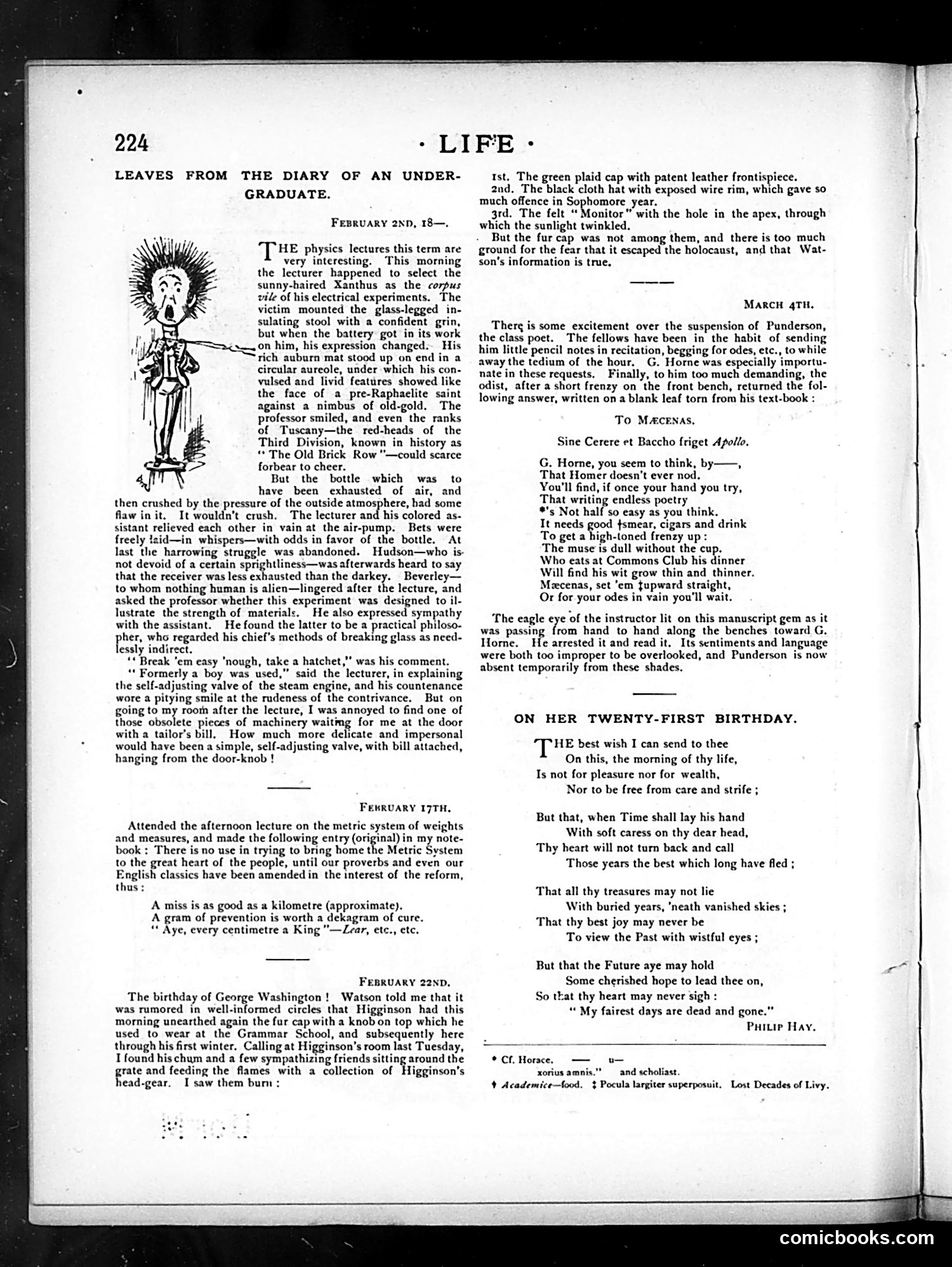
This page satirizes college life through fictionalized diary entries. The cartoon depicts a student ("Xanthus") being electrocuted during a physics lecture—his hair stands on end comically. The accompanying text mocks both the experiment and student reactions, including a racist joke about the professor's "colored assistant." Other entries ridicule academic pretense: a professor replacing an outdated "boy" valve with modern machinery (paralleling the tailor's bill awaiting the diarist), and a lecture on adopting the metric system met with dry wit about revising English proverbs and classics. The final entry jokes about burning old hats in celebration of Washington's birthday—implying the hats were so ugly their destruction was celebratory. The humor targets pompous professors, student absurdities, and academic follies typical of 1880s college satire.
📄 Transcribed text from this page (OCR, searchable)
Machine-transcribed from the original scan — historical spelling and the odd misread are preserved.
224 LEAVES FROM THE DIARY OF AN UNDER- GRADUATE. FEBRUARY 2ND, 18—. THE physics lectures this term are very interesting. This morning the lecturer happened to select the sunny-haired Xanthus as the corpus vile of his electrical experiments. The victim mounted the glass-legged in- sulating stool with a confident grin, but when the battery got in its work on him, his expression changed. His rich auburn mat stood up on end in a circular aureole, under which his con- vulsed and livid features showed like the face of a pre-Raphaelite saint against a nimbus of old-gold. The professor smiled, and even the ranks of Tuscany—the red-heads of the Third Division, known in history as ‘* The Old Brick Row "—could scarce forbear to cheer. But the bottle which was to have been exhausted of air, and then crushed by the pressure of the outside atmosphere, had some flaw init, It wouldn't crush, The lecturer and his colored as- sistant relieved each other in vain at the air-pump. Bets were freely t2id—in whispers—with odds in favor of the bottle. At last the harrowing struggle was abandoned. Hudson—who is- not devoid of a certain sprightliness—was afterwards heard to say that the receiver was less exhausted than the darkey. Beverley— to whom nothing human is alien—lingered after the lecture, and asked the professor whether this experiment was designed to il- lustrate the strength of materials. He also expressed sympathy with the assistant. He found the latter to be a practical philoso- pher, who regarded his chief's methods of breaking glass as need- lessly indirect. Break ‘em easy ‘nough, take a hatchet,"* was his comment. “Formerly a boy was used,” said the lecturer, in explaining the self-adjusting valve of the steam engine, and his countenance wore a pitying smile at the rudeness of the contrivance. But on going to my room after the lecture, I was annoyed to find one of those obsolete pieces of machinery waitmg for me at the door with a tailor’s bill. How much more delicate and impersonal would have been a simple, self-adjusting valve, with bill attached, hanging from the door-knob ! FeuRvary 17TH. Attended the afternoon lecture on the metric system of weights and measures, and made the following entry (original) in my note- book : There is no use in trying to bring home the Metric System to the great heart of the people, until our proverbs and even our English classics have been amended in the interest of the reform, thus : A miss is as good as a kilometre (approximate). A gram of prevention is worth a dekagram of cure. “* Aye, every centimetre a King "—Zear, etc., etc. FEBRUARY 22ND, The birthday of George Washington !_ Watson told me that it was rumored in well-informed circles that Higginson had this morning unearthed again the fur cap with a knobon top which he used to wear at the Grammar School, and subsequently here through his first winter. Calling at Higginson’s room last Tuesday, I found his chum and a few sympathizing friends sitting around the grate and feeding the flames with a collection of Higginson’s head-gear. I saw them bum : Ist. The green plaid cap with patent leather frontispiece. 2nd. The black cloth hat with exposed wire rim, which gave so much offence in Sophomore year. grd. The felt “ Monitor" with the hole in the apex, through which the sunlight twinkled. But the fur cap was not among them, and there is too much ground for the fear that it escaped the holocaust, and that Wat- son's information is true. MARCH 4TH. Therg is some excitement over the suspension of Punderson, the class poet. The fellows have been in the habit of sending him little pencil notes in recitation, begging for odes, etc., to while away the tedium of the hour, G. Horne was especially importu- nate in these requests, Finally, to him too much demanding, the odist, after a short frenzy on the front bench, returned the fol- lowing answer, written on a blank leaf torn from his text-book : To MACENAS. Sine Cerere et Baccho friget Apollo, G. Horne, you seem to think, by—, That Homer doesn’t ever nod, You'll find, if once your hand you try, That writing endless poetry #5 Not half so easy as you think. It needs good ¢smear, cigars and drink To get a high-toned frenzy up: The muse is dull without the cup. Who eats at Commons Club his dinner Will find his wit grow thin and thinner. Maecenas, set ‘em tupward straight, Or for your odes in vain you'll wait. The eagle eye of the instructor lit on this manuscript gem as it was passing from hand to hand along the benches toward G. Home. He arrested it and read it, Its sentiments and language were both too improper to be overlooked, and Punderson is now absent temporarily from these shades. ON HER TWENTY-FIRST BIRTHDAY. HE best wish I can send to thee On this, the morning of thy life, Is not for pleasure nor for wealth, Nor to be free from care and strife ; But that, when Time shall lay his hand With soft caress on thy dear head, Thy heart will not turn back and call Those years the best which long have fled ; That all thy treasures may not lie With buried years, ‘neath vanished skies ; That thy best joy may never be To view the Past with wistful eyes ; But that the Future aye may hold Some cherished hope to lead thee on, So that thy heart may never sigh : “ My fairest days are dead and gone.” Puitip Hay. * Cf. Horace, — uu xorius amnis."” and scholiast. $ Academice—food, % Pocula largiter superposuit. Lost Decades of Livy. comicbooks.com