
A complete issue · 16 pages · 1883
Life — May 3, 1883
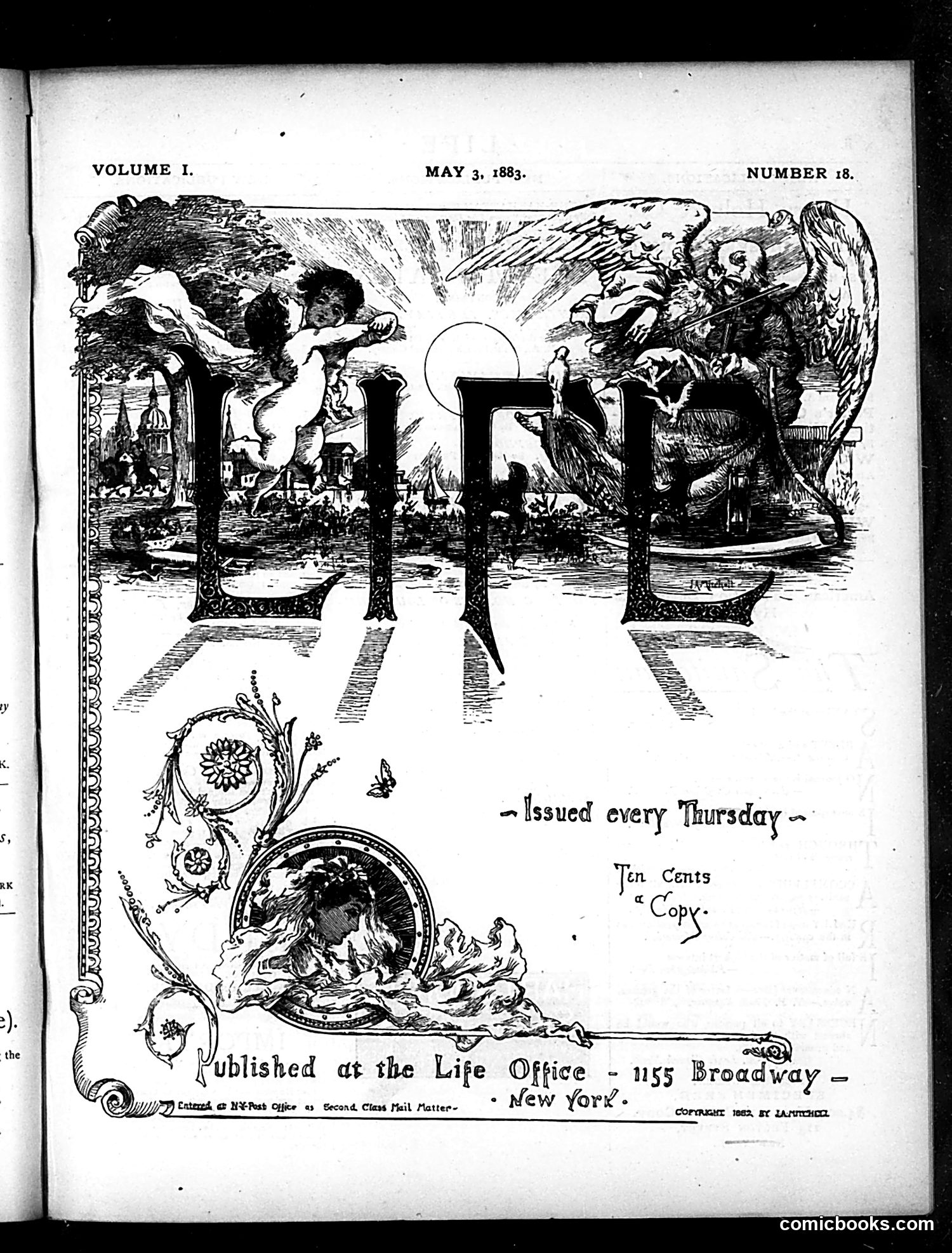
This is the cover of Life magazine's inaugural issue (Volume 1, Number 18). The central illustration depicts allegorical figures—including what appears to be classical cherubs or putti and winged figures—surrounding large letters spelling "LIFE" above a cityscape. The composition employs classical and mythological imagery typical of 19th-century satirical publication design. The ornamental border and elaborate decorative elements frame a central portrait medallion at bottom. The specific satirical content or political references remain unclear from the visual alone, though the grandiose presentation suggests Life positioned itself as a sophisticated, arts-focused satirical publication for educated urban readers. The ten-cent price point indicates middle-class readership. Without additional context, the exact satirical targets cannot be definitively identified.
This page is primarily **advertising and book announcements** rather than political cartoon content. The left column advertises *The Sanitarian* health journal with endorsements from various American newspapers praising its medical and hygiene focus. The center and right columns feature book listings from publishers Henry Holt & Co. and John W. Lovell Company, advertising new literary and educational titles. The only non-text visual element is **Hartshorn's Self-Acting Shade Rollers advertisement** (center-bottom), a standard product ad featuring the company's window shade mechanisms. There is **no political satire, cartoon, or social commentary** visible on this page—it represents typical late 19th-century magazine advertising practices mixing health journal promotion with publisher catalogs.
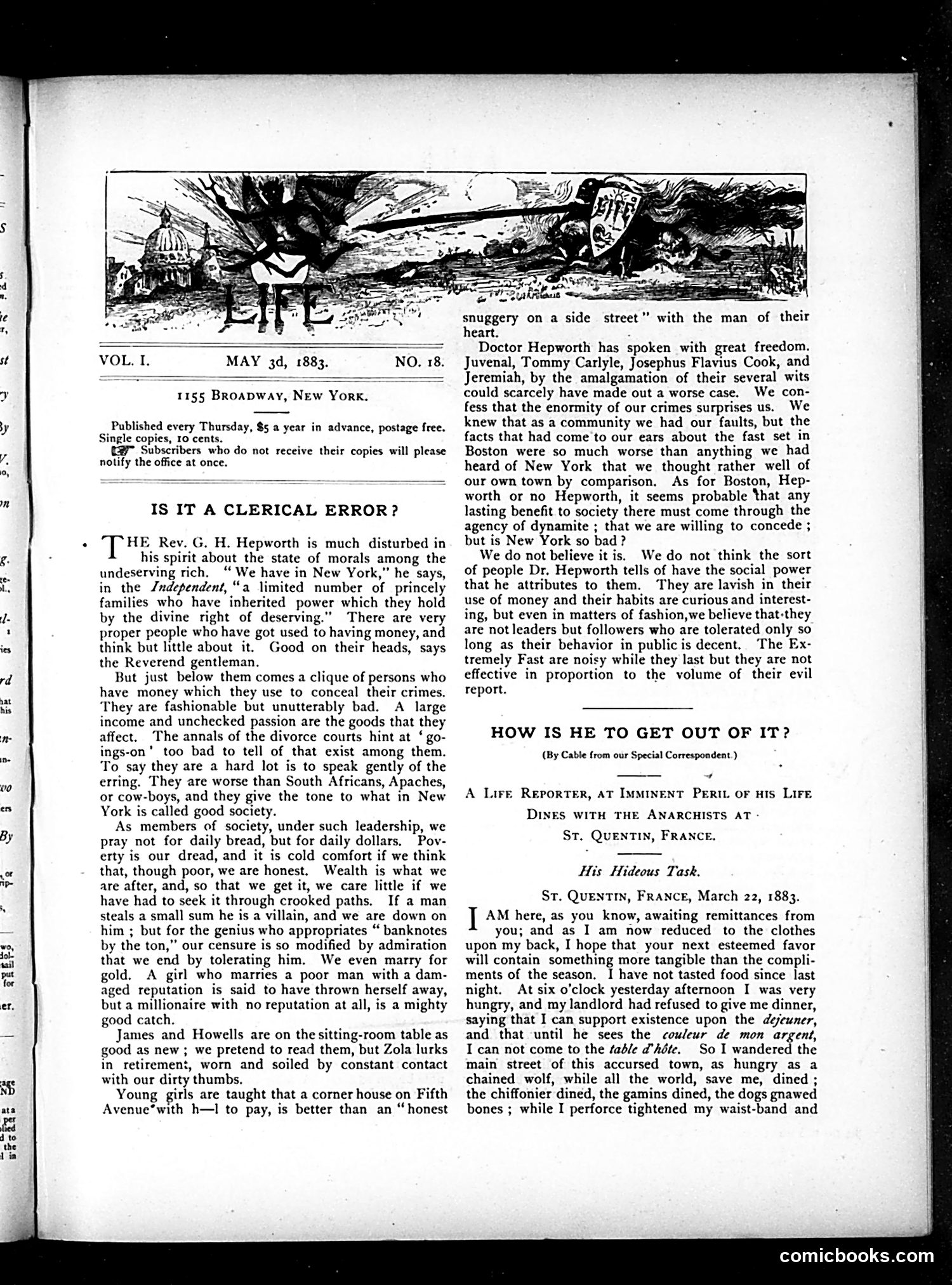
The page contains two articles rather than a political cartoon. The main piece, "IS IT A CLERICAL ERROR?", critiques Rev. G. H. Hepworth's public statements about New York's moral condition. Hepworth apparently claimed New York's poor were worse than Boston's, prompting this editorial response defending New York's character and questioning whether Hepworth possessed actual authority to make such judgments. The second article, "HOW IS HE TO GET OUT OF IT?", reports via cable from a correspondent in St. Quentin, France, about an unnamed life reporter facing anarchist danger. The writer describes desperate poverty and hints at precarious circumstances. Both pieces employ satire—the first mocking clerical moralizing, the second using ironic tone about dangerous foreign radicalism—typical of Life's satirical approach to contemporary social issues.
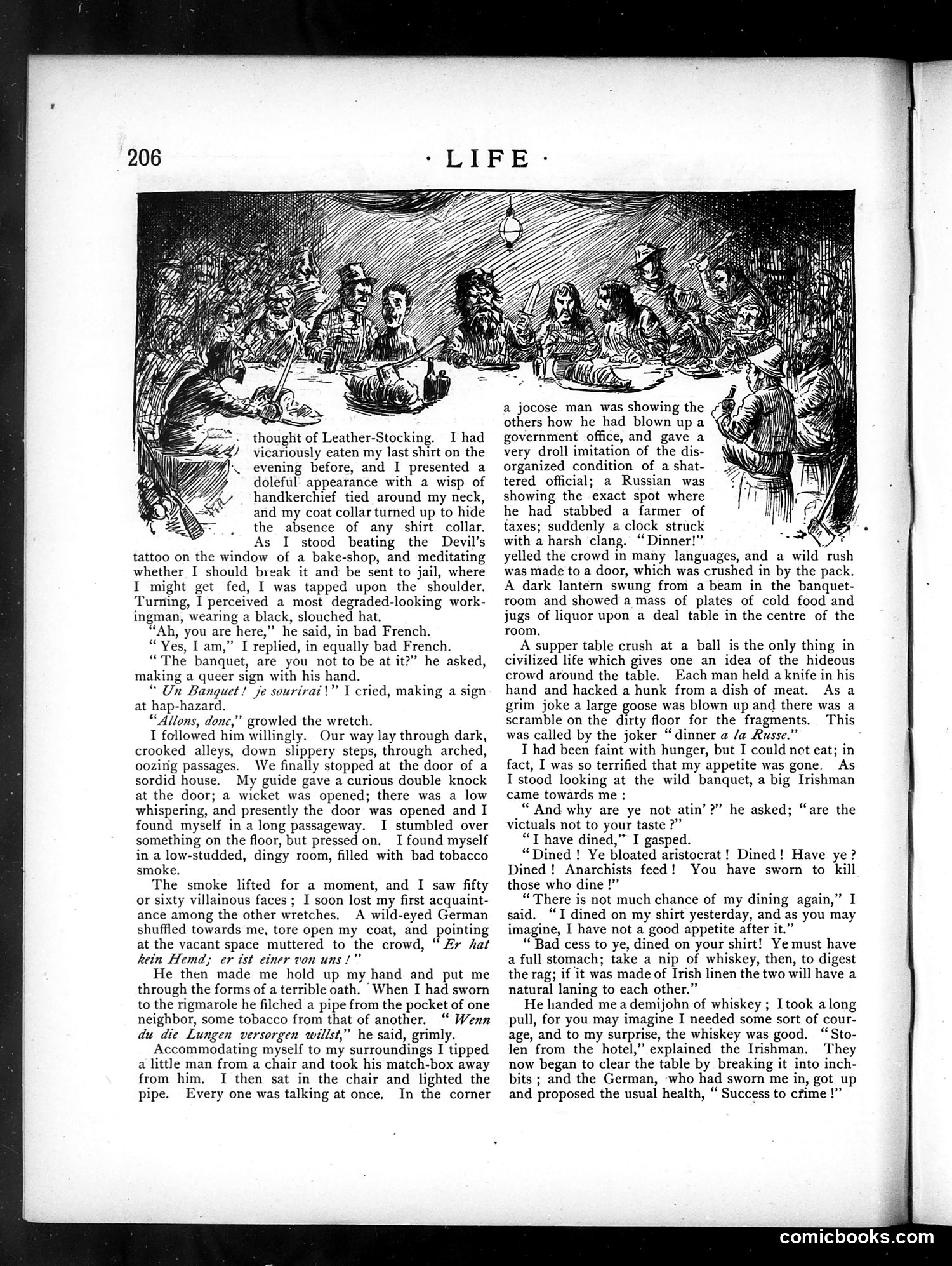
This page from *Life* magazine contains a narrative illustration (not a political cartoon) depicting a chaotic dinner scene. The engraving shows a crowded, boisterous gathering where various nationalities are represented—the text mentions a "jocose man" imitating a disorganized official, a Russian, and references to French, German, and Irish characters. The scene satirizes the disorder and absurdity of a multi-ethnic gathering, with jokes about dining, drunkenness, and nationalist stereotypes. References to "Anarchists" and violent behavior suggest this depicts bohemian or radical circles of the late 19th century. The humor relies on ethnic caricature and the chaos of diverse groups interacting, typical of *Life's* satirical approach to urban life and immigration-era social anxiety. The specific historical event or gathering referenced remains unclear from this excerpt alone.
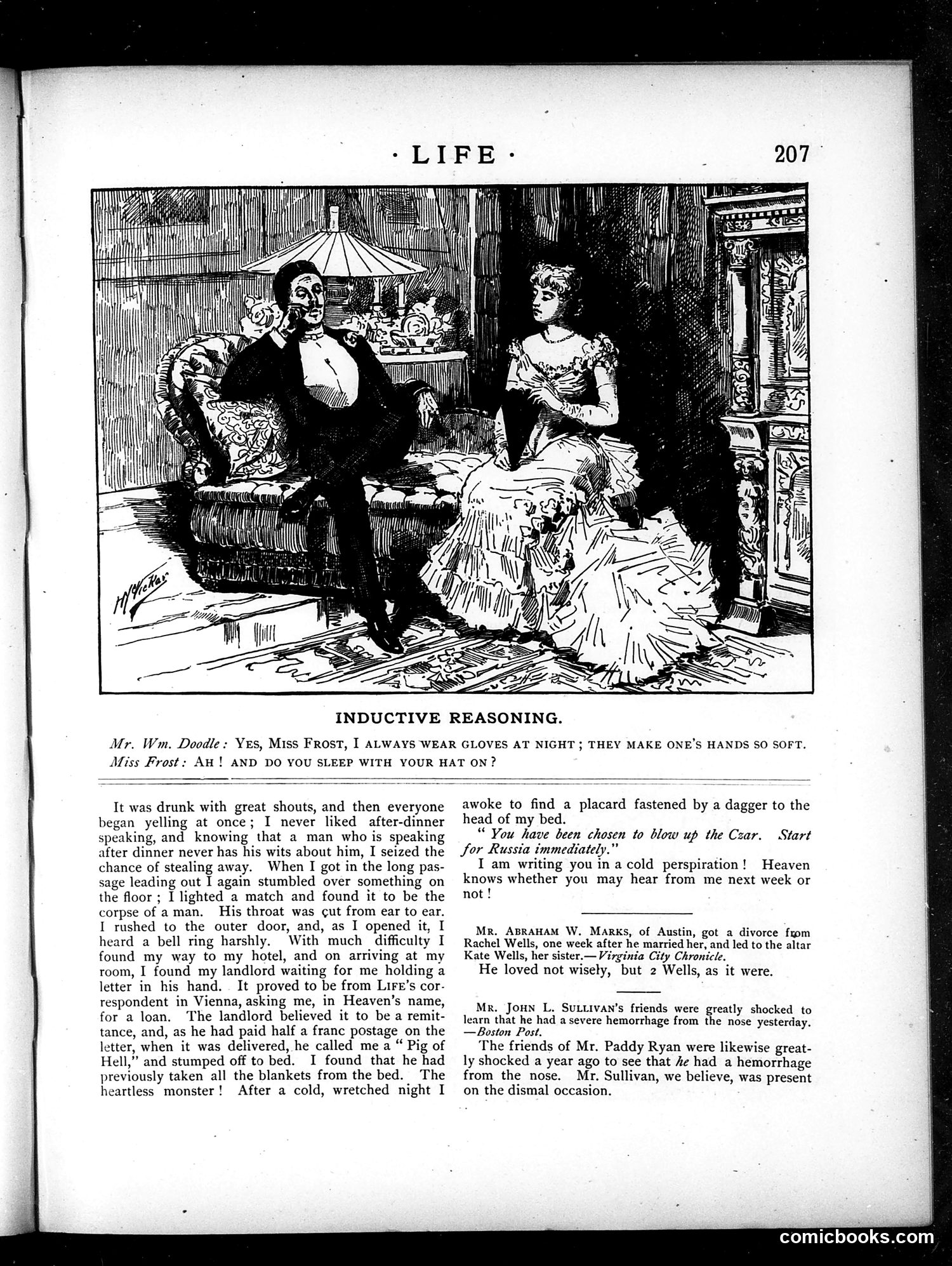
This cartoon satirizes flawed logic through a dialogue between Mr. Wm. Doodle and Miss Frost. Doodle claims he always wears gloves at night because they keep hands soft. Miss Frost points out the logical flaw: "And do you sleep with your hat on?" — implying his reasoning doesn't account for other factors. The humor lies in exposing "inductive reasoning" (drawing broad conclusions from limited examples) as faulty. Doodle assumes gloves alone cause soft hands, overlooking variables like sleeping position or other habits. The cartoon critiques human tendency toward oversimplified cause-and-effect thinking. The elegantly dressed Victorian figures in an ornate interior emphasize that even educated society members fall prey to such reasoning errors.
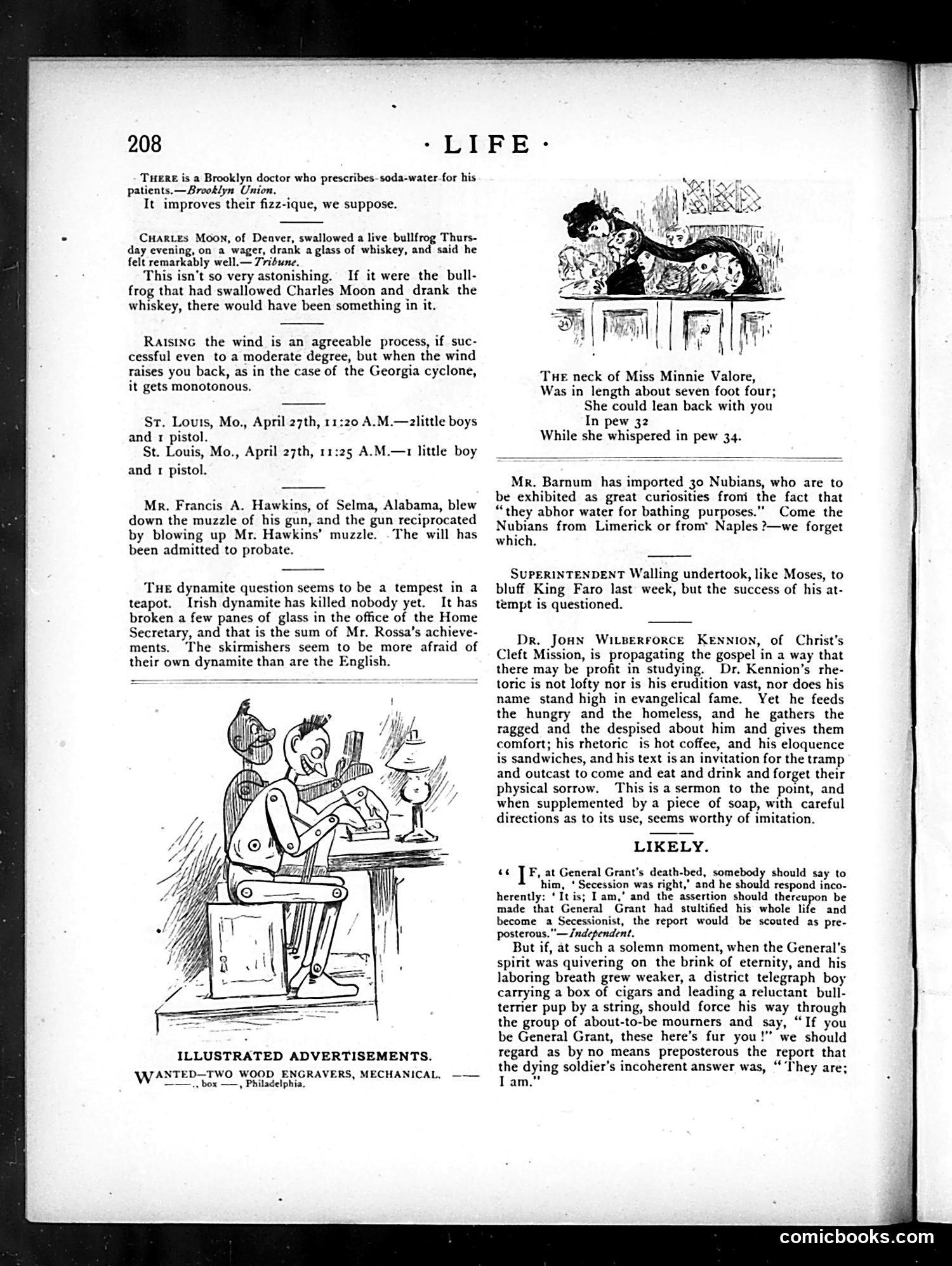
The page contains several brief satirical anecdotes rather than a single cartoon. The main illustrated cartoon (lower left) shows a mechanical contraption or device, though its specific satirical target is unclear from the image alone. The text includes jabs at: a Brooklyn doctor prescribing soda-water as medicine; a Denver man swallowing a live bullfrog; incidents involving firearms in St. Louis; and commentary on dynamite explosions in Irish politics versus English public institutions. The "Likely" section features a hypothetical about General Grant's deathbed—possibly referencing the recent (1885) death of Ulysses S. Grant, with satire about how his final words might be reported versus his actual response. The page is primarily text-based humor with minimal visual satire, typical of Life's early format.
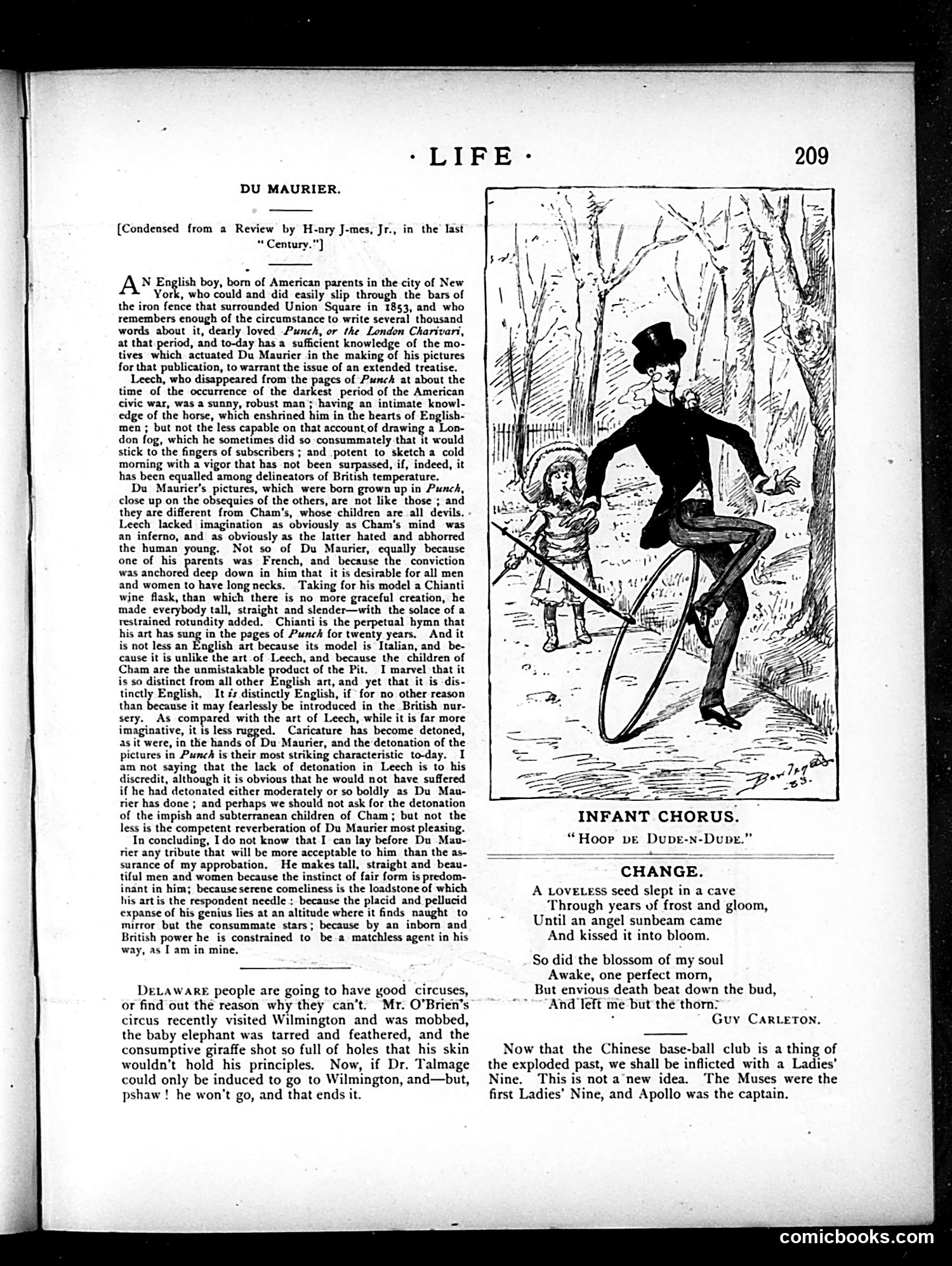
The cartoon depicts an adult (likely a parent or caregiver) with two small children in a winter woodland setting. The adult appears to be teaching or encouraging the children in some physical activity or game involving a hoop. The title "Hoop de Dude-n-Dude" suggests a playful, nonsensical children's rhyme or chant. The scene satirizes the earnest instruction of children in fashionable or trendy activities, poking fun at adult supervision of childhood recreation. The accompanying poem "Change" below uses romantic language about transformation and awakening, contrasting sharply with the humorous domestic scene above, suggesting ironic commentary on sentimentality in contemporary literature.
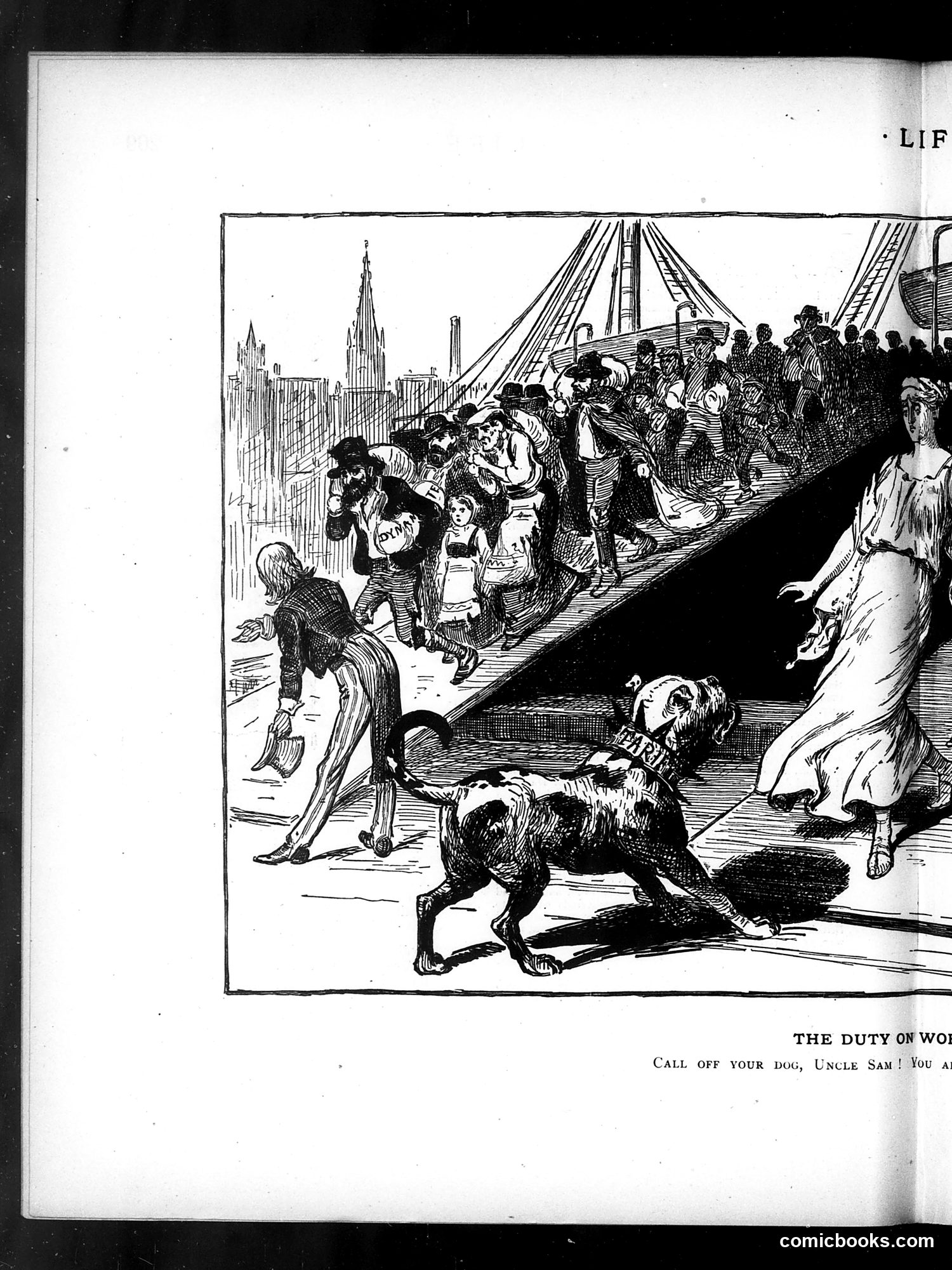
This satirical cartoon is titled "The Duty on Wool" with the caption "Call off your dog, Uncle Sam! You are hurting the wool interests!" The cartoon depicts a scene at what appears to be a harbor or dock, with a large crowd of people and a prominent dog in the foreground. "Uncle Sam" (the personification of the United States government) is shown with the dog, which likely represents American tariff policy or trade enforcement. The satire concerns wool tariffs—the dog appears to be attacking or disrupting wool interests, suggesting that protective tariff duties are harming rather than helping American wool producers. The crowded dock scene indicates commercial activity, possibly international trade. The joke critiques the unintended consequences of protectionist economic policies, arguing they damage the very industries they're meant to protect.
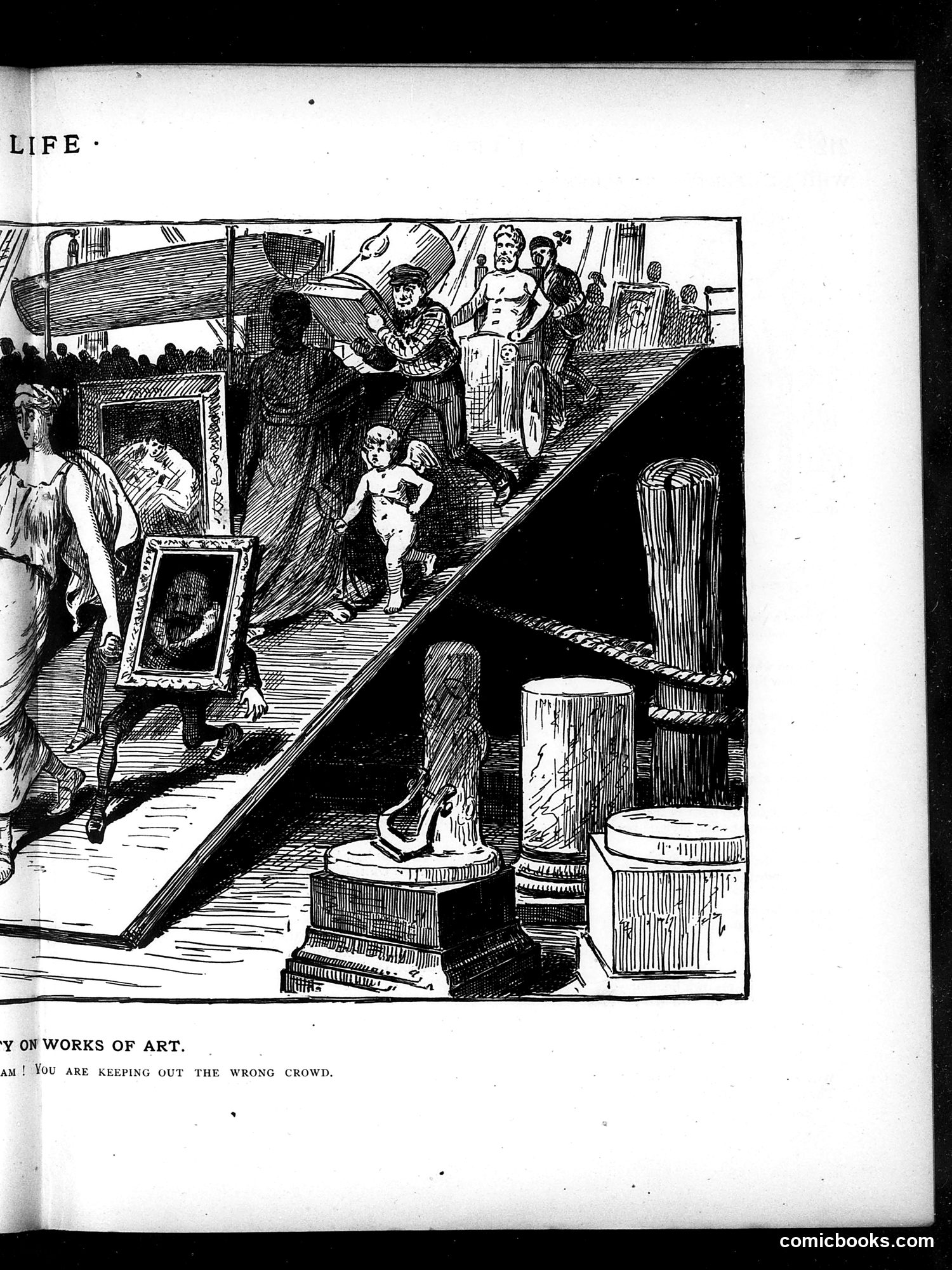
This is a satirical cartoon about art museum management. The scene depicts what appears to be an art gallery or exhibition space with classical sculptures and paintings on display. The caption reads: "A COMMENTARY ON WORKS OF ART" with the punchline "SIR! YOU ARE KEEPING OUT THE WRONG CROWD." The joke satirizes museum gatekeeping and class discrimination. The implication is that museum staff are excluding working-class or "common" visitors while admitting wealthy or fashionable patrons—suggesting they're being snobbish about who deserves access to art. The satire critiques the pretension of high-art institutions that claim to serve the public but actually serve only elite audiences. This reflects early 20th-century debates about art democratization and public access.
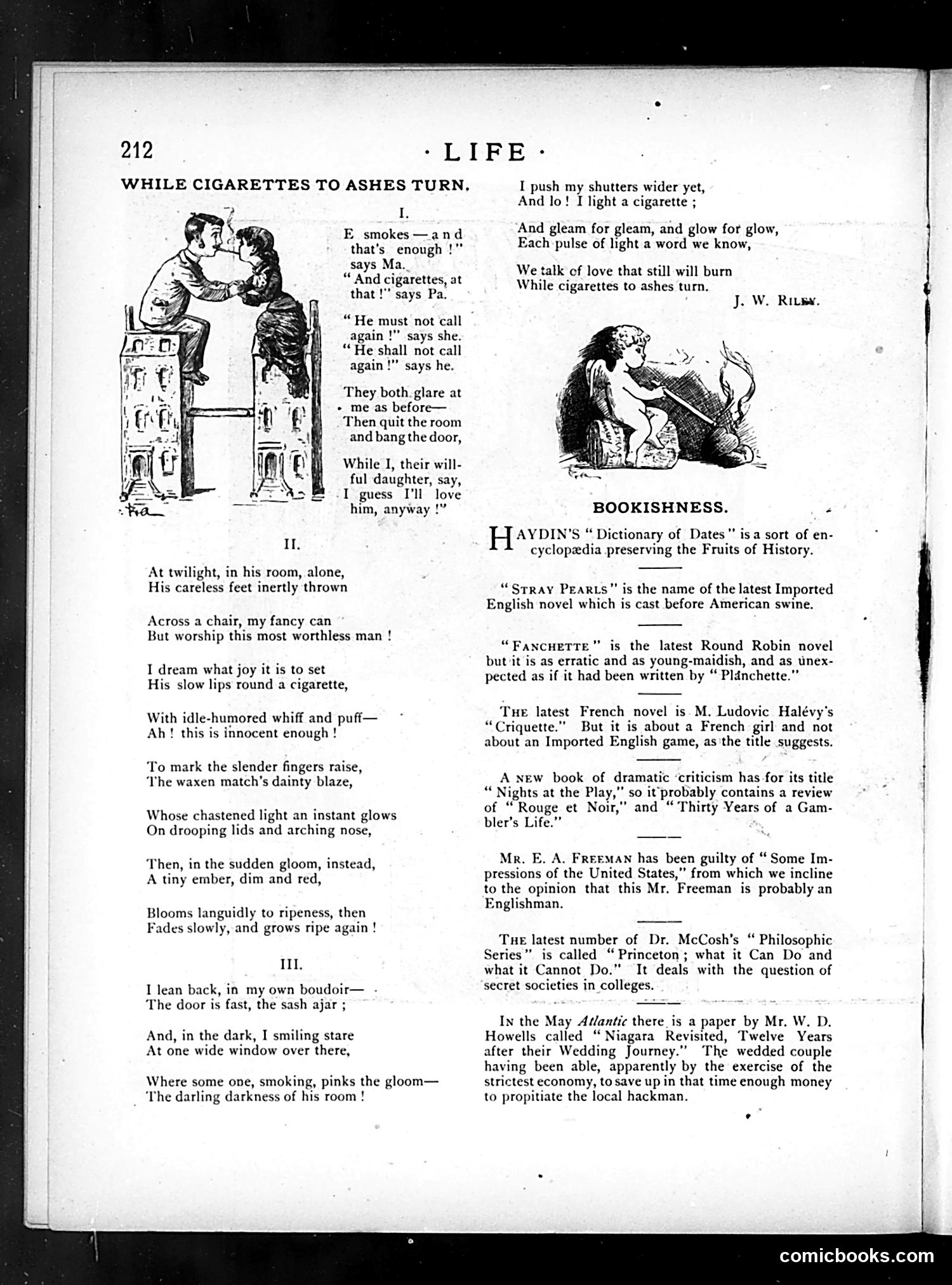
This satirical poem mocks romantic Victorian sentimentality. A young woman defies her parents' disapproval of a suitor by communicating with him across the darkness—using cigarette glows as a coded love language ("Each pulse of light a word we know"). The joke targets both the absurdity of parental prohibition and the overwrought, dramatic way young people romanticize forbidden love. The cigarette becomes a symbol of youthful rebellion and secret romance, with the poem's elaborate descriptions of smoke, ember, and glow treating a trivial act as profound tragedy. The cartoon panel shows parents angrily forbidding the man to call again—he "must not call" and "shall not call"—while the willful daughter declares she'll love him "anyway," establishing the setup for the poem's defiant conclusion.
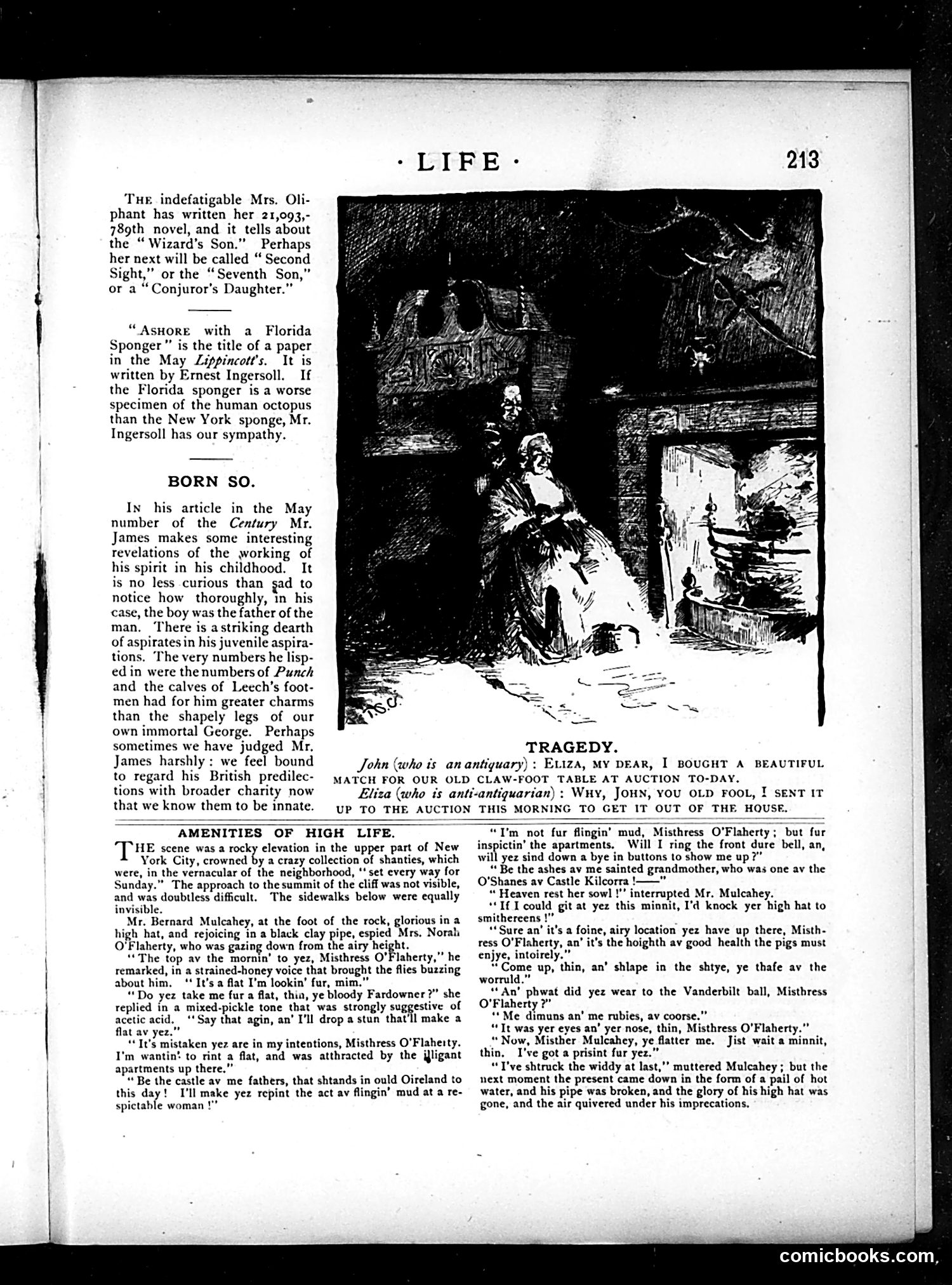
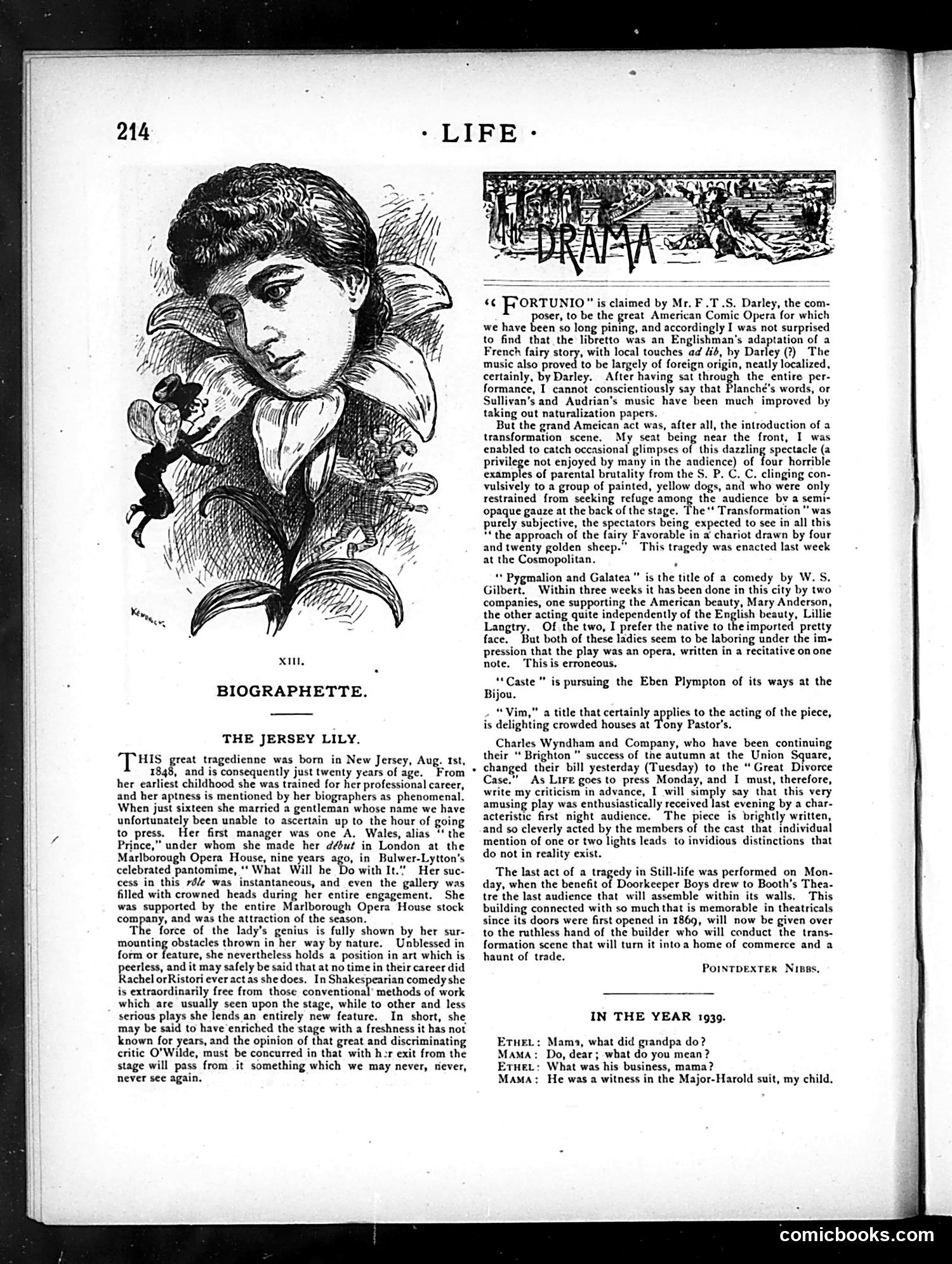
This page features a satirical biography of **Lillie Langtry**, a British actress born in Jersey in 1848. The caricature emphasizes her plain features—the text admits she was "unblessed in form or feature"—yet claims she ranks among history's greatest actresses, comparing her to Rachel and Ristori. The satire mocks the hype surrounding Langtry's London debut. The exaggerated praise (crowds of "crowned heads," Oscar Wilde's glowing reviews) contrasts sharply with the honest admission that she's physically unremarkable. This reflects genuine contemporary debate about whether her fame derived from talent or novelty/beauty marketing. The DRAMA section below reviews recent theatrical productions, including the comic opera *Fortunio* (criticized for being a French adaptation dressed up as American) and W.S. Gilbert's *Pygmalion and Galatea*, noting two actresses—American Mary Anderson and English Lillie Langtry—are performing it simultaneously. The overall message: skepticism about celebrity worship and imported cultural products.
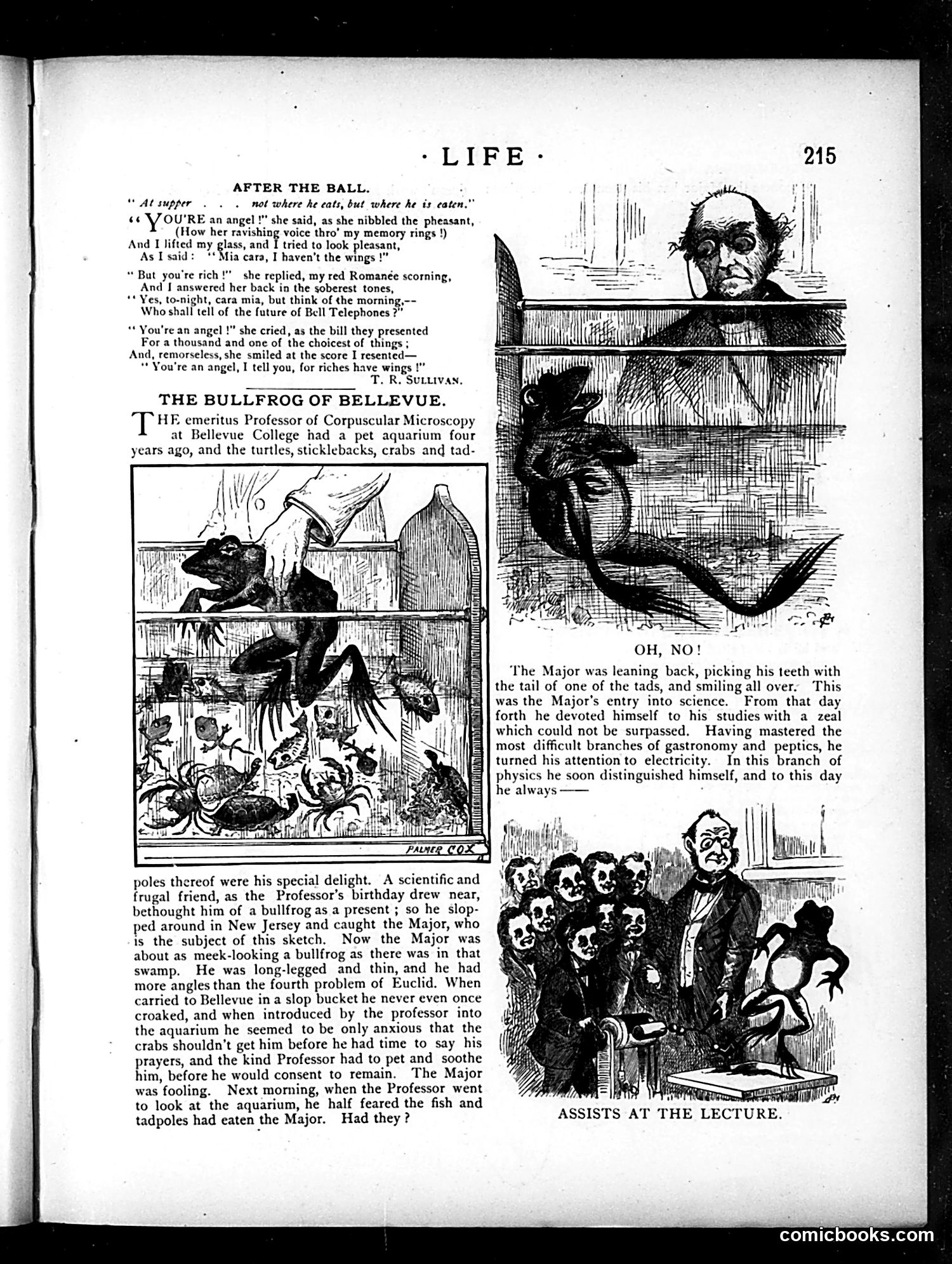
This humorous story satirizes academic pretension and the gap between appearances and reality. A meek-looking bullfrog ("the Major") is gifted to a pompous Bellevue College professor of microscopy. Initially appearing timid and pious, the frog is actually predatory and ambitious. Once placed in the aquarium, he devours the other creatures and becomes obsessed with self-improvement, eventually mastering "gastronomy and peptics" before turning to electricity. The satire mocks the professor's naive sentimentality and the bullfrog's ruthless climb through pseudo-intellectual pursuits. The accompanying illustrations show the professor's shocked discovery and the frog's transformation from meek victim to dominant force. The joke satirizes both academic pomposity and the American success narrative—the frog succeeds not through genuine learning but through aggression and opportunism, disguised as scholarly devotion.
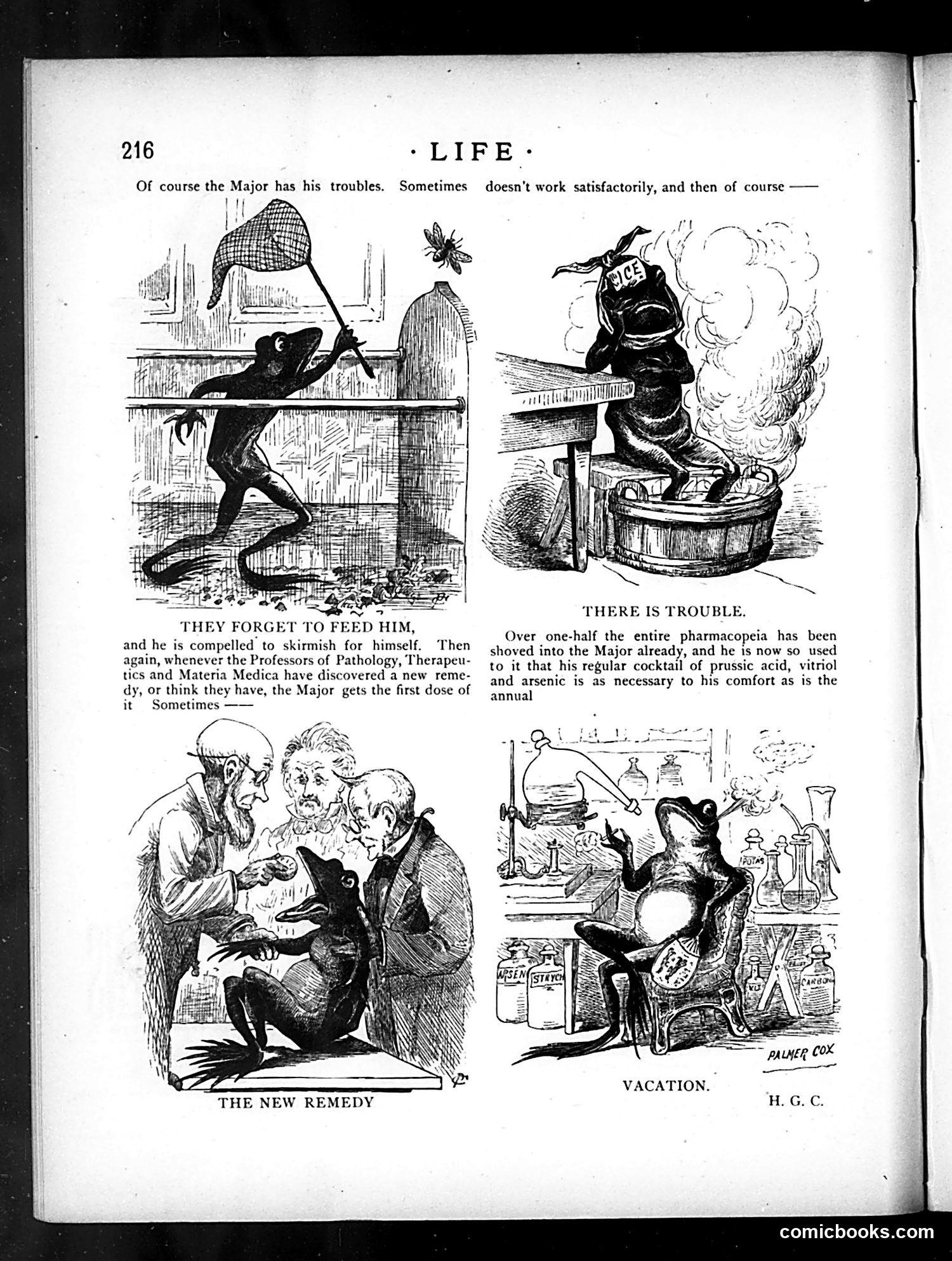
This satirical page from *Life* magazine mocks medical experimentation on animals, specifically depicting a laboratory guinea pig or similar creature called "the Major." The cartoons show: 1. **"They Forget to Feed Him"** — The animal is neglected and forced to hunt for food. 2. **"There Is Trouble"** — The Major has been poisoned with so many experimental drugs (prussic acid, vitriol, arsenic) that toxic substances are now essential to its survival. 3. **"The New Remedy"** — Doctors administer another experimental treatment to the suffering animal. 4. **"Vacation"** — The Major relaxes amid pharmacy bottles, having survived its ordeal. The satire critiques the cruel and excessive nature of medical testing on animals, suggesting that doctors recklessly experiment with dangerous poisons without regard for the creature's welfare. The humor is darkly ironic—the animal has been so thoroughly poisoned it's become dependent on toxins.
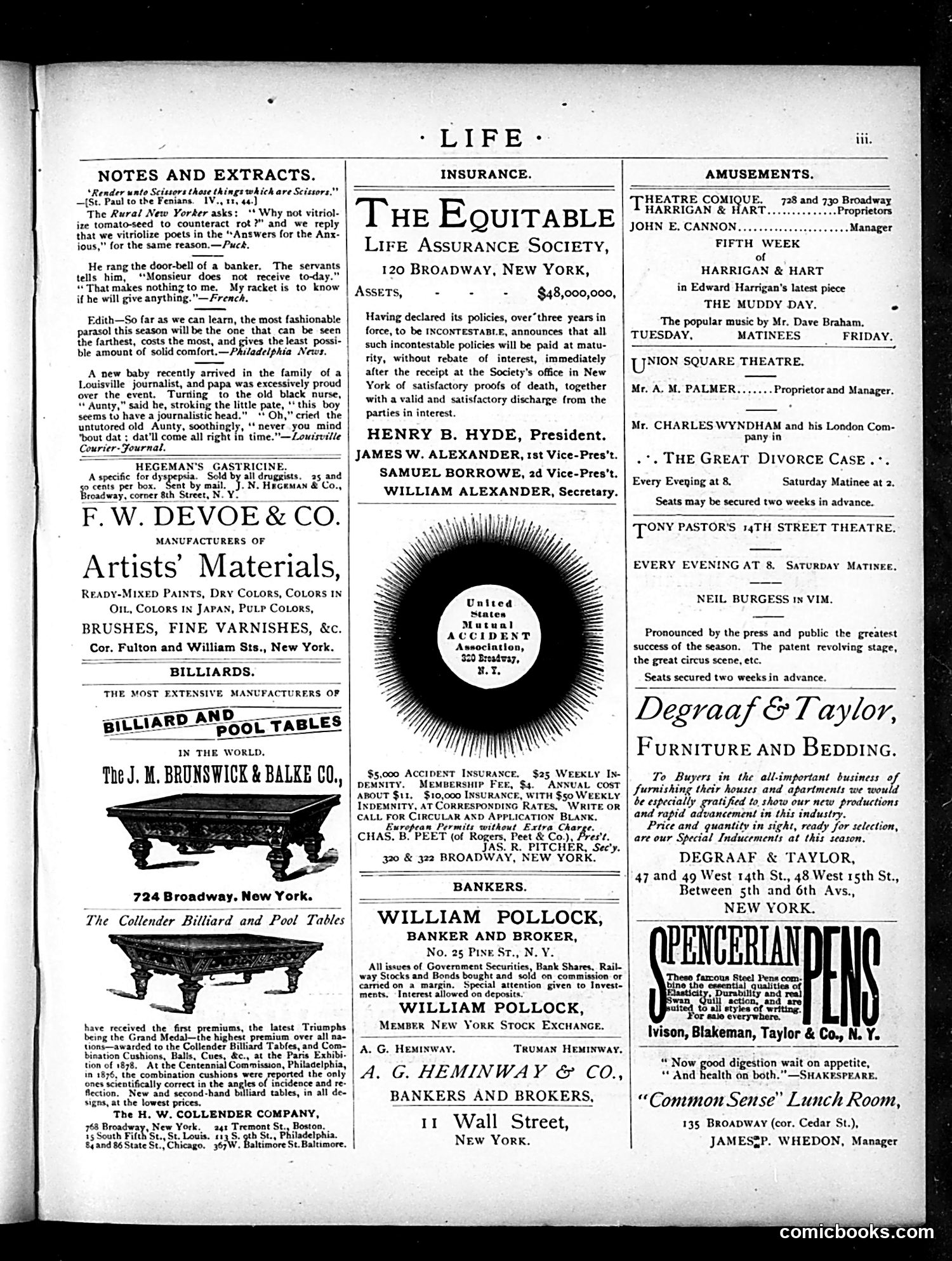
This is primarily a **commercial advertising page** with brief satirical humor notes at the top—typical of *Life's* format mixing content and income sources. The key joke is the pseudo-biblical opener: "*Render unto Scissors those things which are Scissors*" attributed to "St. Paul to the Fenians." This is absurdist humor mocking the contemporary Irish-American "Fenian" movement by inventing a ridiculous pseudo-scriptural justification for cutting things—likely poking fun at radical politics through nonsensical wordplay. Other brief jokes mock: - Urban farming advice (vitriolizing tomato seeds) - Fashion parasols being more decorative than functional - A Black nursemaid's reassurance about a baby's "journalistic head" The bulk of the page advertises financial services (banks, life insurance), art supplies, and billiard tables—revealing late-1870s/early-1880s commercial priorities and the publication's business model.
This page is **primarily advertising**, not a political cartoon. It's a collection of late 19th-century product advertisements from *Life* magazine, featuring: **Notable ads include:** - Arnold Constable & Co. (clothing/umbrellas) - Dunlap & Co. (hats) - Durham House Drainage (plumbing systems) - Wall paper and printing ink - Fine champagne and brandy - Steel pens **The only substantive content** is a warning advertisement against counterfeit Vichy water, a French mineral water marketed for medicinal purposes (gout, rheumatism, kidney diseases). The ad emphasizes the "only genuine" product comes from springs owned by the French government. The drainage company ad includes a small diagram of their plumbing system and claims it was adopted for Columbia College's new School of Mines building. There are **no political cartoons or satire** on this page—it's a straightforward advertising section typical of *Life*'s revenue model during this era.