
Life, 1883-05-03 · page 7 of 16
Life — May 3, 1883 — page 7: what you’re looking at
What you’re looking at
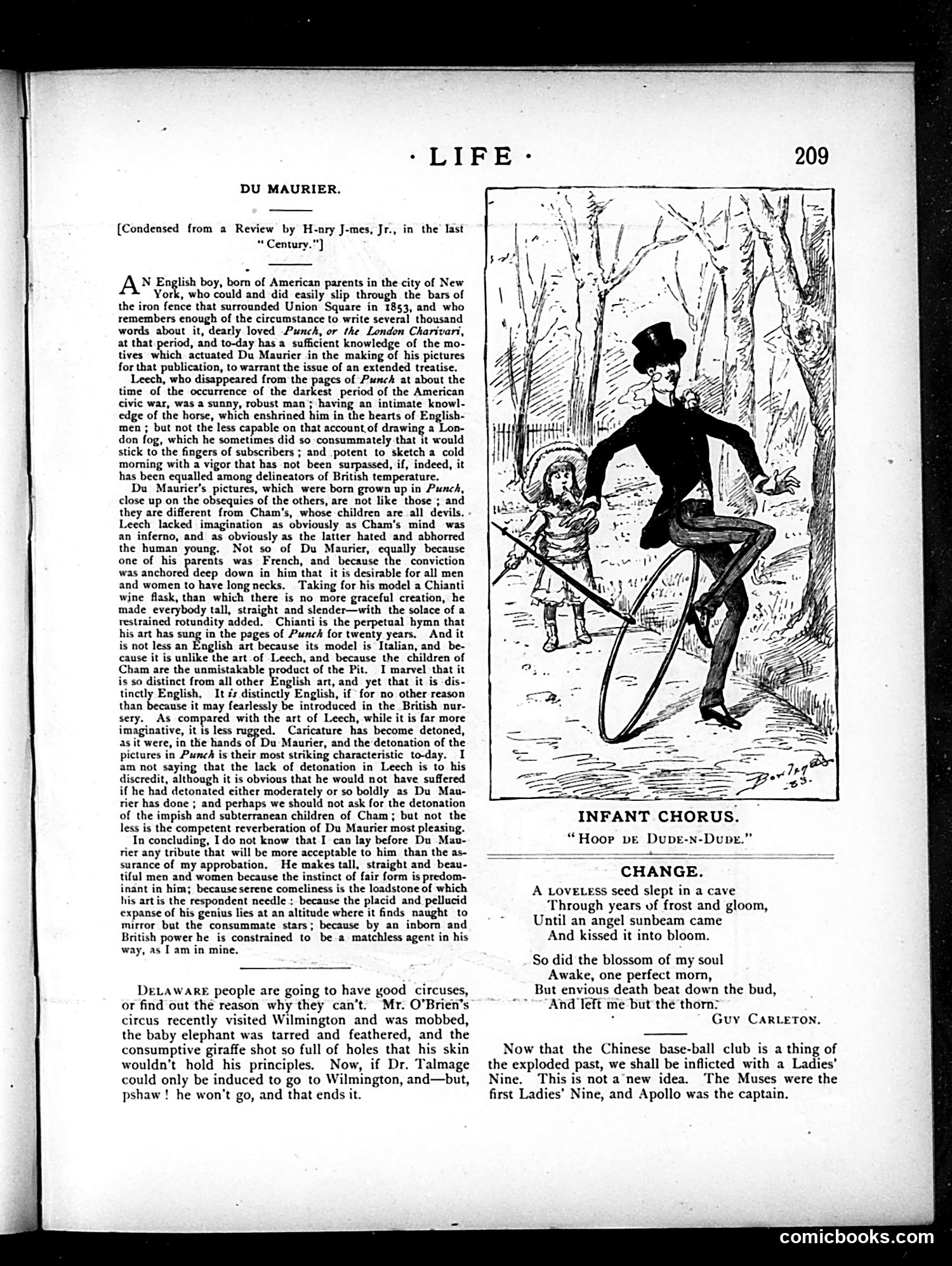
The cartoon depicts an adult (likely a parent or caregiver) with two small children in a winter woodland setting. The adult appears to be teaching or encouraging the children in some physical activity or game involving a hoop. The title "Hoop de Dude-n-Dude" suggests a playful, nonsensical children's rhyme or chant. The scene satirizes the earnest instruction of children in fashionable or trendy activities, poking fun at adult supervision of childhood recreation. The accompanying poem "Change" below uses romantic language about transformation and awakening, contrasting sharply with the humorous domestic scene above, suggesting ironic commentary on sentimentality in contemporary literature.
📄 Transcribed text from this page (OCR, searchable)
Machine-transcribed from the original scan — historical spelling and the odd misread are preserved.
DU MAURIER. (Condensed from a Review by H-nry J-mes, Jr., in the’ last “ Century.") A® English boy, born of American parents in the city of New York, who could and did easily slip through the bars of the iron fence that surrounded Union Square in 1853, and who remembers enough of the circumstance to write several thousand words about it, dearly loved Punch, or the London Charivari, at that period, and to-day has a sufficient knowledge of the mo- tives which actuated Du Maurier in the making of his pictures for that publication, to warrant the issue of an extended treatise. Leech, who disappeared from the pages of Punch at about the time of the occurrence of the darkest period of the American civic war, was a sunny, robust man ; having an intimate knowl- edge of the horse, which enshrined him in the hearts of English- men ; but not the less capable on that account.of drawing i Lon: don fog, which he sometimes did so consummately that it would stick to the fingers of subscribers ; and potent to sketch a cold morning with a vigor that has not been surpassed, if, indeed, it has been equalled among delineators of British temperature. Du Maurier’s pictures, which were born grown up in Punch, close up on the obsequies of the others, are not like those ; and they are different from Cham’s, whose children are all devils. Leech lacked imagination as obviously as Cham’s mind was an inferno, and as obviously as the latter hated and abhorred the human young. Not so of Du Maurier, equally because one of his parents was French, and because the conviction was anchored deep down in him that it is desirable for all men and women to have long necks. Taking for his model a Chianti wine flask, than which there is no more graceful creation, he made everybody tall, straight and slender—with the solace of a restrained rotundity added. Chianti is the perpetual hymn that his art has sung in the pages of Punch for twenty years. And it is not less an English art because its model is Italian, and be- cause it is unlike the art of Leech, and because the children of Cham are the unmistakable product of the Pit. I marvel that it is so distinct from all other English art, and yet that it is dis- tinctly English, It #s distinctly English, if for no other reason than because it may fearlessly be introduced in the British nur- sery. As compared with the art of Leech, while it is far more imaginative, it is less rugged. Caricature has become detoned, as it were, in the hands of Du Maurier, and the detonation of the pictures in Punch is their most striking characteristic to-day. I am not saying that the lack of detonation in Leech is to his discredit, although it is obvious that he would not have suffered if he had detonated either moderately or so boldly as Du Mau- rier has done ; and perhaps we should not ask for the detonation of the impish and subterranean children of Cham; but not the less is the competent reverberation of Du Maurier most pleasing. In concluding, Ido not know that I can lay before Du Mau- rier any tribute that will be more acceptable to him than the as- surance of my approbation. He makes tall, straight and beau- tiful men and women because the instinct of fair form is predom- inant in him; because serene comeliness is the loadstone of which his art is the respondent needle : because the placid and pellucid expanse of his genius lies at an altitude where it finds naught to mirror but the consummate stars; because by an inborn and British power he is constrained to be a matchless agent in his way, as I am in mine, DeLAWarE people are going to have good circuses, or find out the reason why they can’t. Mr. O’Brien’s circus recently visited Wilmington and was mobbed, the baby elephant was tarred and feathered, and the consumptive giraffe shot so full of holes that his skin wouldn't hold his principles. Now, if Dr. Talmage could only be induced to go to Wilmington, and—but, pshaw ! he won't go, and that ends it. INFANT CHORUS. “Hoop ve Dup CHANGE. A LOVELESS seed slept in a cave Through years of frost and gloom, Until an angel sunbeam came And kissed it into bloom. So did the blossom of my soul Awake, one perfect mom, But envious death beat down the bud, And left me but the thorn? 7 Guy CaRLeTon. Now that the Chinese base-ball club is a thing of the exploded past, we shall be inflicted with a Ladies’ Nine. This is not anew idea. The Muses were the first Ladies’ Nine, and Apollo was the captain. comicbooks.com