
Life, 1883-05-03 · page 12 of 16
Life — May 3, 1883 — page 12: what you’re looking at
What you’re looking at
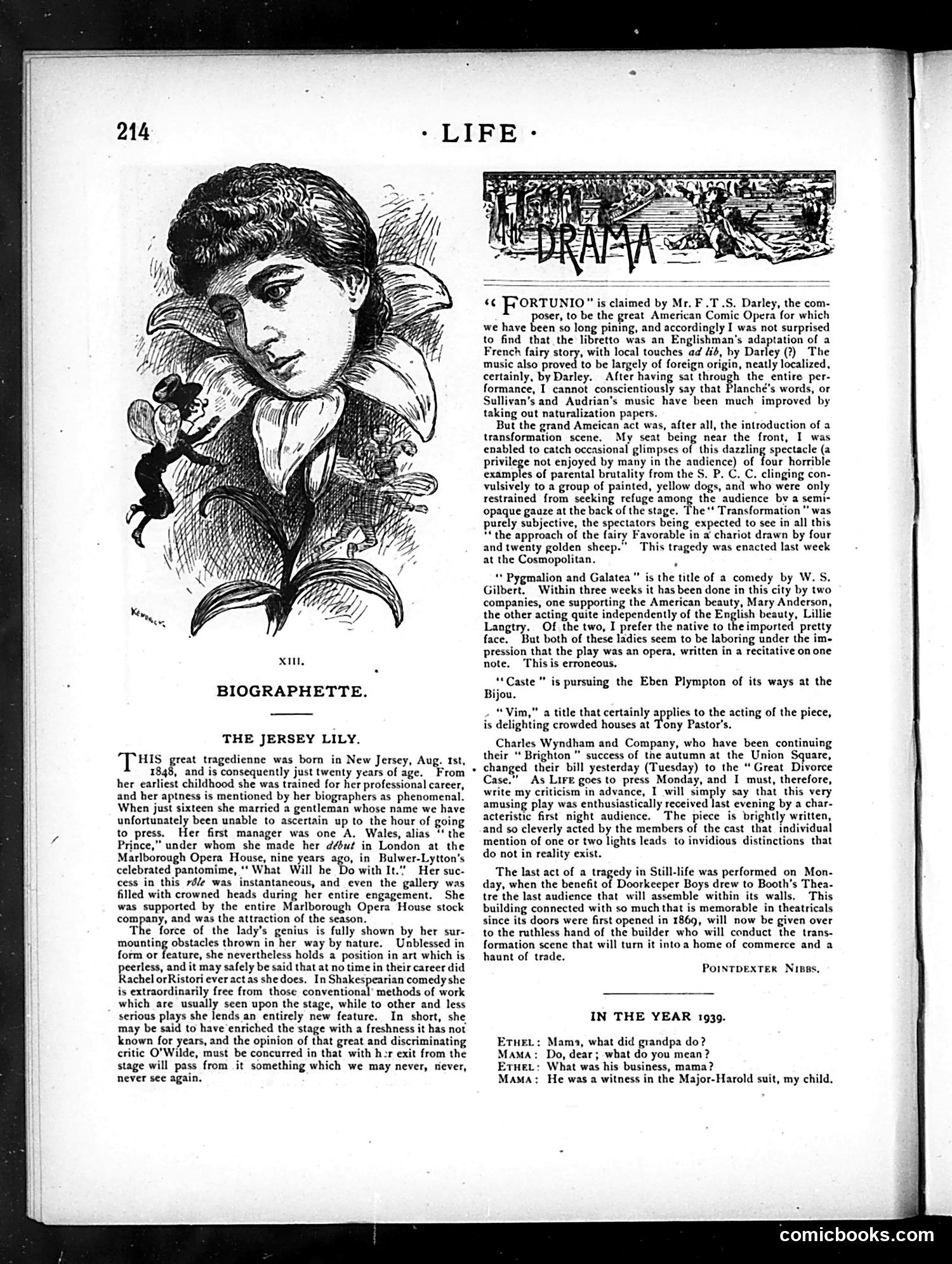
This page features a satirical biography of **Lillie Langtry**, a British actress born in Jersey in 1848. The caricature emphasizes her plain features—the text admits she was "unblessed in form or feature"—yet claims she ranks among history's greatest actresses, comparing her to Rachel and Ristori. The satire mocks the hype surrounding Langtry's London debut. The exaggerated praise (crowds of "crowned heads," Oscar Wilde's glowing reviews) contrasts sharply with the honest admission that she's physically unremarkable. This reflects genuine contemporary debate about whether her fame derived from talent or novelty/beauty marketing. The DRAMA section below reviews recent theatrical productions, including the comic opera *Fortunio* (criticized for being a French adaptation dressed up as American) and W.S. Gilbert's *Pygmalion and Galatea*, noting two actresses—American Mary Anderson and English Lillie Langtry—are performing it simultaneously. The overall message: skepticism about celebrity worship and imported cultural products.
📄 Transcribed text from this page (OCR, searchable)
Machine-transcribed from the original scan — historical spelling and the odd misread are preserved.
BIOGRAPHETTE. THE JERSEY LILY. THs great tragedienne was born in New Jersey, Aug. Ist, 1848, and is consequently just twenty years of age. Fi her earliest childhood she was trained for her professional career, and her aptness is mentioned by her biographers as phenomenal. When just sixteen she married a gentleman whose name we have unfortunately been unable to ascertain up to the hour of going to press. Her first manager was one A, Wales, alias ‘the Prince,” under whom she made her début in London at the Marlborough Opera House, nine years ago, in Bulwer-Lytton’s celebrated pantomime, ‘* What Will he Do with It.’ Her suc- cess in this ré/e was instantaneous, and even the gallery was filled with crowned heads during her entire engagement. She was supported by the entire Marlborough Opera House stock company, and was the attraction of the season. The force of the lady's genius is fully shown by her sur- mounting obstacles thrown in her way by nature. Unblessed in form or feature, she nevertheless holds a position in art which is peerless, and it may safely be said that at no time in their career did Rachel orRistori ever act as she does. In Shakespearian comedy she is extraordinarily free from those conventional’ methods of work which are usually seen upon the stage, while to other and less serious plays she lends an entirely new feature. In short, she may be said to have enriched the stage with a freshness it has not known for years, and the opinion of that great and discriminating critic O'Wilde, must be concurred in that with her exit from the stage will pass from it something which we may never, never, never see again. From * “ ORTUNIO" is claimed by Mr. F .T .S. Darley, the com- poser, to be the great American Comic Opera for which we have been so long pining, and accordingly I was not surprised to find that the libretto was an Englishman's adaptation of a French fairy story, with local touches ad 45, by Darley (2) The music also ahead to be largely of foreign origin, neatly localized, certainly, by Darley. After having sat through the entire per- formance, I cannot conscientiously say that Planche’s words, or Sullivan’s and Audrian'’s music have been much improved by taking out naturalization papers. But the grand Ameican act was, after all, the introduction of a transformation scene. My seat being near the front, I was enabled to catch occasional glimpses of this dazzling spectacle (a privilege not enjoyed by many in the audience) of four horrible Samples of parental brutality from the S. P. C. C. clinging con- vulsively to a group of painted, yellow dogs, and who were only restrained from seeking refuge among the audience bv a semi- opaque gauze at the back of the stage. The‘ Transformation" was purely subjective, the spectators being expected to see in all this ** the approach of the fairy Favorable in @ chariot drawn by four and twenty golden sheep.” at the Cosmopolitan, This tragedy was enacted last week ** Pygmalion and Galatea” is the title of a comedy by W. S. Gilbert. Within three weeks it has been done in this city by two companies, one supporting the American beauty, Mary Anderson, the other acting quite independently of the English beauty, Lill Langtry. Of the two, I prefer the native to the imported pretty face. But both of these ladies seem to be laboring under the im- pression that the play was an opera, written in a recitative on one note, This is erroneous, **Caste " is pursuing the Eben Plympton of its ways at the Bijou. “Vim,” a title that certainly applies to the acting of the piece, is delighting crowded houses at Tony Pastor's. Charles Wyndham and Company, who have been continuing their “ Brighton ” success of the autumn at the Union Square, changed their bill yesterday (Tuesday) to the “Great Divorce Case." As Lire goes to press Monday, and I must, therefore, write my criticism in advance, I will simply say that this very amusing play was enthusiastically received last evening by a char- acteristic first night audience. The piece is brightly written, and so cleverly acted by the members of the cast that individual mention of one or two lights leads to invidious distinctions that do not in reality exist. The last act of a tragedy in Still-life was performed on Mon- day, when the benefit of Doorkeeper Boys drew to Booth’s Thea- tre the last audience that will assemble within its walls. This building connected with so much that is memorable in theatricals since its doors were first opened in 1869, will now be given over to the ruthless hand of the builder who will conduct the trans- formation scene that will turn it intoa home of commerce and a haunt of trade. POINTDEXTER Nipss, IN THE YEAR 1939. Mama, what did grandpa do? Do, dear; what do you mean? : What was his business, mama? : He was a witness in the Major-Harold suit, my child. comicbooks.com