
Life, 1883-05-03 · page 3 of 16
Life — May 3, 1883 — page 3: what you’re looking at
What you’re looking at
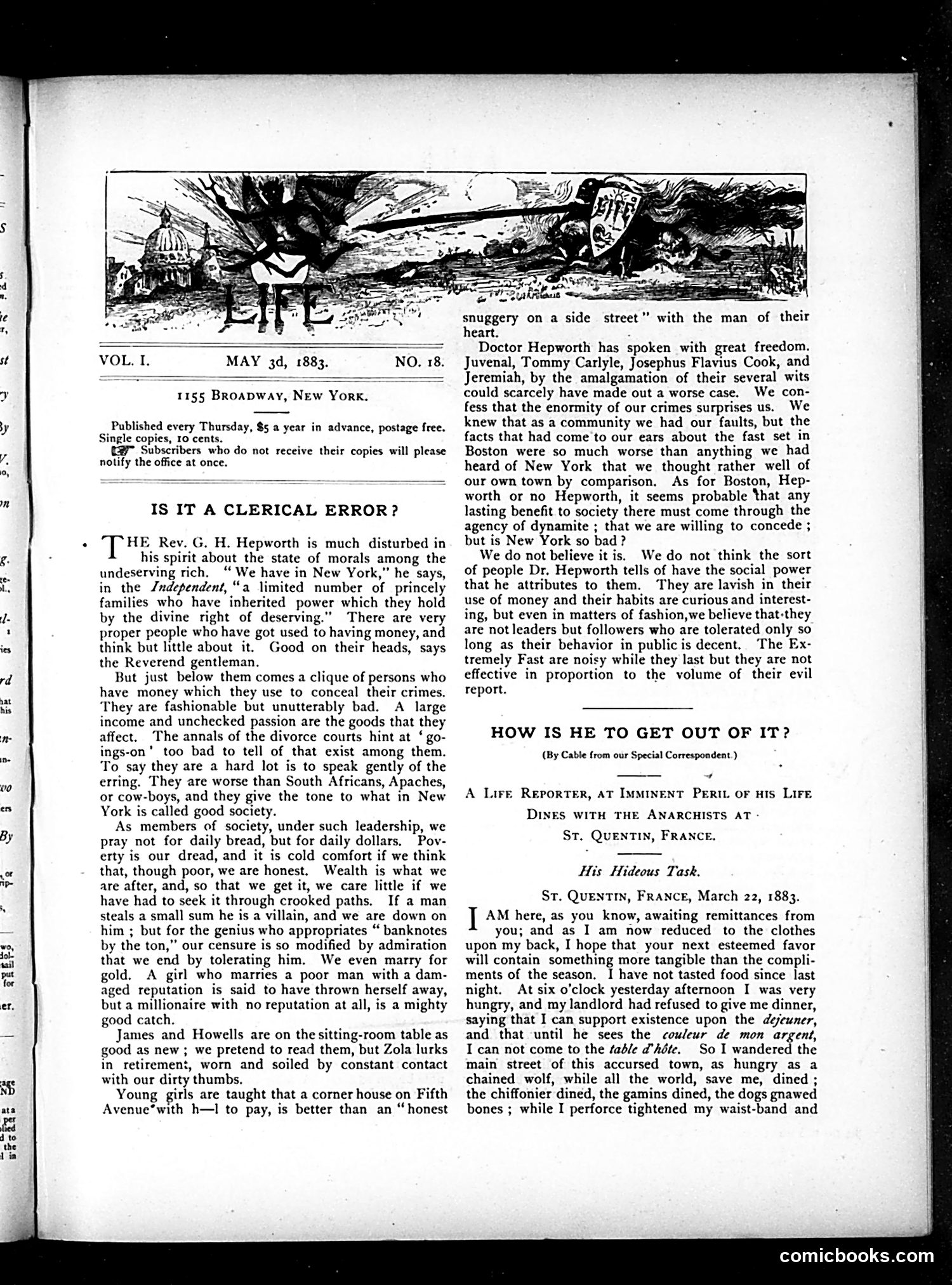
The page contains two articles rather than a political cartoon. The main piece, "IS IT A CLERICAL ERROR?", critiques Rev. G. H. Hepworth's public statements about New York's moral condition. Hepworth apparently claimed New York's poor were worse than Boston's, prompting this editorial response defending New York's character and questioning whether Hepworth possessed actual authority to make such judgments. The second article, "HOW IS HE TO GET OUT OF IT?", reports via cable from a correspondent in St. Quentin, France, about an unnamed life reporter facing anarchist danger. The writer describes desperate poverty and hints at precarious circumstances. Both pieces employ satire—the first mocking clerical moralizing, the second using ironic tone about dangerous foreign radicalism—typical of Life's satirical approach to contemporary social issues.
📄 Transcribed text from this page (OCR, searchable)
Machine-transcribed from the original scan — historical spelling and the odd misread are preserved.
MAY 3d, 1883. 1155 Broapway, New York. Published every Thursday, $5 a year in advance, postage free. Single copies, 10 cents. 2 Subscribers who do not receive their copies will please notify the office at once. IS IT A CLERICAL ERROR? HE Rev. G. H. Hepworth is much disturbed in his spirit about the state of morals among the undeserving rich, “ We have in New York,” he says, in the Jndependent, “a limited number of princely families who have inherited power which they hold by the divine right of deserving.” There are very proper people who have got used to having money, and think but little about it. Good on their heads, says the Reverend gentleman. But just below them comes a clique of persons who have money which they use to conceal their crimes. They are fashionable but unutterably bad. A_ large income and unchecked passion are the goods that they affect. The annals of the divorce courts hint at ‘ go- ings-on’ too bad to tell of that exist among them. To say they are a hard lot is to speak gently of the erring. They are worse than South Africans, Apaches, or cow-boys, and they give the tone to what in New York is called good society. As members of society, under such leadership, we pray not for daily bread, but for daily dollars. Pov- erty is our dread, and it is cold comfort if we think that, though poor, we are honest. Wealth is what we are after, and, so that we get it, we care little if we have had to seek it through crooked paths. If a man steals a small sum he is a villain, and we are down on him ; but for the genius who appropriates “ banknotes by the ton,” our censure is so modified by admiration that we end by tolerating him. We even marry for gold. A girl who marries a poor man with a dam- aged reputation is said to have thrown herself away, but a millionaire with no reputation at all, is a mighty good catch. James and Howells are on the sitting-room table as good as new ; we pretend to read them, but Zola lurks in retirement, worn and soiled by constant contact with our dirty thumbs. Young girls are taught that a corner house on Fifth Avenue*with h—I to pay, is better than an “honest snuggery on a side street’ with the man of their heart. 5 Doctor Hepworth has spoken with great freedom. Juvenal, Tommy Carlyle, Josephus Flavius Cook, and Jeremiah, by the amalgamation of their several wits could scarcely have made out a worse case. We con- fess that the enormity of our crimes surprises us. We knew that as a community we had our faults, but the facts that had come'to our ears about the fast set in Boston were so much worse than anything we had heard of New York that we thought rather well of our own town by comparison. As for Boston, Hep- worth or no Hepworth, it seems probable that any lasting benefit to society there must come through the agency of dynamite ; that we are willing to concede ; but is New York so bad? We do not believe it is. Wedo not think the sort of people Dr. Hepworth tells of have the social power that he attributes to them. They are lavish in their use of money and their habits are curious and interest- ing, but even in matters of fashion,we believe that-they are not leaders but followers who are tolerated only so long as their behavior in public is decent. The Ex- tremely Fast are noisy while they last but they are not effective in proportion to the volume of their evil report. HOW IS HE TO GET OUT OF IT? (By Cable from our Special Correspondent.) A Lire Reporter, aT IMMINENT PERIL OF HIS LIFE DINES WITH THE ANARCHISTS AT - St, QUENTIN, FRANCE, His Hideous Task. St. QUENTIN, FRANCE, March 22, 1883. AM here, as you know, awaiting remittances from you; and as I am now reduced to the clothes upon my back, I hope that your next esteemed favor will contain something more tangible than the compli- ments of the season. I have not tasted food since last night. At six o’clock yesterday afternoon I was very hungry, and my landlord had refused to give me dinner, saying that I can support existence upon the dejeuner, and that until he sees the couleur de mon argent, I can not come to the fad/e d’hdte. So 1 wandered the main street of this accursed town, as hungry as a chained wolf, while all the world, save me, dined ; the chiffonier dined, the gamins dined, the dogs gnawed bones ; while I perforce tightened my waist-band and comicbooks.com