
A complete issue · 16 pages · 1883
Life — April 12, 1883
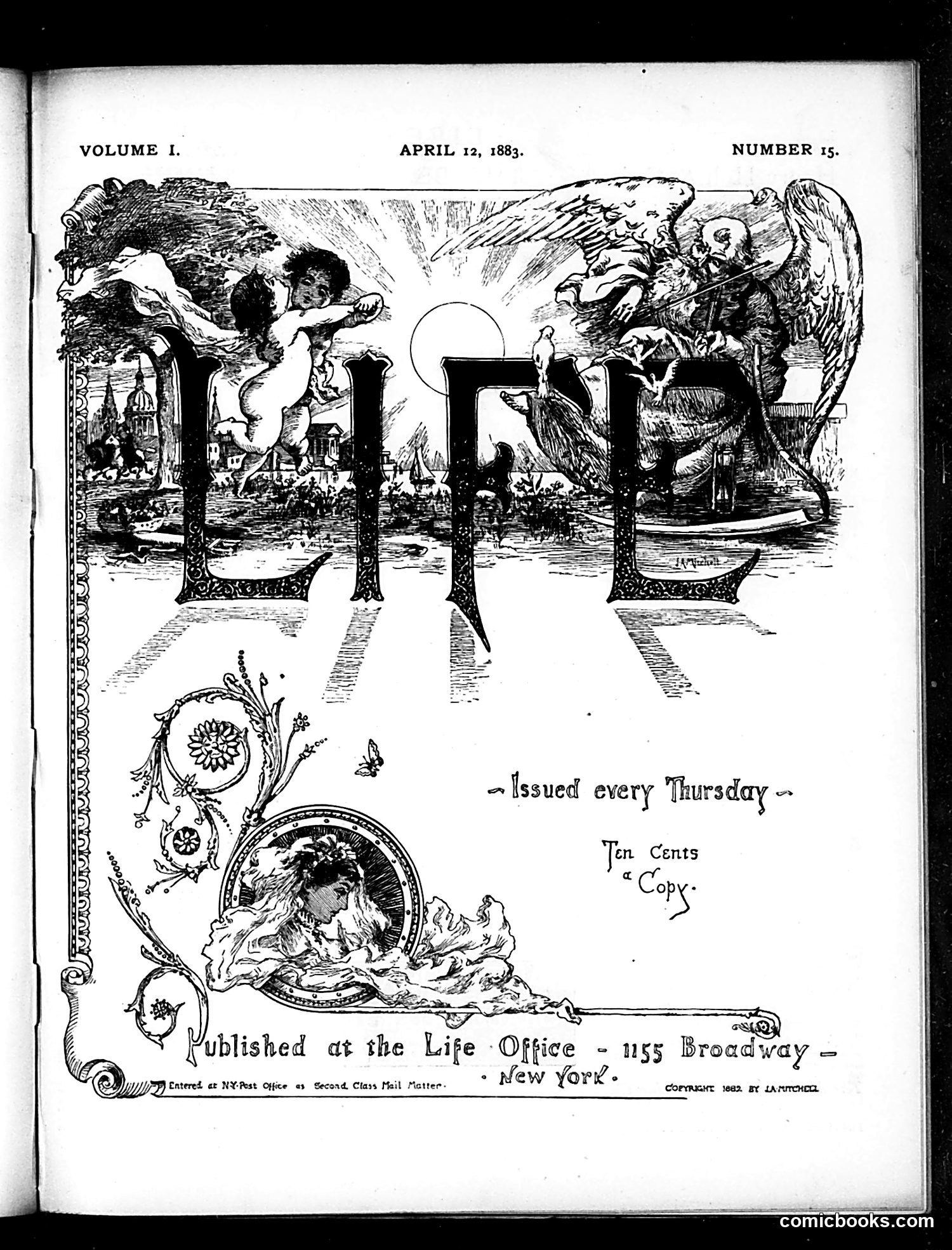
This is the title page for *Life* magazine, a satirical weekly published in New York. The ornate decorative letters spelling "LIFE" frame an elaborate allegorical illustration featuring classical figures—cherubs, an angel, and what appears to be a cityscape with a rising sun in the background. The imagery suggests themes of renewal, enlightenment, or spiritual awakening. The specific satirical content or political commentary isn't immediately clear from this title page alone—it functions primarily as decorative branding. The elaborate Victorian aesthetic and classical allegorical figures reflect the magazine's sophisticated, illustrated approach to American satire during the Gilded Age. Further pages would contain the actual editorial cartoons and satirical commentary.
This page is **primarily advertising and publication notices** rather than political cartoon content. It contains advertisements for: - Henry Holt & Co.'s book series - "The Sanitarian" journal - "The Modern Age" magazine - "Life" magazine itself (a new illustrated weekly) - Hartshorn's Self-Acting Shade Rollers - Candy and hotel services The only substantive editorial content is promotional text praising "The Sanitarian" as a health journal, with endorsements from various publications. There are no visible political cartoons or caricatures on this page to analyze. The layout is typical of late-19th-century magazine advertising sections, designed to fund the publication through commercial notices.
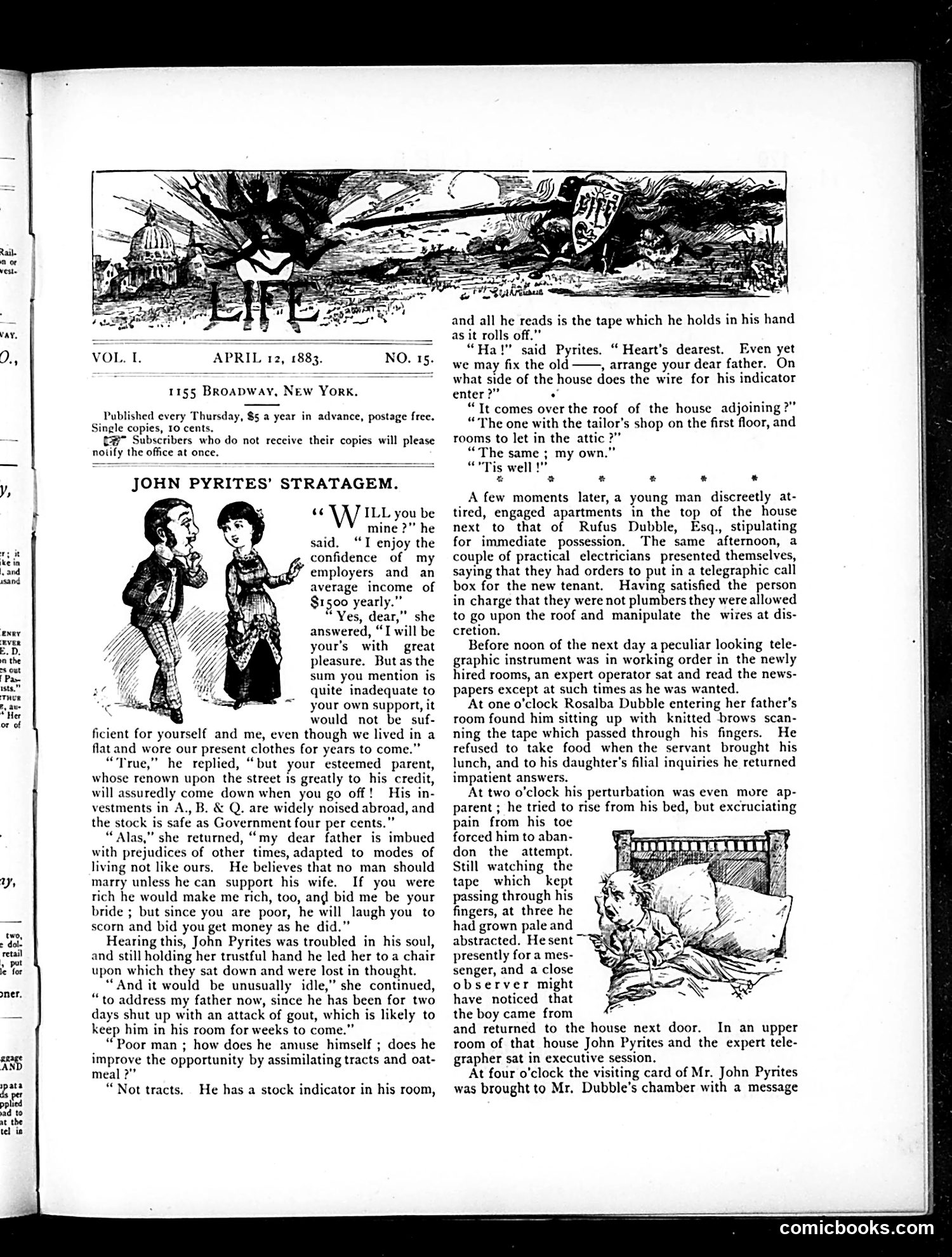
This satirical story illustrates late 19th-century class anxiety about financial deception. "John Pyrites" (a name punning on "pyrite"—fool's gold) is a wealthy man whose son seeks to marry above his station. The illustration shows two figures in conversation, discussing marriage prospects and financial support. The satire targets the pretense of the wealthy class: Pyrites claims sufficient means to support his son, yet his wife reveals their fortune is actually precarious. The story that follows involves a "stock indicator" (ticker tape) and telegraph wires—emerging technologies used in stock speculation—suggesting how financial instability plagued even apparently wealthy households during this era of rapid economic change.
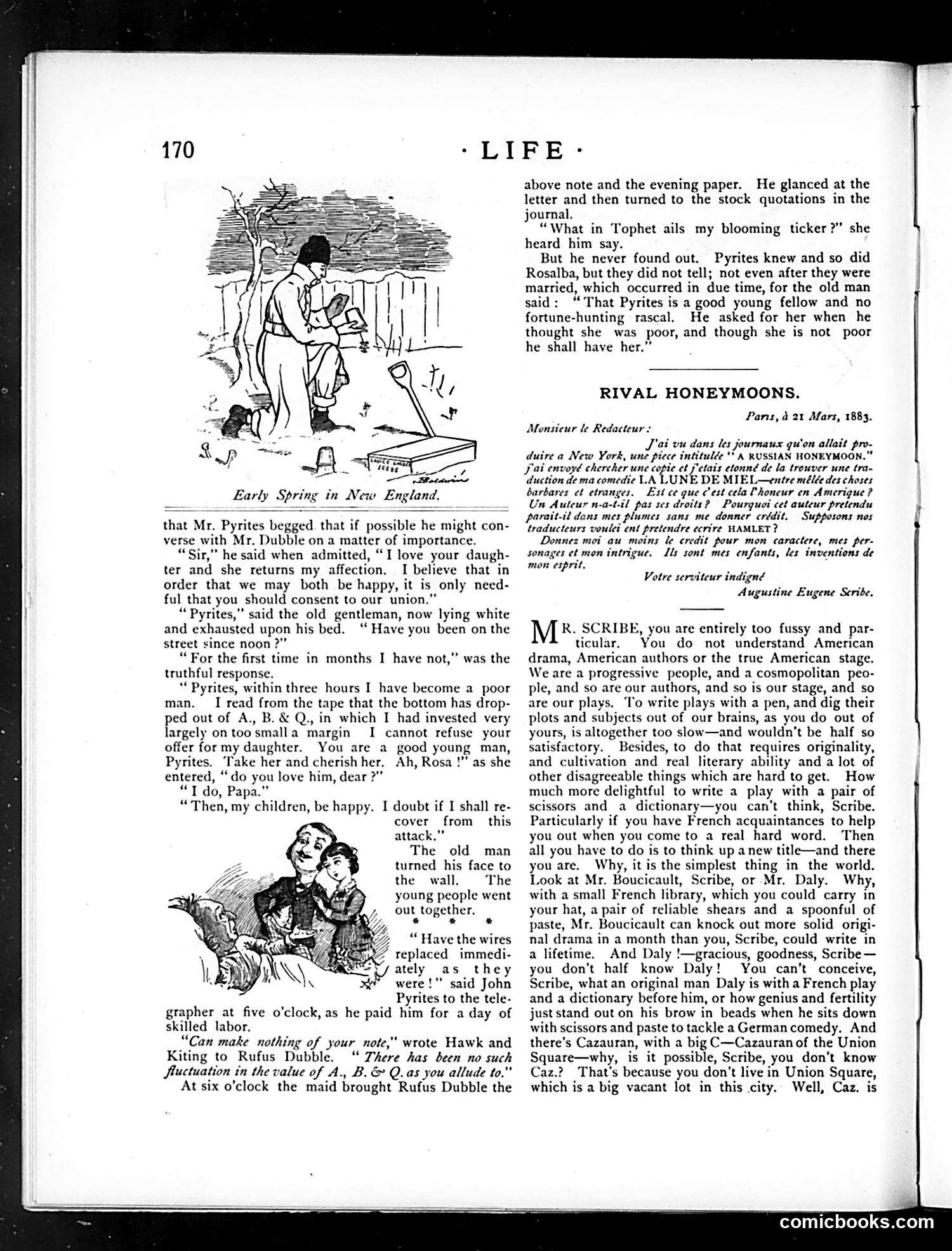
This cartoon depicts a man (identified in the text as "Pyrites") begging from a woman while holding a shovel in winter conditions. The satire concerns Pyrites's financial desperation and failed fortune-hunting. The text reveals Pyrites is a "good young fellow and no fortune-hunting rascal" who married poorly—he married a woman without wealth, contrary to his financial interests. Now destitute ("within three hours I have become a poor man"), he's reduced to manual labor and begging. The cartoon mocks the era's social anxieties about class mobility and marriage, satirizing men who calculated marriages by wealth rather than affection, now facing the consequences of their miscalculations.
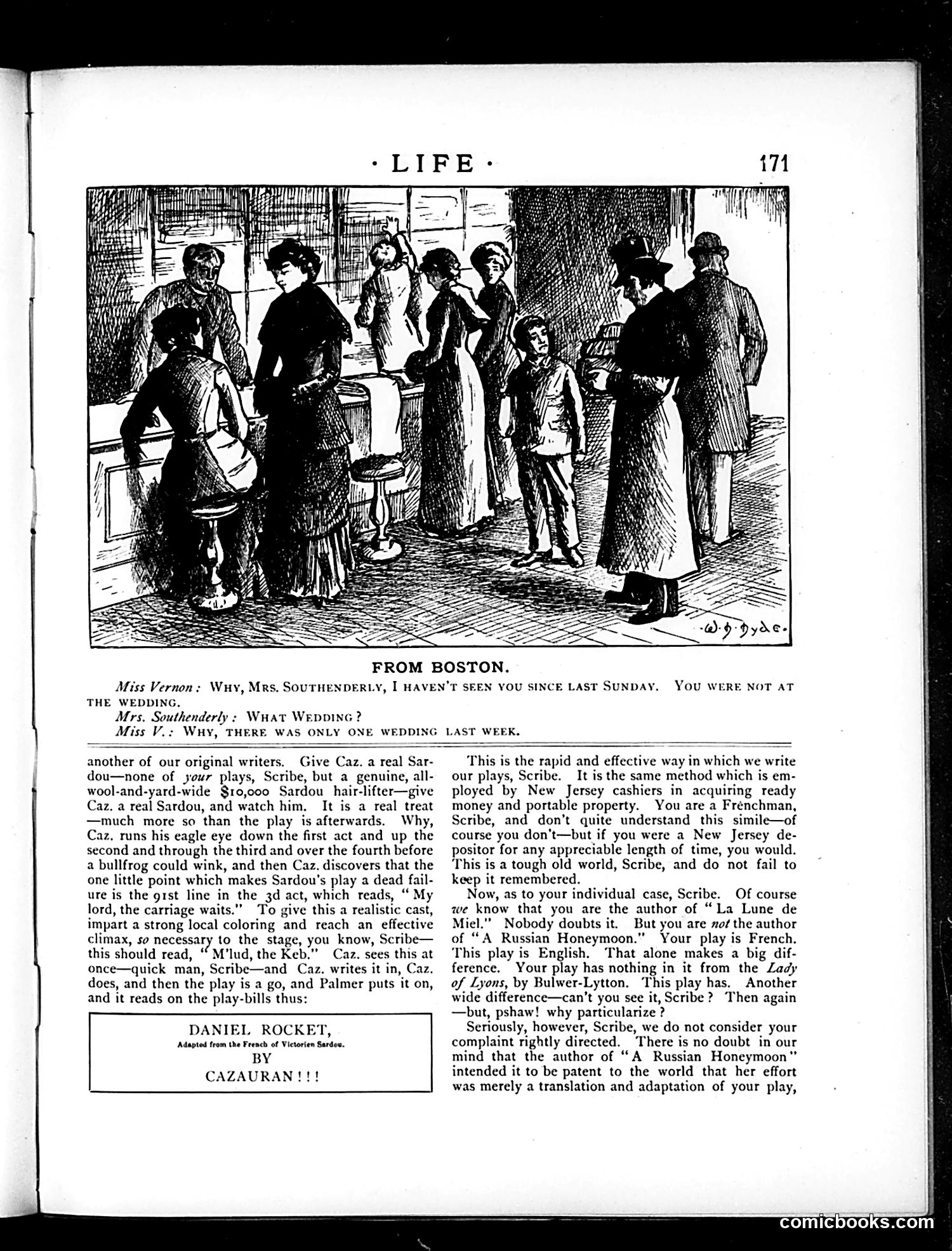
**The Cartoon:** The sketch titled "FROM BOSTON" depicts a social scene where Miss Vernon encounters Mrs. Southenderly, questioning why she missed "the wedding." Mrs. Southenderly's confusion—asking "What Wedding?"—suggests the wedding was so unremarkable or poorly attended that it barely registered as a social event. **The Satire:** The humor targets Boston's elite social circles, mocking the pretentiousness of high-society occasions. The joke implies that even major social events in Boston society can be so forgettable or attended by so few that they fail to qualify as noteworthy happenings—a jab at the city's supposed cultural sophistication and the exclusivity of its upper classes. **Additional Content:** The page includes commentary about theatrical adaptations and playwrights, discussing issues of authorship and translation of European works for American audiences.
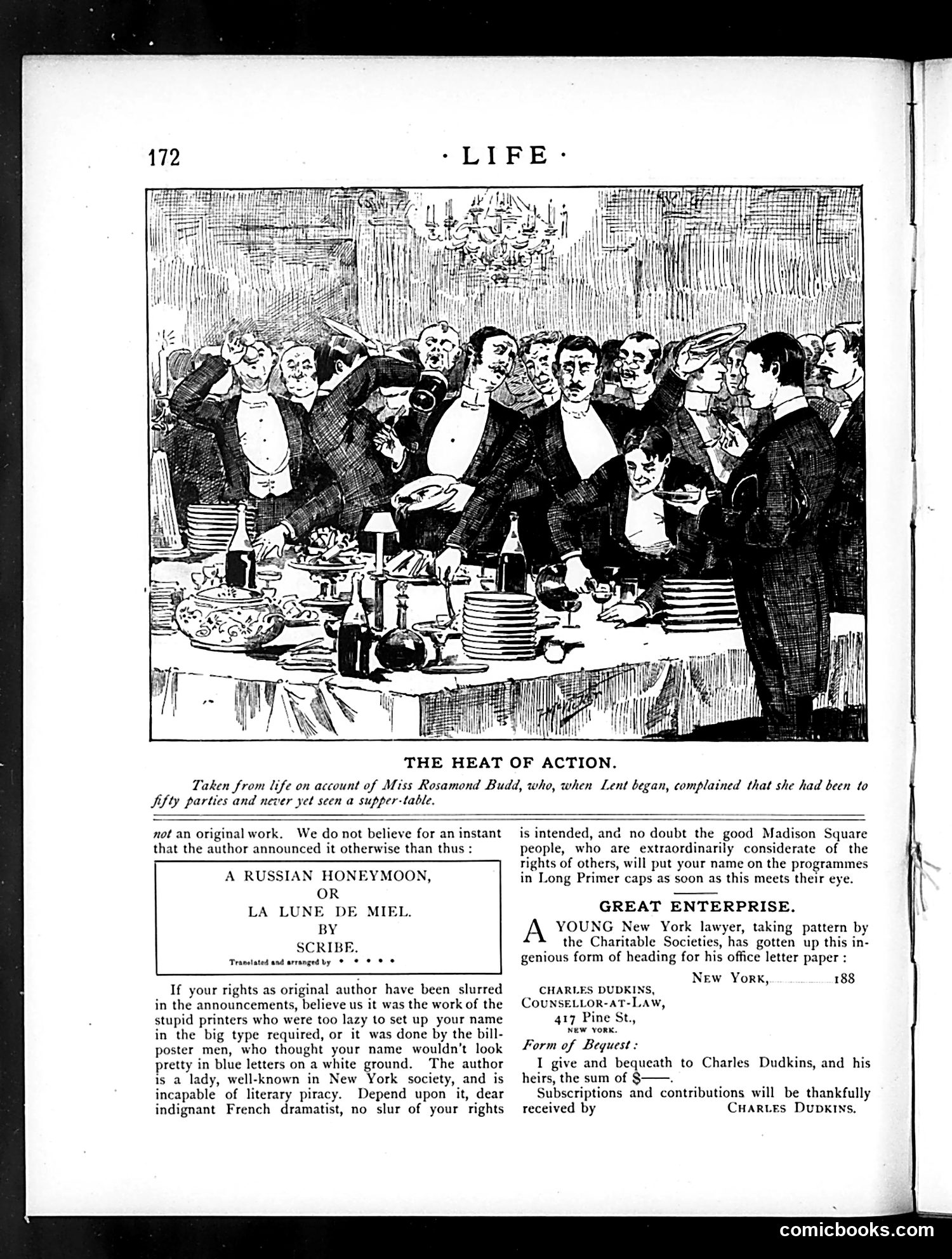
This page satirizes a woman named Rosamond Budd who complained during Lent that she "had been to fifty parties and never yet seen a supper-less one." The cartoon depicts a formal dinner party where well-dressed men in evening clothes gather around a laden table with food, wine, and plates—contradicting Lenten fasting traditions. The satire mocks both Budd's complaint and the hypocrisy of wealthy New York society claiming to observe religious abstinence while indulging lavishly. The "heat of action" title suggests the frantic social scene where religious observance becomes mere pretense. The page also includes unrelated content about a book and a lawyer's charitable letterhead design, suggesting this is a typical miscellaneous Life magazine page mixing satire with advertisements and notices.
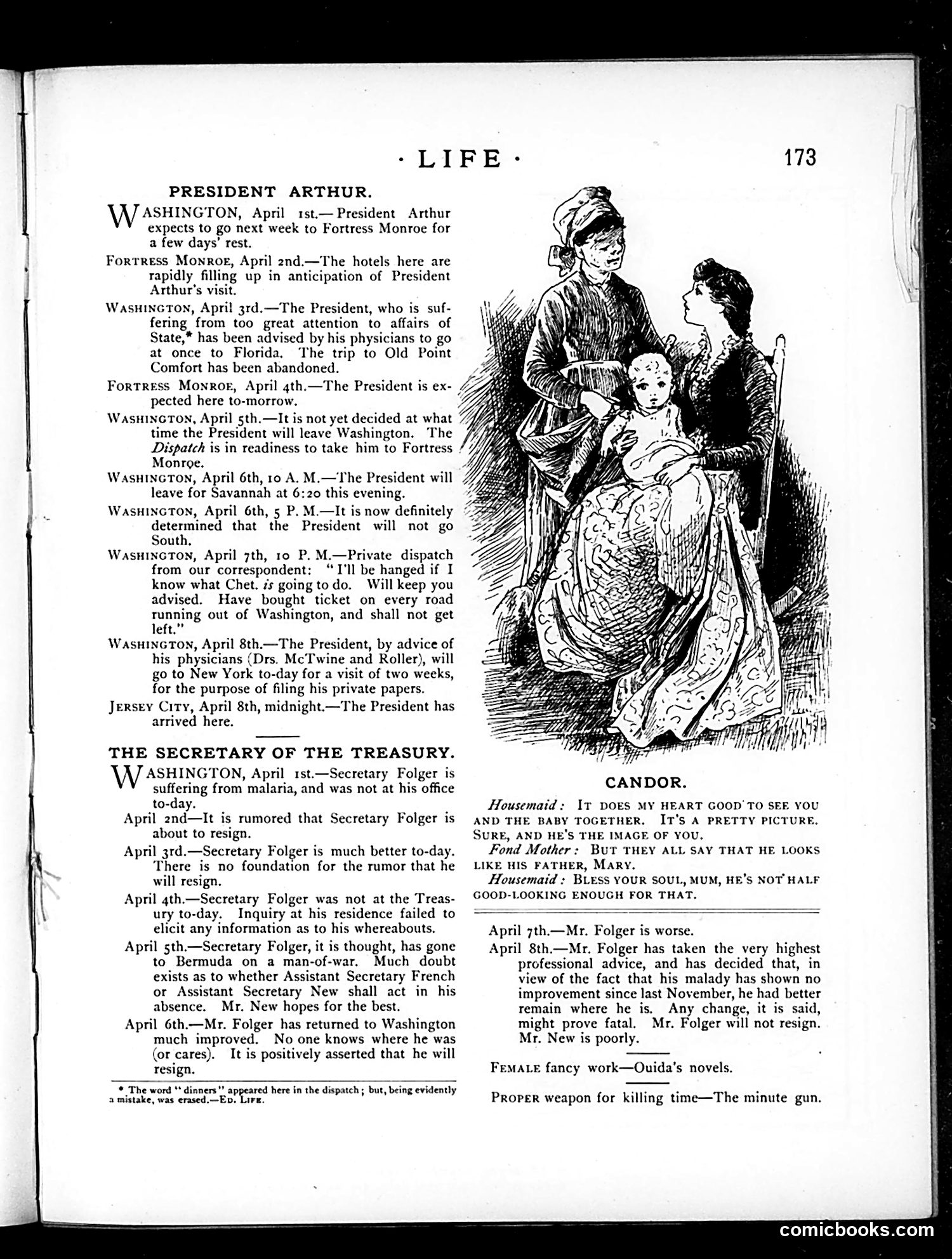
The main cartoon titled "CANDOR" depicts a housemaid showing a well-dressed woman and child to an elegant visitor. The housemaid's dialogue suggests the child resembles his father rather than being "good-looking," while the "Fond Mother" defends the child's appearance. This is a humorous domestic scene satirizing maternal pride and polite social conventions—the joke being the maid's blunt, unflattering honesty that contradicts the mother's protective sentiment. The page also contains news dispatches about President Arthur's travel plans (April 1-8) and Secretary of Treasury Folger's health troubles, presented as running commentary. These brief items indicate the magazine's format mixed satirical cartoons with contemporary political gossip and updates about government figures.
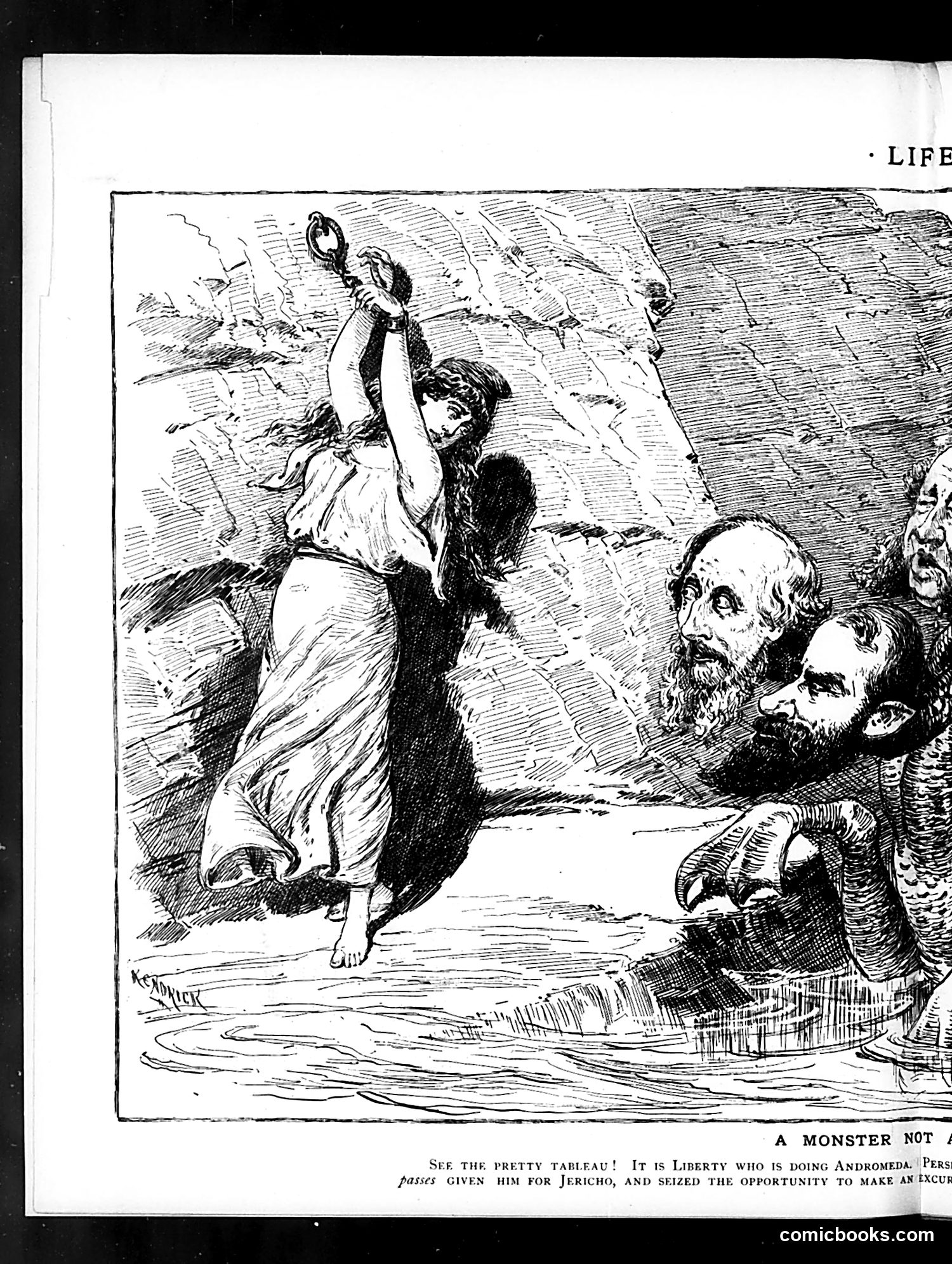
This satirical illustration from *Life* magazine depicts a female figure (identified in the caption as "Liberty") performing acrobatics while male observers watch. The caption references "Andromeda," "Jericho," and mentions someone named "Andromeda" being "seized the opportunity to make an excur[sion]." The cartoon appears to be political satire criticizing how Liberty—a fundamental American ideal—is being manipulated or exploited by politicians or public figures for personal gain. The male figures watching suggest those in power or authority benefiting from this spectacle. The title reads "A MONSTER NOT A..." (text cut off), suggesting condemnation of whoever is portrayed. Without the complete caption and historical context, the specific political figures and event referenced remain unclear, though the satire targets misuse of patriotic ideals.
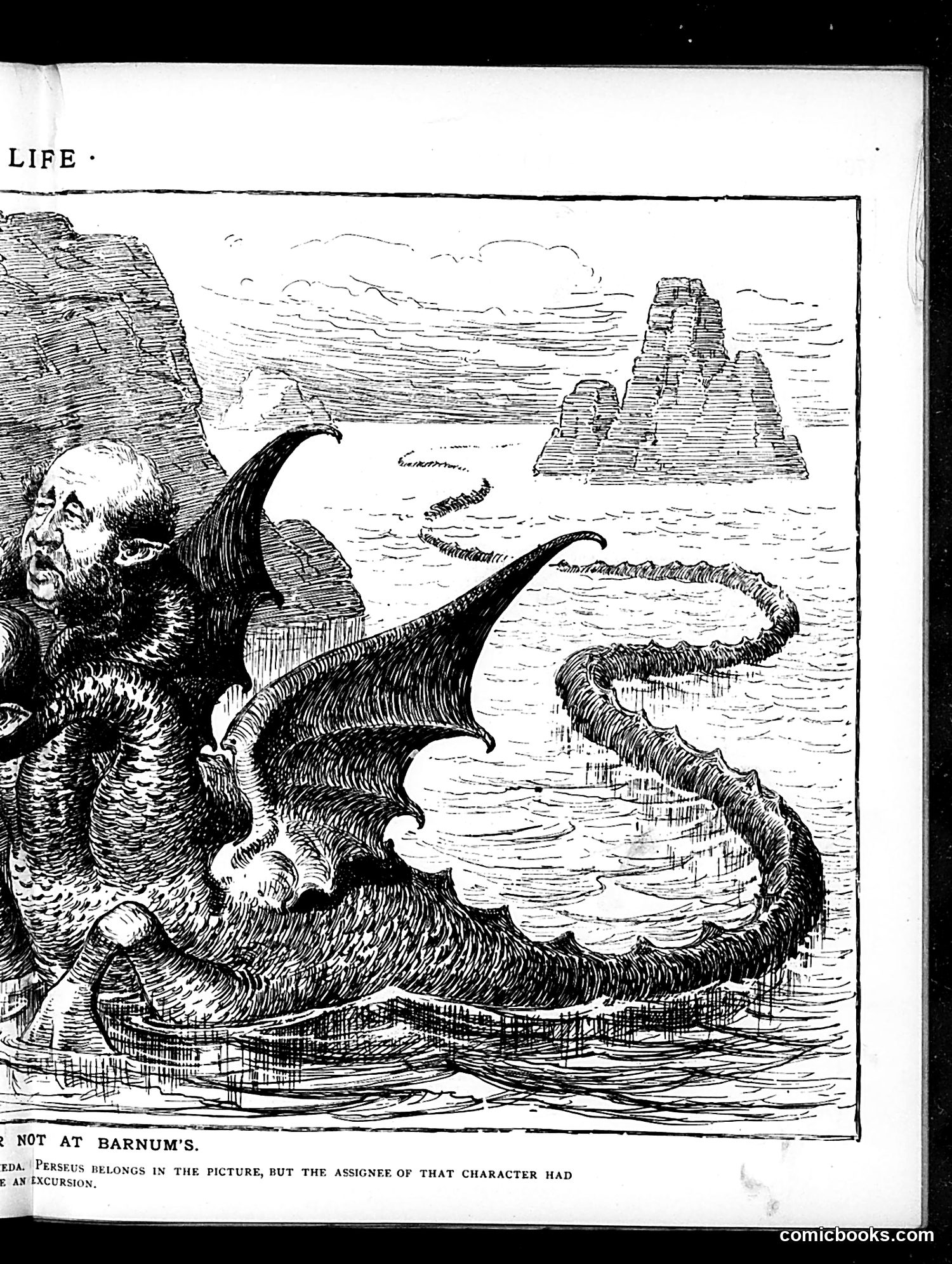
This satirical engraving from *Life* magazine depicts a mythological scene with contemporary political commentary. The visible text references "Perseus" and "Medusa," indicating this is a classical allusion cartoon. The figure on the left appears to be a caricatured man (likely a political figure) shown as Perseus, while the serpentine creature in the water represents Medusa. The caption mentions that "Perseus belongs in the picture, but the assignee of that character had an excursion"—suggesting the satire concerns someone who should occupy a particular role but has absented themselves. The rocky islands in the background establish the mythological setting. Without the full caption or publication date, the specific political target remains unclear, though this appears to mock an absent or negligent political figure through classical mythology.
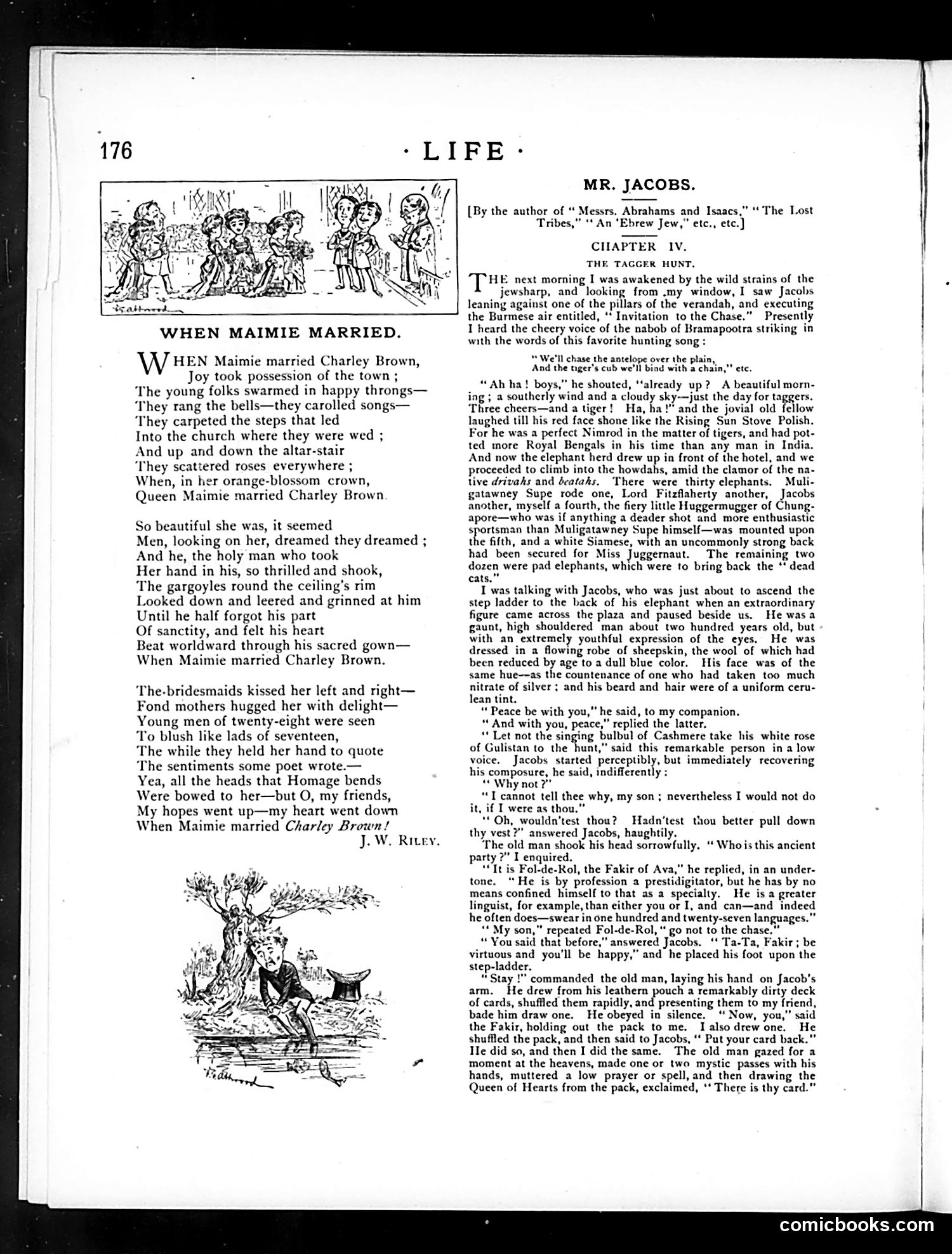
This page contains two distinct pieces of satirical content: **"When Maimie Married"** (poem by J.W. Riley): A sentimental wedding poem that ironically celebrates a bride's beauty and the joy surrounding her marriage to Charley Brown—only to reveal the speaker's disappointment in the final couplet. The satire targets romantic excess and the gap between idealized courtship and married reality. The detailed description of swooning guests and emotional upheaval suggests mockery of Victorian sentimentality about marriage. **"Mr. Jacobs" (Chapter IV)**: A serialized adventure story featuring colonial India, elephant hunting expeditions, and exotic characters. The narrative includes stereotypical colonial tropes—native servants, tiger hunts, and colorful "Oriental" characters like the blue-faced holy man. This appears to be light entertainment satirizing adventure fiction conventions rather than political commentary. Both pieces exemplify *Life* magazine's blend of social satire (marriage culture) and humorous serialized fiction (colonial adventure tales).
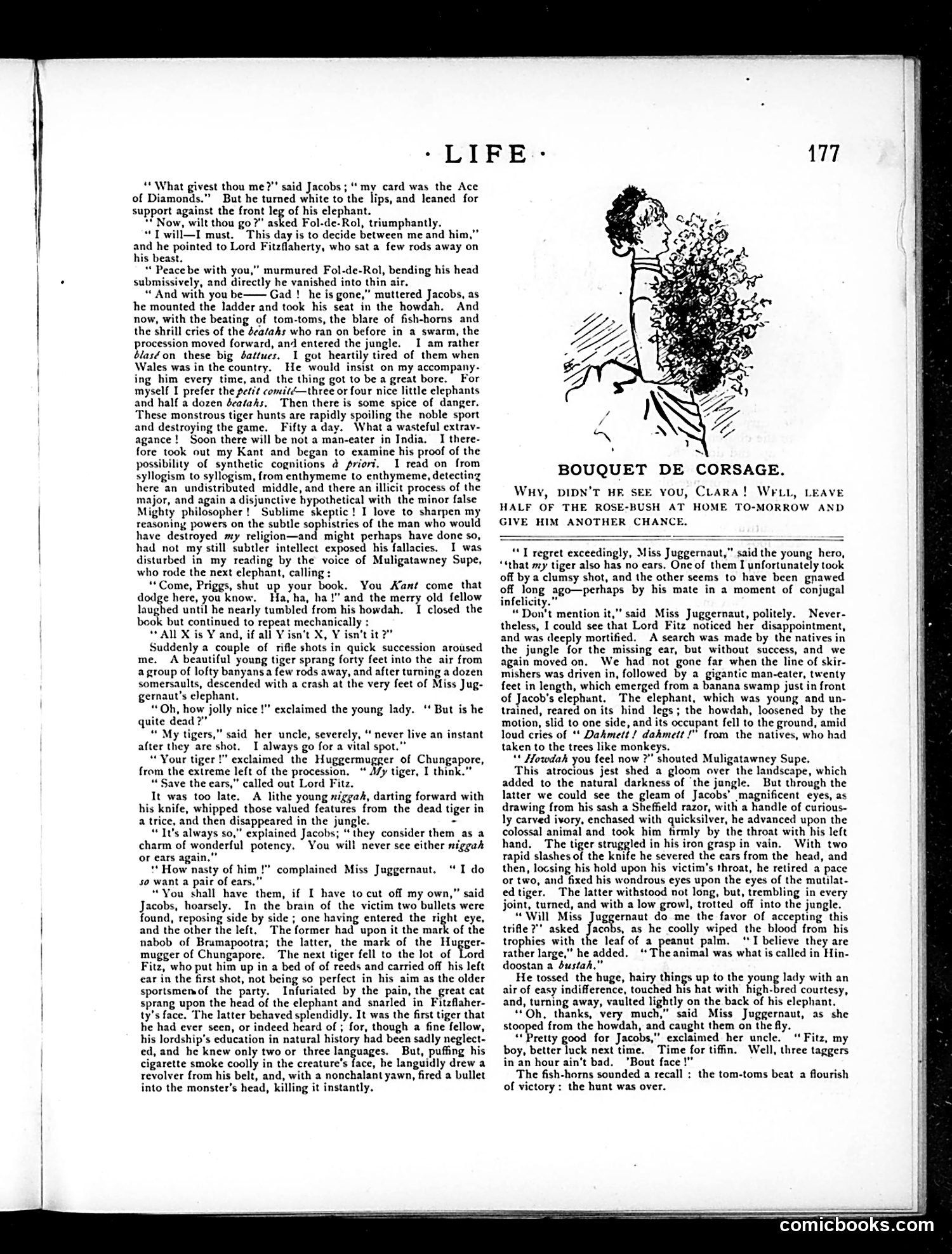
This page contains a fictional narrative about a tiger hunt in India, not a political cartoon. The illustration shows a woman in a decorative dress holding flowers—labeled "BOUQUET DE CORSAGE"—unrelated to the story text. The narrative satirizes British colonial attitudes in India. The protagonist, "Jacobs," is portrayed as an intellectual snob who reads Kant's philosophy during a tiger hunt while dismissing others' hunting prowess. The text mocks excessive colonial hunting ("Fifty a day. What a wasteful extravagance!") and uses period-appropriate but deeply offensive racial language that reflects the text's late 19th-century origins. The satire targets pretentious colonial gentlemen who adopt philosophical airs while engaging in destructive sport, and the narrative's casual racism reveals attitudes typical of the era's imperialist literature. The story pokes fun at colonial hierarchy and competitive status-seeking among British officials in India.
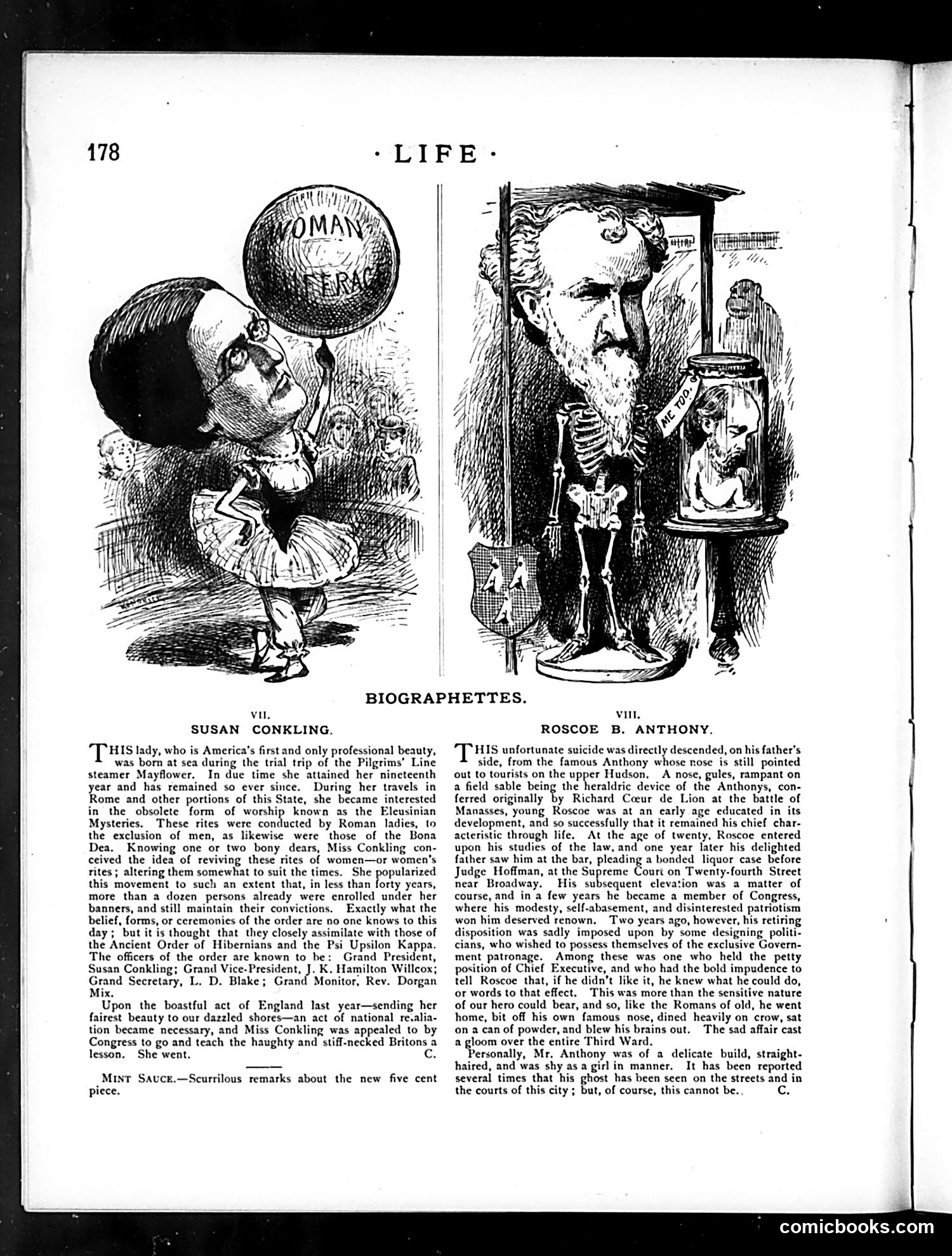
This page presents two mock biographical entries—a standard Life magazine format for political satire. **Susan Conkling** (left): The caricature depicts a portly figure juggling a globe labeled "Woman's Era." The text absurdly claims she was "America's first and only professional beauty," born at sea on the Mayflower, and perpetually nineteen years old. The satire mocks the women's rights movement by suggesting Conkling founded a mysterious women-only organization (comparing it to ancient Eleusinian Mysteries) that supposedly enrolled "more than a dozen persons" in forty years—ridiculing both the movement's slow progress and its secretiveness. **Roscoe B. Anthony** (right): The grotesque profile emphasizes an enormous nose (his "heraldric device"). The biography traces his lineage to Richard the Lionheart, describing his nose as his defining characteristic. The absurd conclusion: after political disappointment, Anthony bit off his own nose, dined on crow, and shot himself—mocking political corruption and wounded pride among congressmen. Both entries use exaggeration and invented genealogy to satirize contemporary figures and causes.
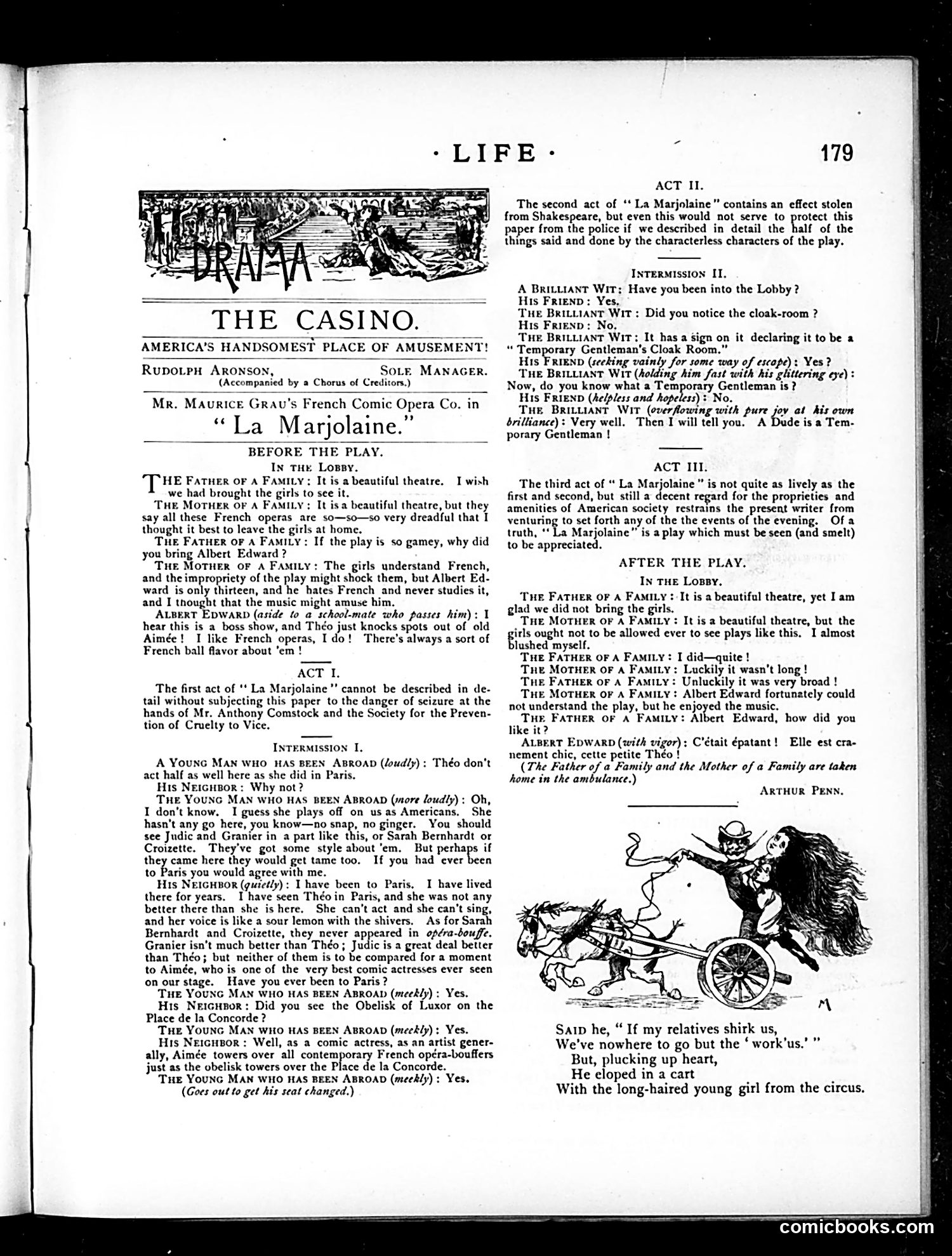
This page reviews a French comic opera performed at New York's Casino theater. The satirical commentary targets both the play itself and American society's attitudes toward it. The central joke concerns **Anthony Comstock**, the famous vice-crusader mentioned explicitly. Life sarcastically notes the opera contains scandalous content that would invite police seizure, yet they cannot describe it due to Comstock's censorship efforts. This mocks both his aggressive morality policing and the play's questionable propriety. The dialogue vignettes satirize **American prudishness and class pretension**: parents shield daughters from "improper" French content while allowing their thirteen-year-old son to attend, assuming his ignorance of French offers protection (it doesn't—he enjoys it anyway). The "temporary gentleman" joke mocks wealthy but uncultured social climbers ("dudes"). The cartoon illustration (bottom right) appears to show circus or theatrical performers, likely referencing the opera's themes or the broader entertainment world being critiqued.
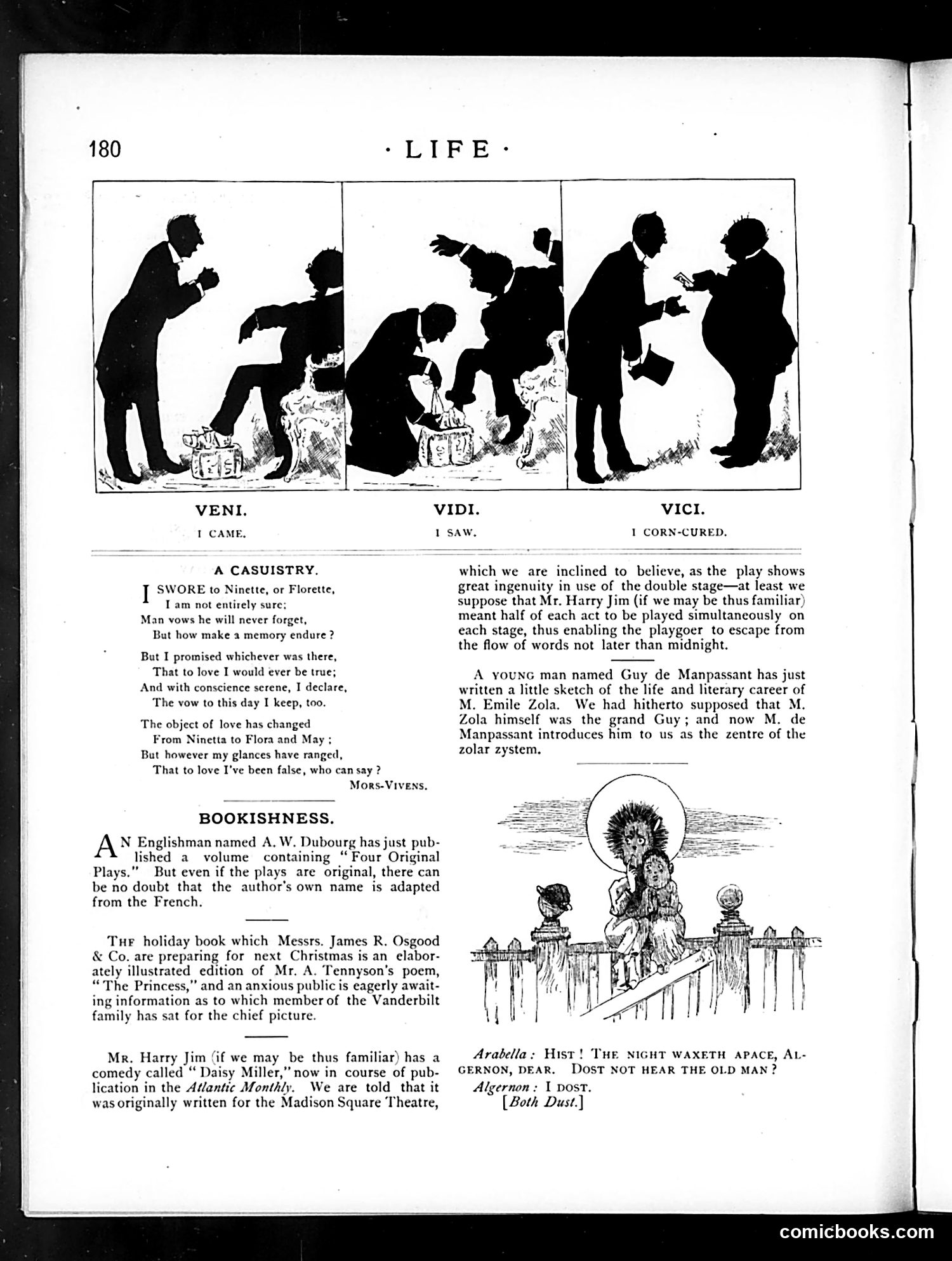
This page collects brief satirical notes on books and theater. The top cartoon uses the Latin phrase "Veni, Vidi, Vici" (I came, I saw, I conquered) as a pun: "Corn-Cured" mockingly suggests someone has been defeated or humiliated rather than victorious. The "Casuistry" section satirizes a man who swore fidelity to different women (Ninette, Florette, Flora, May), then rationalizes his infidelity with circular logic—claiming he's been faithful because his *love* hasn't changed, only its object. The wit lies in exposing how easily conscience accommodates contradiction. The "Bookishness" section includes in-jokes: mocking an English playwright named "Dubourg" for having a French-sounding name; joking that Vanderbilt family wealth will determine who models for Tennyson's illustrated "Princess"; and noting Harry James's comedy "Daisy Miller" was adapted for stage. The quotation at bottom appears to be from a theatrical work, with characters named Arabella and Algernon discussing time passing.
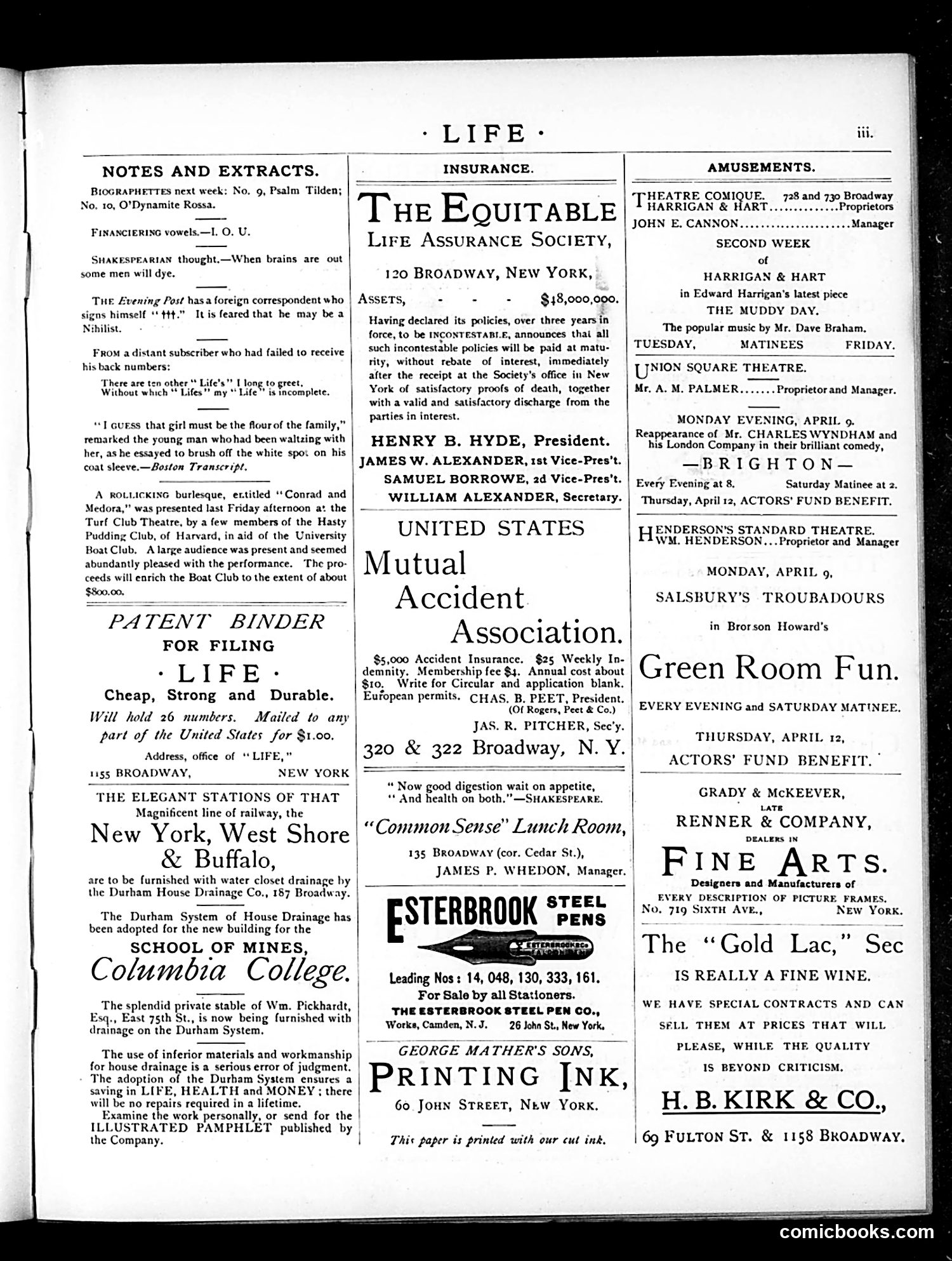
This is primarily an **advertising and notices page**, not a satirical cartoon section. It's from an early issue of *Life* magazine and contains: **Content sections:** - Brief humorous notes mocking pretension (a joke about a man brushing white powder off his coat while dancing) - References to upcoming biographical features on "Psalm Tilden" and "O'Dynamite Rossa" (likely political figures, though unclear to modern readers) - A joke suggesting the *Evening Post's* foreign correspondent signing as "H" might be a Nihilist—a jab at anarchist politics **Advertisements dominate the page:** Insurance (Equitable Life Assurance, United States Mutual Accident Association), patent binders for filing magazines, house drainage systems, and theatre listings for venues featuring comedic performances. The "satire" here is light—mostly social humor rather than political commentary. The magazine's identity as both **satirical publication and commercial product** is evident in its advertising-heavy layout.
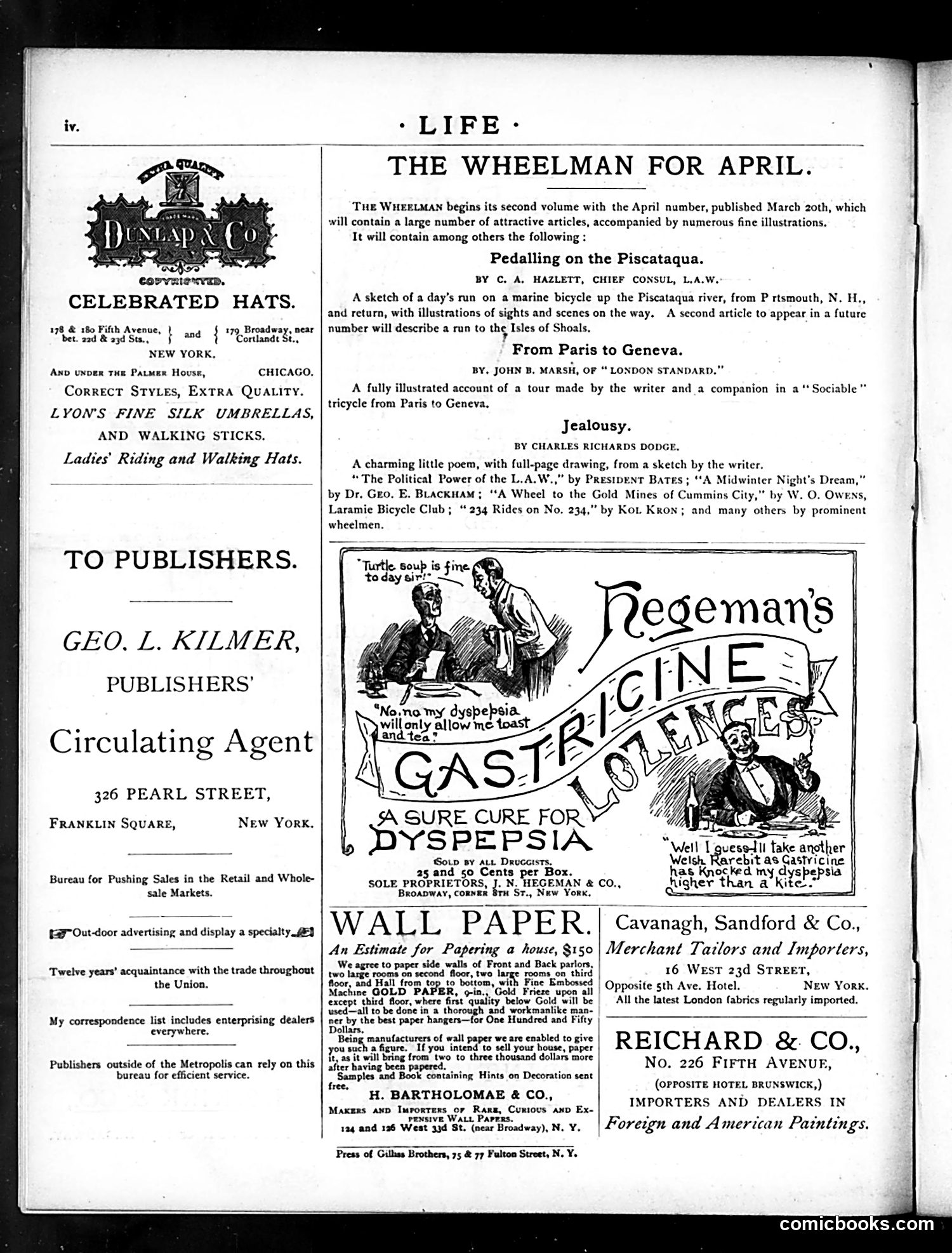
This page is primarily **advertisements and announcements**, not political satire. The main visual element is a product advertisement for **Hedeman's Gastricine**, a patent medicine claiming to cure dyspepsia (indigestion). The cartoon shows two figures: a man and woman at a dining table. The woman says "Turtle soup is fine to day Sir" while the man responds "No, no my dyspepsia, will only allow me toast and tea?" A third figure (well-dressed gentleman) states the product "will take another Wells Fargo bit as Gastricine has knocked my dyspepsia higher than a kite." The "joke" reflects late-19th-century attitudes: dyspepsia was a common complaint among the wealthy, and patent medicines promised miraculous cures. The satire is mild—simply showing someone's miraculous recovery enabling them to eat normal food again. This was typical advertising humor of the era, not political commentary.