
Life, 1883-04-12 · page 5 of 16
Life — April 12, 1883 — page 5: what you’re looking at
What you’re looking at
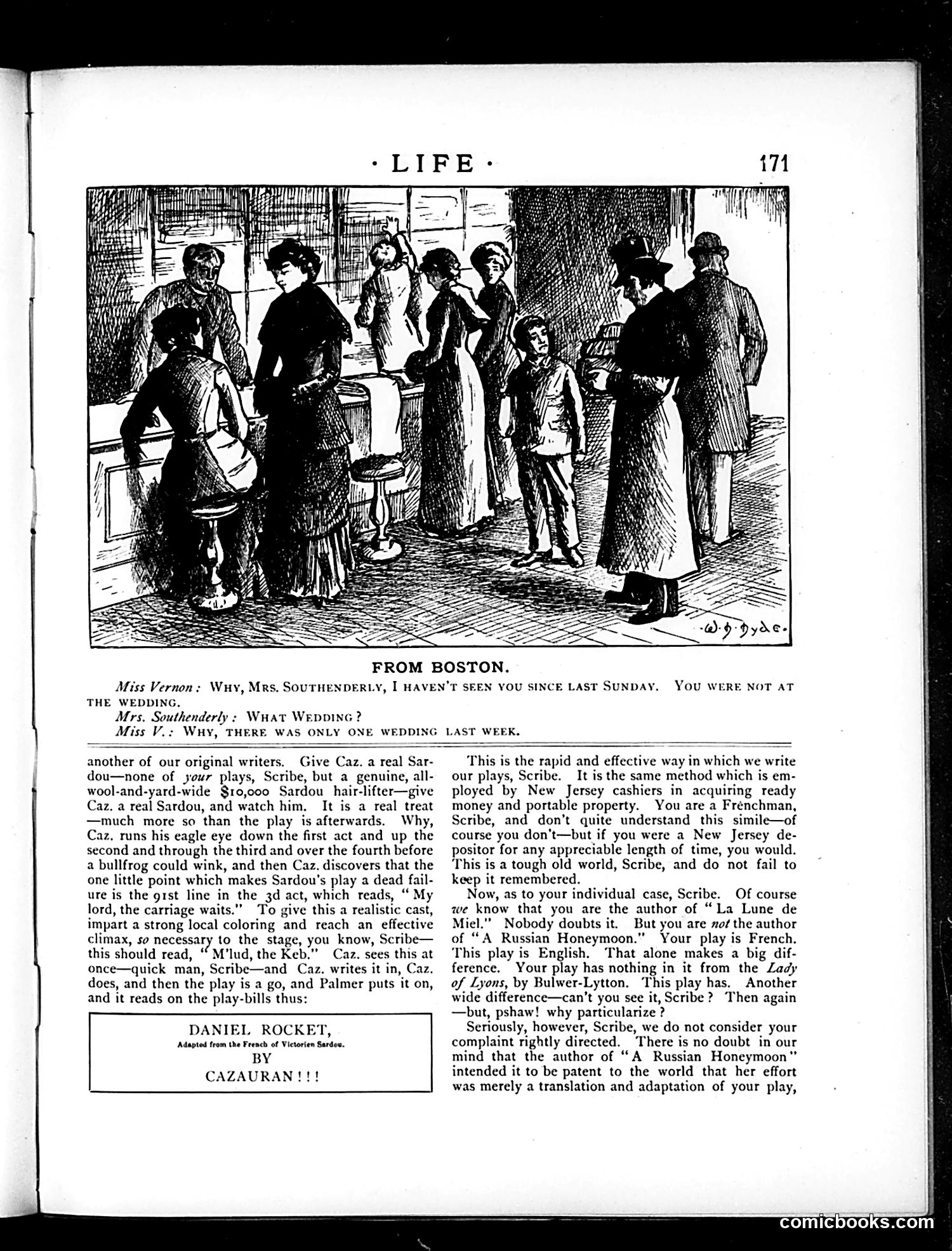
**The Cartoon:** The sketch titled "FROM BOSTON" depicts a social scene where Miss Vernon encounters Mrs. Southenderly, questioning why she missed "the wedding." Mrs. Southenderly's confusion—asking "What Wedding?"—suggests the wedding was so unremarkable or poorly attended that it barely registered as a social event. **The Satire:** The humor targets Boston's elite social circles, mocking the pretentiousness of high-society occasions. The joke implies that even major social events in Boston society can be so forgettable or attended by so few that they fail to qualify as noteworthy happenings—a jab at the city's supposed cultural sophistication and the exclusivity of its upper classes. **Additional Content:** The page includes commentary about theatrical adaptations and playwrights, discussing issues of authorship and translation of European works for American audiences.
📄 Transcribed text from this page (OCR, searchable)
Machine-transcribed from the original scan — historical spelling and the odd misread are preserved.
FROM BOSTON. Miss Vernon: THE WEDDING. Mrs. Southenderly : Wat Wepvinc ? Miss V.: Why, THERE WAS ONLY ONE WEDDING Wuy, Mrs, SOUTHENDERLY, I HAVEN'T SEEN YOU SINCE LAST SUNDAY, You WERE NOT AT another of our original writers. Give Caz. a real Sar- dou—none of your plays, Scribe, but a genuine, all- wool-and-yard-wide $1o,ooo Sardou_hair-lifter—give Caz. a real Sardou, and watch him. It is a real treat —much more so than the play is afterwards. Why, Caz. runs his eagle eye down the first act and up the second and through the third and over the fourth before a bullfrog could wink, and then Caz. discovers that the one little point which makes Sardou’s play a dead fail- ure is the grst line in the 3d act, which reads, “ My lord, the carriage waits.” To give this a realistic cast, impart a strong local coloring ‘and reach an effective climax, so necessary to the stage, you know, Scribe— this should read, ‘“ M’lud, the Keb.” Caz. sees this at once—quick man, Scribe—and Caz. writes it in, does, and then the play is a go, and Palmer puts it and it reads on the play-bills thus: DANIEL ROCKET, Adapted from the French of Victorien Sardee. BY CAZAURAN!!! This is the rapid and effective way in which we write our plays, Scribe. It is the same method which is em- ployed by New Jersey cashiers in acquiring ready money and portable property. You are a Frénchman, Scribe, and don’t quite understand this simile—of course you don't—but if you were a New Jersey de- positor for any appreciable length of time, you would. This is a tough old world, Scribe, and do not fail to keep it remembered. Now, as to your individual case, Scribe. Of course we know that you are the author of “La Lune de Miel.” Nobody doubts it. But you are zof the author of “A Russian Honeymoon.” Your play is French. ‘This play is English, That alone makes a big dif- ference. Your play has nothing in it from the Lady of Lyons, by Bulwer-Lytton. This play has. Another wide difference—can’t you see it, Scribe? Then again —but, pshaw! why particularize ? Seriously, however, Scribe, we do not consider your complaint rightly directed. ‘There is no doubt in our mind that the author of “A Russian Honeymoon” intended it to be patent to the world that her effort was merely a translation and adaptation of your play,