
Life, 1883-04-12 · page 14 of 16
Life — April 12, 1883 — page 14: what you’re looking at
What you’re looking at
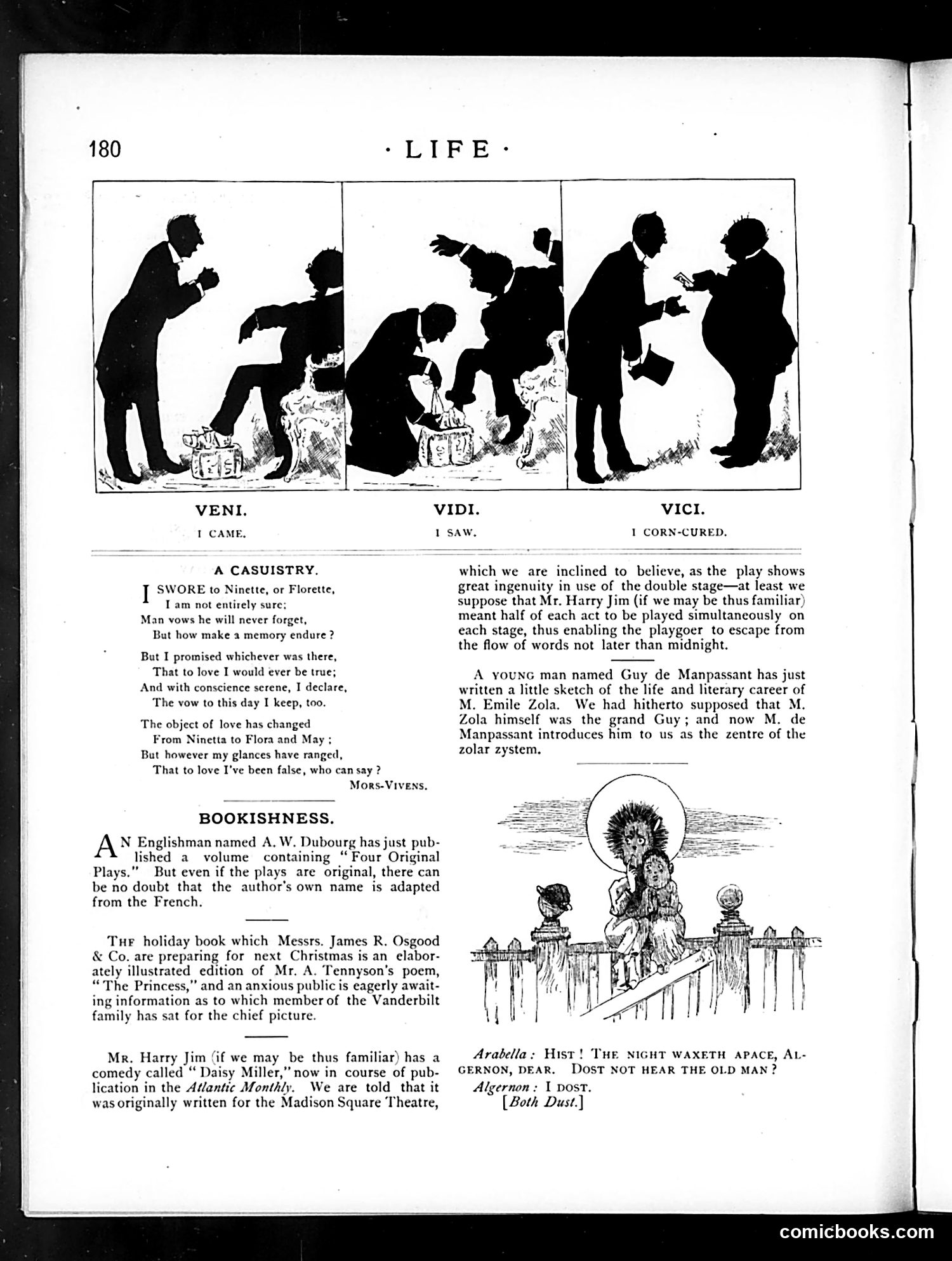
This page collects brief satirical notes on books and theater. The top cartoon uses the Latin phrase "Veni, Vidi, Vici" (I came, I saw, I conquered) as a pun: "Corn-Cured" mockingly suggests someone has been defeated or humiliated rather than victorious. The "Casuistry" section satirizes a man who swore fidelity to different women (Ninette, Florette, Flora, May), then rationalizes his infidelity with circular logic—claiming he's been faithful because his *love* hasn't changed, only its object. The wit lies in exposing how easily conscience accommodates contradiction. The "Bookishness" section includes in-jokes: mocking an English playwright named "Dubourg" for having a French-sounding name; joking that Vanderbilt family wealth will determine who models for Tennyson's illustrated "Princess"; and noting Harry James's comedy "Daisy Miller" was adapted for stage. The quotation at bottom appears to be from a theatrical work, with characters named Arabella and Algernon discussing time passing.
📄 Transcribed text from this page (OCR, searchable)
Machine-transcribed from the original scan — historical spelling and the odd misread are preserved.
VENI, vIcl. 1 CAME, 1 SAW. 1 CORN-CURED. A CASUISTRY. which we are inclined to believe, as the play shows I SWORE to Ninette, or Florette, great ingenuity in use of the double stage—at least we Tam not entirely sure: suppose that Mr. Harry Jim (if we may be thus familiar) Man vows he will never forget, meant half of each act to be played simultaneously on But how make a memory endure ? each stage, thus enabling the playgoer to escape from . . the flow of words not later than midnight. But I promised whichever was there, That to love I would ever be true; A younG man named Guy de Manpassant has just And with conscience serene, I declare, written a little sketch of the life and literary career of The vow to this day I keep, too. M. Emile Zola. We had hitherto supposed that M. The object of love has changed Zola himself was the grand Guy; and now M. de Manpassant introduces him to us as the zentre of the From Ninetta to Flora and May ; zolar zystem, But however my glances have ranged, That to love I've been false, who can say ? Mors-Vivens, BOOKISHNESS. AN Englishman named A, W. Dubourg has just pub- lished a volume containing ‘Four Original Plays.” But even if the plays are original, there can be no doubt that the author's own name is adapted from the French, Tur holiday book which Messrs. James R. Osgood & Co. are preparing for next Christmas is an elabor- ately illustrated edition of Mr. A. Tennyson's poem, “The Princess,” and an anxious public is eagerly await- ing information as to which member of the Vanderbilt family has sat for the chief picture. Mr. Harry Jim (if we may be thus familiar) has a Arabella; Hist! THE NIGHT WAXETH APACE, AL- comedy called “ Daisy Miller,” now in course of pub- GERNON, DEAR. Dost NOT HEAR THE OLD MAN? lication in the Adantic Monthly. We are told that it Algernon: 1 post. was originally written for the Madison Square Theatre, [Both Dust. comicbooks.com