
Life, 1883-04-12 · page 4 of 16
Life — April 12, 1883 — page 4: what you’re looking at
What you’re looking at
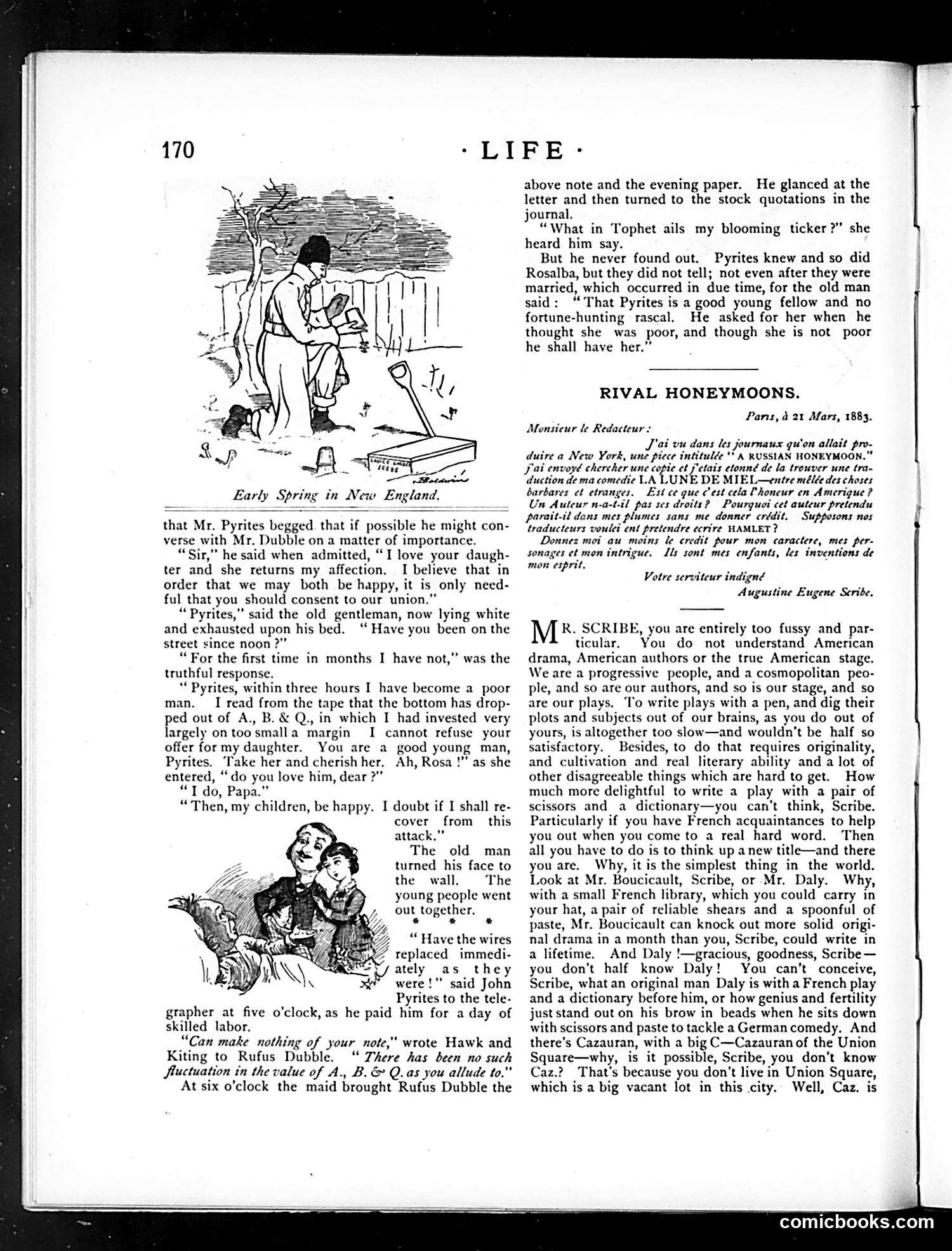
This cartoon depicts a man (identified in the text as "Pyrites") begging from a woman while holding a shovel in winter conditions. The satire concerns Pyrites's financial desperation and failed fortune-hunting. The text reveals Pyrites is a "good young fellow and no fortune-hunting rascal" who married poorly—he married a woman without wealth, contrary to his financial interests. Now destitute ("within three hours I have become a poor man"), he's reduced to manual labor and begging. The cartoon mocks the era's social anxieties about class mobility and marriage, satirizing men who calculated marriages by wealth rather than affection, now facing the consequences of their miscalculations.
📄 Transcribed text from this page (OCR, searchable)
Machine-transcribed from the original scan — historical spelling and the odd misread are preserved.
begged: that if pole he eight con- verse with Mr. Dubble on a matter of importance. “Sir,” he said when admitted, “I love your daugh- ter and she returns my affection. I believe that in order that we may both be happy, it is only need- ful that you should consent to our union.” “ Pyrites,” said the old gentleman, now lying white and exhausted upon his bed. “ Have you been on the street since noon ?” “For the first time in months I have not,” truthful response. “Pyrites, within three hours I have become a poor man. I read from the tape that the bottom has drop- ped out of A., B. & Q., in which I had invested very largely on too smalla margin I cannot refuse your offer for my daughter. You are a good young man, Pyrites. ‘Take her and cherish her. Ah, Rosa !”" as she entered, “do you love him, dear ?” “T do, Papa.” “Then, my children, be happy. I doubt if I shall re- was the cover from this attack,”” The old man turned his face to the wall, The young people went out together, * * Zp ately as they were!" said John Pyrites to the tele- grapher at five o'clock, as he paid him for a day of skilled labor. “Can make nothing of your note," wrote Hawk and Kiting to Rufus Dubble. “ There has been no such Sluctuation in the value of A., B.& Q.as you allude to.” At six o'clock the maid brought Rufus Dubble the LIFE above note and the evening paper. He glanced at the letter and then turned to the stock quotations in the journal. “What in Tophet ails my blooming ticker?” she heard him say. But he never found out. Pyrites knew and so did Rosalba, but they did not tell; not even after they were married, which occurred in due time, for the old man said: ‘That Pyrites is a good young fellow and no fortune-hunting rascal. He asked for her when he thought she was poor, and though she is not poor he shall have her.” RIVAL HONEYMOONS. Pans, 4 21 Mars, 1883. Monsieur le Redacteur : J'ai vu dans les journaux qu'on allait pro. duire a New York, une piece intitulée * & RUSSIAN HONEYMOON, Sai envoyé chercher une copie et jretais etonné de la trouver une tra- duction de ma comedie LA LUNE DE MIEL—entre mélée des choses barbares et etranges. Est ce que c'est cela Phoneur en Amerigue ? Un Auteur n-a-t-il pas ses droits? Pourquoi cet auteur pretendu parait.il dans mes plumes sans me donner crédit, Supposons nos traducteurs voulei ent pretendre ecrire HAMLET? Donnez moi au moins le credit pour mon caractere, mes per- sonages et mon intrigue. Ils sont mes enfants, les inventions de mon esprit. Votre serviteur indigné Augustine Eugene Scribe. R. SCRIBE, you are entirely too fussy and par- ticular, You do not understand American drama, American authors or the true American stage. We are a progressive people, and a cosmopolitan peo- ple, and so are our authors, and so is our stage, and so are our plays, ‘To write plays with a pen, and dig their plots and subjects out of our brains, as you do out of yours, is altogether too slow—and wouldn't be half so satisfactory. Besides, to do that requires originality, and cultivation and real literary ability and a lot of other disagreeable things which are hard to get. How much more delightful to write a play with a pair of scissors and a dictionary—you can’t think, Scribe. Particularly if you have French acquaintances to help you out when you come to a real hard word. Then all you have to do is to think up a new title—and there you are. Why, it is the simplest thing in the world. Look at Mr. Boucicault, Scribe, or Mr. Daly. Why, with a small French library, which you could carry in your hat, a pair of reliable shears and a spoonful of paste, Mr. Boucicault can knock out more solid origi- nal drama in a month than you, Scribe, could write in a lifetime. And Daly !—gracious, goodness, Scribe — you don’t half know Daly! You can’t conceive, Scribe, what an original man Daly is with a French play and a dictionary before him, or how genius and fertility just stand out on his brow in beads when he sits down with scissors and paste to tackle a German comedy. And there’s Cazauran, with a big C—Cazauran of the Union Square—why, is it possible, Scribe, you don’t know Caz.? That's because you don’t live in Union Square, which is a big vacant lot in this city. Well, Caz. is comicbooks.com