
Life, 1883-04-12 · page 10 of 16
Life — April 12, 1883 — page 10: what you’re looking at
What you’re looking at
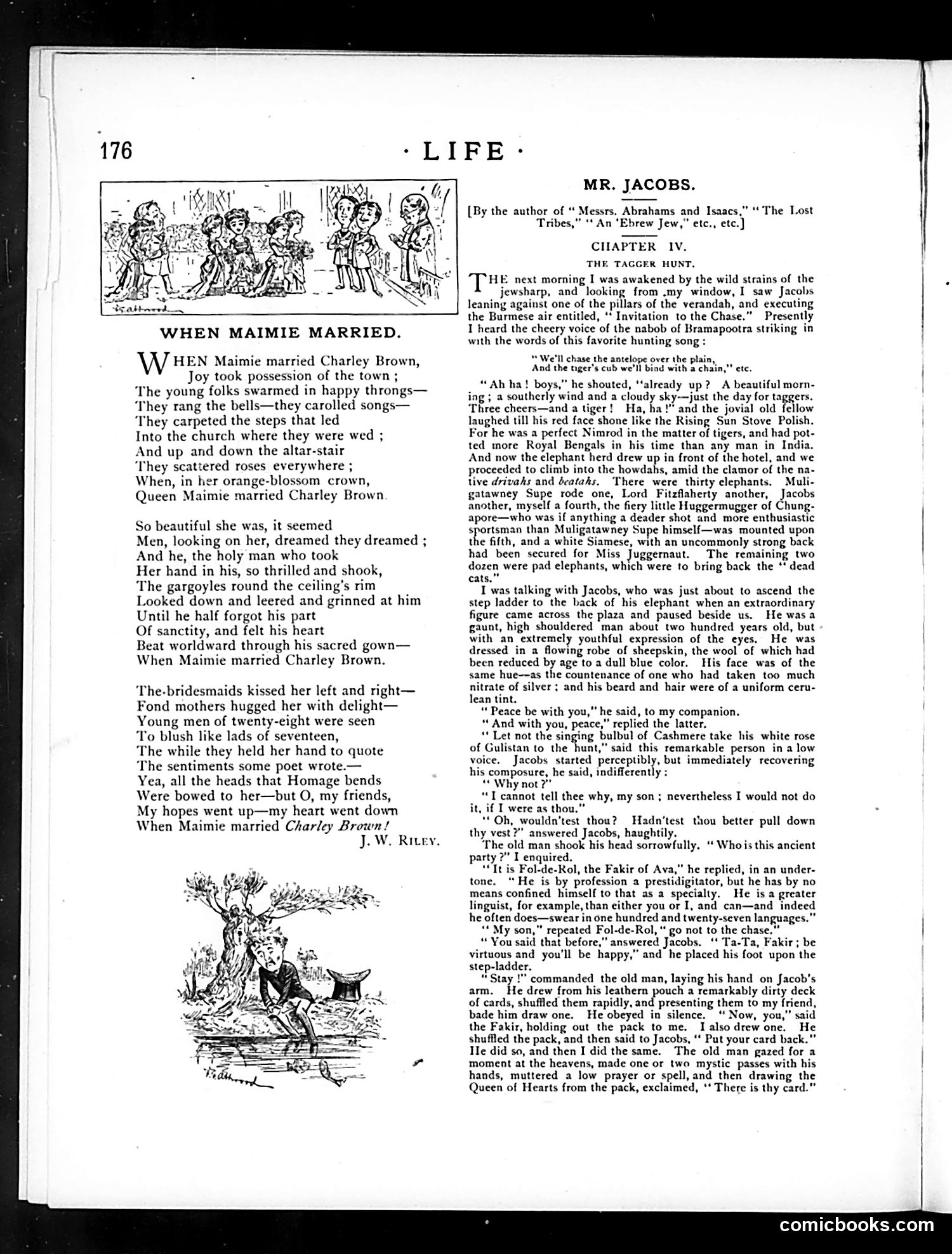
This page contains two distinct pieces of satirical content: **"When Maimie Married"** (poem by J.W. Riley): A sentimental wedding poem that ironically celebrates a bride's beauty and the joy surrounding her marriage to Charley Brown—only to reveal the speaker's disappointment in the final couplet. The satire targets romantic excess and the gap between idealized courtship and married reality. The detailed description of swooning guests and emotional upheaval suggests mockery of Victorian sentimentality about marriage. **"Mr. Jacobs" (Chapter IV)**: A serialized adventure story featuring colonial India, elephant hunting expeditions, and exotic characters. The narrative includes stereotypical colonial tropes—native servants, tiger hunts, and colorful "Oriental" characters like the blue-faced holy man. This appears to be light entertainment satirizing adventure fiction conventions rather than political commentary. Both pieces exemplify *Life* magazine's blend of social satire (marriage culture) and humorous serialized fiction (colonial adventure tales).
📄 Transcribed text from this page (OCR, searchable)
Machine-transcribed from the original scan — historical spelling and the odd misread are preserved.
teabhered WHEN MAIMIE MARRIED. WHEN Maimie married Charley Brown, Joy took possession of the town ; ‘The young folks swarmed in happy throngs— ‘They rang the bells—they carolled songs— ‘They carpeted the steps that led Into the church where they were wed ; And up and down the altar-stair ‘They scattered roses everywhere ; When, in her orange-blossom crown, Queen Maimie married Charley Brown So beautiful she was, it seemed Men, looking on her, dreamed they dreamed ; And he, the holy man who took Her hand in his, so thrilled and shook, The gargoyles round the ceiling’s rim Looked down and leered and grinned at him Until he half forgot his part Of sanctity, and felt his heart Beat worldward through his sacred gown— When Maimie married Charley Brown, The-bridesmaids kissed her left and right— Fond mothers hugged her with delight— Young men of twenty-eight were seen ‘To blush like lads of seventeen, The while they held her hand to quote The sentiments some poet wrote.— Yea, all the heads that Homage bends Were bowed to her—but O, my friends, My hopes went up—my heart went down When Maimie married Charley Brown! J. W. Rivey. MR. JACOBS. Tribes,” ‘An ‘Ebrew Jew,” etc., etc.) CHAPTER IV. THE TAGGER HUNT. “THE next moming I was awakened by the wild strains of the jewsharp, and ‘looking from .my window, I saw Jacobs leaning against one of the pillars of the verandah, and executing the Burmese air entitled, ‘* Invitation to the Chase.” Presently I heard the cheery voice of the nabob of Bramapootra striking in with the words of this favorite hunting song : * We'll chase the antelope over the plain, And the uger's cub we'll bind with a chain,” ete. “ Ah ha! boys,” he shouted, ‘already up? A beautiful morn- ing; a southerly wind and a cloudy sky—just the day for taggers. Three cheers—and a tiger! Ha, ha!” and the jovial old fellow laughed till his red face shone like the Rising Sun Stove Polish, For he was a perfect Nimrod in the matter of tigers, and had pot- ted more Royal Bengals in his time than any man in India. And now the elephant herd drew up in front of the hotel, and we proceeded to climb into the howdahs, amid the clamor of the na- tive drivaks and bcatahs, There were thirty elephants. Muli- gatawney Supe rode one, Lord Fitzflaherty another, Jacobs another, myself a fourth, the fiery little Huggermugger of Chung- apore—who was if anything a deader shot and more enthusiastic sportsman than Muligatawney Supe himself—was mounted upon the fifth, and a white Siamese, with an uncommonly strong back had been secured for Miss Juggernaut. The remaining two dozen were pad elephants, which were to bring back the ‘dead cats.” I was talking with Jacobs, who was just about to ascend the step ladder to the back of his elephant when an extraordinary figure came across the plaza and paused beside us. He was a gaunt, high shouldered man about two hundred years old, but with an extremely youthful expression of the eyes. He was dressed in a flowing robe of sheepskin, the wool of which had been reduced by age to a dull blue color. His face was of the same hue—as the countenance of one who had taken too much nitrate of silver ; and his beard and hair were of a uniform ceru- lean tint. “ Peace be with you,” he said, to my companion. “And with you, peace,” replied the latter. ‘* Let not the singing bulbul of Cashmere take his white rose of Gulistan to the hunt,” said this remarkable person in alow voice. Jacobs started perceptibly, but immediately recovering his composure, he said, indifferently : + Why not ?” “T cannot tell thee why, my son ; nevertheless I would not do it, if I were as thou.” ‘© Oh, wouldn’test thou? Hadn’test thou better pull down thy vest?” answered Jacobs, haughtily. The old man shook his head sorrowfully, ‘ Whois this ancient party ?” I enquired. “Tt is Fol-de-Rol, the Fakir of Av: ¢ replied, in an under- tone. “He is by profession a prestidigitator, but he has by no means confined himself to that as a specialty. He is a greater linguist, for example, than either you or I, and can—and indeed he often does—swear in one hundred and twenty-seven languages.” ‘* My son,” repeated Fol-de-Rol, “ go not to the chase.” “ You said that before,” answered Jacobs. ‘* Ta-Ta, Fakir; be virtuous and you'll be happy,” and’ he placed his foot upon the step-ladder. “Stay !" commanded the old man, laying his hand on Jacob’s arm. He drew from his leathern pouch a remarkably dirty deck of cards, shuffled them rapidly, and presenting them to my friend, bade him draw one. He obeyed in silence. ‘ Now, you,” said the Fakir, holding out the pack to me. I also drew one. He shuffled the pack, and then said to Jacobs, ‘‘ Put your card back.” Ile did so, and then I did the same. The old man gazed for a moment at the heavens, made one or two mystic passes with his hands, muttered a low prayer or spell, and then drawing the Queen of Hearts from the pack, exclaimed, ** There is thy card.” comicbooks.com