
A complete issue · 16 pages · 1883
Life — March 15, 1883
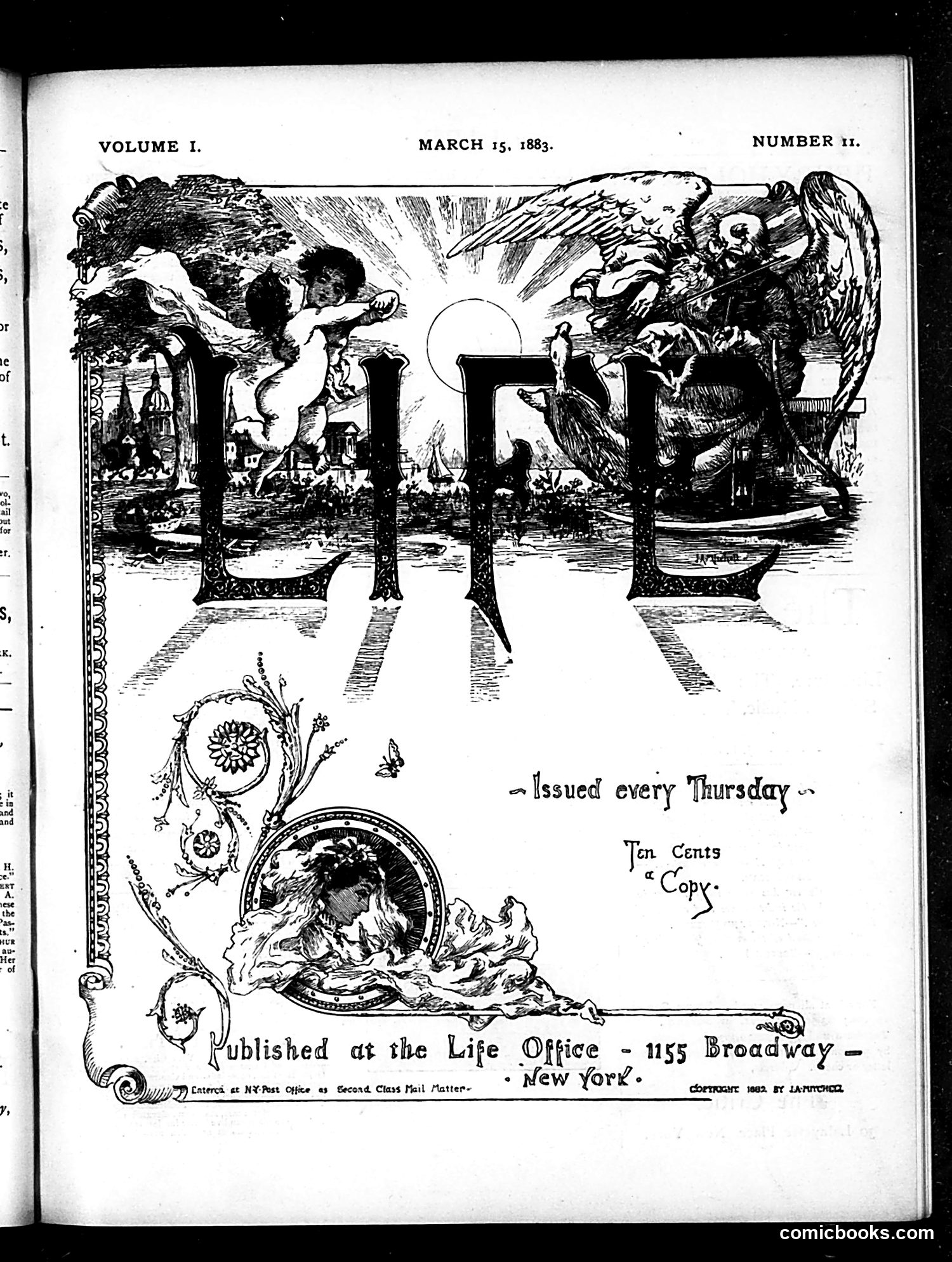
This is the cover of *Life* magazine, a satirical weekly published in New York. The large decorative letters "LIFE" dominate the center, framed by an elaborate allegorical illustration featuring angelic and demonic figures—likely representing good versus evil or competing forces in contemporary society. The specific satirical targets are unclear from the image alone, though the elaborate Victorian-era artistic style with mythological/religious imagery was typical of *Life*'s social commentary. Without additional context about March 1883 events, the precise political or social references cannot be determined. The cover emphasizes the magazine's identity as a source of satirical humor, issued weekly at ten cents per copy.
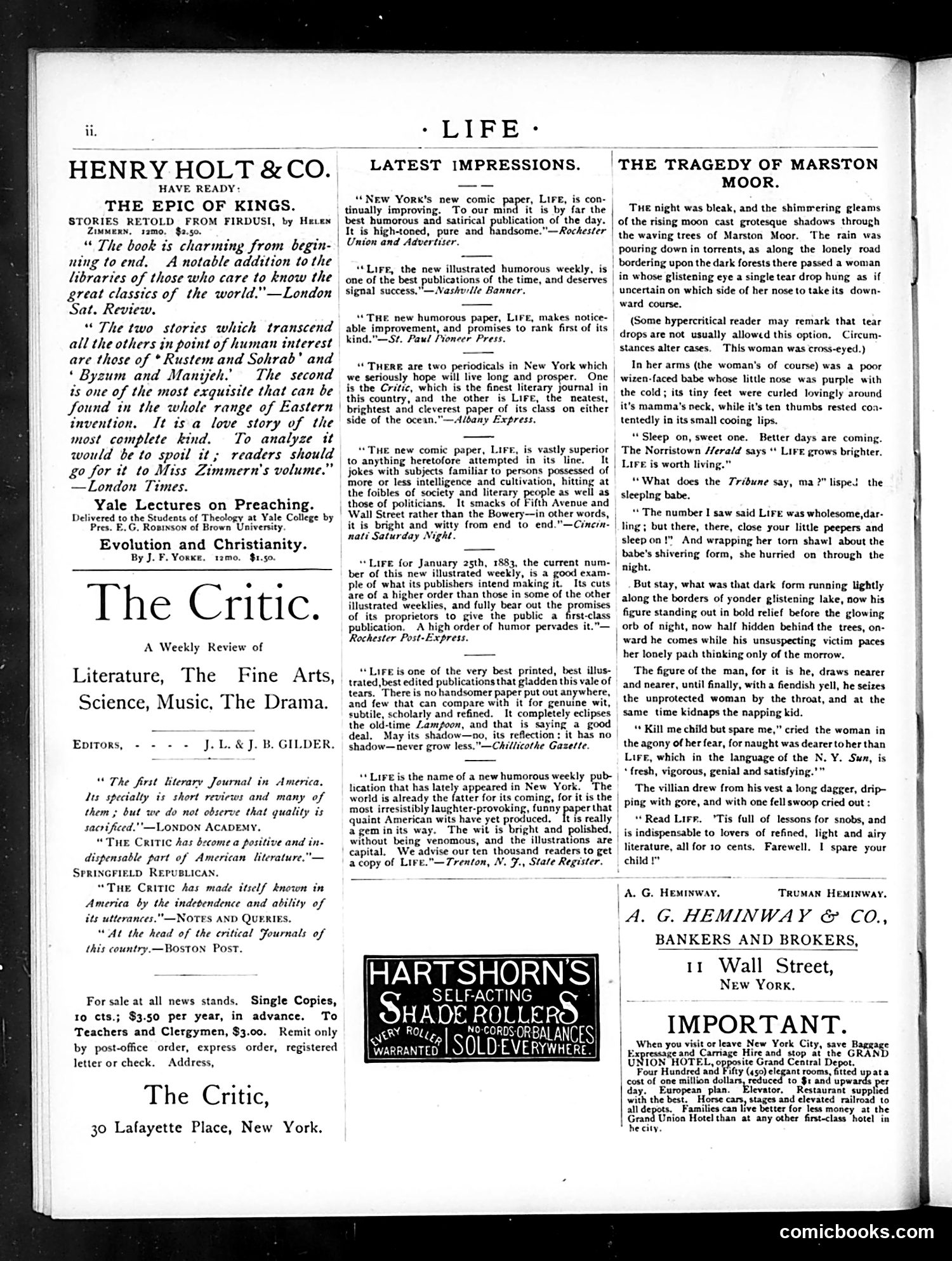
This page is primarily **advertising and editorial content**, not political cartoons. It contains: 1. **Book advertisements** for Henry Holt & Co. publications, including "The Epic of Kings" and works on evolution and Christianity 2. **"The Critic" masthead** — a weekly review of literature, fine arts, science, music, and drama, edited by J.L. & J.B. Gilder 3. **"The Tragedy of Marston Moor"** — a literary excerpt or story about a woman on a dark night near Marston Moor 4. **Multiple positive reviews of *Life* magazine itself**, praising it as a humorous weekly publication superior to competitors 5. **Commercial advertisements** for Hartshorn's Shade Rollers and A.G. Hemingway & Co. bankers The page reflects late 19th-century magazine culture, showcasing *Life*'s literary aspirations and advertising-dependent business model.
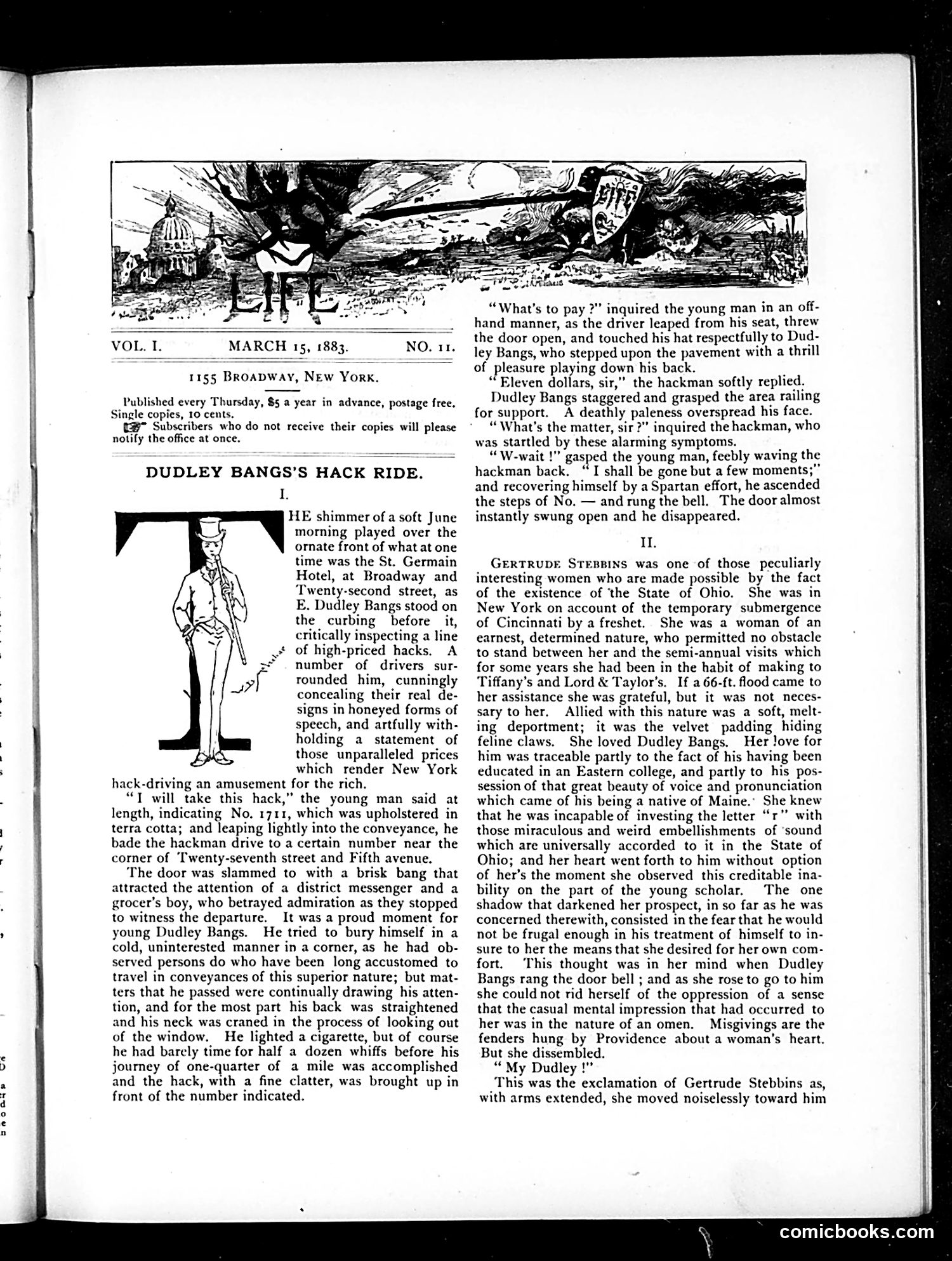
This page from *Life* magazine (March 15, 1883) contains a short story rather than political satire. The illustration shows a well-dressed man in a hack (taxi) carriage, and the narrative describes a ride through New York City. The story humorously recounts young Dudley Bangs's interaction with a hackman (taxi driver) over payment, establishing Bangs as a recurring character in the magazine. The second section introduces Gertrude Stebbins, an Ohio woman visiting New York, who becomes enamored with Dudley Bangs. This appears to be social satire mocking wealthy New Yorkers and their pretensions rather than political commentary. The humor derives from character interactions and romantic intrigue rather than contemporary events.
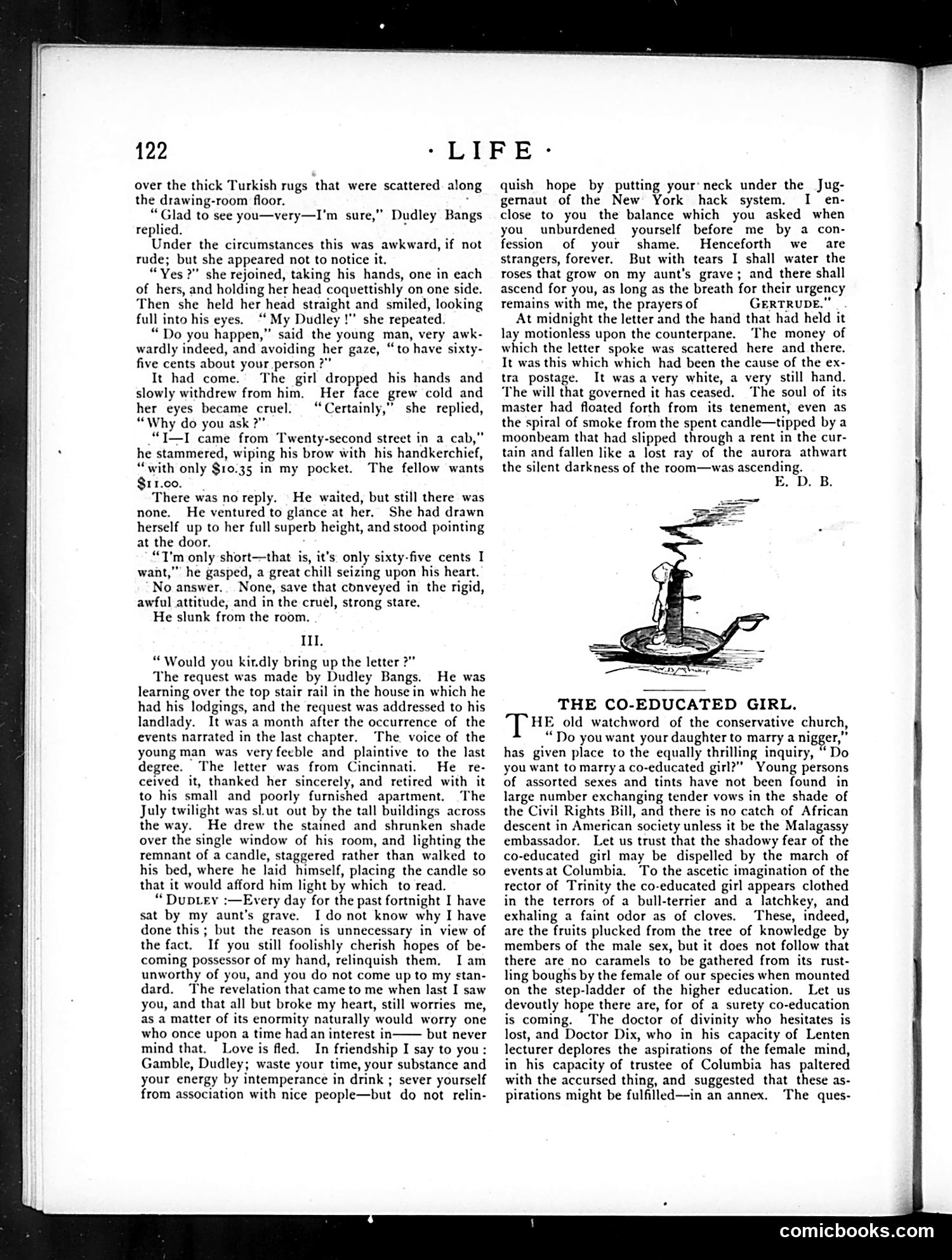
The page contains a short story titled "The Co-Educated Girl." The accompanying illustration shows a female figure standing on what appears to be a pedestal or platform, with lightning bolts above her head. The story satirizes contemporary debates about women's education. It opens with the rhetorical question, "Do you want your daughter to marry a nigger," then pivots to discuss co-education at Columbia University. The text mocks anxieties about educated women, suggesting fears that education makes women unsuitable for traditional roles or marriage. The lightning bolt imagery in the cartoon likely suggests the "shocking" or controversial nature of female education to conservative readers of the era. The satire targets both racist prejudices and gender anxieties among early-20th-century American society regarding women's intellectual advancement.
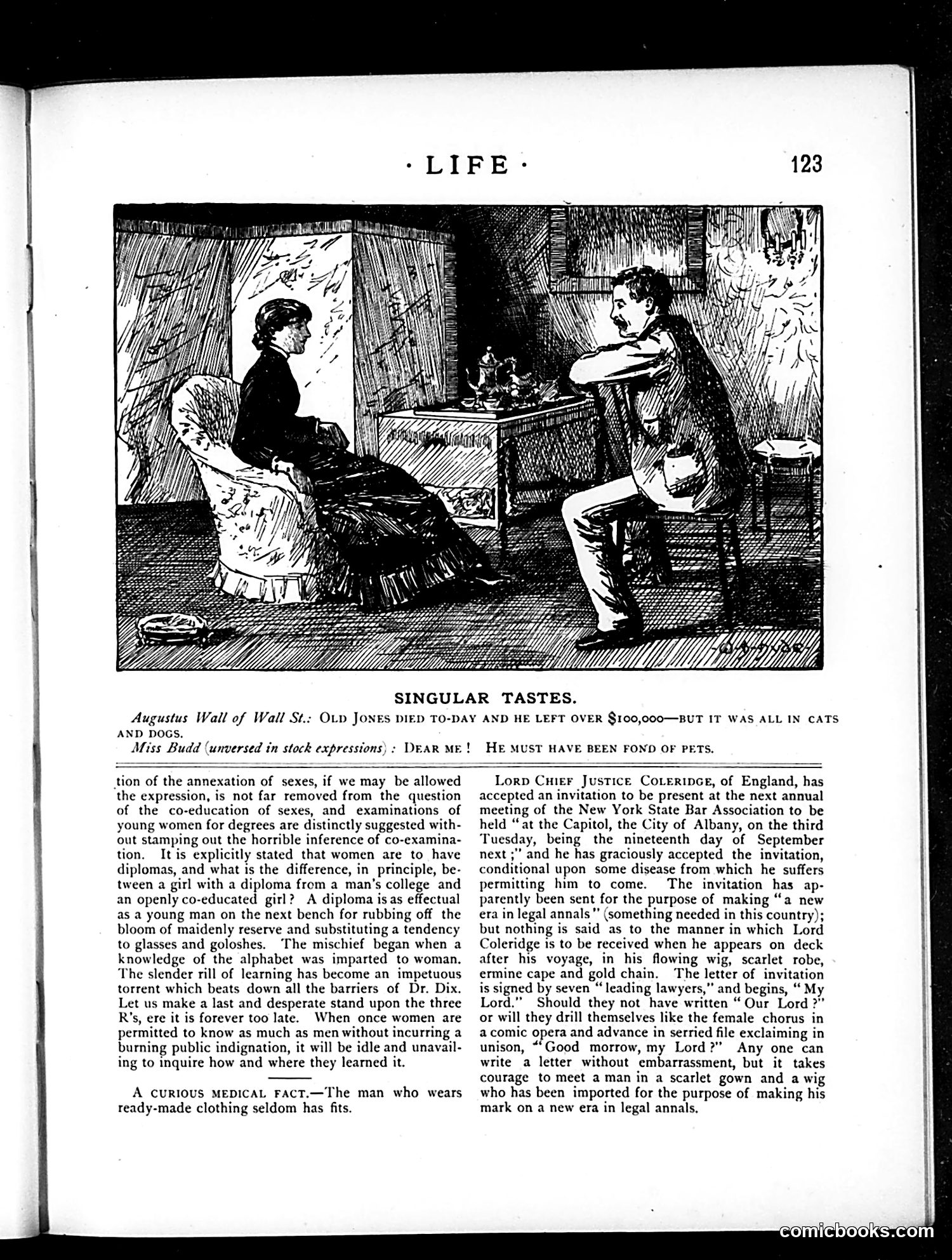
The cartoon depicts a social scene where a wealthy man (identified in the caption as "Augustus Wall of Wall St.") has died leaving over $100,000 to cats and dogs rather than people. A woman responds with sharp commentary: "He must have been fond of pets." The satire targets eccentric wealthy individuals who bequeathed fortunes to animals rather than charitable causes or people. This was apparently a known phenomenon among the ultra-rich that Life magazine found ridiculous and worthy of mockery. The accompanying text discusses women's education and co-education, plus legal news about Lord Chief Justice Coleridge visiting New York—seemingly unrelated filler content typical of Life's format as a miscellaneous satirical publication mixing cartoons, social commentary, and news items.
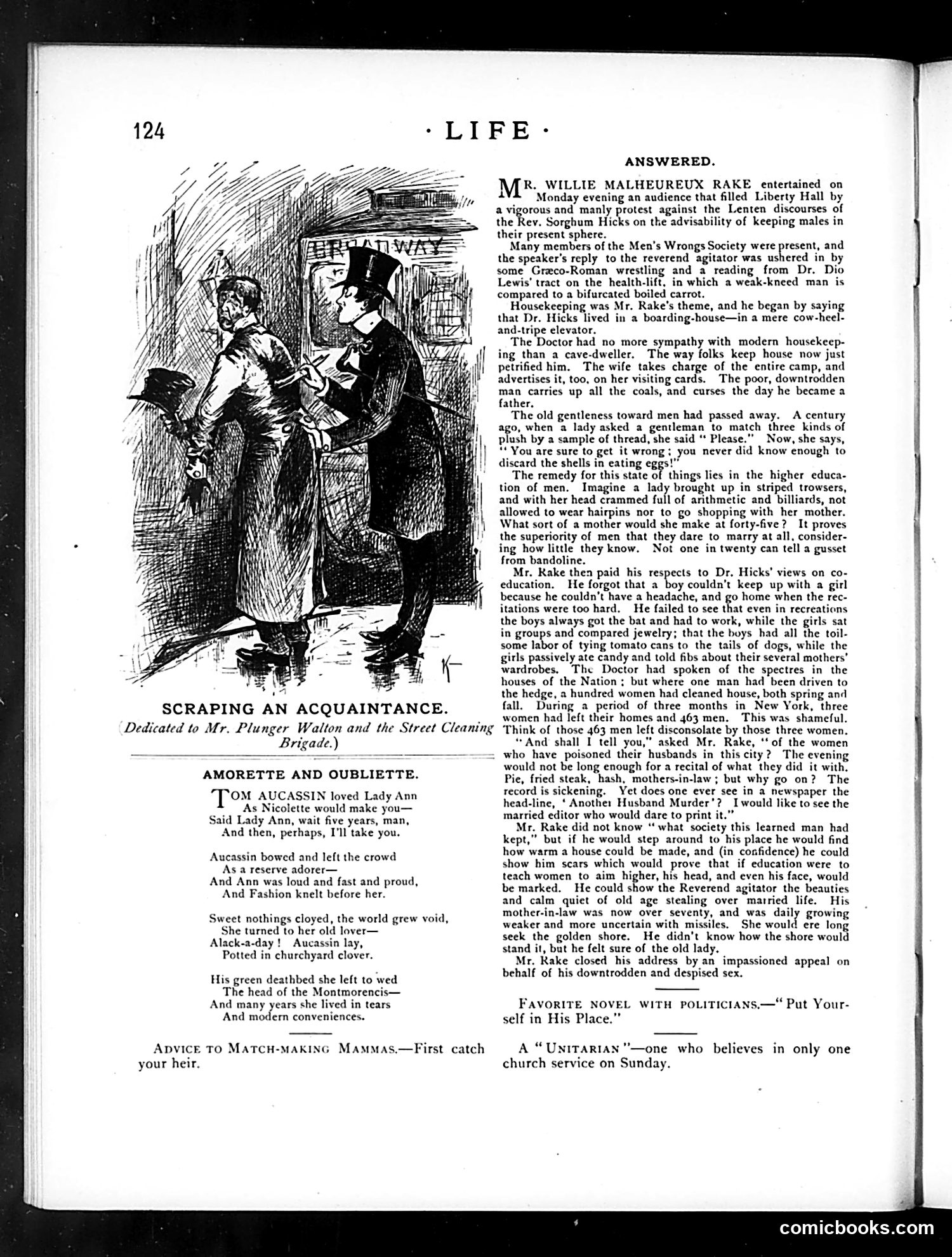
This cartoon satirizes Victorian social conventions about introductions and etiquette. The illustration shows two formally dressed men meeting on a street, with the caption "Scraping an Acquaintance" — a period term for making a casual social connection. The accompanying poem "Amorette and Oubliette" appears unrelated to the cartoon itself. Below the cartoon, the text mocks gender relations, particularly Mr. Willie Malheureaux Rake's address to the Men's Wrong Society. Rake argues that men are superior because they "dare to marry at all," suggesting women are difficult, demanding, and prone to nagging — a common Victorian stereotype. The satire critiques both Rake's misogyny and, implicitly, the backward attitudes it represents.
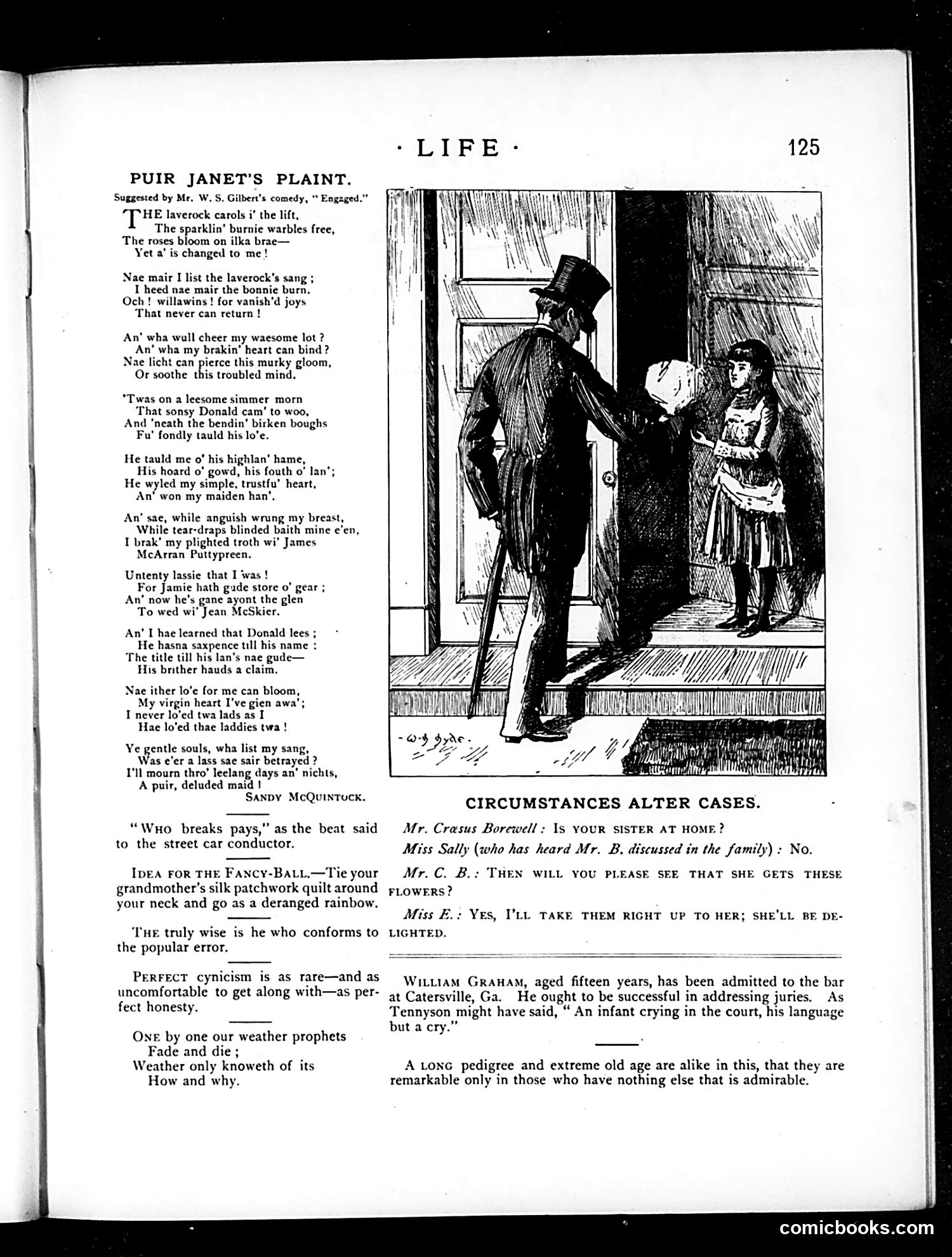
The main illustration shows a social scene with two men in formal attire (top hats and coats) interacting with a woman. The accompanying text section titled "CIRCUMSTANCES ALTER CASES" depicts a brief dialogue where Mr. Craus Borrwell asks Miss Sally if her sister is at home, and Mr. C.B. requests that flowers be sent to her, with Miss E. agreeing to deliver them. This appears to be gentle social satire about courtship rituals and the awkward formality of Victorian-era romantic communication. The title suggests the humor lies in how circumstances change social propriety—what might be acceptable in one context becomes notable in another. The specific identities of the characters are unclear from the image alone.
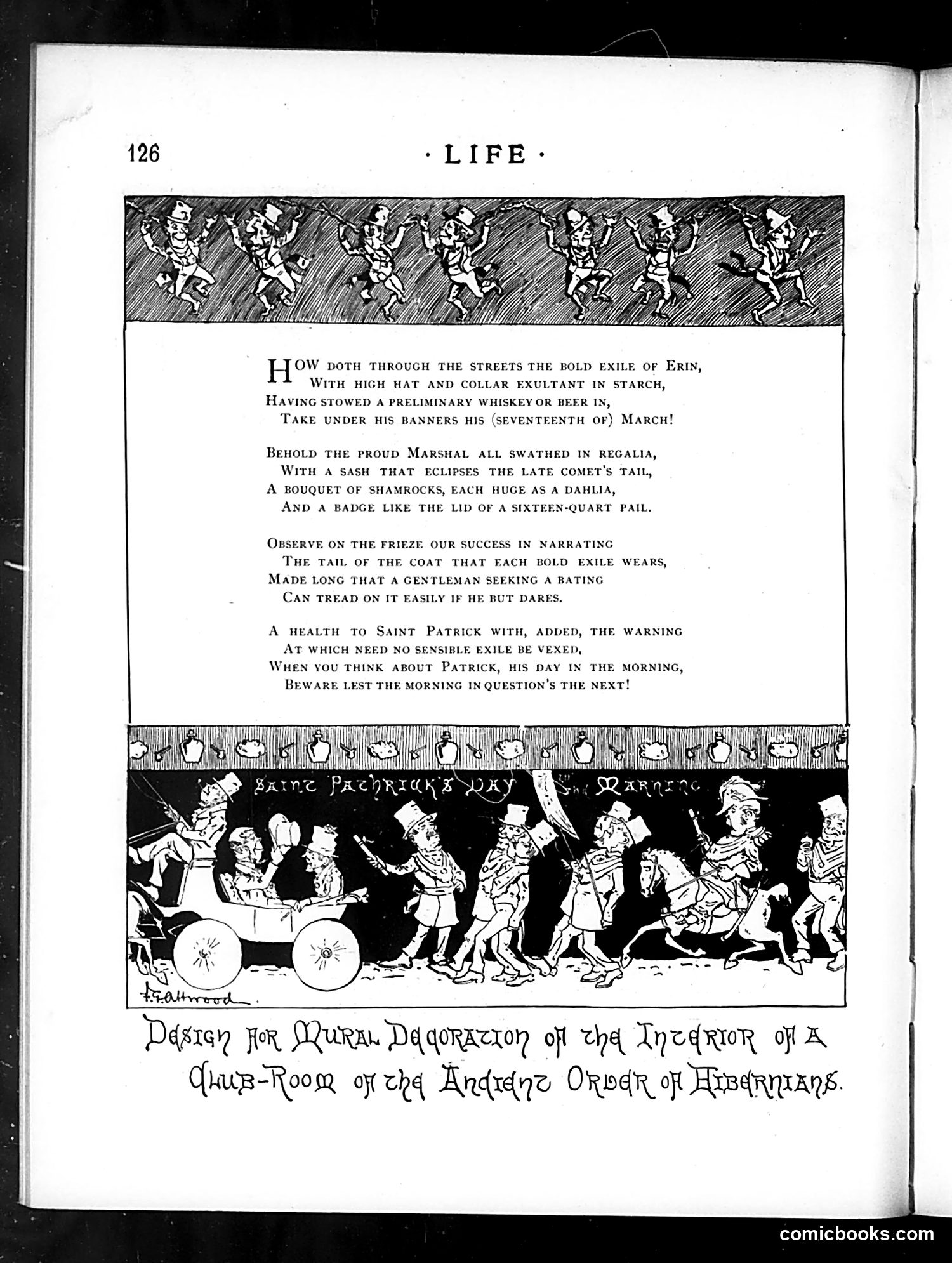
This page satirizes Irish-American St. Patrick's Day celebrations, specifically mocking the stereotype of Irish exiles ("bold exile of Erin") parading through streets in exaggerated formal dress—"high hat and collar exultant in starch"—after drinking whiskey or beer beforehand. The cartoon ridicules the elaborate regalia: a "proud Marshal" in ceremonial sash, oversized shamrock bouquets, and badges described mockingly as large as "a sixteen-quart pail." The satirical poem warns that observers should notice the coat-tails these exiles wear are so long "a gentleman seeing a batting / Can tread on it easily if he but dares"—suggesting both the pretentiousness and potential for drunken street confrontations during these parades. The bottom illustration depicts Saint Patrick's Day parade revelry.
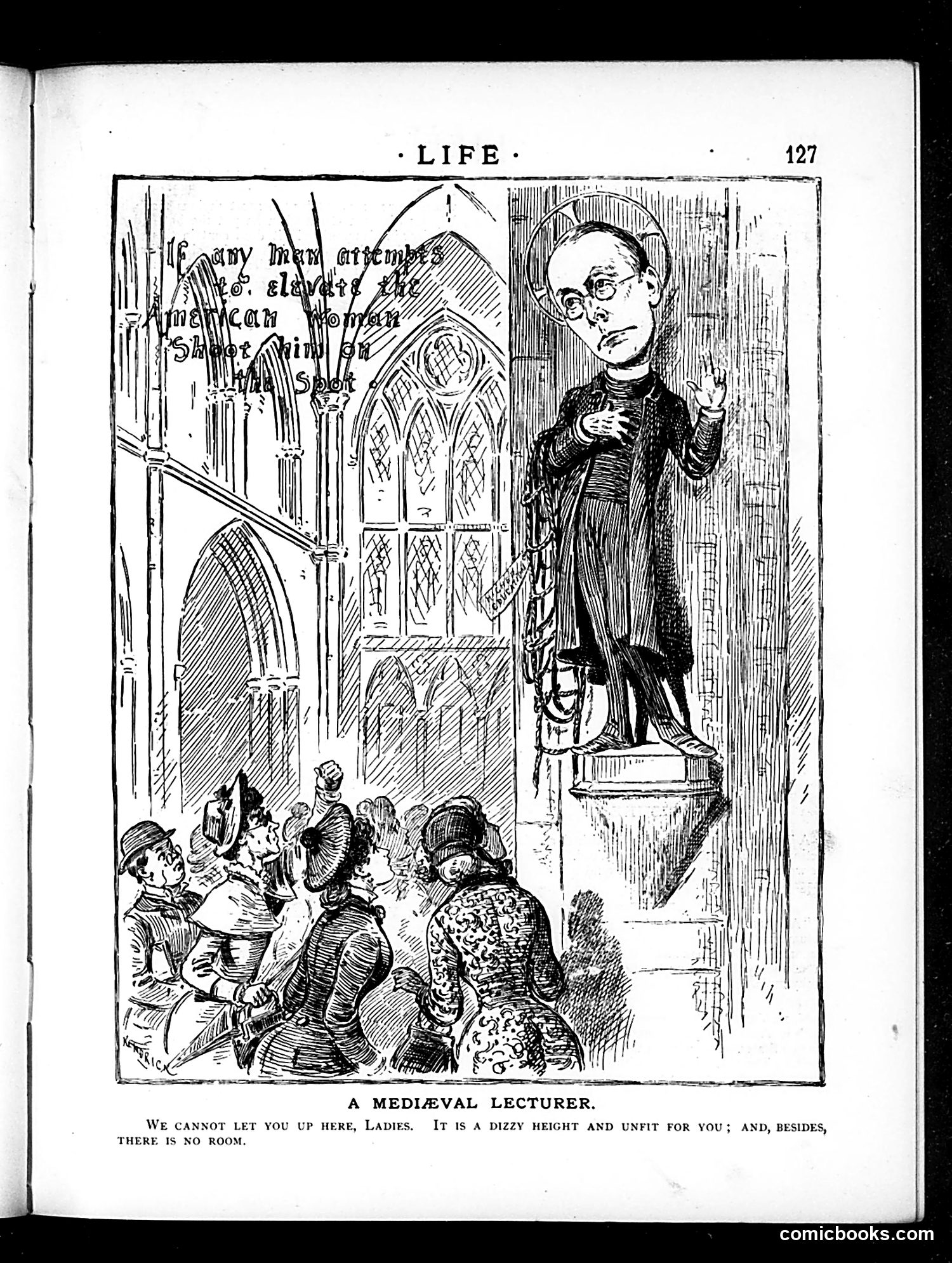
This satirical cartoon depicts a lecture hall scene labeled "A Medieval Lecturer." A thin, bespectacled man stands elevated on a pulpit, addressing a group of women seated below in a Gothic church or cathedral setting. The caption reads: "We cannot let you up here, ladies. It is a dizzy height and unfit for you; and, besides, there is no room." The satire critiques Victorian-era exclusion of women from higher education and intellectual spaces. The "medieval" framing suggests these discriminatory practices are archaic. The lecturer's patronizing excuse—claiming the height is unsuitable for women while denying them access—mocks the paternalistic justifications used to bar women from universities and professional advancement. The cartoon advocates for women's educational equality.
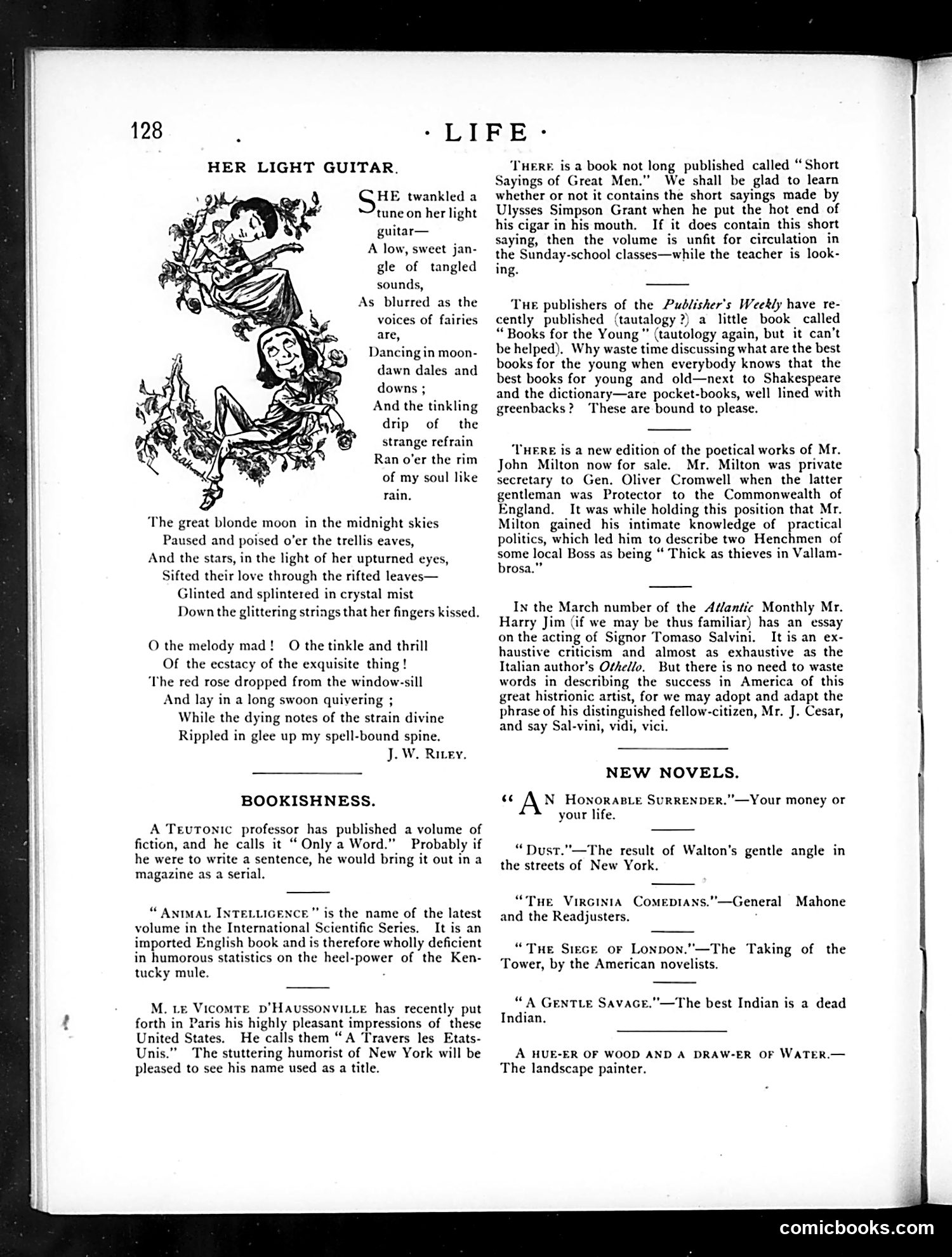
This *Life* page combines romantic poetry with literary mockery. The illustrated poem "Her Light Guitar" (credited to J. W. Riley) is sentimental Victorian verse about a woman playing music—the accompanying decorative illustrations show idealized figures in romantic poses, typical of the era's aesthetic sensibilities. The "Bookishness" section satirizes contemporary literary pretension. It mocks: - A "Teutonic professor" who publishes single words as novels, then stretches sentences into magazine serials (exaggerating prolixity) - An English scientific book lacking American humor (jingoistic criticism) - A French aristocrat's travel book given an ironic title suggesting stuttering The satire targets pompous intellectualism, particularly foreign and academic pretension. The final jab—about books for the young being worthless unless "well lined with greenbacks" (money)—cynically suggests genuine value lies only in profit, not literature. The "New Novels" section continues this mockery with punning, reductive plot summaries of contemporary works, dismissing serious literature through crude summarization.
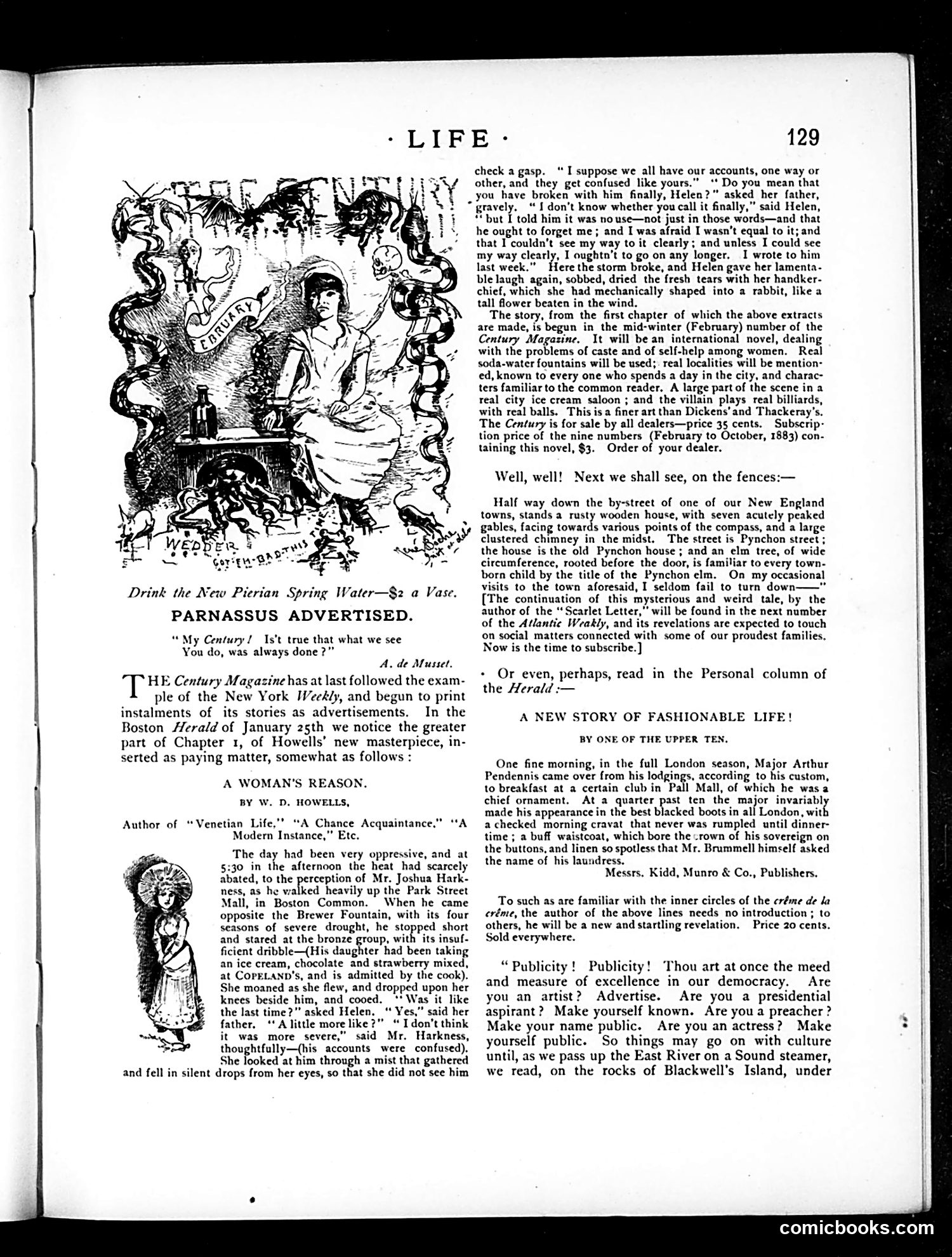
This page satirizes the **Century Magazine's** shift toward advertising strategy by serializing fiction installments as paid advertisements—following the *New York Weekly's* example. The cartoon shows classical figures (likely representing Literature and the Muses) being commercialized, with the title "Parnassus Advertised" mocking how high literary culture is being reduced to commercial promotion. The satire works by: 1. **Parody**: Life reprints a fabricated opening of W.D. Howells' novel "A Woman's Reason" filled with overwrought emotional descriptions and trivial domestic details (ice cream flavors, fountain dripping), exaggerating the melodrama of serialized fiction. 2. **Meta-joke**: By inserting this fake "advertisement" for the Century's actual serialization, Life ridicules how magazines blur editorial content with advertising, making literature itself a commercial product. 3. **Cultural criticism**: The jab at "finer art than Dickens' and Thackeray's" for using "real" locations and billiard balls mocks the realist movement's pretensions. Life's point: serious literature shouldn't be degraded into advertising copy.
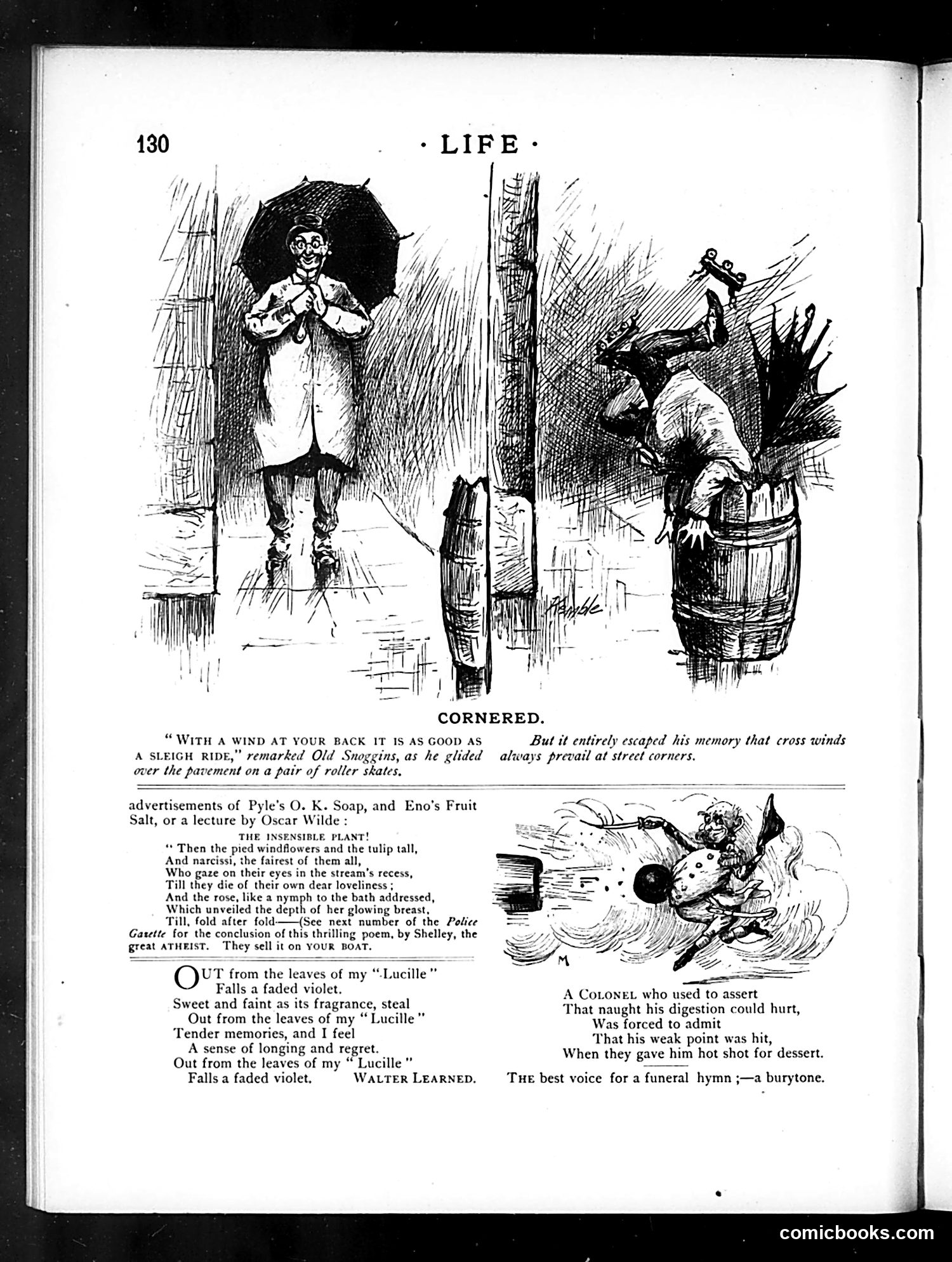
The main cartoon depicts a man on roller skates encountering a street corner while boasting that skating "with a wind at your back" is "as good as a sleigh ride." The satire's point is explicit in the caption: he forgot that "cross winds always prevail at street corners"—suggesting his overconfidence will result in disaster at the corner. This appears to be a general-audience humorous cartoon about human folly and underestimating practical obstacles, rather than political satire. The page also includes period advertising (Pyle's Soap, Eno's Fruit Salt, Oscar Wilde lectures), poetry excerpts, and brief joke items about digestive weakness and funeral singing. These are typical Life magazine filler content from the late 19th century—clever wordplay and light humor intended for genteel readers rather than sharp political commentary.
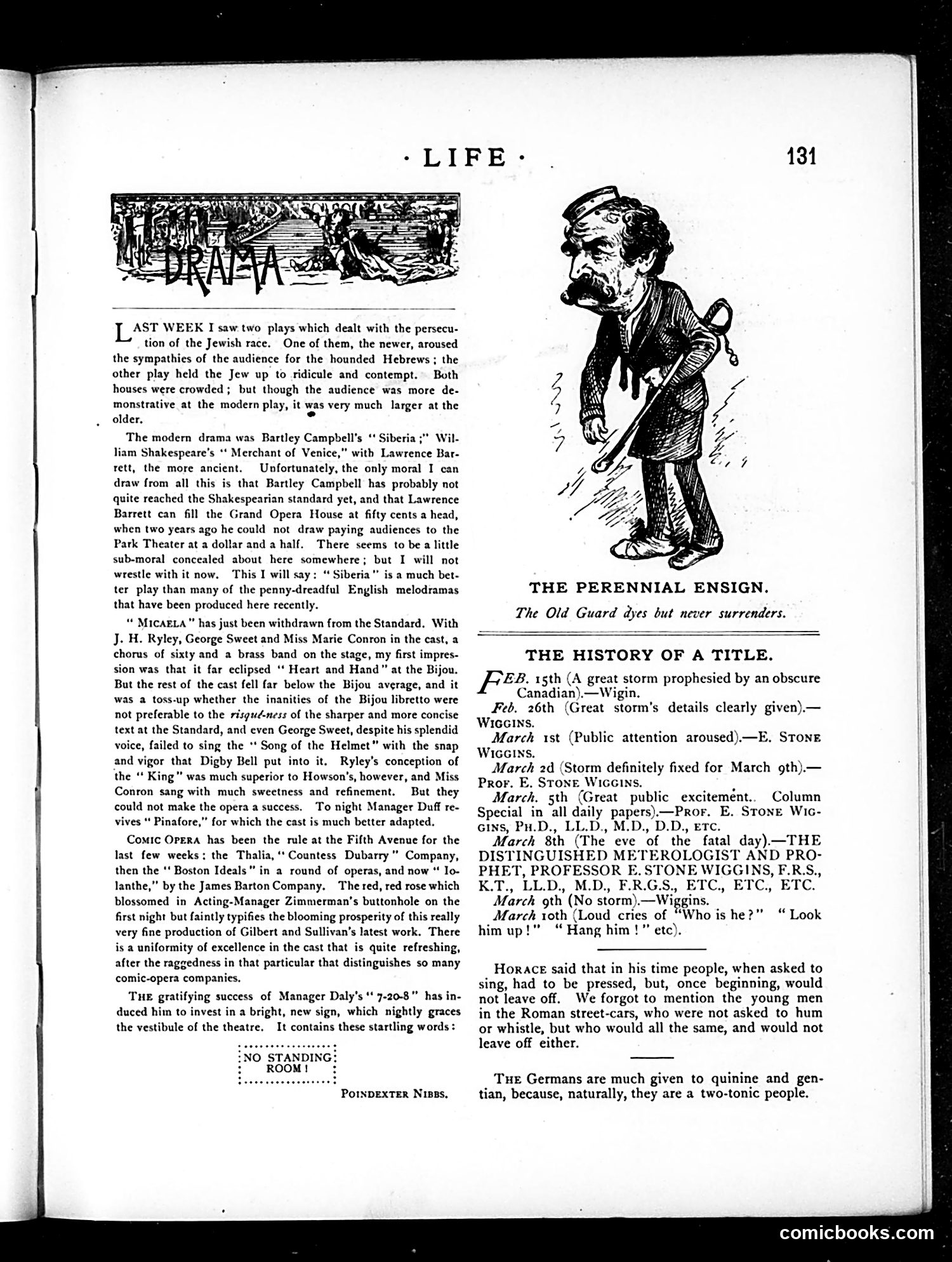
## Main Cartoon: "The Perennial Ensign" The caricature depicts **Professor E. Stone Wiggins**, a meteorologist who became a public figure (likely in the 1870s) after making a sensational prediction of a great storm. The cartoon satirizes his fall from grace. ## The Satire's Point "The History of a Title" tracks Wiggins's humiliating trajectory: his prediction gained him media attention and prestigious credentials (Ph.D., F.R.S., etc.), but when **no storm occurred on the predicted date (March 9th)**, he became a laughingstock—hence the angry mob cries "Who is he?" and "Hang him!" The title "The Perennial Ensign" with the motto "The Old Guard dyes but never surrenders" sarcastically suggests Wiggins clings to his inflated reputation despite public ridicule. The worn, shabby appearance emphasizes his diminished status. ## Context This mocks pseudoscientific charlatan experts and the public's gullibility in elevating them based on sensational claims—a recurring satire target in 19th-century humor magazines.
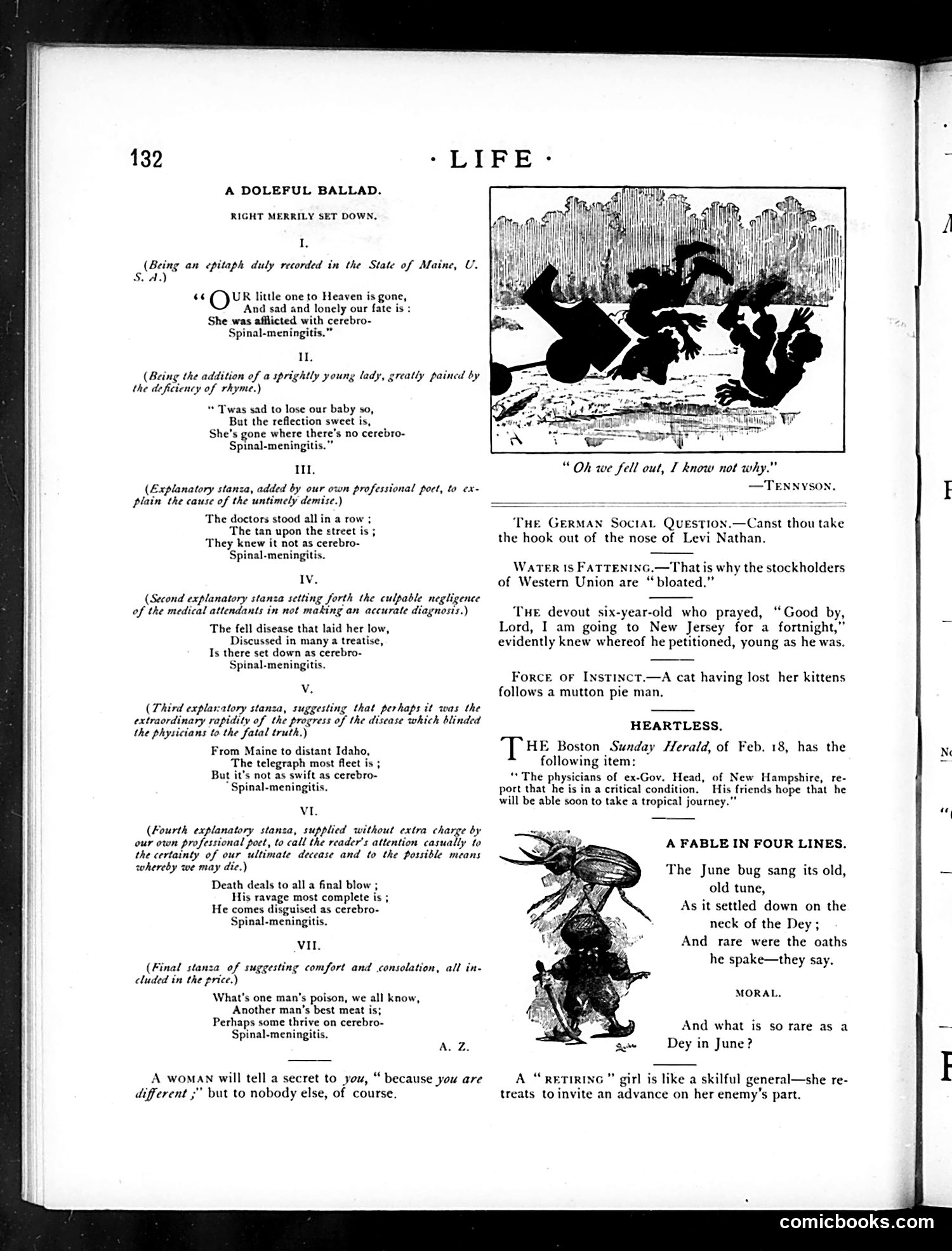
This satirical piece mocks the medical establishment's inability to diagnose cerebrospinal meningitis during an apparent outbreak. The ballad presents a child's death from this disease, with successive stanzas progressively criticizing doctors for failing to recognize the illness—they stood helplessly "all in a row" unable to identify the "fell disease." The humor lies in the relentless repetition of "cerebro-spinal-meningitis" forced into every stanza for rhyme, highlighting both the disease's rapid fatality ("swifter than telegrams") and society's resigned acceptance of death. The final stanza's darkly comic suggestion that some might "thrive on" the disease represents *Life* magazine's typical sardonic commentary on contemporary medical limitations and public health failures. The accompanying illustrations and shorter jokes employ similar biting social satire about gender, wealth, and current events.
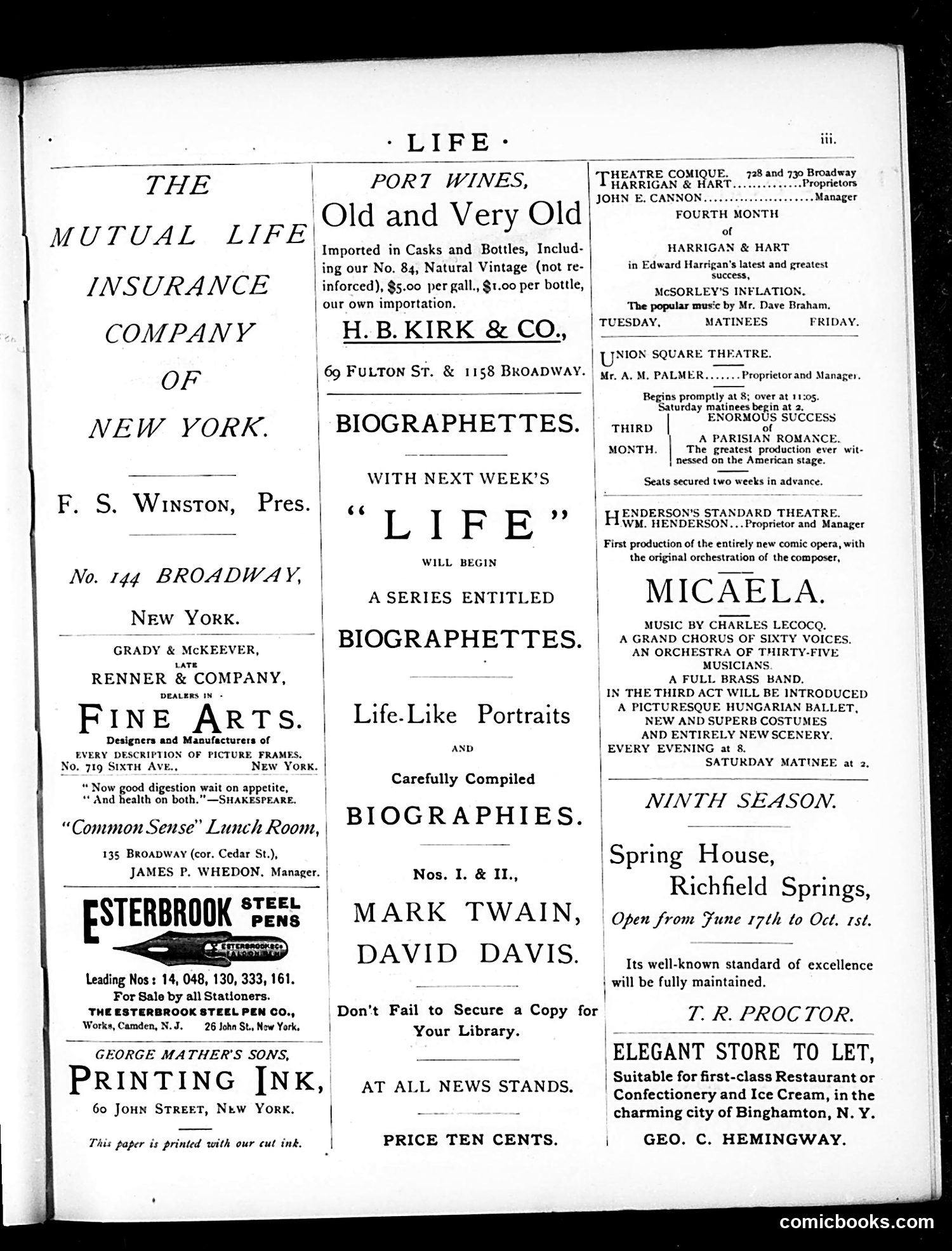
This is primarily an **advertising page** from Life magazine, not a satirical cartoon page. The page announces that Life will begin publishing a series called "Biographettes"—short biographical sketches featuring **Mark Twain** and **David Davis** in the upcoming issue (price: ten cents). The bulk of the content consists of period advertisements for New York businesses: insurance, wine merchants, steel pens, printing ink, lunch rooms, and picture frames. Theatre advertisements promote current productions including "McSorley's Inflation" at Union Square Theatre and a comic opera called "Micaela" at Henderson's Standard Theatre. There is **no visible cartoon or satirical content** on this page—it functions as a title/contents page mixed with commercial advertisements typical of 19th-century magazines, which relied heavily on advertising revenue.
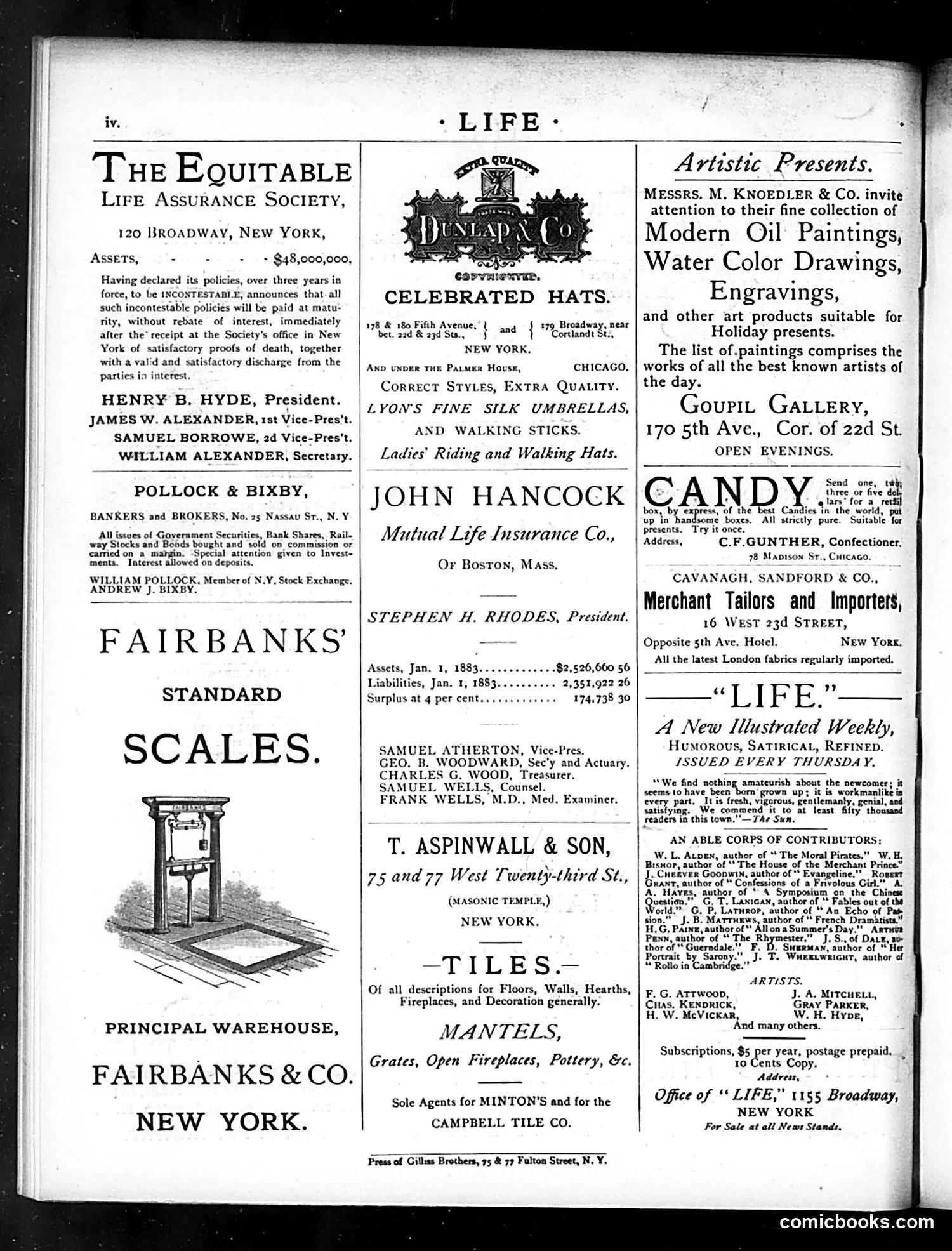
This is primarily an **advertising page** from an 1883 issue of *Life* magazine, with no political cartoons or satirical content visible. The page showcases advertisements for major American businesses of the era: insurance companies (Equitable Life, John Hancock Mutual), banking/brokerage services, scales manufacturer Fairbanks, hat makers, tailors, and art galleries. The only editorial content is a self-advertisement for *Life* itself—described as "A New Illustrated Weekly, Humorous, Satirical, Refined"—which lists its contributors and emphasizes the magazine's quality and respectability. The page reflects the commercial landscape of 1880s New York, targeting affluent urban readers with luxury goods and financial services. The prominent placement of insurance company advertisements suggests these were growing industries seeking credibility and public trust during this period.