
Life, 1883-03-15 · page 13 of 16
Life — March 15, 1883 — page 13: what you’re looking at
What you’re looking at
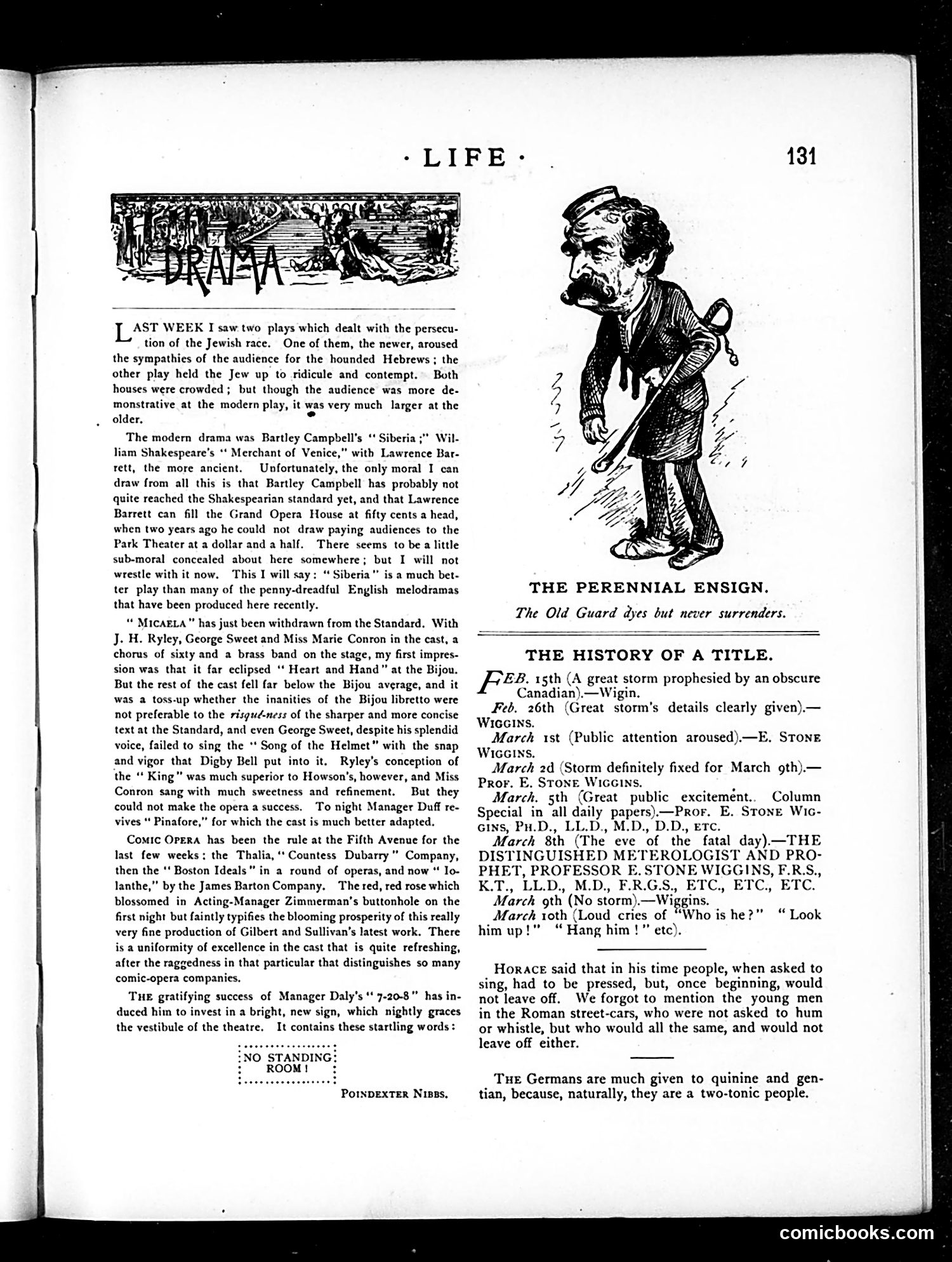
## Main Cartoon: "The Perennial Ensign" The caricature depicts **Professor E. Stone Wiggins**, a meteorologist who became a public figure (likely in the 1870s) after making a sensational prediction of a great storm. The cartoon satirizes his fall from grace. ## The Satire's Point "The History of a Title" tracks Wiggins's humiliating trajectory: his prediction gained him media attention and prestigious credentials (Ph.D., F.R.S., etc.), but when **no storm occurred on the predicted date (March 9th)**, he became a laughingstock—hence the angry mob cries "Who is he?" and "Hang him!" The title "The Perennial Ensign" with the motto "The Old Guard dyes but never surrenders" sarcastically suggests Wiggins clings to his inflated reputation despite public ridicule. The worn, shabby appearance emphasizes his diminished status. ## Context This mocks pseudoscientific charlatan experts and the public's gullibility in elevating them based on sensational claims—a recurring satire target in 19th-century humor magazines.
📄 Transcribed text from this page (OCR, searchable)
Machine-transcribed from the original scan — historical spelling and the odd misread are preserved.
LAST WEEK I saw two plays which dealt with the persecu- tion of the Jewish race. One of them, the newer, aroused the sympathies of the audience for the hounded Hebrews ; the other play held the Jew up to ridicule and contempt. Both houses were crowded ; but though the audience was more de- monstrative at the modern play, it was very much larger at the older. ©. The modern drama was Bartley Campbell's ‘' Siberia; Wil- liam Shakespeare's *‘ Merchant of Venice,” with Lawrence Bar- rett, the more ancient. Unfortunately, the only moral I can draw from all this is that Bartley Campbell has probably not quite reached the Shakespearian standard yet, and that Lawrence Barrett can fill the Grand Opera House at fifty cents a head, when two years ago he could not draw paying audiences to the Park Theater at a dollar and a half. There seems to be a little sub-moral concealed about here somewhere; but I will not wrestle with it now. This I will say: “ Siberia” is a much bet- ter play than many of the penny-dreadful English melodramas that have been produced here recently. “ MICAELA” has just been withdrawn from the Standard. With J. H. Ryley, George Sweet and Miss Marie Conron in the cast, a chorus of sixty and a brass band on the stage, my first impres- sion was that it far eclipsed ‘* Heart and Hand” at the Bijou. But the rest of the cast fell far below the Bijou avgrage, and it was a toss-up whether the inanities of the Bijou libretto were not preferable to the risgué-ness of the sharper and more concise text at the Standard, and even George Sweet, despite his splendid voice, failed to sing the ** Song of the Helmet” with the snap and vigor that Digby Bell put into it. Ryley’s conception of ‘the “ King” was much superior to Howson’s, however, and Miss Conron sang with much sweetness and refinement. But they could not make the opera a success. To night Manager Duff re- vives “ Pinafore," for which the cast is much better adapted. Comic Opera has been the rule at the Fifth Avenue for the last few weeks: the Thalia, ‘* Countess Dubarry"” Company, then the ‘' Boston Ideals in a round of operas, and now “* Io- lanthe,” by the James Barton Company. The red, red rose which blossomed in Acting-Manager Zimmerman’s buttonhole on the first night but faintly typifies the blooming prosperity of this really very fine production of Gilbert and Sullivan’s latest work. There is a uniformity of excellence in the cast that is quite refreshing, after the raggedness in that particular that distinguishes so many comic-opera companies. THE gratifying success of Manager Daly's ‘* 7-20-8" has in- duced him to invest in a bright, new sign, which nightly graces the vestibule of the theatre. It contains these startling words: PomnDEXTER N1pss, THE PERENNIAL ENSIGN. The Old Guard dyes but never surrenders. THE HISTORY OF A TITLE. FE. sth (A great storm prophesied by an obscure Canadian),—Wigin. Feb, 26th (Great storm's details clearly given).— Wiceins. March ist (Public attention aroused).—E. STONE Wiccins. March 2d (Storm definitely fixed for March gth).— Pror. E. Stone Wiccins. . March. 5th (Great public excitement... Column Special in all daily papers)—Pror. E. Stone Wic- cins, Pu.D., LL.D., M.D., D.D., Erc. March 8th (The ev the fatal day).—THE DISTINGUISHED METEROLOGIST AND PRO- PHET, PROFESSOR ONE WIGGINS, F.R.S., K.T., LL.D., M.D., F.R.G.S., ETC., ETC., ETC. March gth (No storm).—Wiggins. March oth (Loud cries of “Who is he?” him up!" “Hang him!” etc). “ Look Horace said that in his time people, when asked to sing, had to be pressed, but, once beginning, would not leave off. We forgot to mention the young men in the Roman street-cars, who were not asked to hum or whistle, but who would all the same, and would not leave off either. Tue Germans are much given to quinine and gen- tian, because, naturally, they are a two-tonic people. comicbooks.com