
Life, 1883-03-15 · page 11 of 16
Life — March 15, 1883 — page 11: what you’re looking at
What you’re looking at
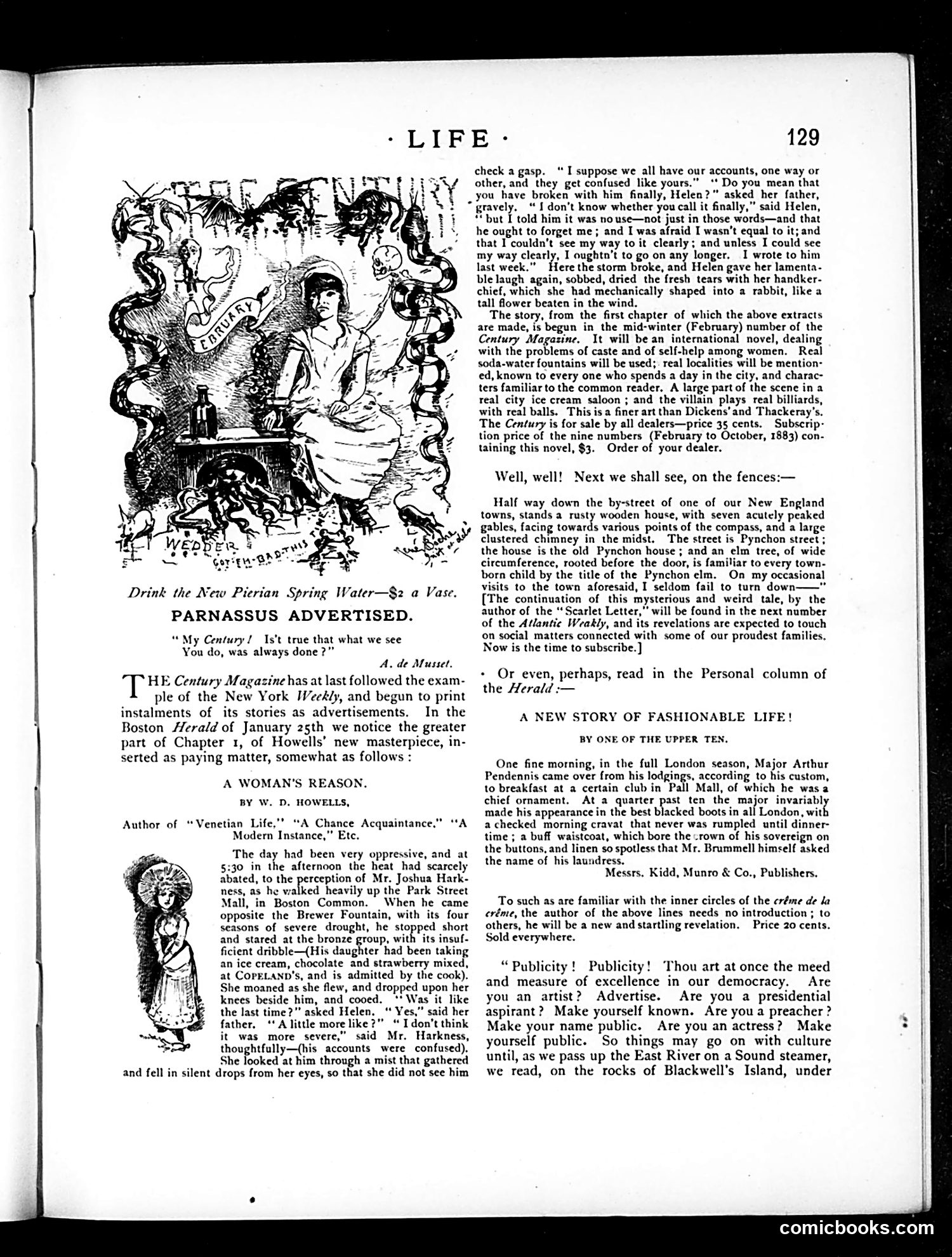
This page satirizes the **Century Magazine's** shift toward advertising strategy by serializing fiction installments as paid advertisements—following the *New York Weekly's* example. The cartoon shows classical figures (likely representing Literature and the Muses) being commercialized, with the title "Parnassus Advertised" mocking how high literary culture is being reduced to commercial promotion. The satire works by: 1. **Parody**: Life reprints a fabricated opening of W.D. Howells' novel "A Woman's Reason" filled with overwrought emotional descriptions and trivial domestic details (ice cream flavors, fountain dripping), exaggerating the melodrama of serialized fiction. 2. **Meta-joke**: By inserting this fake "advertisement" for the Century's actual serialization, Life ridicules how magazines blur editorial content with advertising, making literature itself a commercial product. 3. **Cultural criticism**: The jab at "finer art than Dickens' and Thackeray's" for using "real" locations and billiard balls mocks the realist movement's pretensions. Life's point: serious literature shouldn't be degraded into advertising copy.
📄 Transcribed text from this page (OCR, searchable)
Machine-transcribed from the original scan — historical spelling and the odd misread are preserved.
- LIFE: Drink the New Pierian Spring Water—§2 a Vase. PARNASSUS ADVERTISED. “My Century! Is't true that what we see You do, was always done ?” A. de Musset. HE Century Magazine has at last followed the exam- ple of the New York MWeed/y, and begun to print instalments of its stories as advertisements. In the Boston Herald of January 25th we notice the greater part of Chapter 1, of Howells’ new masterpiece, in- serted as paying matter, somewhat as follows : A WOMAN'S REASON. BY W. D, HOWELLS, Author of “Venetian Life,’" “A Chance Acquaintance,” ‘tA Modern Instance," Ete. The day had been very oppressive, and at 5:30 in the afternoon the heat had scarcely abated, to the perception of Mr. Joshua Hark- ness, as he walked heavily up the Park Street Mall, in Boston Common. When he came opposite the Brewer Fountain, with its four seasons of severe drought, he stopped short and stared at the bronze group, with its insuf- ficient dribble—{His daughter had been takin, an ice cream, chocolate and strawberry mixed, at CopELANp's, and is admitted by the cook). She moaned as she flew, and dropped upon her knees beside him, and cooed. ** Was it like the last time?” asked Helen, ‘ Yes,” said her father. ‘*A little more like?" “ I don’t think it was more severe,” said Mr. Harkness, thoughtfully—{(his accounts were confused), She looked at him through a mist that gathered and fell in silent drops from her eyes, so that she did not see him 129 check a gasp. “I suppose we all have our accounts, one way or other, and they get confused like yours.” ‘* Do you mean that _ You have broken with him finally, Helen?” asked her father, gravely, “J don’t know whether you call it finally,” said Helen, “but I told him it was no use—not just in those words—and that he ought to forget me; and I was afraid I wasn’t equal to it; and that I couldn't see my way to it clearly; and unless I could see my way clearly, I oughtn’t to go on any longer. I wrote to him last week.” Here the storm broke, and Helen gave her lamenta- ble laugh again, sobbed, dried the fresh tears with her handker- chief, which she had mechanically shaped into a rabbit, like a tall flower beaten in the wind. The story, from the first chapter of which the above extracts are made, is begun in the mid-winter (February) number of the Century Magazine, It will be an international novel, dealing with the problems of caste and of self-help among women. Real soda-water fountains will be used;. real localities will be mention- ed, known to every one who spends a day in the city, and charac- ters familiar to the common reader. A large part of the scene in a real city ice cream saloon ; and the villain plays real billiards, with real balls. This isa finer art than Dickens’and Thackeray's. The Century is for sale by all dealers—price 35 cents. Subscrip- tion price of the nine numbers (February to October, 1883) con- taining this novel, $3. Order of your dealer. Well, well! Next we shall see, on the fences:— Half way down the by-street of one of our New England towns, stands a rusty wooden house, with seven acutely peaked gables, facing towards various points of the compass, and a large clustered chimney in the midst, The street is Pynchon street ; the house is the old Pynchon house ; and an elm tree, of wide circumference, rooted before the door, is familiar to every town- born child by the title of the Pynchon elm. On my occasional visits to the town aforesaid, I seldom fail to turn down——" [The continuation of this mysterious and weird tale, by the author of the “Scarlet Letter,” will be found in the next number of the Atlantic Weakly, and its revelations are expected to touch on social matters connected with some of our proudest families, Now is the time to subscribe. ] Or even, perhaps, read in the Personal column of the Herald :— A NEW STORY OF FASHIONABLE LIFE! BY ONE OF THE UPPER TEN, One fine morning, in the full London season, Major Arthur Pendennis came over from his lodgings, according to his custom, to breakfast at a certain club in Pall Mall, of which he was a chief ornament. At a quarter past ten the ere invariably made his appearance in the best blacked boots in all London, with achecked morning cravat that never was rumpled until dinner- time ; a buff waistcoat, which bore the crown of his sovereign on the buttons, and linen so spotless that Mr. Brummell himself asked the name of his laundress. Messrs. Kidd, Munro & Co., Publishers. To such as are familiar with the inner circles of the créme de la eréme, the author of the above lines needs no introduction ; to others, he will be a new and startling revelation. Price 20 cents. Sold everywhere. “Publicity! Publicity! Thou art at once the meed and measure of excellence in our democracy. Are you an artist? Advertise. Are you a presidential aspirant? Make yourself known. Are you a preacher ? Make your name public. Are you an actress? Make yourself public. So things may go on with culture until, as we pass up the East River on a Sound steamer, we read, on the rocks of Blackwell's Island, under comicbooks.com