
Life, 1883-03-15 · page 4 of 16
Life — March 15, 1883 — page 4: what you’re looking at
What you’re looking at
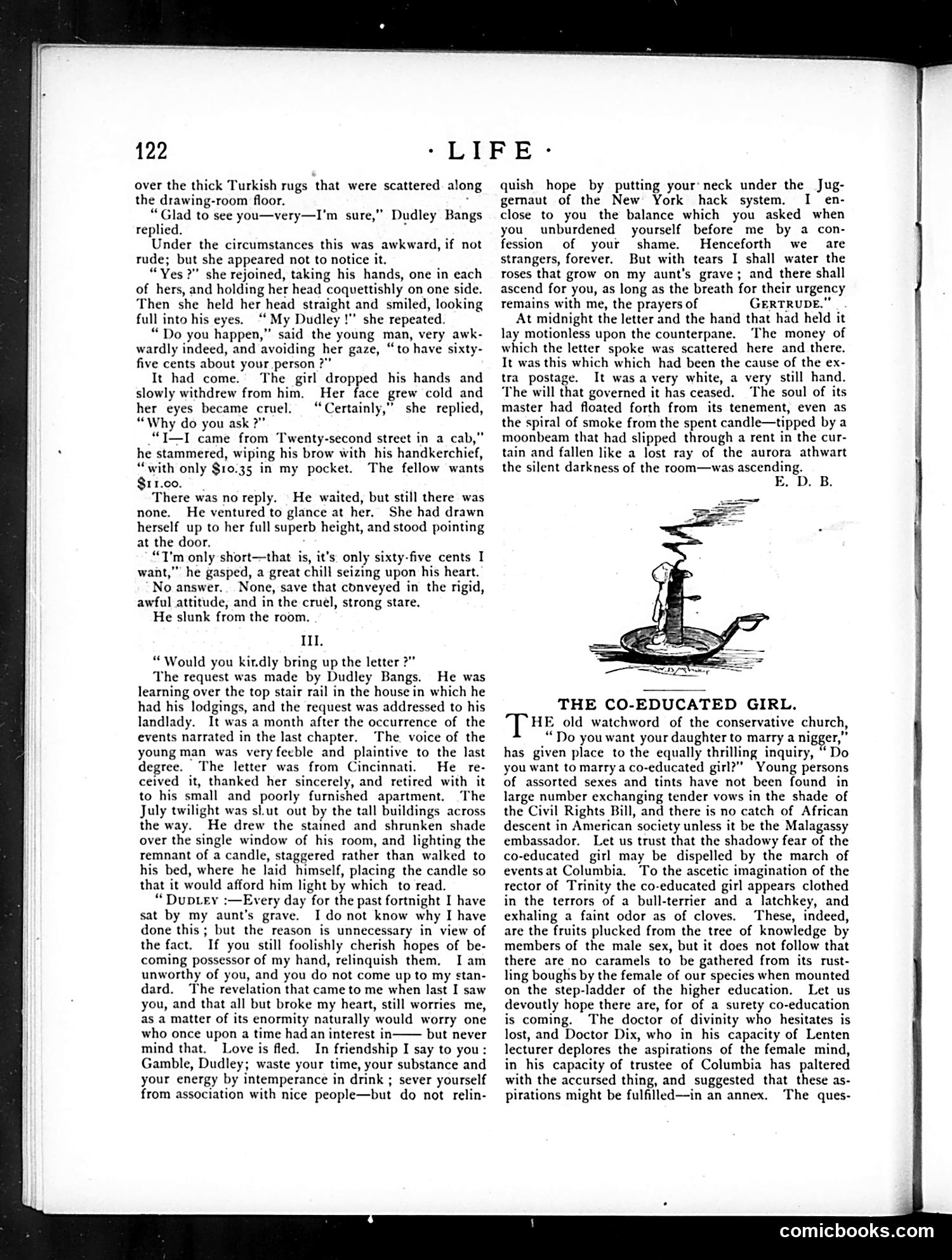
The page contains a short story titled "The Co-Educated Girl." The accompanying illustration shows a female figure standing on what appears to be a pedestal or platform, with lightning bolts above her head. The story satirizes contemporary debates about women's education. It opens with the rhetorical question, "Do you want your daughter to marry a nigger," then pivots to discuss co-education at Columbia University. The text mocks anxieties about educated women, suggesting fears that education makes women unsuitable for traditional roles or marriage. The lightning bolt imagery in the cartoon likely suggests the "shocking" or controversial nature of female education to conservative readers of the era. The satire targets both racist prejudices and gender anxieties among early-20th-century American society regarding women's intellectual advancement.
📄 Transcribed text from this page (OCR, searchable)
Machine-transcribed from the original scan — historical spelling and the odd misread are preserved.
122 over the thick Turkish rugs that were scattered along the drawing-room floor. “Glad to see you—very—I'm sure,” Dudley Bangs replied. Under the circumstances this was awkward, if not rude; but she appeared not to notice it. “Yes ?” she rejoined, taking his hands, one in each of hers, and holding her head coquettishly on one side. Then she held her head straight and smiled, looking full into his eyes.“ My Dudley !"" she repeated. “Do you happen,” said the young man, very awk- wardly indeed, and avoiding her gaze, “to have sixty- five cents about your person ?” It had come. The girl dropped his hands and slowly withdrew from him. Her face grew cold and her eyes became cruel. “Certainly,” she replied, “Why do you ask ?” “I—I came from Twenty-second street in a cab,” he stammered, wiping his brow with his handkerchief, “with only $10.35 in my pocket. The fellow wants $11.00. There was no reply. He waited, but still there was none. He ventured to glance at her. She had drawn herself up to her full superb height, and stood pointing at the door. “T'm only short—that is, it’s only sixty-five cents I want,” he gasped, a great chill seizing upon his heart. No answer.. None, save that conveyed in the rigid, awful attitude, and in the cruel, strong stare. He slunk from the room. Ill. “Would you kirdly bring up the letter ?” The request was made by Dudley Bangs. He was learning over the top stair rail in the house in which he had his lodgings, and the request was addressed to his landlady. It was a month after the occurrence of the events narrated in the last chapter. ‘The. voice of the young man was very feeble and plaintive to the last degree. The letter was from Cincinnati. He re- ceived it, thanked her sincerely, and retired with it to his small and poorly furnished apartment. The July twilight was slut out by the tall buildings across the way. He drew the stained and shrunken shade over the single window of his room, and lighting the remnant of a candle, staggered rather than walked to his bed, where he laid himself, placing the candle so that it would afford him light by which to read. “Duptey :—Every day for the past fortnight I have sat by my aunt’s grave. I do not know why I have done this ; but the reason is unnecessary in view of the fact. If you still foolishly cherish hopes of be- coming possessor of my hand, relinquish them. I am unworthy of you, and you do not come up to my stan- dard. The revelation that came to me when last I saw you, and that all but broke my heart, still worries me, as a matter of its enormity naturally ‘would worry one who once upon a time had an interest in but never mind that. Love is fled. In friendship I say to you: Gamble, Dudley; waste your time, your substance and your energy by intemperance in drink ; sever yourself from association with nice people—but do not relin- LIFE quish hope by putting your’neck under the Jug- gernaut of the New York hack system. I en- close to you the balance which you asked when you unburdened yourself before me by a con- fession of your shame. Henceforth we are strangers, forever. But with tears I shall water the roses that grow on my aunt's grave; and there shall ascend for you, as long as the breath for their urgency remains with me, the prayers of GERTRUDE. At midnight the letter and the hand that had held it lay motionless upon the counterpane. ‘The money of which the letter spoke was scattered here and there. It was this which which had been the cause of the ex- tra postage. It was a very white, a very still hand. The will that governed it has ceased. ‘The soul of its master had floated forth from its tenement, even as the spiral of smoke from the spent candle—tipped by a moonbeam that had slipped through a rent in the cur- tain and fallen like a lost ray of the aurora athwart the silent darkness of the room—was ascending. E. D. B. THE CO-EDUCATED GIRL. HE old watchword of the conservative church, “Do you want your daughter to marry a nigger,” has given place to the equally thrilling inquiry, “ Do you want to marry a co-educated girl?” Young persons of assorted sexes and tints have not been found in large number exchanging tender vows in the shade of the Civil Rights Bill, and there is no catch of African descent in American society unless it be the Malagassy embassador. Let us trust that the shadowy fear of the co-educated girl may be dispelled by the march of events at Columbia. To the ascetic imagination of the rector of Trinity the co-educated girl appears clothed in the terrors of a bull-terrier and a latchkey, and exhaling a faint odor as of cloves. These, indeed, are the fruits plucked from the tree of knowledge by members of the male sex, but it does not follow that there are no caramels to be gathered from its rust- ling boughs by the female of our species when mounted on the step-ladder of the higher education. Let us devoutly hope there are, for of a surety co-education is coming. The doctor of divinity who hesitates is lost, and Doctor Dix, who in his capacity of Lenten lecturer deplores the aspirations of the female mind, in his capacity of trustee of Columbia has paltered with the accursed thing, and suggested that these as- pirations might be fulfilled—in an annex. The ques- comicbooks.com