
A complete issue · 16 pages · 1883
Life — February 22, 1883
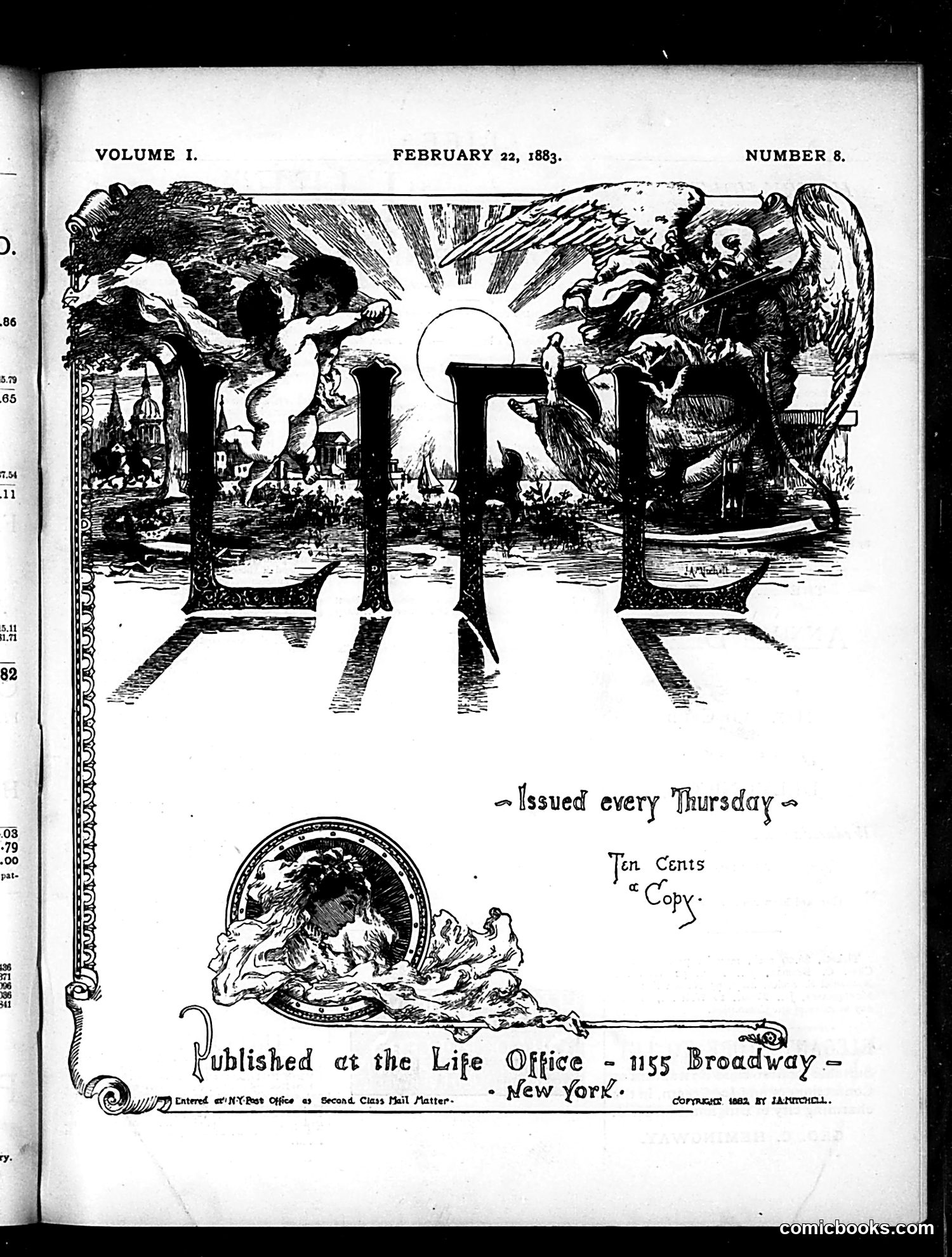
This is the cover/title page for Life magazine's eighth issue of volume one. The elaborate engraved illustration shows allegorical figures in a fantastical landscape viewed through large decorative letters spelling "LIFE." The scene includes cherubs, classical figures, and a rising or setting sun, rendered in the ornate Victorian style typical of 1880s satirical publications. The image appears primarily decorative rather than satirical commentary on specific current events. It establishes the magazine's artistic aesthetic and brand identity as a sophisticated, illustrated publication. Published weekly at 10 cents per copy from the Life Office at 1155 Broadway in New York, this represented an early example of American satirical magazine design during the Gilded Age.
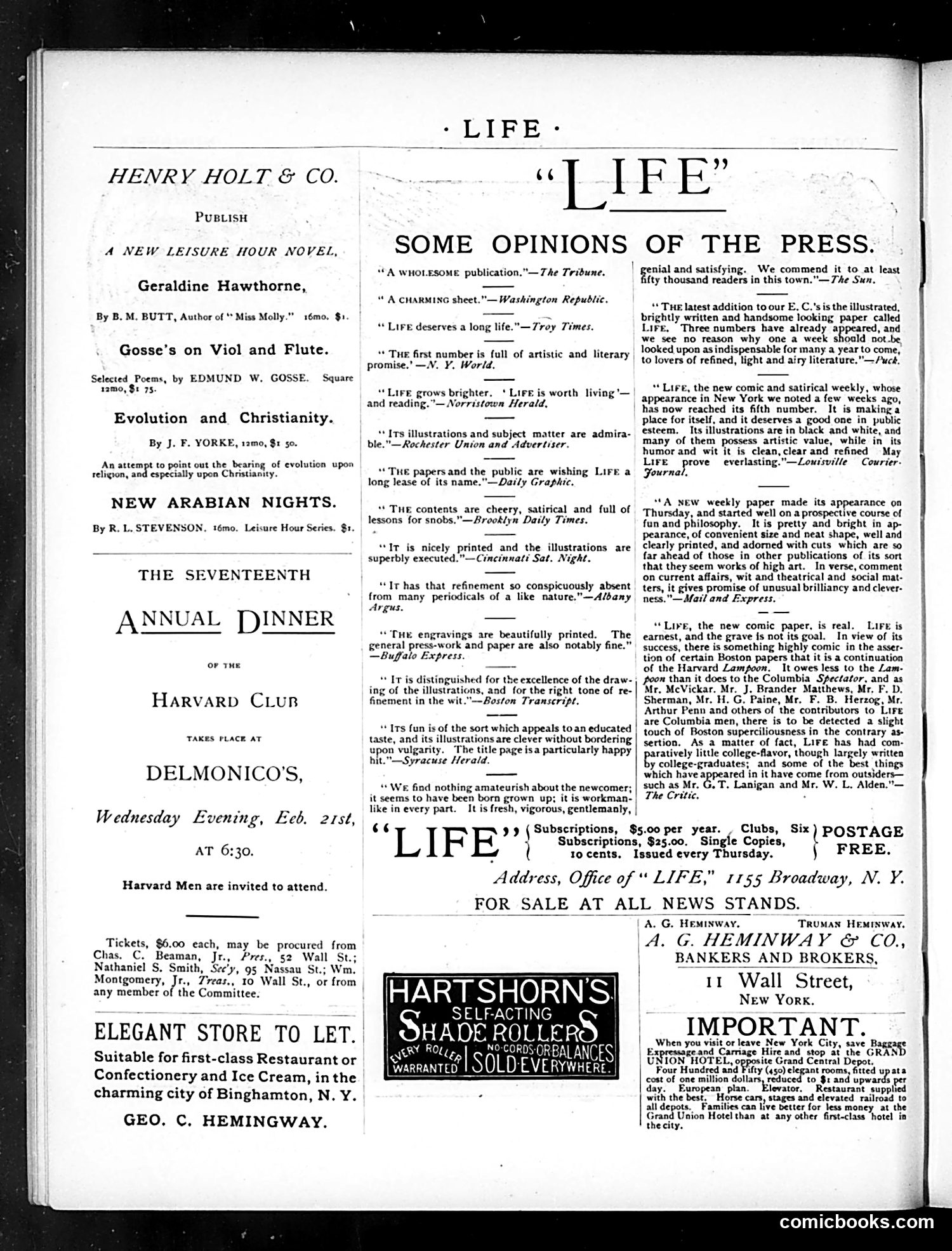
This page is primarily **advertising and announcements** rather than political cartoons. The left column advertises new books published by Henry Holt & Co., including works on evolution and Christianity, plus notices for a Harvard Club dinner and a store rental in Binghamton, New York. The center-right features promotional material for *Life* magazine itself, reprinting positive press reviews praising its "artistic and literary promise," illustrations, and satirical content. The text emphasizes *Life*'s status as a successful New York-based weekly comic publication. The only illustration visible is an advertisement for **Hartshorn's Self-Acting Shade Rollers** at bottom-center—a product advertisement, not political satire. This appears to be a **self-promotional issue** focused on marketing *Life*'s own quality and circulation.
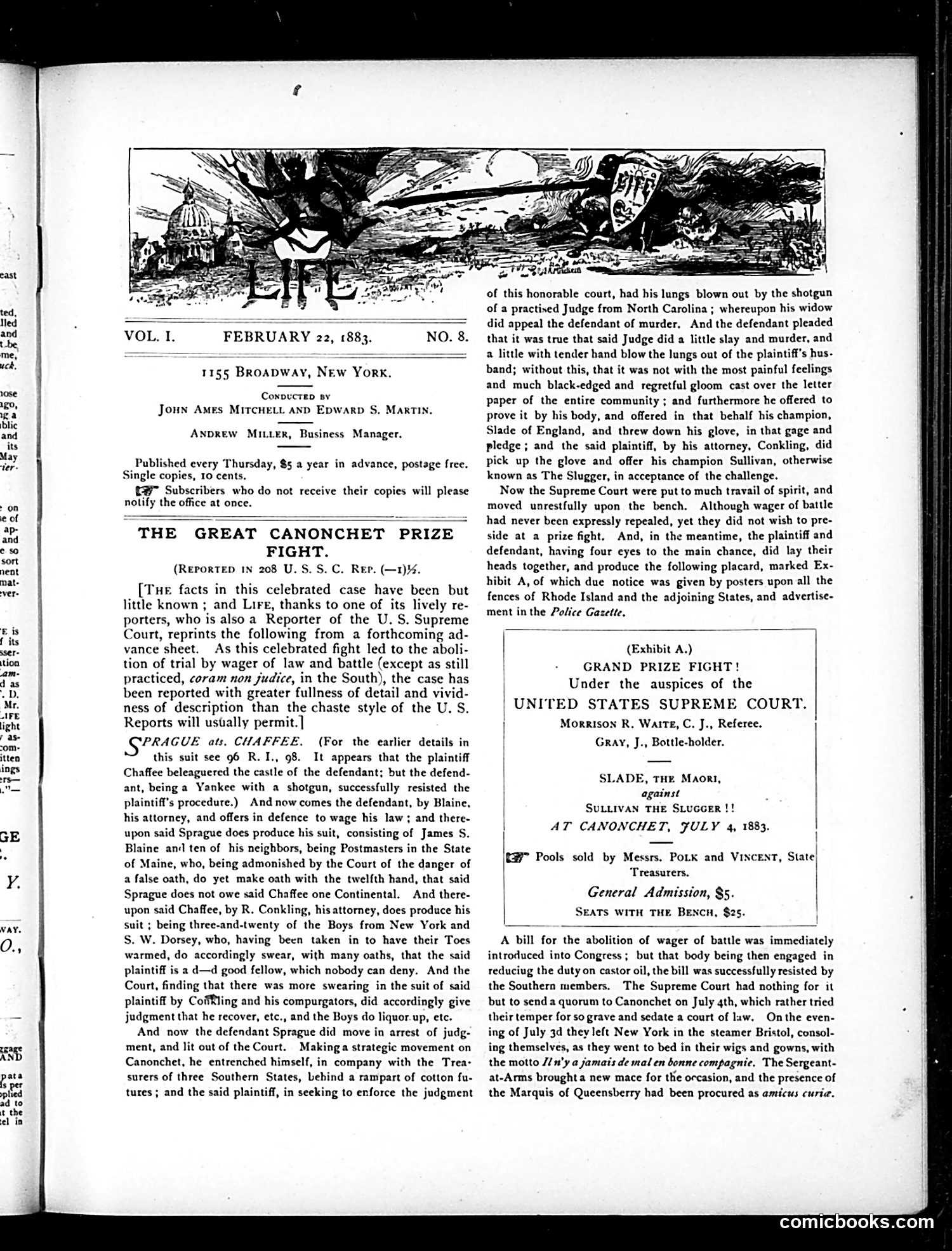
The page features "The Great Canonchet Prize Fight," a satirical account of a legal case reported as a mock boxing match. The text describes a dispute between Sprague and Ciaffee involving competing claims and oaths, with the defendant successfully resisting the plaintiff's suit. The satire presents this courtroom contest as a gladiatorial spectacle, complete with a fictional "Grand Prize Fight" announcement under U.S. Supreme Court auspices. The cartoon at the top (partially visible) likely depicts this mock-heroic legal battle. The satire mocks both the legal combatants and the sensationalism surrounding the case, treating serious litigation as entertainment—a commentary on how American courts and newspapers dramatized high-profile disputes during the Gilded Age.
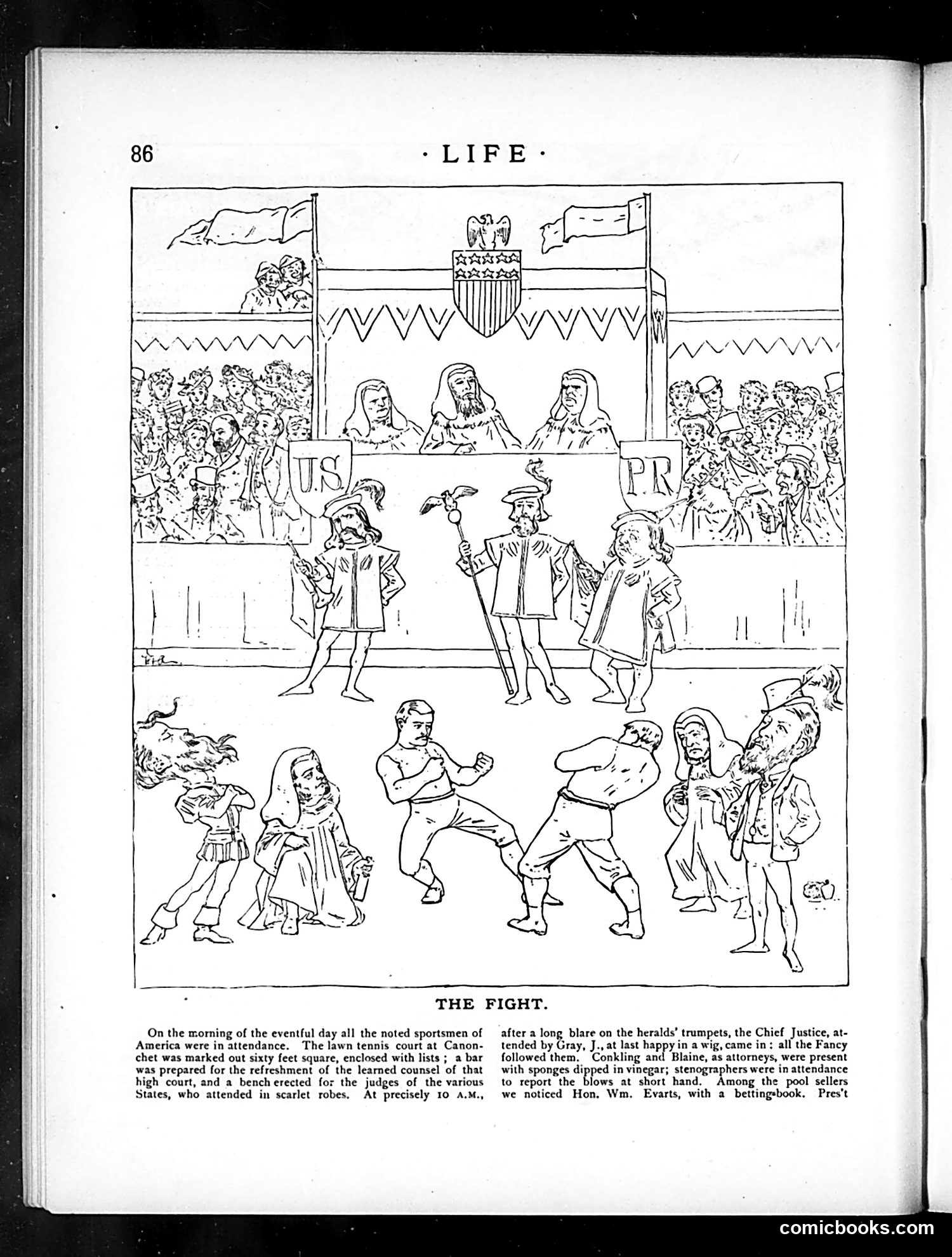
This satirical cartoon depicts a legal/political confrontation styled as a boxing match. The image shows judges presiding over a "fight" in what appears to be a courtroom arena, with spectators in stands labeled "U.S." and "PR" (likely Puerto Rico). The text references a "eventful day" involving "noted statesmen" and "America," with the Chief Justice attending. It mentions judges in "scarlet robes," a "lawn tennis court" at Canonichet marked as a "sixty foot square," and various officials including Hon. Wm. Evarts with a "bettingbook." The cartoon satirizes what appears to be a prominent legal or political dispute being treated as public entertainment—transforming serious constitutional or territorial matters into a spectacle for mass consumption and gambling.
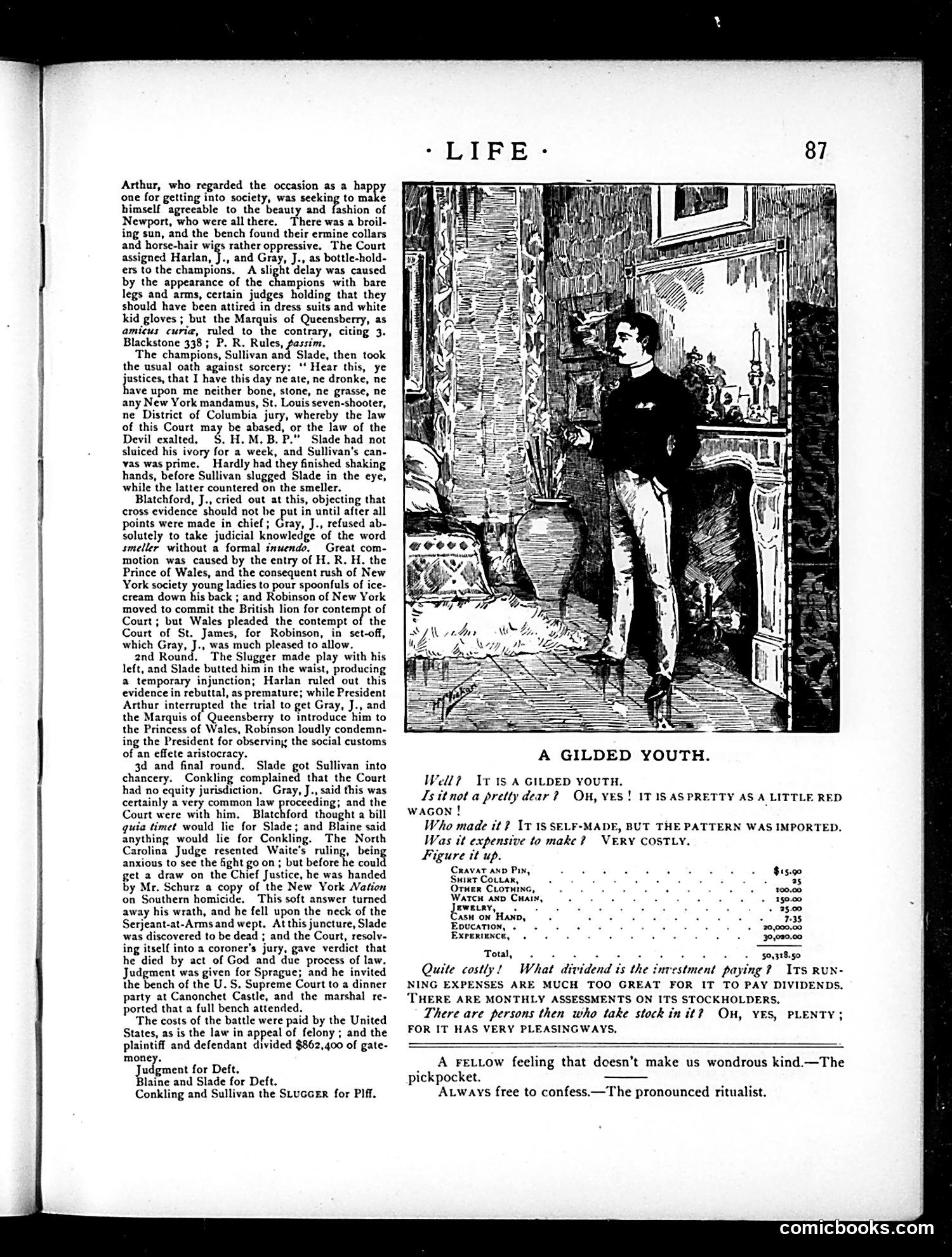
This cartoon satirizes wealthy young men of the Gilded Age through a cost accounting of a gentleman's lifestyle. The illustration shows an elegantly dressed youth in his study, surrounded by markers of affluence (candlesticks, decorative items). The accompanying list itemizes expenses—cravat and pin, silk collar, dress clothes, watch and chain, etc.—culminating in "$20,000" for "education" and "$30,000" for "experience," totaling "$94,115.95." The satire's point: the youth's refinement is entirely purchased rather than earned or genuinely cultivated. The text notes these are "running expenses" too substantial for dividends. The cartoon mocks how wealthy young men of this era displayed status through consumption rather than accomplishment, questioning whether such expense actually produces character or merely appearance.
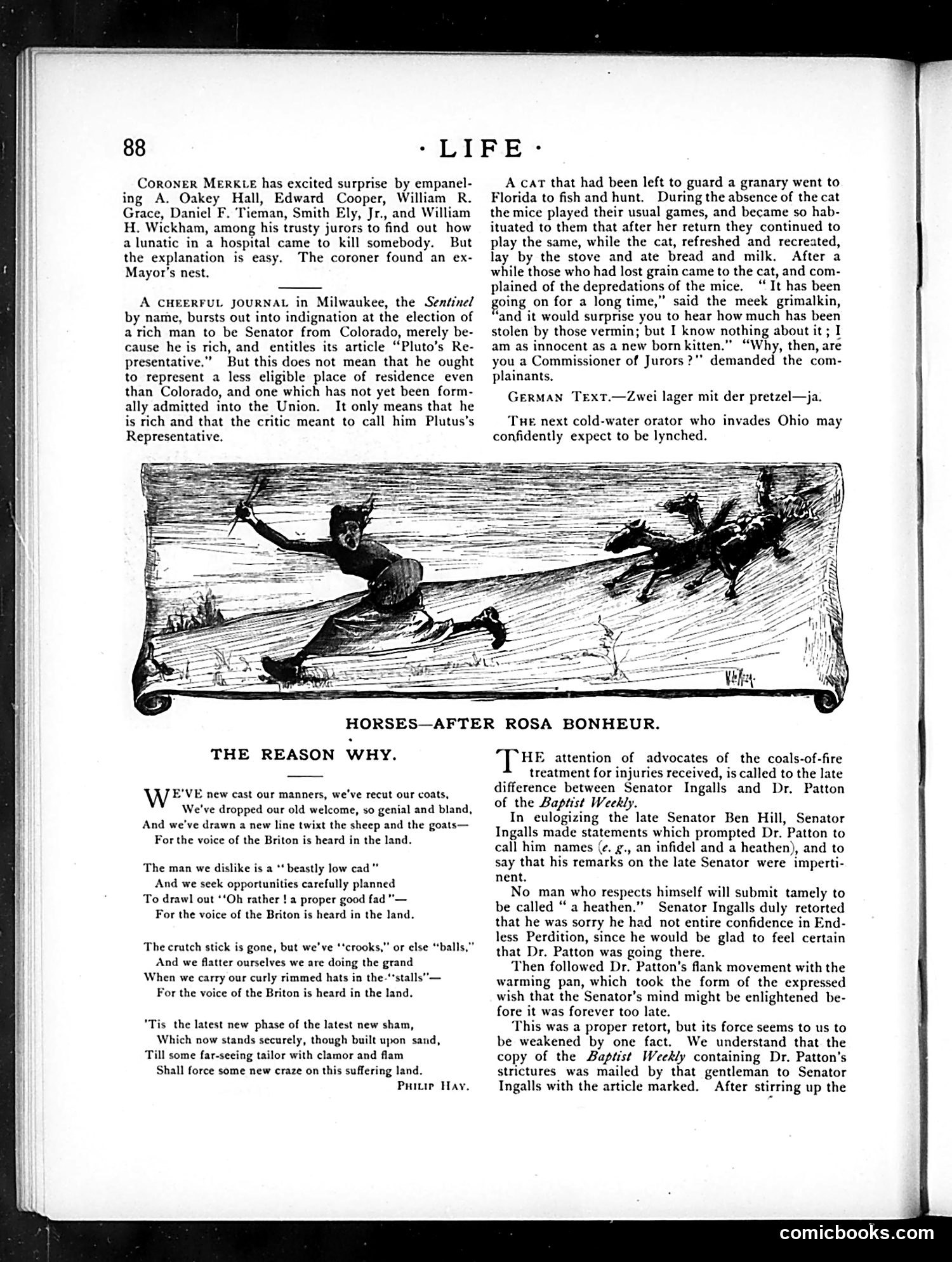
The cartoon depicts horses galloping dynamically across ice, referencing French artist Rosa Bonheur's famous horse paintings. The accompanying poem "The Reason Why" critiques American social change—specifically "new manners," dropped traditions, and altered comportment among the upper classes. The text discusses a controversy between Senator Ingalls and Dr. Patton of the *Baptist Weekly* regarding "coals-of-fire treatment for injuries." Ingalls apparently called Patton derogatory names ("infidel and heathen"), which Patton addressed in published criticism. The poem sardonically suggests America's old social standards and genteel behavior are being abandoned, comparing this cultural shift to horses running wild on unstable ice.
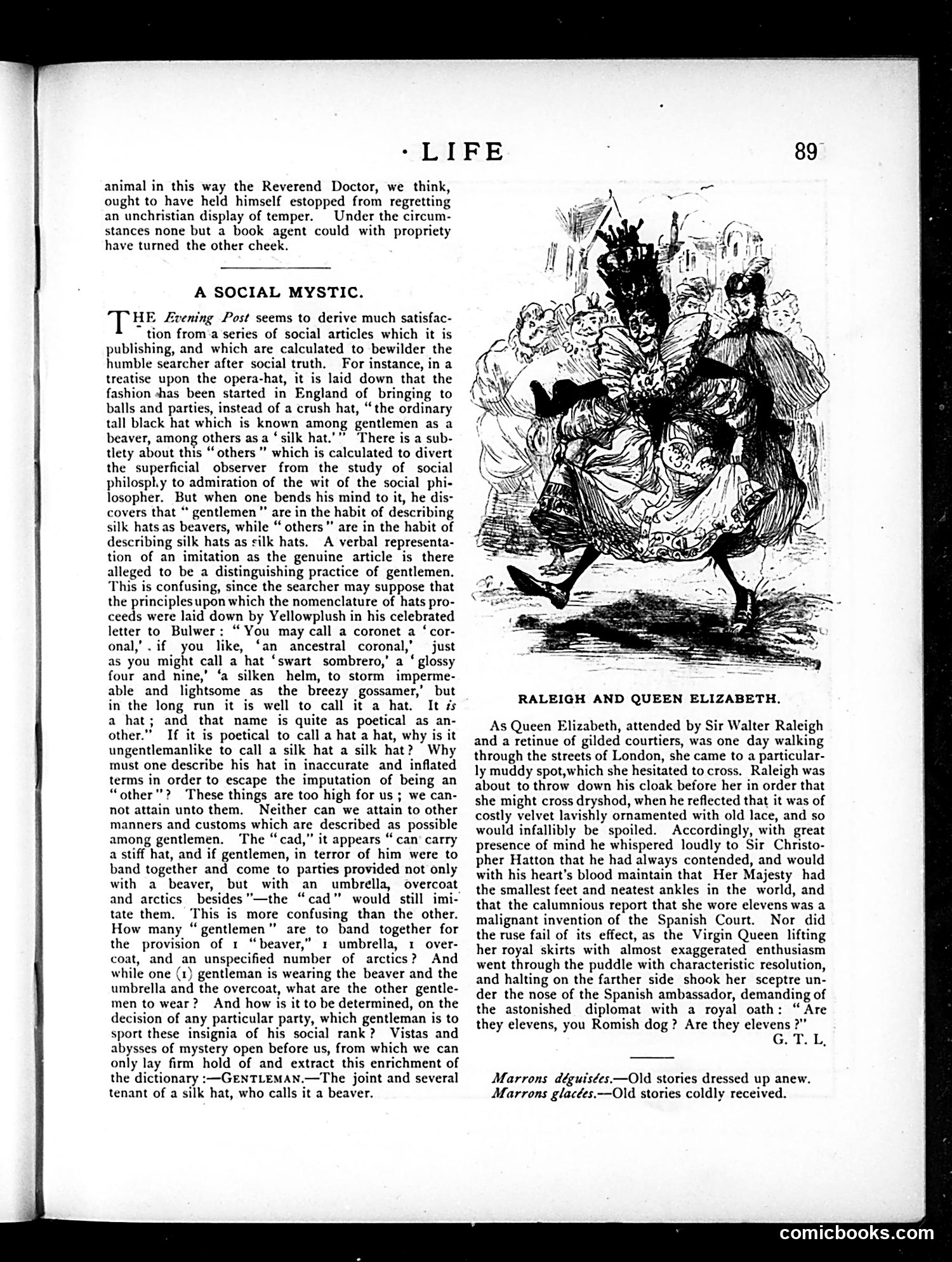
The page contains two distinct articles. "A Social Mystic" satirizes the *Evening Post*'s social commentary about hat nomenclature among gentlemen—mocking the confusion between calling them "beavers," "silk hats," and other terms. The satire questions the pretentious gatekeeping of social rank through clothing terminology. The illustration and accompanying article titled "Raleigh and Queen Elizabeth" depicts Sir Walter Raleigh's famous legend of laying his cloak before Queen Elizabeth. The text humorously recounts this romantic historical anecdote, suggesting Raleigh whispered to Christopher Hatton that Elizabeth had the smallest feet and neatest ankles, and mocks the Spanish ambassador's response calling them "elevens"—a shoe size joke undermining the dignity of the historical scene.
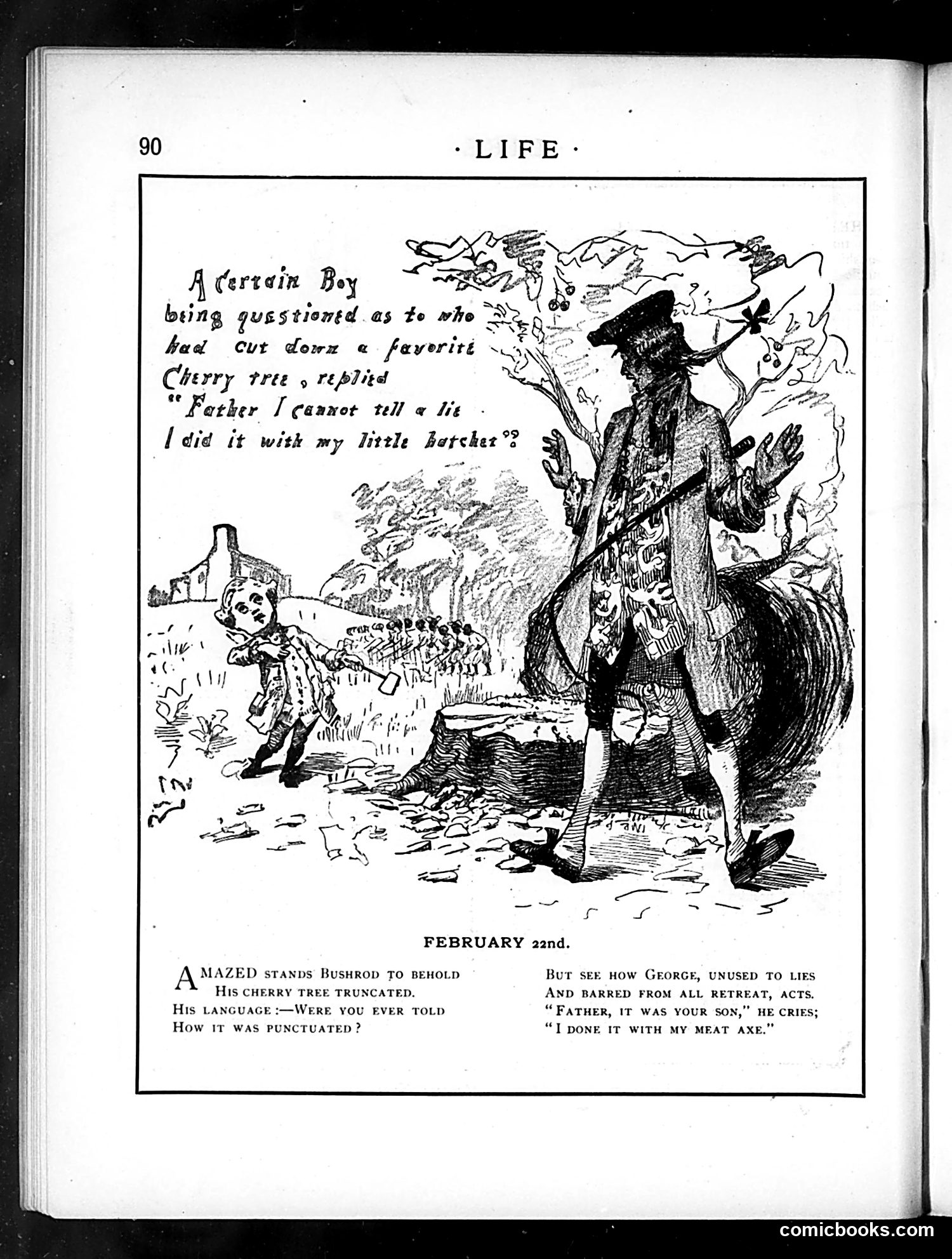
This page depicts a well-known American legend reimagined as satire. A young boy (labeled "a certain Boy") confesses to his father that he cut down a cherry tree with his "little hatchet." The father figure responds with surprise and anger, warning the boy he's "barred from all retreat." This satirizes the famous (likely apocryphal) story of young George Washington confessing to his father about cutting down a cherry tree—a tale traditionally used to illustrate honesty and virtue. The satire inverts this moral lesson: instead of praising the boy's honesty, the father threatens punishment, suggesting the real lesson is fear of consequences rather than moral principle. The cartoon mocks how this founding myth sanitizes American values.
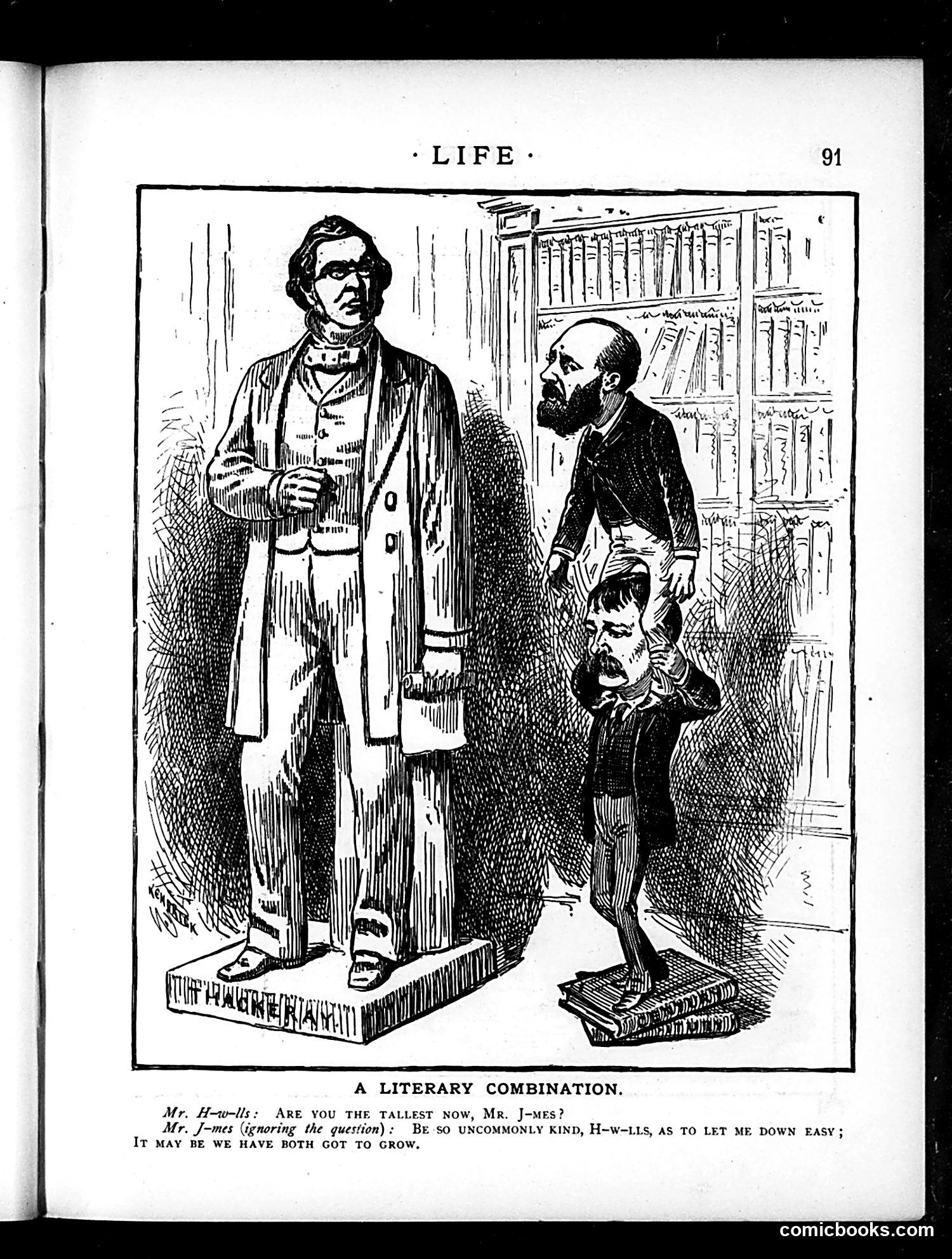
This satirical cartoon depicts two men in a library setting. The taller figure on the left is labeled "Mr. H—lls" and the smaller man on the right is "Mr. J—mes" (names partially obscured, likely referring to real literary figures of the period). The humor centers on a height disparity joke: Mr. H—lls asks if J—mes is "the tallest now," and J—mes responds by requesting H—lls be "uncommonly kind" and let him down "easy," suggesting both men have inflated egos or reputations they're reluctant to diminish. The title "A Literary Combination" implies these are prominent writers of the era engaged in competitive or complementary literary circles. The cartoon satirizes literary vanity and professional rivalry among contemporary authors, with physical stature serving as metaphor for literary standing.
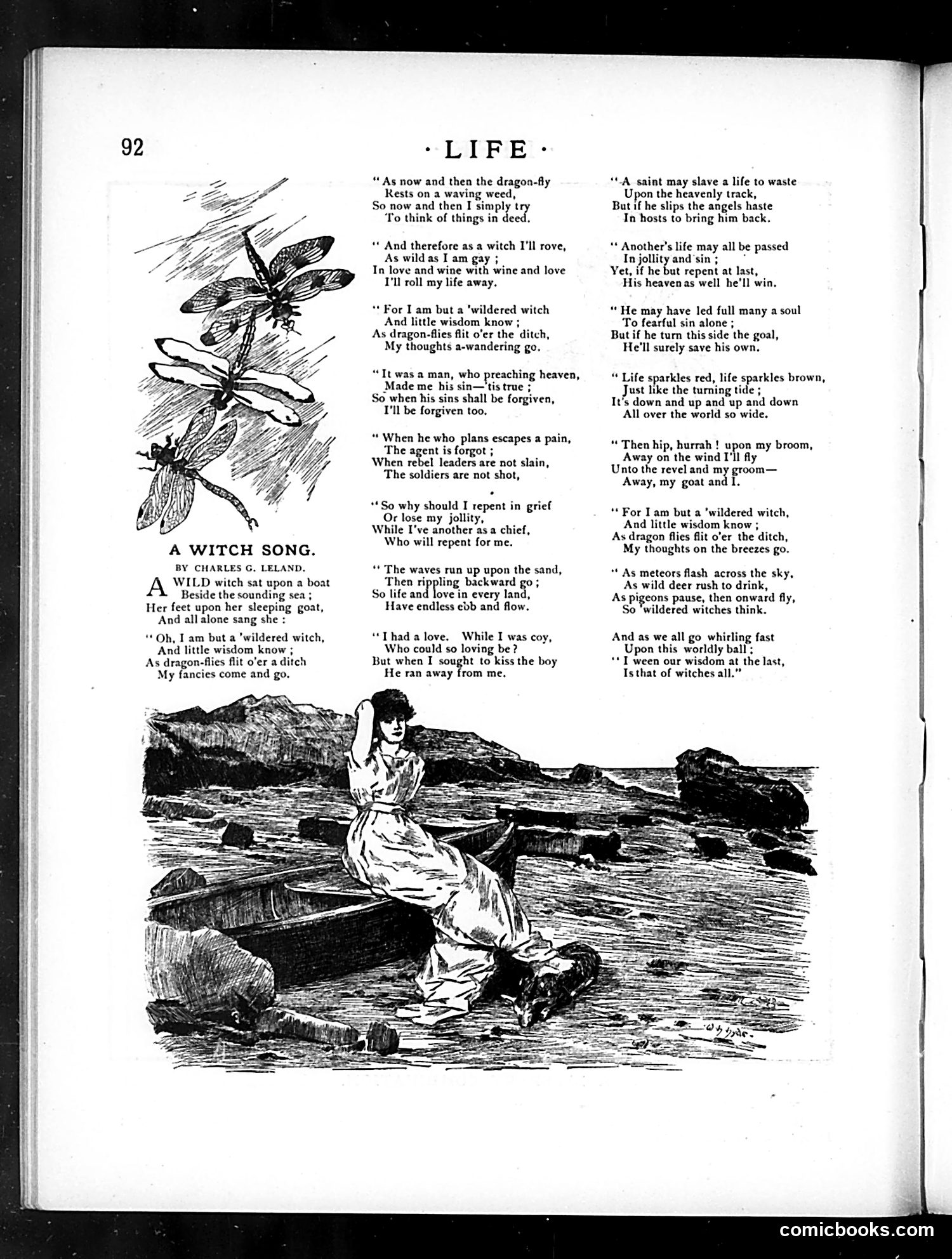
This page presents "A Witch Song" by Charles G. Leland—a literary poem rather than political satire. The poem features a witch character who uses her outsider status as a framing device to critique conventional morality. The witch's perspective allows commentary on hypocrisy: she observes that people can delegate their sins to others ("another as a chief, / Who will repent for me"), that deathbed repentance cancels lifelong wickedness, and that consequences are arbitrary and unpredictable. The repeated refrain about being a "wildered witch" emphasizes her position as society's fool-figure, speaking uncomfortable truths. The accompanying illustrations—dragonflies and a woman by the sea—visualize the poem's central metaphor: life as aimless, flickering motion without direction. Rather than targeting specific political figures, Leland uses the witch as a vehicle for social commentary on forgiveness, morality, and human inconsistency.
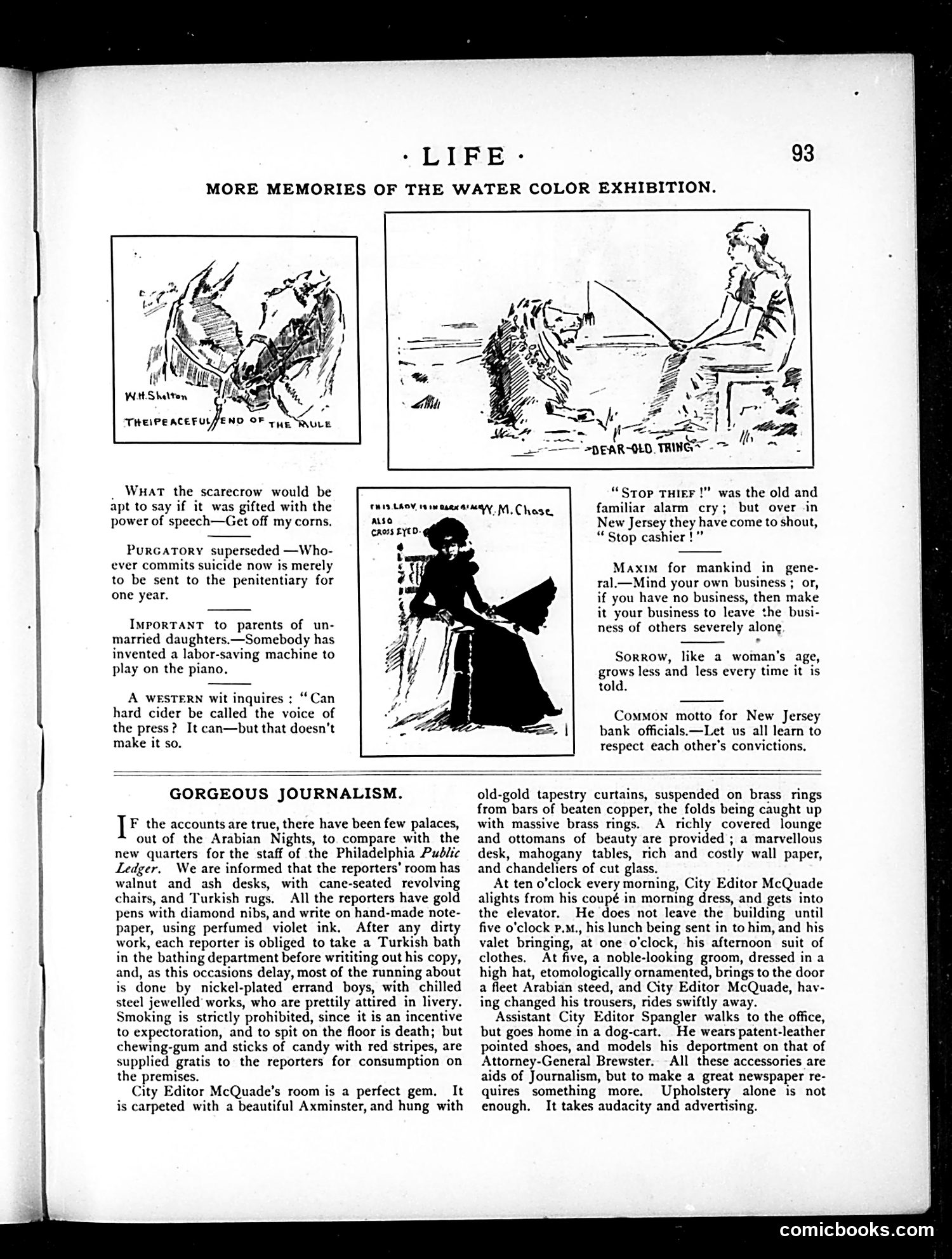
This page contains satirical humor typical of Life magazine's approach. The top section presents brief jokes mocking various topics: a scarecrow complaining about corns, a jab at suicide law reform, a piano-playing machine for daughters, hard cider as "voice of the press," and New Jersey bank robberies (the "Stop cashier!" joke). The main article, "Gorgeous Journalism," satirizes the *Philadelphia Public Ledger*'s lavishly appointed newsroom. Life mocks the excessive luxury—gold pens with diamond nibs, perfumed violet ink, Turkish baths for reporters, and City Editor McQuade's ornate office with Axminster carpeting and mahogany furnishings. The satire peaks when describing McQuade's daily routine: arriving in formal dress via elevator, leaving only at five o'clock to ride away on an Arabian steed after changing trousers. The joke's point: all this opulence is absurd window-dressing. The final line delivers the sting—"It takes audacity and advertising," not fancy furniture, to make great journalism. Life is mocking pretentious newspaper management prioritizing appearance over substance.
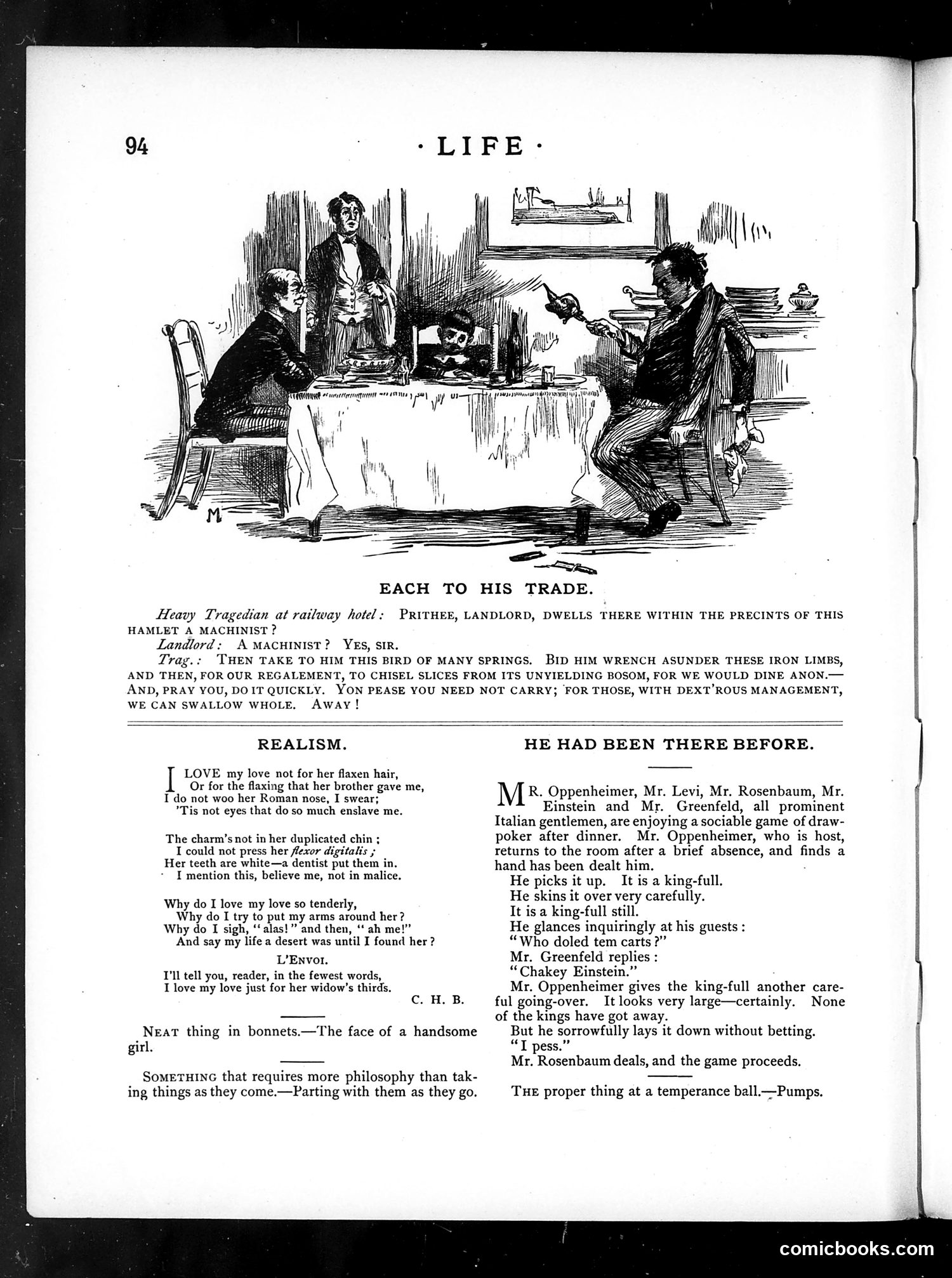
This page from *Life* magazine contains three satirical pieces: **Top cartoon ("Each to His Trade")**: A theatrical actor speaks to a landlord in exaggerated Shakespearean language, asking him to find a machinist to disassemble a chicken so they can eat it. The joke mocks overly dramatic actors who use pompous language for simple tasks—satirizing theatrical excess and pretension. **"Realism" poem**: Mocks sentimental love poetry by listing artificial or mercenary reasons for loving someone (fake teeth installed by dentists, financial motives like inheritance). It's satirizing both flowery romantic verse and shallow materialism. **"He Had Been There Before"**: A poker joke with Jewish characters (Oppenheimer, Levi, Rosenbaum, Einstein, Greenfeld). A host receives an excellent poker hand but refuses to bet, suspecting cheating because he's "been there before"—implying he's previously caught someone dealing marked cards. The humor relies on stereotypes about Jewish businessmen and card-game suspicion.
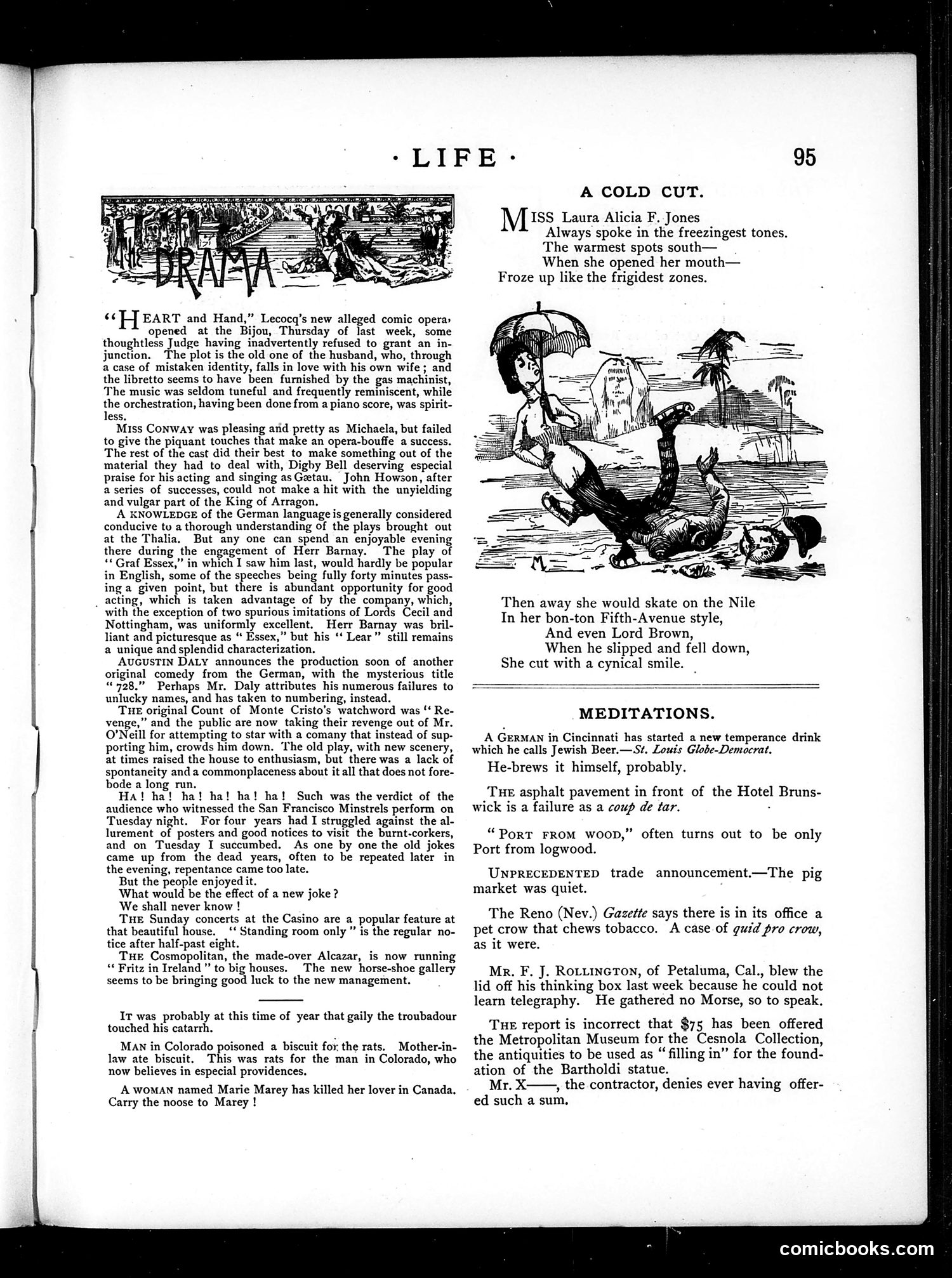
This is a brief satirical poem about Miss Laura Alicia F. Jones, a performer (likely an actress or singer of the era). The joke is a play on words: she "always spoke in the freezingest tones," meaning her voice or delivery was cold and emotionally distant. The accompanying illustration shows a woman ice-skating in winter clothing, literalizing the metaphor—she's depicted as literally cold/frozen rather than warm and engaging. The satire targets her as a performer who lacked warmth or charisma on stage. The accompanying sketch converts the figurative criticism ("cold" performance) into a visual pun, showing her skating in winter. This was typical *Life* magazine humor: sharp, witty commentary on theater personalities, using wordplay and illustration to mock performers deemed insufficiently talented or engaging for their roles.
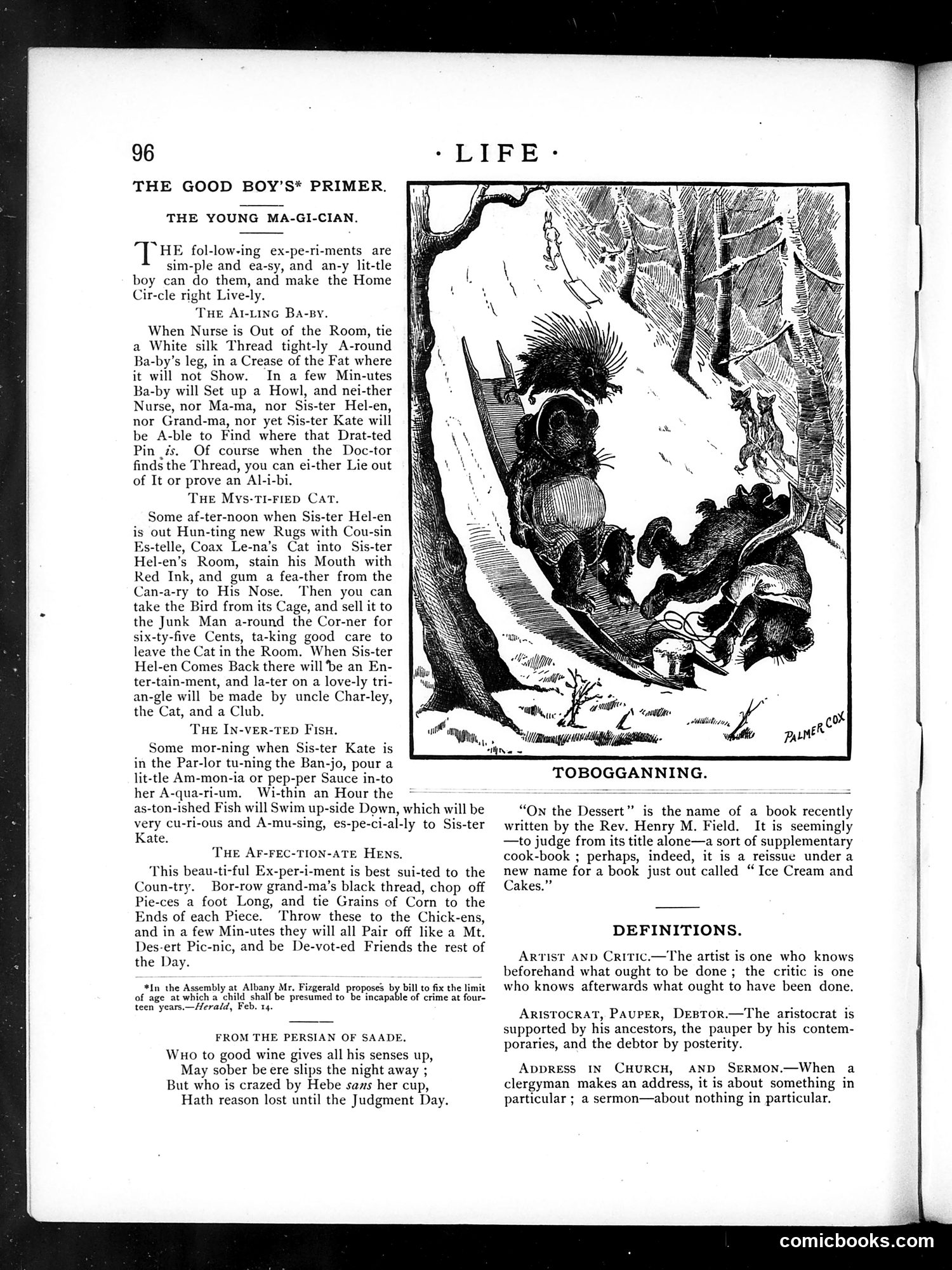
This page satirizes children's instruction manuals through darkly comic "experiments" presented in primer style (with hyphenated words for young readers). The humor lies in describing genuinely harmful pranks as innocent activities: - **The Ailing Baby**: Tying thread around an infant's leg to make it cry, then lying to adults about it - **The Mystified Cat**: Doctoring a cat with ink and feathers, selling the family canary, ensuring domestic chaos - **The Inverted Fish**: Poisoning a sister's aquarium with ammonia - **Affectionate Hens**: Feeding chickens strings with corn, causing them to choke The satire mocks both mischievous boys and the earnest tone of Victorian parenting guides. A footnote notes a real Albany bill proposing age 14 as the limit for criminal responsibility, suggesting the piece comments on childhood misbehavior and accountability. The cartoon shows a boy engaged in some unspecified mischief outdoors, reinforcing the theme of youthful troublemaking presented as wholesome activity.
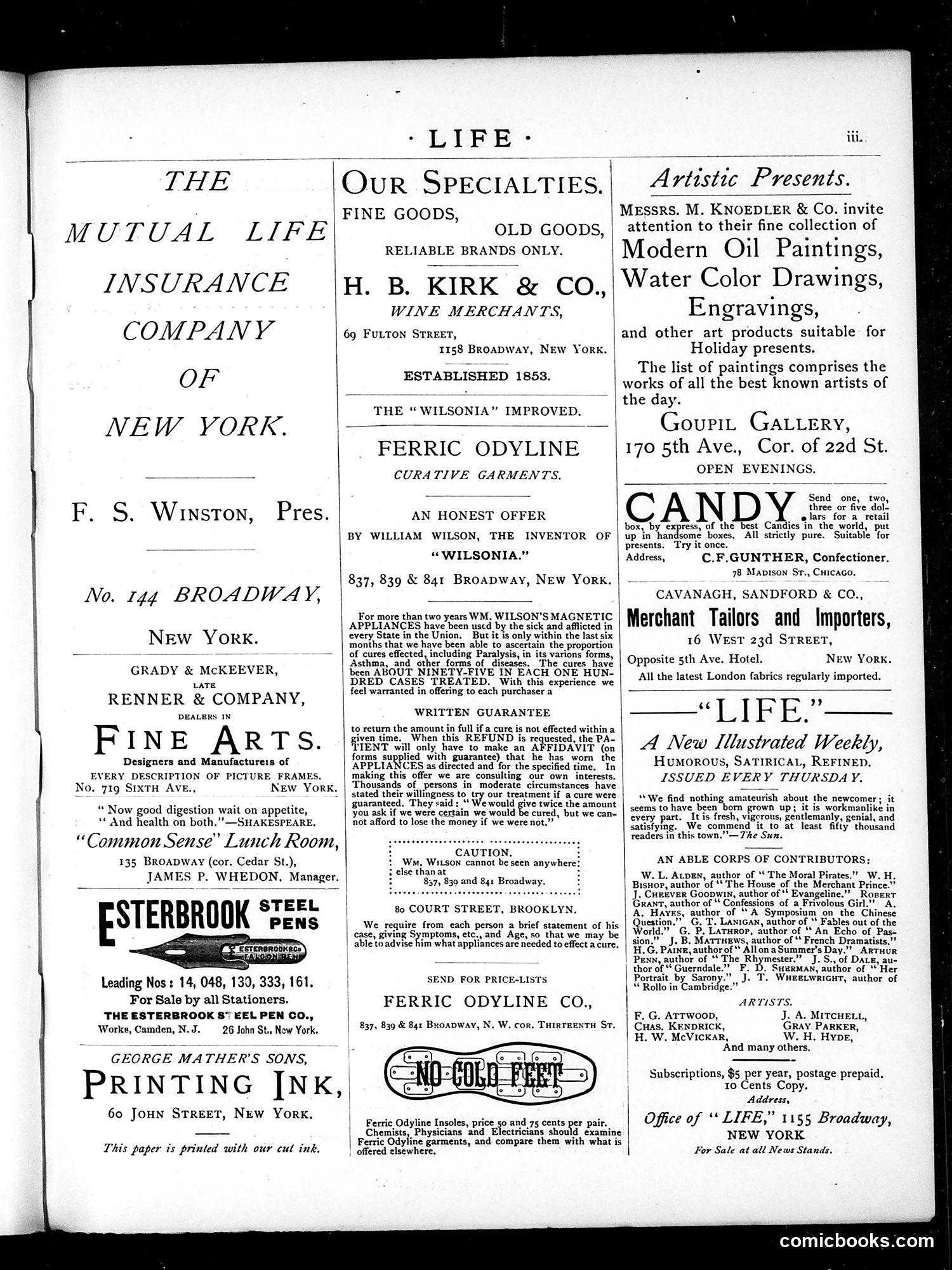
This is primarily an **advertising page** from Life magazine, not a satirical cartoon page. The layout features various commercial advertisements typical of the era. Most notably, the page advertises **"Ferric Odyline" magnetic healing garments** by William Wilson—a classic example of 19th-century medical quackery. The advertisement makes extraordinary claims: a "95% cure rate" for paralysis, asthma, and other diseases, with a written guarantee to refund money if the appliance fails to cure within a specified time. The fine print revealing Wilson's real motivation is telling: he admits people would pay "twice the amount" if guaranteed cures were certain, but he "cannot afford to lose the money if we were not"—essentially admitting the guarantee is designed to appear generous while remaining profitable. Other ads include insurance, fine art, wine merchants, printing supplies, and candy—standard period advertising alongside this medical fraud pitch.
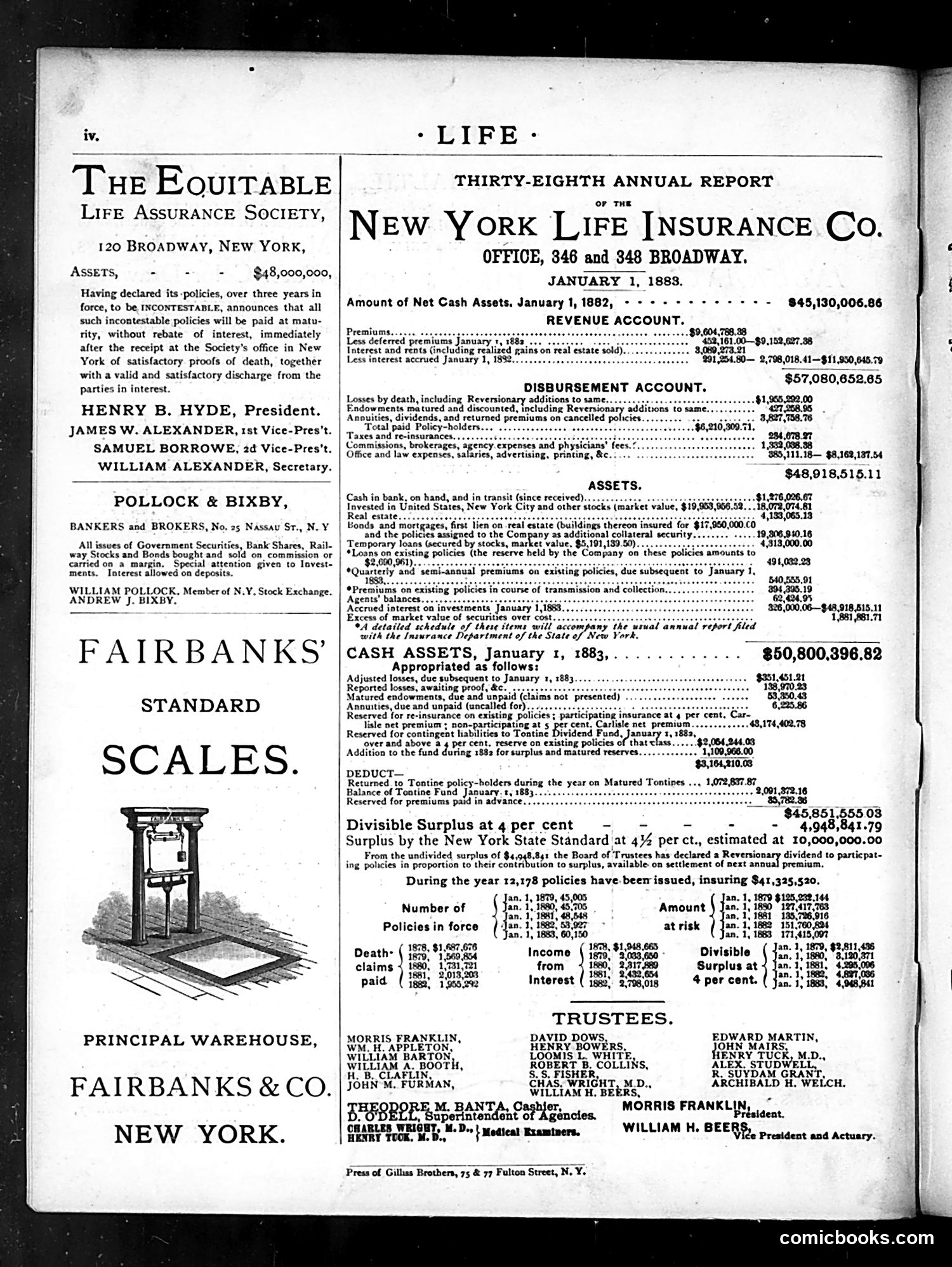
This page is primarily **insurance company financial advertising**, not satirical content. It contains the thirty-eighth annual reports of two major New York life insurance companies: The Equitable Life Assurance Society and New York Life Insurance Company. The page also features advertisements for financial services: Pollock & Bixby (bankers and brokers) and Fairbanks & Co. (manufacturers of standard scales). The Fairbanks scales advertisement includes an illustration of their standard weighing equipment. There are **no cartoons or satirical illustrations** on this page. The detailed financial statements, asset listings, and trustee names represent corporate transparency typical of the era. This is essentially a historical business document inserted into Life magazine—a common practice for insurance and banking institutions to reach the magazine's educated, affluent readership.