
Life, 1883-02-22 · page 3 of 16
Life — February 22, 1883 — page 3: what you’re looking at
What you’re looking at
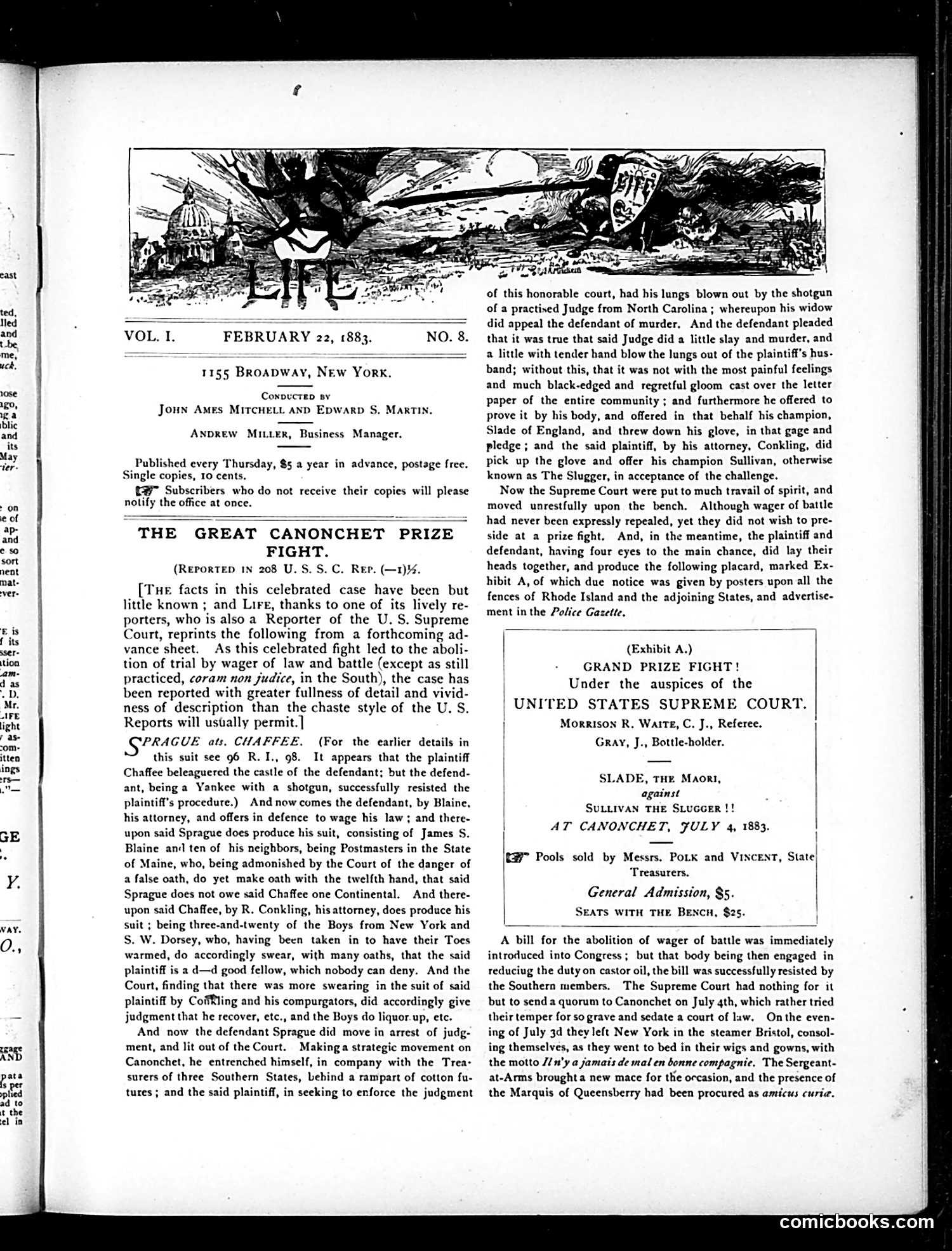
The page features "The Great Canonchet Prize Fight," a satirical account of a legal case reported as a mock boxing match. The text describes a dispute between Sprague and Ciaffee involving competing claims and oaths, with the defendant successfully resisting the plaintiff's suit. The satire presents this courtroom contest as a gladiatorial spectacle, complete with a fictional "Grand Prize Fight" announcement under U.S. Supreme Court auspices. The cartoon at the top (partially visible) likely depicts this mock-heroic legal battle. The satire mocks both the legal combatants and the sensationalism surrounding the case, treating serious litigation as entertainment—a commentary on how American courts and newspapers dramatized high-profile disputes during the Gilded Age.
📄 Transcribed text from this page (OCR, searchable)
Machine-transcribed from the original scan — historical spelling and the odd misread are preserved.
VOL. I. FEBRUARY 22, 1883. 1155 BRoADWAY, New York. Conpuctep sy Joun Ames MITCHELL AND Epwarp S, MARTIN, ANDREW MILLER, Business Manager. Published every Thursday, $5 a year in advance, postage free. Single copies, ro cents, EB™ Subscribers who do not receive their copies will please notify ihe‘ office at once. THE GREAT CANONCHET PRIZE FIGHT. (REPORTED IN 208 U.S. S.C. Rep. (—1)%. [Tue facts in this celebrated case have been but little known ; and Lire, thanks to one of its lively re- porters, who is also a Reporter of the U.S. Supreme Court, reprints the following from a forthcoming ad- vance sheet. As this celebrated fight led to the aboli- tion of trial by wager of law and battle (except as still practiced, coram non judice, in the South), the case has been reported with greater fullness of detail and vivid- ness of description than the chaste style of the U.S. Reports will ustally permit.] ‘PRAGUE ats, CHAFFEE, (For the earlier details in this suit see 96 R.I., 98. It appears that the plaintiff Chaffee beleaguered the castle of the defendant; but the defend- ant, being a Yankee with a shotgun, successfully resisted the plaintiff's procedure.) And now comes the defendant, by Blaine, his attorney, and offers in defence to wage his law ; and there- upon said Sprague does produce his suit, consisting of James S. Blaine an ten of his neighbors, being Postmasters in the State of Maine, who, being admonished by the Court of the danger of a false oath, do yet make oath with the twelfth hand, that said Sprague does not owe said Chaffee one Continental. And there- upon said Chaffee, by R. Conkling, his attorney, does produce his suit ; being three-and-twenty of the Boys from New York and S. W. Dorsey, who, having been taken in to have their Toes warmed, do accordingly swear, with many oaths, that the said plaintiff is a d—d good fellow, which nobody can deny. And the Court, finding that there was more swearing in the suit of said plaintiff by Coiling and his compurgators, did accordingly give judgment that he recover, etc., and the Boys do liquor. up, etc. And now the defendant Sprague did move in arrest of judg- ment, and lit out of the Court. Makinga strategic movement on Canonchet, he entrenched himself, in company with the Trea- surers of three Southern States, Lehind a rampart of cotton fu- tures ; and the said plaintiff, in seeking to enforce the judgment of this honorable court, had his lungs blown out by the shotgun of a practised Judge from North Carolina ; whereupon his widow did appeal the defendant of murder, And the defendant pleaded that it was true that said Judge did a little slay and murder, and a little with tender hand blow the lungs out of the plaintiff's hus- band; without this, that it was not with the most painful feelings and much black-edged and regretful gloom cast over the letter paper of the entire community ; and furthermore he offered to prove it by his body, and offered in that behalf his champion, Slade of England, and threw down his glove, in that gage and pledge ; and the said plaintiff, by his attorney, Conkling, did pick up the glove and offer his champion Sullivan, otherwise known as The Slugger, in acceptance of the challenge. Now the Supreme Court were put to much travail of spirit, and moved unrestfully upon the bench. Although wager of battle had never been expressly repealed, yet they did not wish to pre- side at a prize fight. And, in the meantime, the plaintiff and defendant, having four eyes to the main chance, did lay their heads together, and produce the following placard, marked Ex- hibit A, of which due notice was given by posters upon all the fences of Rhode Island and the adjoining States, and advertise- ment inthe Police Gazette, (Exhibit A.) GRAND PRIZE FIGHT! Under the auspices of the | UNITED STATES SUPREME COURT. Morrison R. Waite, C. J., Referee. Gray, J., Bottle-holder. SLADE, THE Maori, against SULLIVAN THE SLUGGER !! | AT CANONCHET, FULY 4, 1883. er Pools sold by Messrs. PoLK and VINCENT, State Treasurers. General Admission, $5. | SEATS WITH THE BENCH, $25. A bill for the abolition of wager of battle was immediately introduced into Congress; but that body being then engaged in reduciug the duty on castor oil, the bill was successfully resisted by the Southern members. The Supreme Court had nothing for it but to senda quorum to Canonchet on July 4th, which rather tried their temper for so grave and sedate a court of law. On the even- ing of July 3d they left New York in the steamer Bristol, consol- ing themselves, as they went to bed in their wigs and gowns, with the motto //n'y a jamais de mal en bonne compagnie. The Sergeant- at-Arms brought a new mace for the occasion, and the presence of the Marquis of Queensberry had been procured as amicus curiae. comicbooks.com