
A complete issue · 16 pages · 1883
Life — February 15, 1883
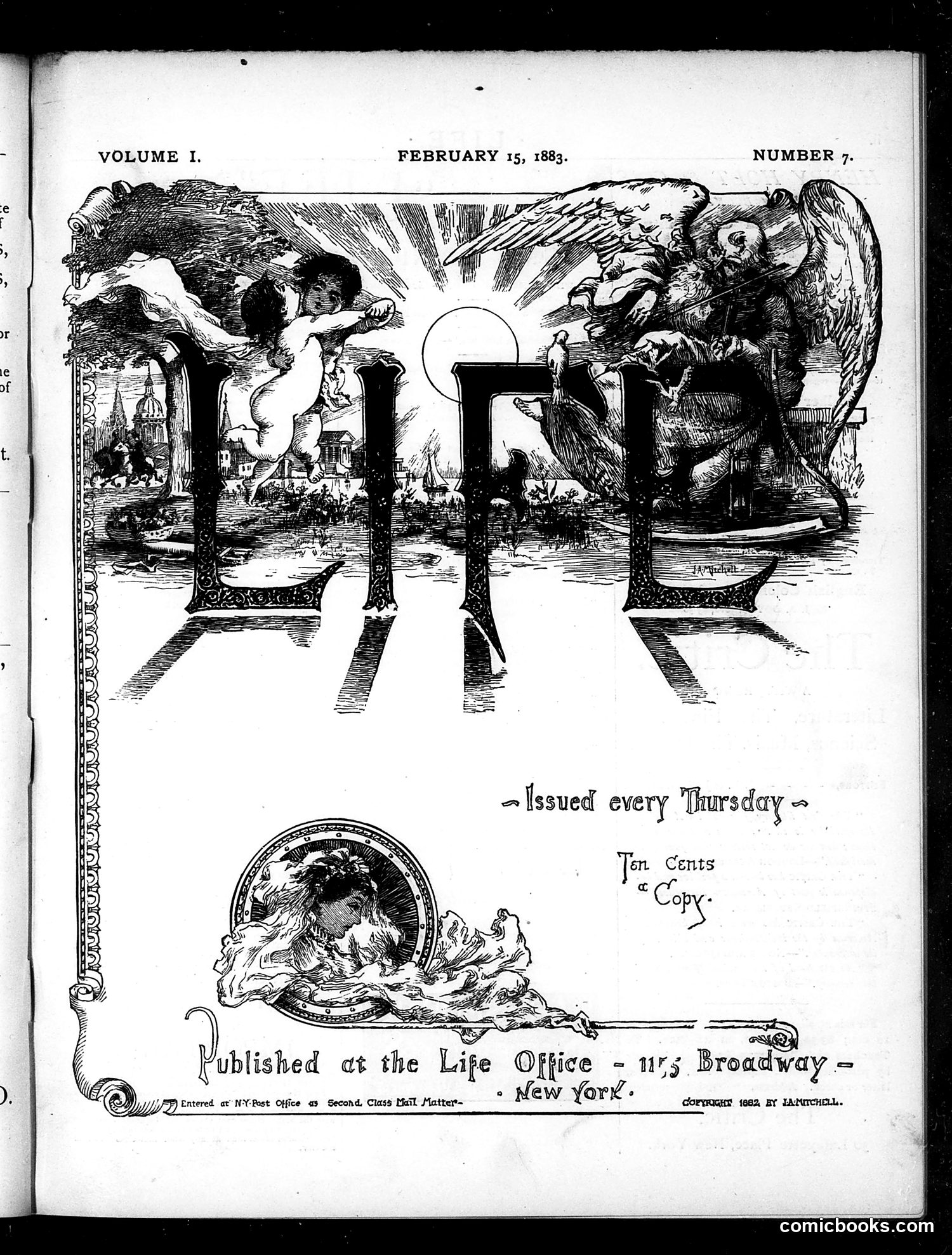
**February 15, 1883 | Volume 1, Number 7** This is the cover page of *Life* magazine's early run. The large decorative letters "LIFE" dominate the composition, framed by an elaborate allegorical engraving. The artwork features classical and mythological figures—cherubs, winged beings, and draped forms—surrounding what appears to be a rising or setting sun, suggesting themes of enlightenment or new beginnings. The specific satirical content or political references remain unclear from the image alone. The ornate, allegorical style was typical of 1880s magazine aesthetics. The page indicates publication at "1115 Broadway, New York" and notes the magazine was "Issued every Thursday" at ten cents per copy. This appears to be a masthead/cover design emphasizing the magazine's artistic presentation rather than commenting on particular events.
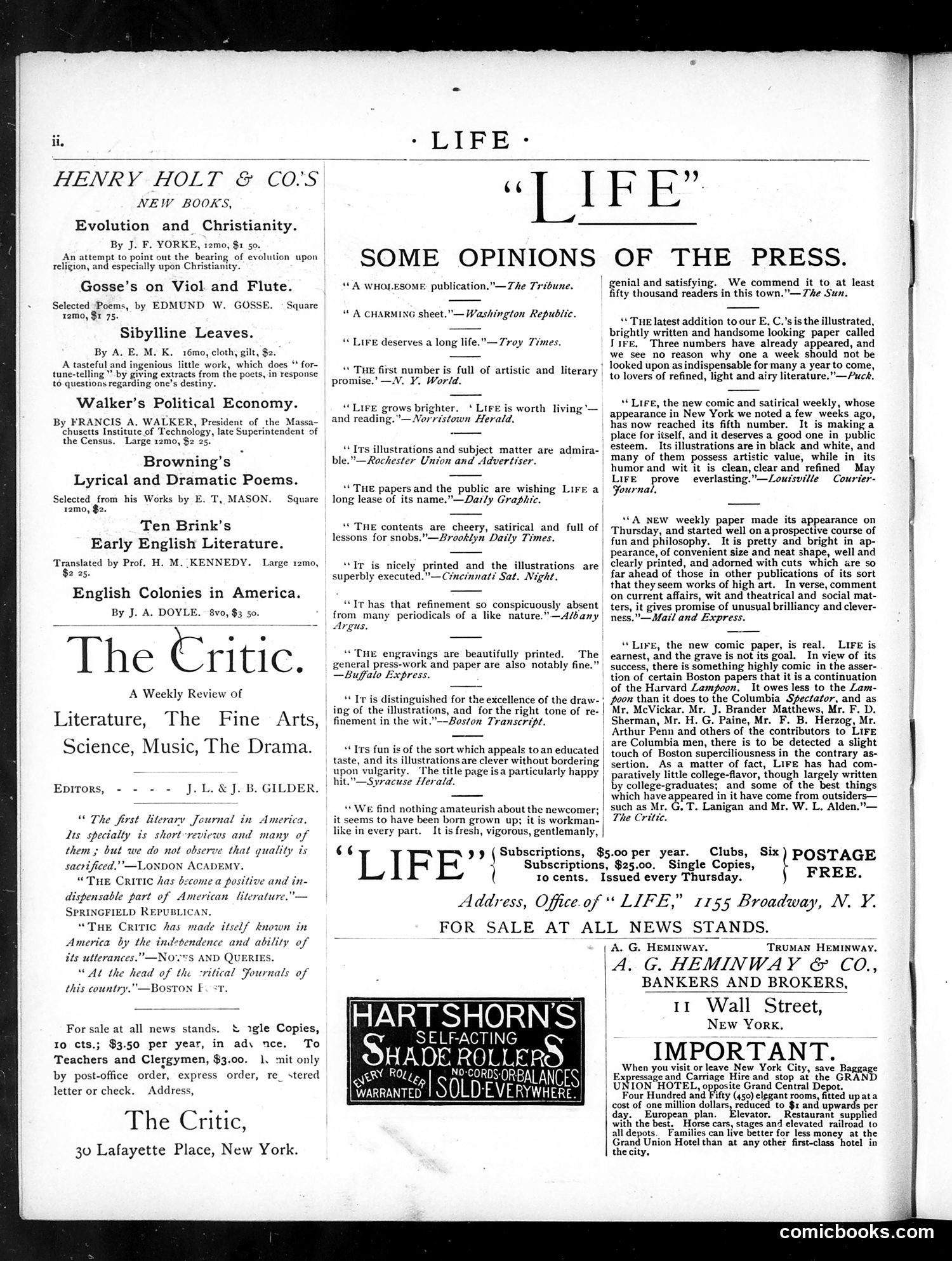
This page is primarily **advertising and promotional content** for Life magazine itself, rather than featuring political cartoons or satire. The main content includes: 1. **Book advertisements** (left column) for various publications on evolution, literature, and economics 2. **"Life" magazine promotion** (center/right) — lengthy press testimonials praising the publication as "wholesome," "charming," and featuring "artistic and literary" content with quality illustrations 3. **The Critic advertisement** — promoting a competing weekly review of literature and fine arts 4. **Commercial advertisements** — including Hartshorn's Shade Rollers and Truman Hemingway & Co. (bankers) with the Grand Hotel promotion The page demonstrates how 19th-century magazines funded themselves through extensive advertising. No specific political cartoons or satirical commentary are visible — this is a business/promotional page rather than editorial content.
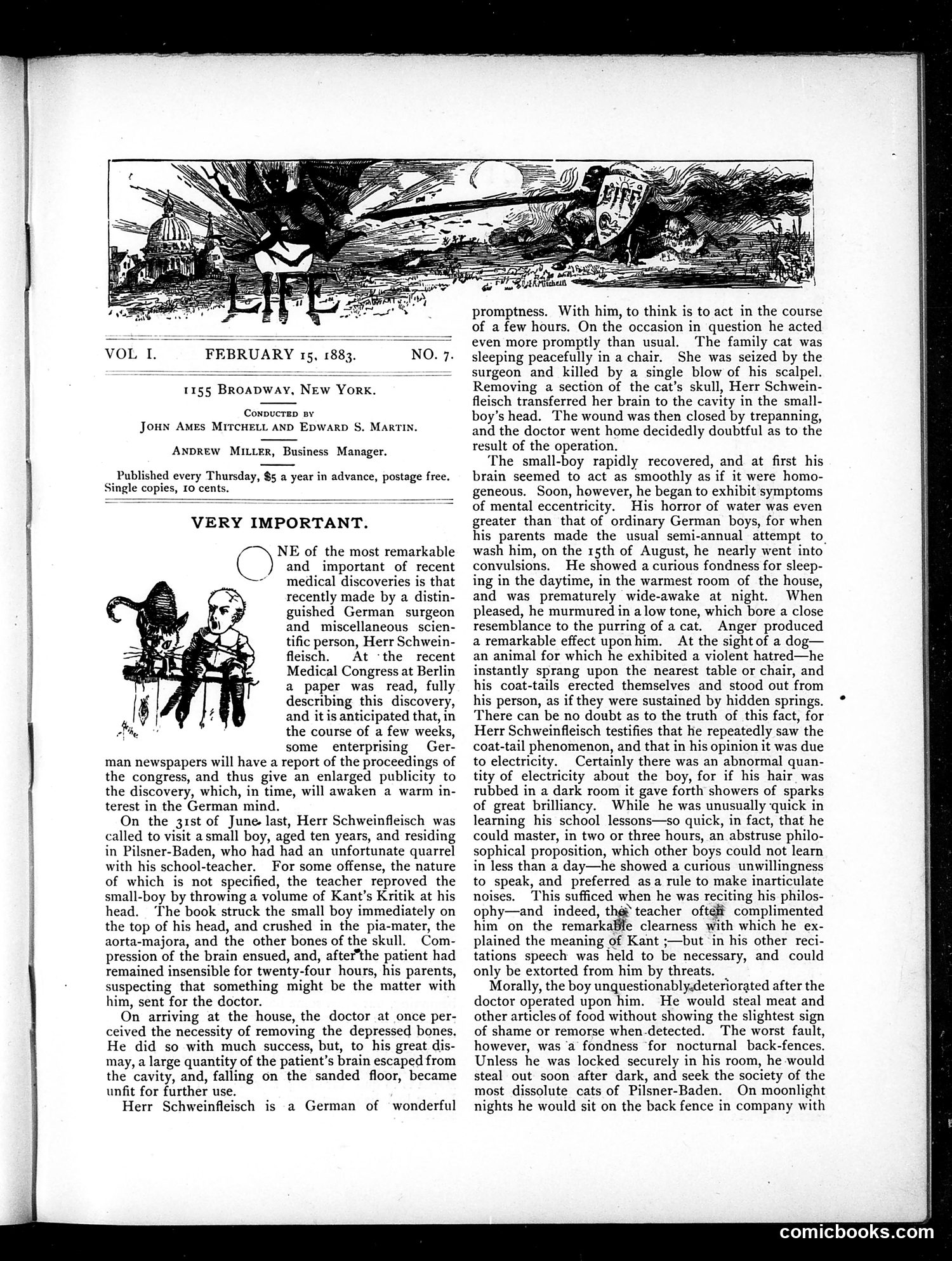
The illustrated header and accompanying article describe a bizarre medical case involving a German surgeon named Herr Schweinleisch, who conducted an experimental brain transplant. The text recounts how Schweinleisch transferred a cat's brain into a young boy's head after the original boy's brain was damaged. The satirical point appears to be mocking both pseudoscientific medical claims and German scientific pretensions popular in 1880s American journalism. The grotesque illustration—showing exaggerated figures in a nightmarish landscape—reinforces the absurdity. The article's increasingly ridiculous details (the boy's cat-like behaviors, his nocturnal fence-sitting) signal this is satirical commentary rather than genuine medical reporting, likely poking fun at sensationalized European science reporting that American publications eagerly republished.
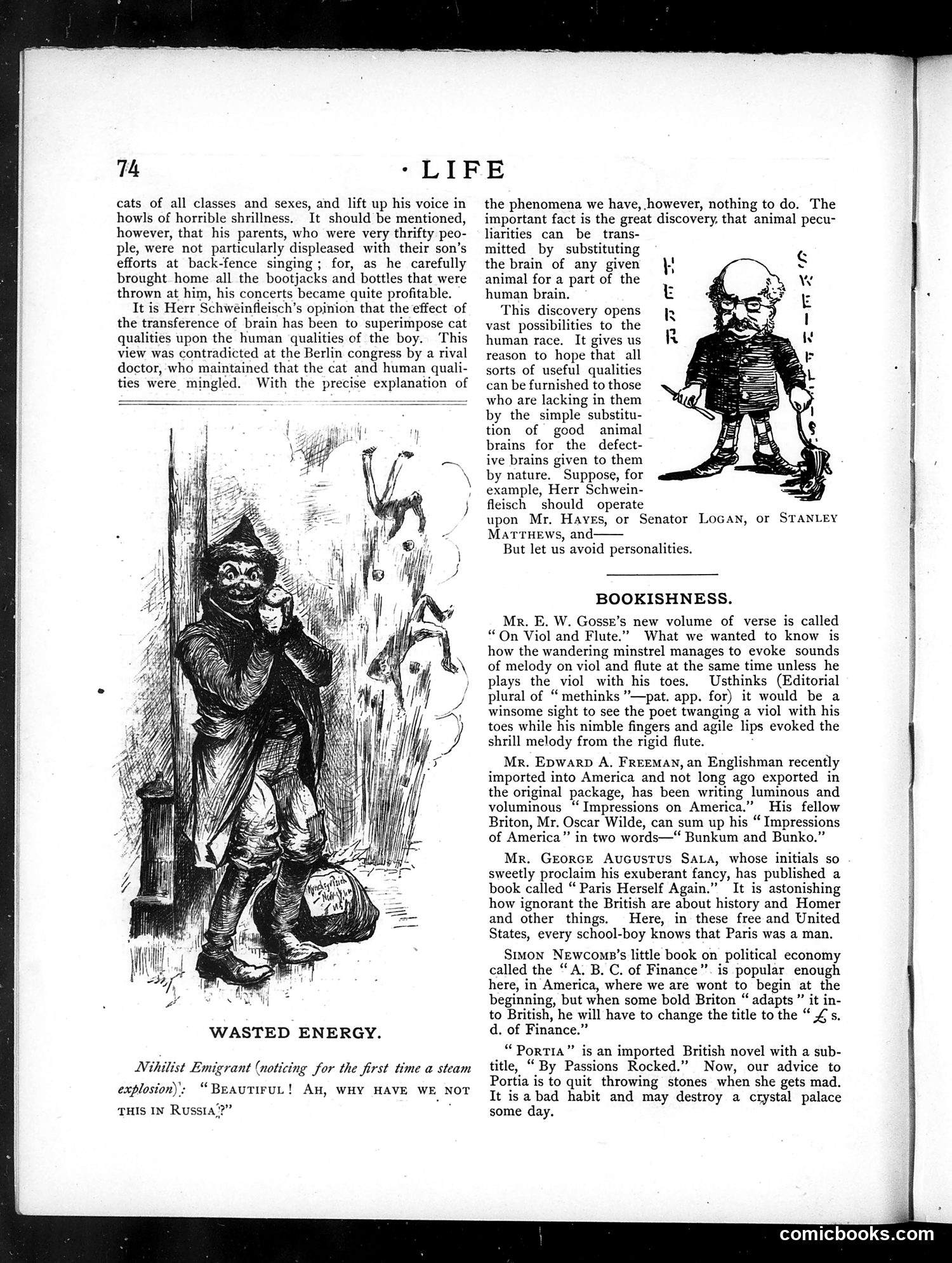
The page contains two distinct sections: **"WASTED ENERGY"** (left illustration): A sketch shows a figure noticing a steam explosion for the first time, exclaiming "Beautiful! Ah, why have we not this in Russia?" The satire mocks a nihilist emigrant's enthusiasm for industrial destruction—suggesting that Russian revolutionary ideologues were so enamored with violent upheaval they'd appreciate explosions even in mundane contexts. It critiques radical Russian politics through absurdist humor. **"BOOKISHNESS"** (right section): Brief reviews sarcastically critique recent publications, including jabs at E.W. Gosse's poetry, George Augustus Sala's ignorant book about Paris, and Simon Newcomb's economics text. The humor targets pretentious or poorly-researched contemporary literature. The page exemplifies Life's satirical style: political commentary through illustration and literary mockery of current events and publications.
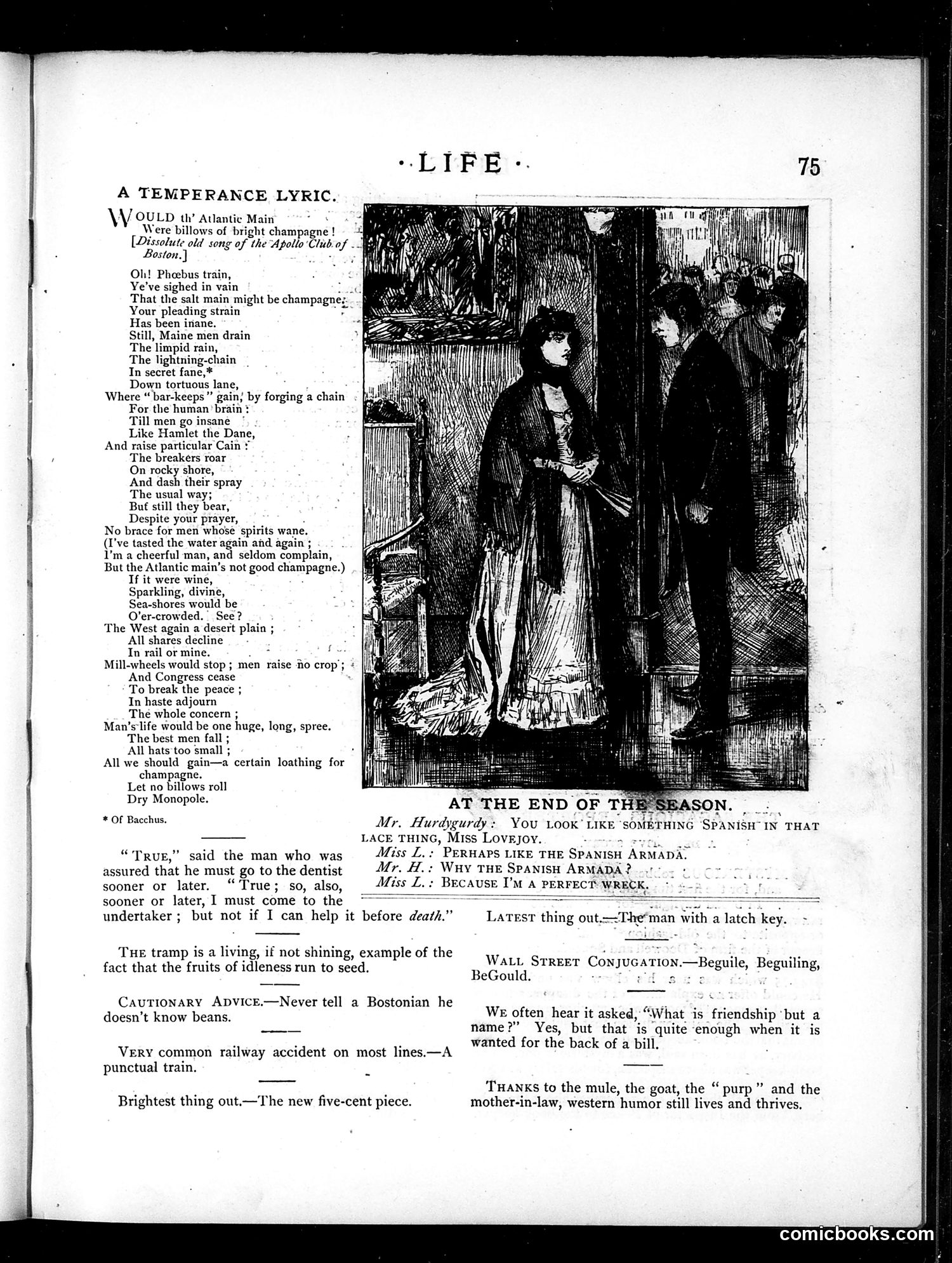
This illustration depicts a social scene at what appears to be a formal gathering or ball. A woman in an ornate dress speaks with a man in evening attire. The dialogue references "Spanish lace" and makes a joke comparing the woman's appearance to the Spanish Armada—a historical naval fleet. The humor relies on a double meaning: the man is complimenting (or mockingly commenting on) her lace garment while also making a sarcastic reference to her formidable or imposing presence, likening her to a famous military force. This type of backhanded compliment was typical of period satire in *Life* magazine, poking fun at both fashion pretensions and romantic social interactions among the wealthy classes.
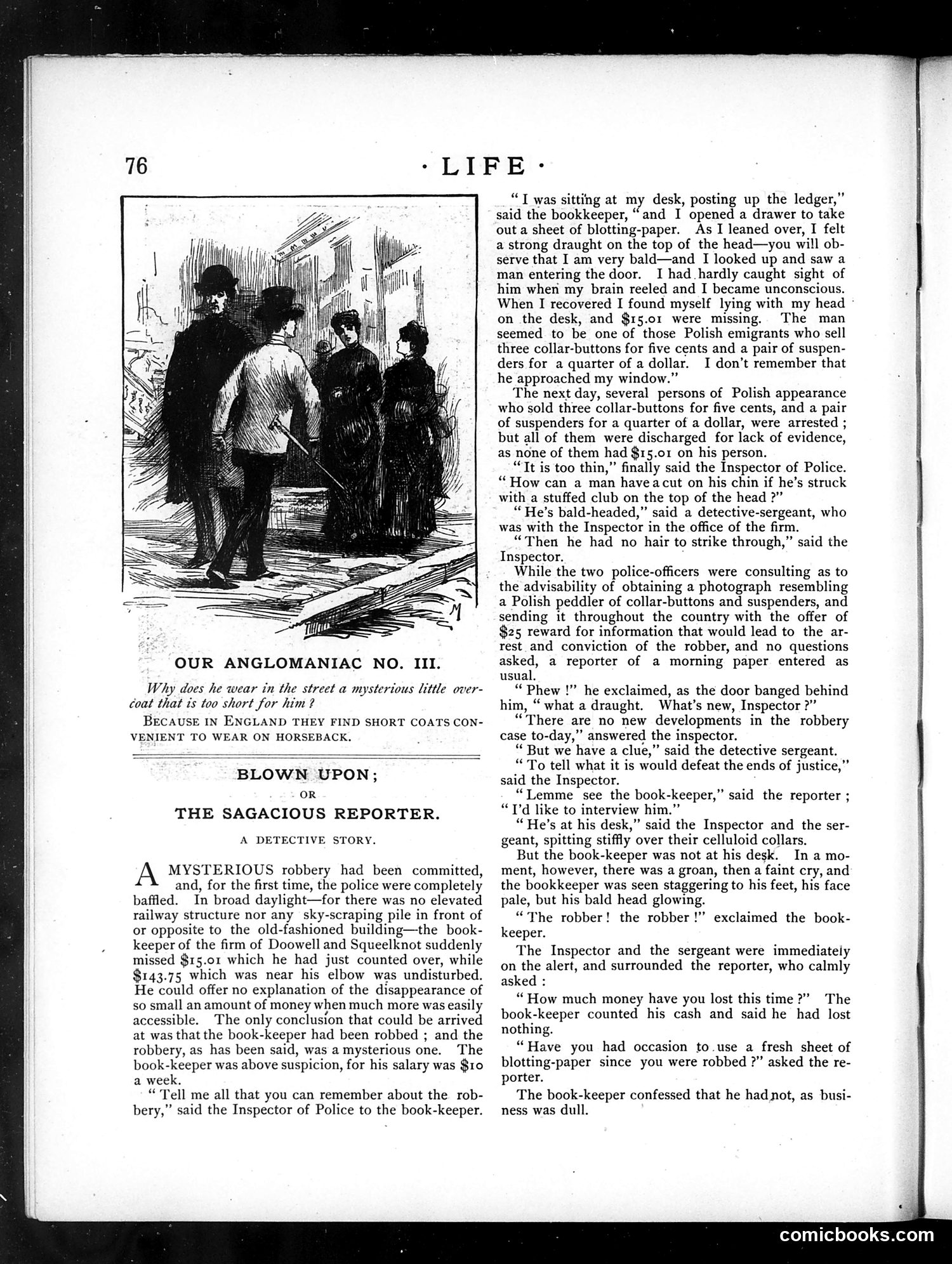
This satirical cartoon mocks English fashion affectations among wealthy Americans. The caption explains the joke: "Because in England they find short coats convenient to wear on horseback"—implying American dandies blindly imitate British styles without practical reason. The illustration shows a man in an absurdly short overcoat that barely covers his torso, standing awkwardly on a city street. The satire targets "Anglomaniacs"—wealthy Americans who slavishly adopt English customs and fashion regardless of suitability for American urban life. The exaggerated shortness of the coat emphasizes the ridiculousness of copying equestrian wear for street-walking in cities. The accompanying story "Blown Upon" is an unrelated detective fiction piece.
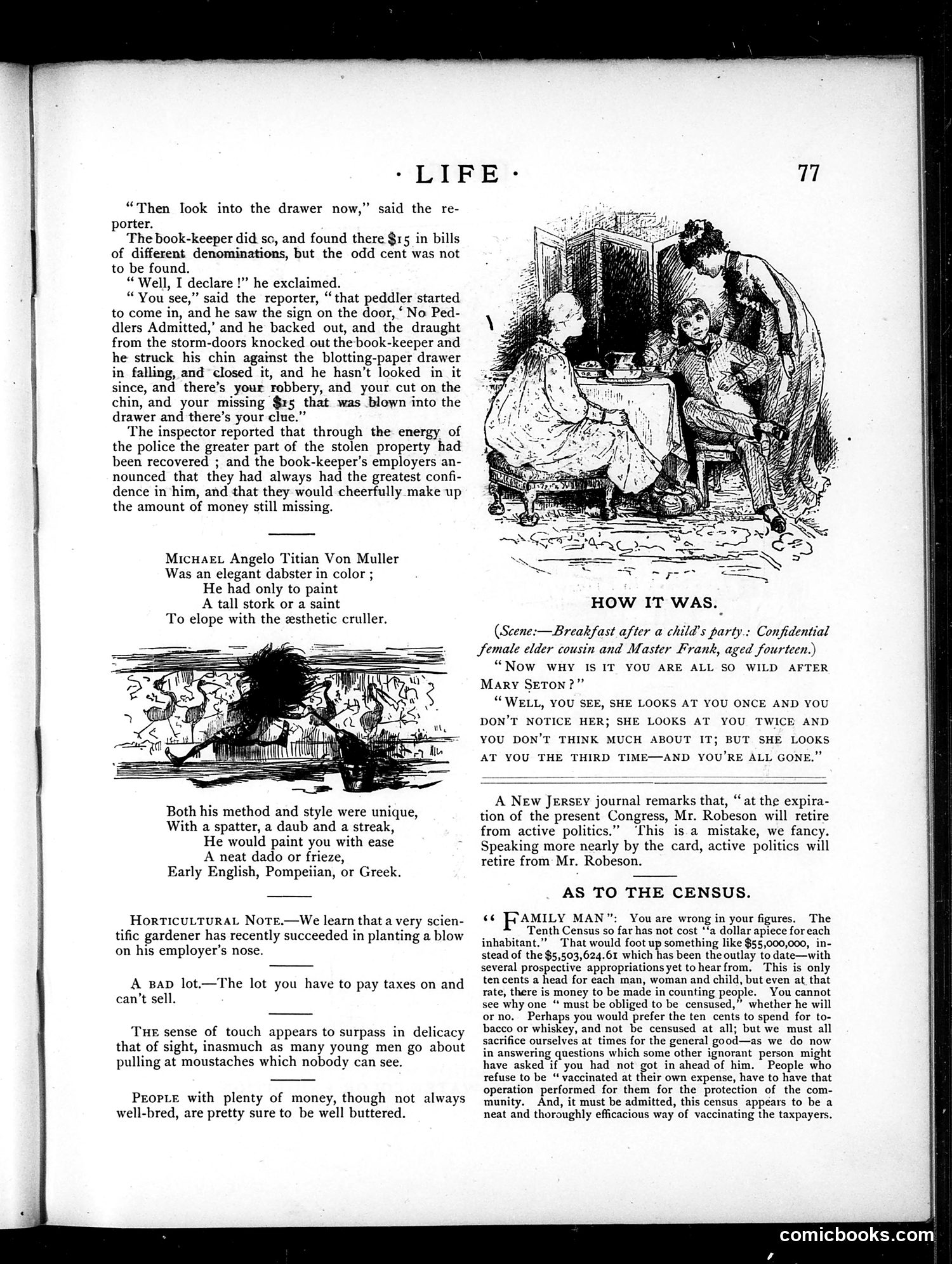
This page contains several brief humorous pieces typical of *Life* magazine's satirical format: The main illustrated story concerns a book-keeper who discovered $15 missing from a drawer after a peddler and storm disrupted the shop. The police recovered most stolen property, but the employers humorously promise to "make up" the remaining odd cent—a gentle joke about employer-employee relations. Below are character sketches of "Michael Angelo Titian Von Muller," a pretentious artist who paints dabster portraits, and biographical verse about his methods and style. The right panel titled "How It Was" depicts a domestic scene at a children's party, illustrating how a woman's repeated glances at a young man progressively unsettle him—a light social satire on courtship anxieties. The bottom section includes brief commentary on Congressional politics, census-taking costs, and social customs regarding vaccination and taxation.
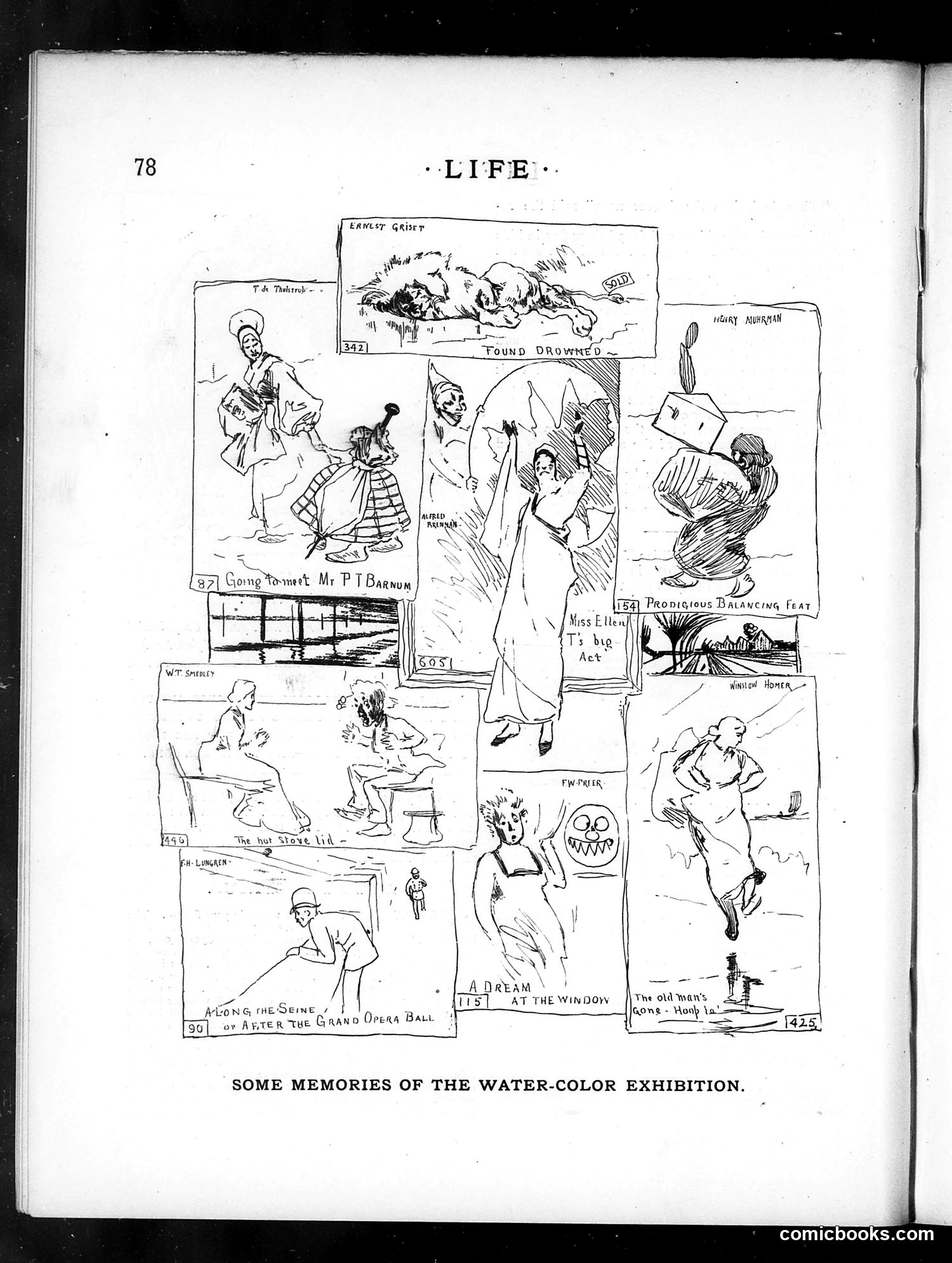
This page features a collection of cartoon sketches satirizing works displayed at a water-color exhibition. Each small panel is labeled with artist names (including Ernest Gether, T.A. Thibaud, and others) and titles like "Found Drowned," "Going to Meet Mr. P.T. Barnum," and "A Dream at the Window." The satire appears to mock the artistic pretensions and melodramatic subject matter common in late 19th-century water-color paintings—sentimental scenes of drowning, circus acts, and theatrical moments. The crude, exaggerated sketches ridicule both the exhibition's artistic merit and the sentimental taste of contemporary audiences. This represents *Life* magazine's characteristic satirical approach to cultural institutions and popular aesthetic trends of the period.
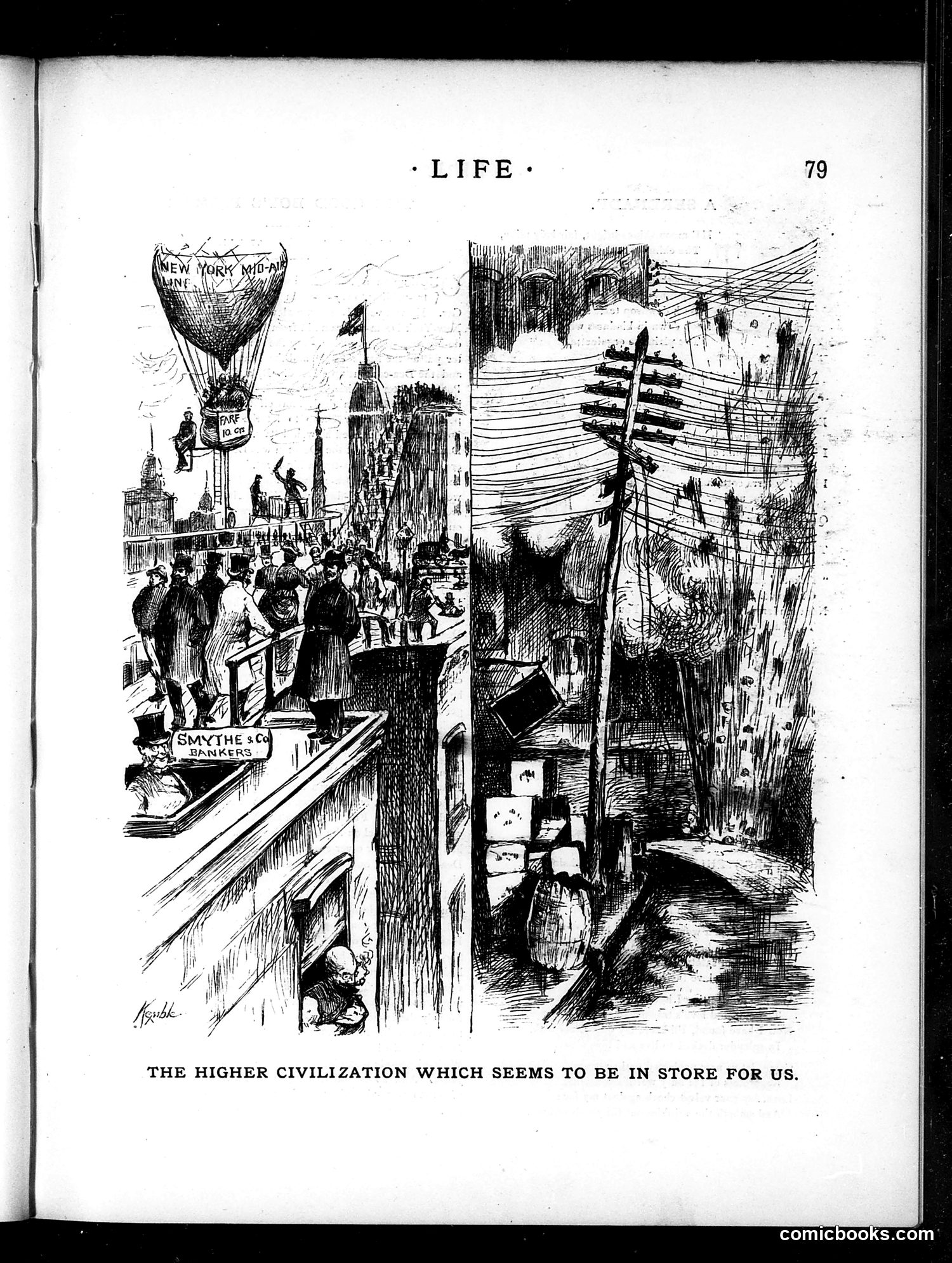
This is a satirical cartoon titled "The Higher Civilization Which Seems to Be in Store for Us." It presents a stark visual contrast: the left side depicts a prosperous, modern cityscape with a hot air balloon labeled "New York Mid-Air Line," crowds of well-dressed people, and commercial establishments (including "Smythe & Co. Bank"). The right side shows a cramped, squalid urban alley with tangled electrical wires, dilapidated buildings, and poverty. The satire critiques the gap between technological progress and urban inequality in early 20th-century America. While innovations like air travel are celebrated, many citizens remain trapped in deteriorating slums. The cartoon suggests that despite America's advancement, it's creating a two-tiered society—literal vertical separation between the privileged upper class and the impoverished masses below.
This mock children's story parodies religious hypocrisy. A pious deacon traveling by train challenges an innocent drummer (traveling salesman) to a card game, appearing virtuous while systematically cheating him. The deacon deals himself winning hands while pretending ignorance, secretly knowing the deck's arrangement. He feigns piety ("secretly Pleased") while fleecing the drummer through card manipulation—likely marked cards ("Hair was comparatively Short"). The satire targets sanctimonious religious figures who publicly profess morality while privately engaging in dishonest dealings. By framing this as a children's primer with exaggerated syllable breaks, Life mocks both the deacon's false virtue and the hypocrisy of presenting such behavior as instructive. The story illustrates the gap between what respectable society professes and what it actually practices.
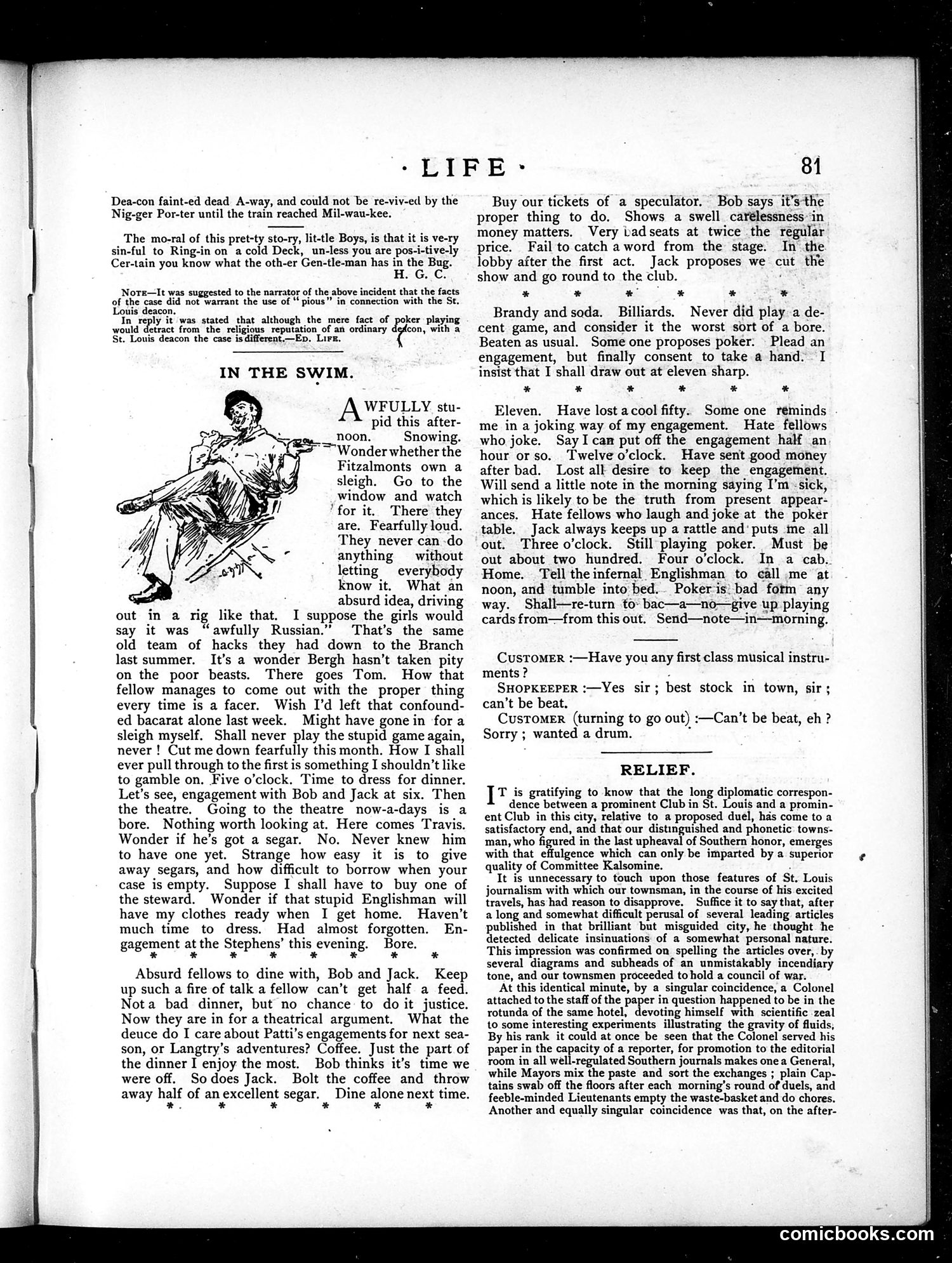
This page satirizes the shallow, idle lifestyle of a wealthy young man in late 19th-century New York society. The narrative follows his tedious day: envying neighbors' sleighs, worrying about gambling debts, dressing for dinner with "absurd fellows" Bob and Jack, attending the theater (which he finds boring), and ending in an all-night poker game. The satire targets upper-class affectation and moral hypocrisy—he obsesses over trivial social rituals while losing money recklessly, then plans to lie about illness to avoid consequences. The title "In the Swim" (meaning fashionably engaged in society) is ironic; the character is actually drowning in vice and irresponsibility while pretending sophistication. His internal monologue reveals vanity, resentment, and shallow values dressed up as worldly refinement—the magazine's critique of Gilded Age excess.
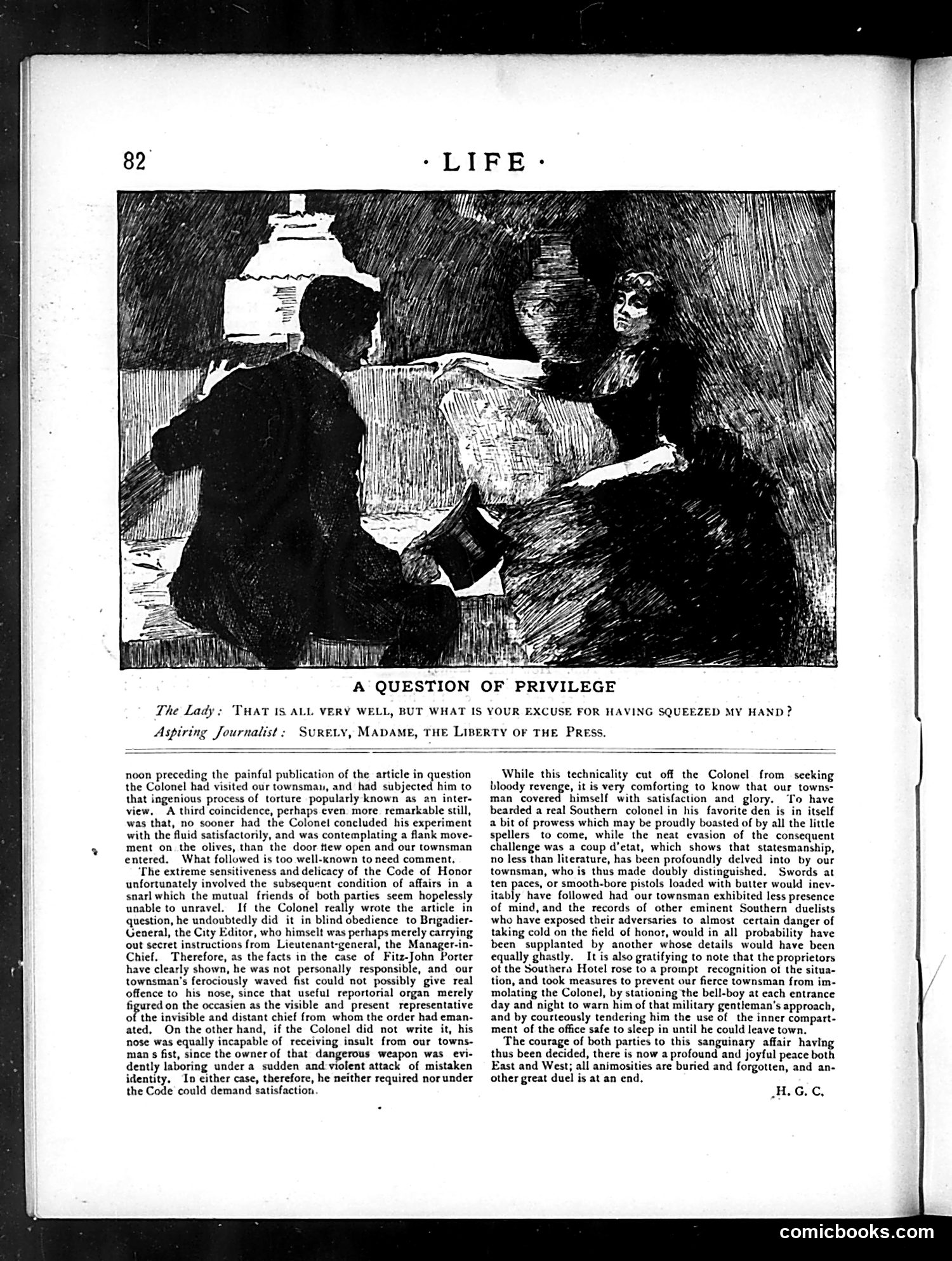
This cartoon satirizes both press freedom and sexual propriety norms of the era. An "aspiring journalist" has squeezed a lady's hand, and when confronted, he defensively invokes "the liberty of the press" as justification—absurdly claiming journalistic privilege extends to physical contact. The accompanying text parodies Southern honor culture and dueling traditions through an elaborate, tongue-in-cheek account of a confrontation between a Colonel and a townsman (likely a journalist). The satire mocks: - The absurd chain-of-command logic used to avoid responsibility (blaming editors/managers rather than the Colonel) - Technicalities that allow men to escape consequences for insults - The elaborate etiquette of Southern duels - Journalistic boldness masquerading as principled behavior The humor derives from applying exaggerated formal reasoning to justify crude behavior, and from ridiculing both journalistic overreach and the South's outdated honor codes.
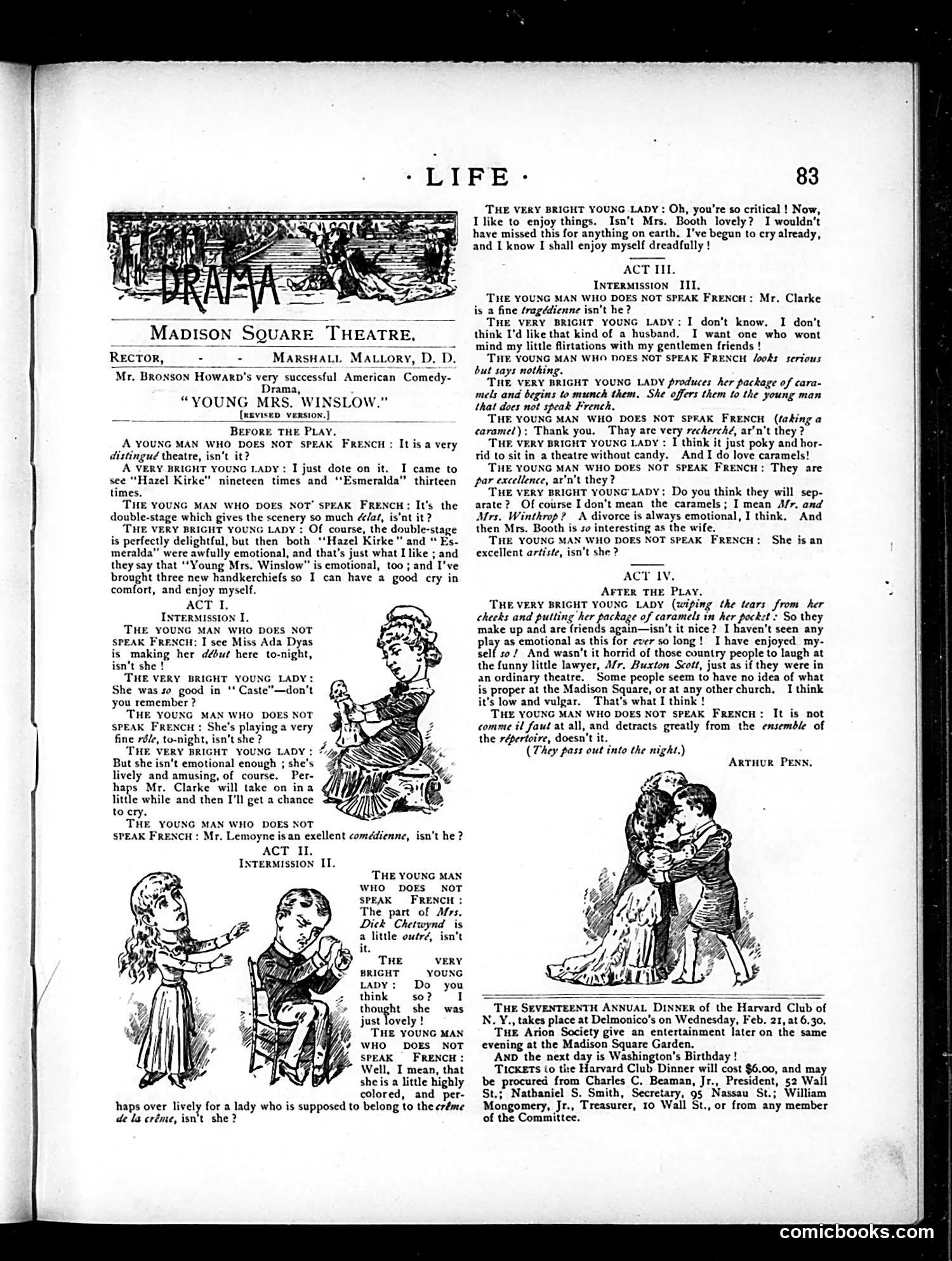
This page satirizes a common social type of the era: the vapid, theatrically enthusiastic young woman who attends plays primarily for emotional entertainment rather than artistic appreciation. The humor centers on a contrast between two characters at Madison Square Theatre watching "Young Mrs. Winslow": a young man who struggles with French (and presumably theater refinement) and a "very bright young lady" who constantly misuses French phrases while revealing her shallow engagement with theater. The satire targets her behavior: she attends purely to cry, brings multiple handkerchiefs, munches caramels throughout, judges performances by emotional impact rather than artistry, and confuses actors' names. Her repeated use of affected French phrases ("par excellence," "recherché," "créme de la créme") undercuts her pretension to sophistication. The cartoon mocks both theatrical sentimentality of the period and the class-conscious affectation of upper-class audiences attempting cultural refinement while remaining fundamentally unrefined.
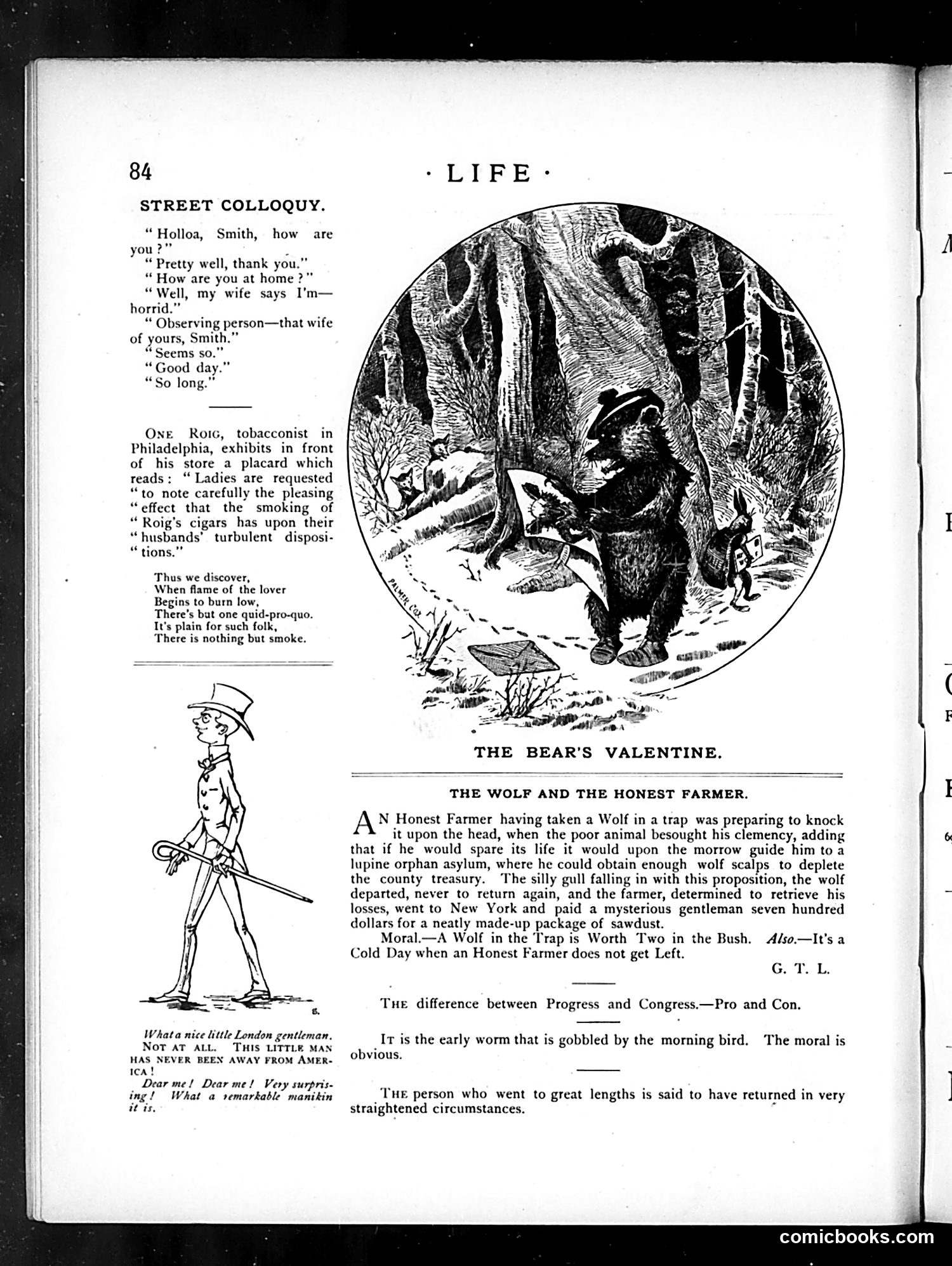
This page contains several brief satirical pieces typical of 19th-century American humor magazines: **"Street Colloquy"**: A short dialogue mocking social convention—a man admits his wife finds him "horrid," yet the acquaintance accepts this without concern, highlighting the era's detached politeness about domestic unhappiness. **Philadelphia Tobacco Advertisement Satire**: Life ridicules a tobacconist's claim that his cigars calm husbands' "turbulent dispositions." The accompanying verse sarcastically suggests smoking is the only remedy when romantic passion fades—reducing marriage to empty comfort rather than genuine connection. **"The Wolf and the Honest Farmer"**: An Aesop-style fable mocking rural naiveté. A farmer foolishly trusts a wolf's promise of reward, later loses money to a con artist selling fake "wolf scalps." The moral: country people are easily swindled by city schemes. **"Progress and Congress"**: A pun contrasting the words; the early worm metaphor suggests those who expose themselves (to scrutiny or danger) get destroyed. The overall tone is cynical—about marriage, rural simplicity, and human nature.
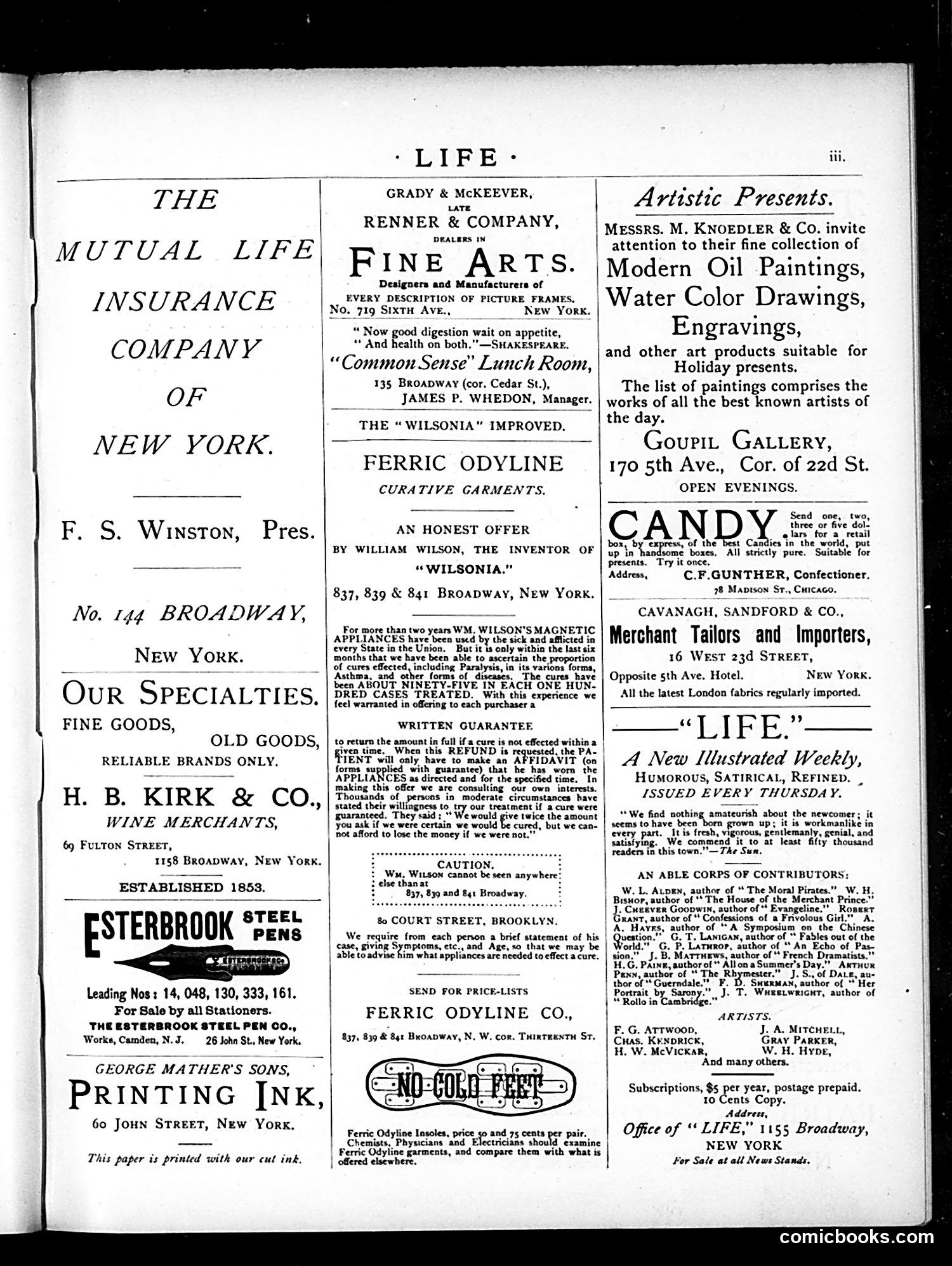
This is primarily an **advertising page**, not a satirical cartoon page. The page contains commercial advertisements from late 19th-century New York businesses, arranged in columns. The most notable item is an **advertisement for "Wilsonia" magnetic medical appliances** by William Wilson. This represents a common fraud of the era—pseudoscientific "cure-all" devices marketed to desperate patients. Wilson claims a 95% cure rate for ailments including paralysis and asthma, offering a written guarantee with a catch: customers must provide an affidavit proving they wore the device as directed. This was likely satirized by *Life* magazine elsewhere, as the publication frequently mocked such medical quackery. Other ads include insurance, wine merchants, printing supplies, art galleries, and confectionery—typical urban commerce of the period. The page reflects *Life's* business model: mixing satirical editorial content with lucrative advertisements, including those for dubious products the magazine itself likely ridiculed.
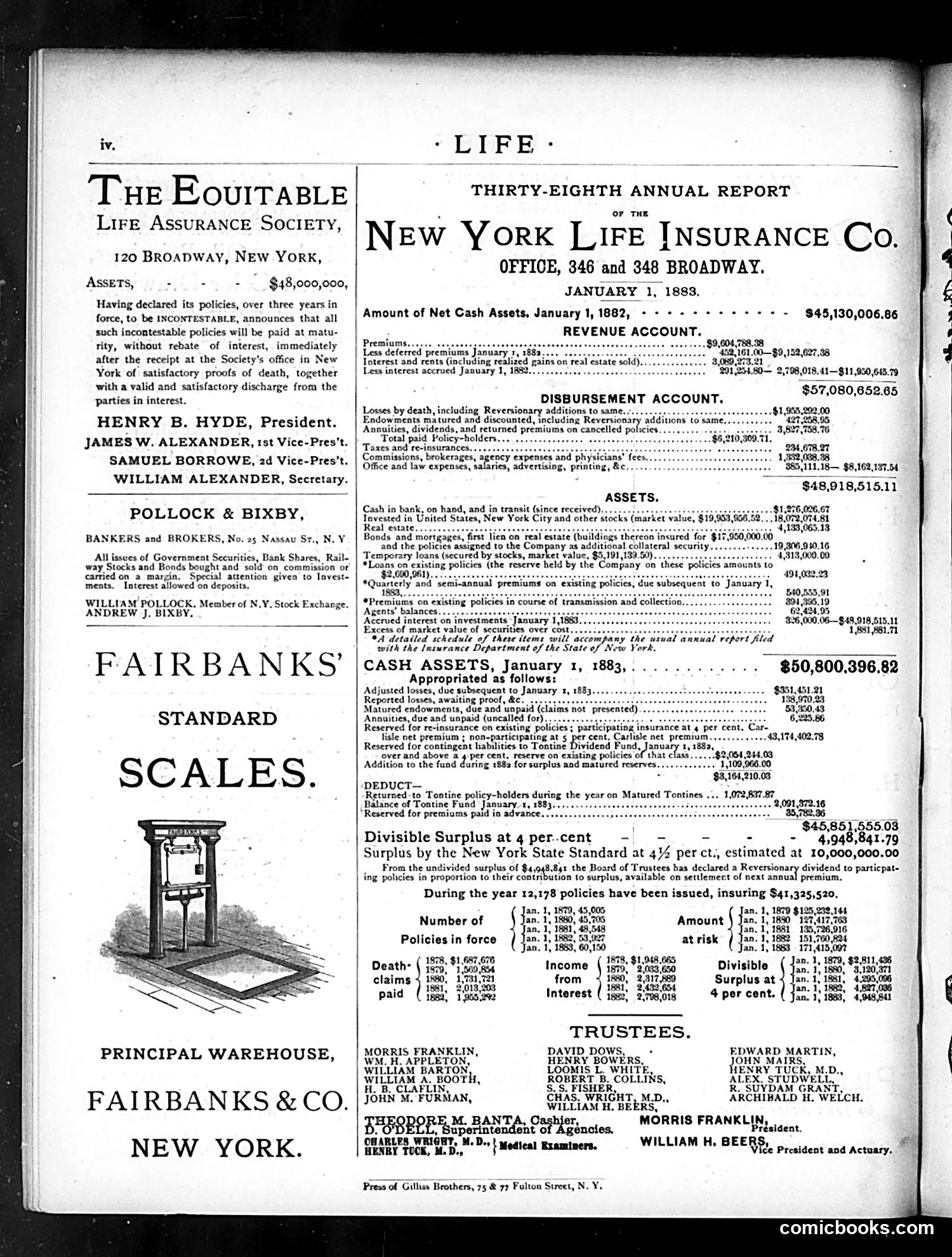
This page is **not a cartoon or satirical content** — it's a title page and financial advertisement section from *Life* magazine (January 1, 1883). The visible content consists entirely of: 1. **Insurance company advertisements** — prominently featuring the Equitable Life Assurance Society and New York Life Insurance Company with detailed financial statements and asset reports 2. **Business service advertisements** — for Pollock & Bixby (bankers/brokers), Fairbanks Standard Scales, and related financial firms 3. **Trustee listings** for the insurance companies There is **no political cartoon, satirical illustration, or humorous content** on this page. The only image is a product advertisement (the Fairbanks scale). This appears to be an issue's front matter dedicated to financial announcements, which was common for the era's *Life* magazine, before it evolved into purely satirical content.