
Life, 1883-02-15 · page 3 of 16
Life — February 15, 1883 — page 3: what you’re looking at
What you’re looking at
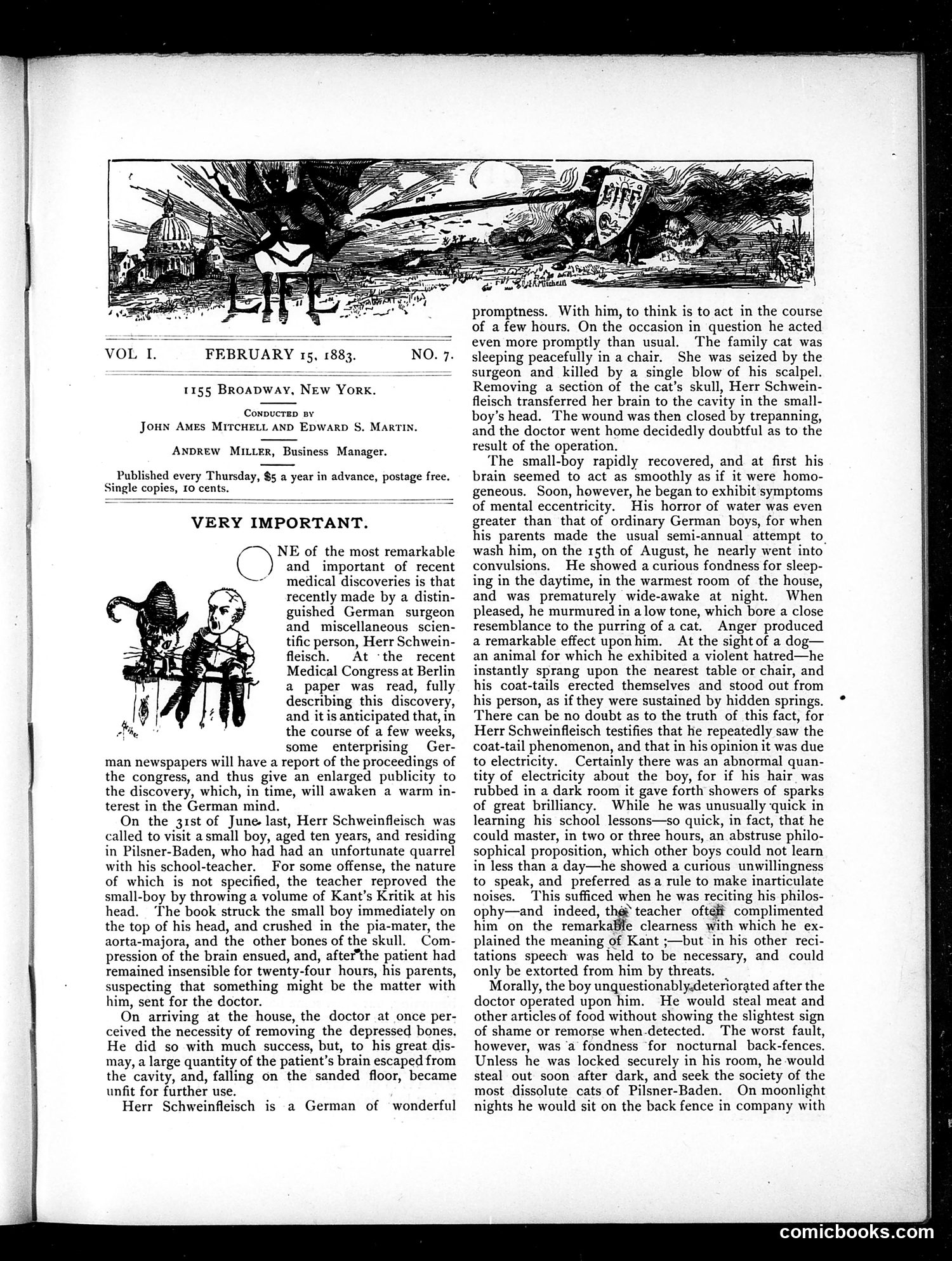
The illustrated header and accompanying article describe a bizarre medical case involving a German surgeon named Herr Schweinleisch, who conducted an experimental brain transplant. The text recounts how Schweinleisch transferred a cat's brain into a young boy's head after the original boy's brain was damaged. The satirical point appears to be mocking both pseudoscientific medical claims and German scientific pretensions popular in 1880s American journalism. The grotesque illustration—showing exaggerated figures in a nightmarish landscape—reinforces the absurdity. The article's increasingly ridiculous details (the boy's cat-like behaviors, his nocturnal fence-sitting) signal this is satirical commentary rather than genuine medical reporting, likely poking fun at sensationalized European science reporting that American publications eagerly republished.
📄 Transcribed text from this page (OCR, searchable)
Machine-transcribed from the original scan — historical spelling and the odd misread are preserved.
| ] i ; | | FEBRUARY 15, 1883. 1155 BROADWAY, NEw York. Conpucrep By JouHN AMES MITCHELL AND Epwarp S. Martin. ANDREW MILLER, Business Manager. Published every Thursday, $5 a year in advance, postage free. Single copies, 10 cents. VERY IMPORTANT. NE of the most remarkable C) and important of recent medical discoveries is that recently made by a distin- guished German surgeon and miscellaneous scien- tific person, Herr Schwein- fleisch. At ‘the recent Medical Congress at Berlin a paper was read, fully describing this discovery, and it is anticipated that, in the course of a few weeks, some enterprising Ger- man newspapers will have a report of the proceedings of the congress, and thus give an enlarged publicity to the discovery, which, in time, will awaken a warm in- terest in the German mind. On the gist of June last, Herr Schweinfleisch was called to visit a small boy, aged ten years, and residing in Pilsner-Baden, who had had an unfortunate quarrel with his school-teacher. For some offense, the nature of which is not specified, the teacher reproved the small-boy by throwing a volume of Kant’s Kritik at his head. The book struck the small boy immediately on the top of his head, and crushed in the pia-mater, the aorta-majora, and the other bones of the skull. Com- pression of the brain ensued, and, after*the patient had remained insensible for twenty-four hours, his parents, suspecting that something might be the matter with him, sent for the doctor. On arriving at the house, the doctor at once per- ceived the necessity of removing the depressed bones. He did so with much success, but, to his great dis- may, a large quantity of the patient’s brain escaped from the cavity, and, falling on the sanded floor, became unfit for further use. Herr Schweinfleisch is a German of wonderful aes promptness. With him, to think is to act in the course of a few hours. On the occasion in question he acted even more promptly than usual. The family cat was sleeping peacefully in a chair. She was seized by the surgeon and killed by a single blow of his scalpel. Removing a section of the cat’s skull, Herr Schwein- fleisch transferred her brain to the cavity in the small- boy’s head. The wound was then closed by trepanning, and the doctor went home decidedly doubtful as to the result of the operation. The small-boy rapidly recovered, and at first his brain seemed to act as smoothly as if it were homo- geneous. Soon, however, he began to exhibit symptoms of mental eccentricity. His horror of water was even greater than that of ordinary German boys, for when his parents made the usual semi-annual attempt to, wash him, on the 15th of August, he nearly went into convulsions. He showed a curious fondness for sleep- ing in the daytime, in the warmest room of the house, and was prematurely wide-awake at night. When pleased, he murmured in a low tone, which bore a close resemblance to the purring of a cat. Anger produced a remarkable effect uponhim. At the sight of a dog— an animal for which he exhibited a violent hatred—he instantly sprang upon the nearest table or chair, and his coat-tails erected themselves and stood out from his person, as if they were sustained by hidden springs. There can be no doubt as to the truth of this fact, for Herr Schweinfleisch testifies that he repeatedly saw the coat-tail phenomenon, and that in his opinion it was due to electricity. Certainly there was an abnormal quan- tity of electricity about the boy, for if his hair was rubbed in a dark room it gave forth showers of sparks of great brilliancy. While he was unusually quick in learning his school lessons—so quick, in fact, that he could master, in two or three hours, an abstruse philo- sophical proposition, which other boys could not learn in less than a day—he showed a curious unwillingness to speak, and preferred asa rule to make inarticulate noises. This sufficed when he was reciting his philos- ophy—and indeed, thé teacher ofteit complimented him on the remarkable clearness with which he ex- plained the meaning of Kant ;—but ‘in his other reci- tations speech was held to be necessary, and could only be extorted from him by threats. Morally, the boy unquestionably.deteriorated after the doctor operated upon him. He would steal meat and other articles of food without showing the slightest sign of shame or remorse when-detected. The worst fault, however, was ‘a fondness for nocturnal back-fences. Unless he was locked securely in his room, he would steal out soon after dark, and seek the society of the most dissolute cats of Pilsner-Baden. On moonlight nights he would sit on the back fence in company with | comicbooks.com