
A complete issue · 16 pages · 1883
Life — January 18, 1883
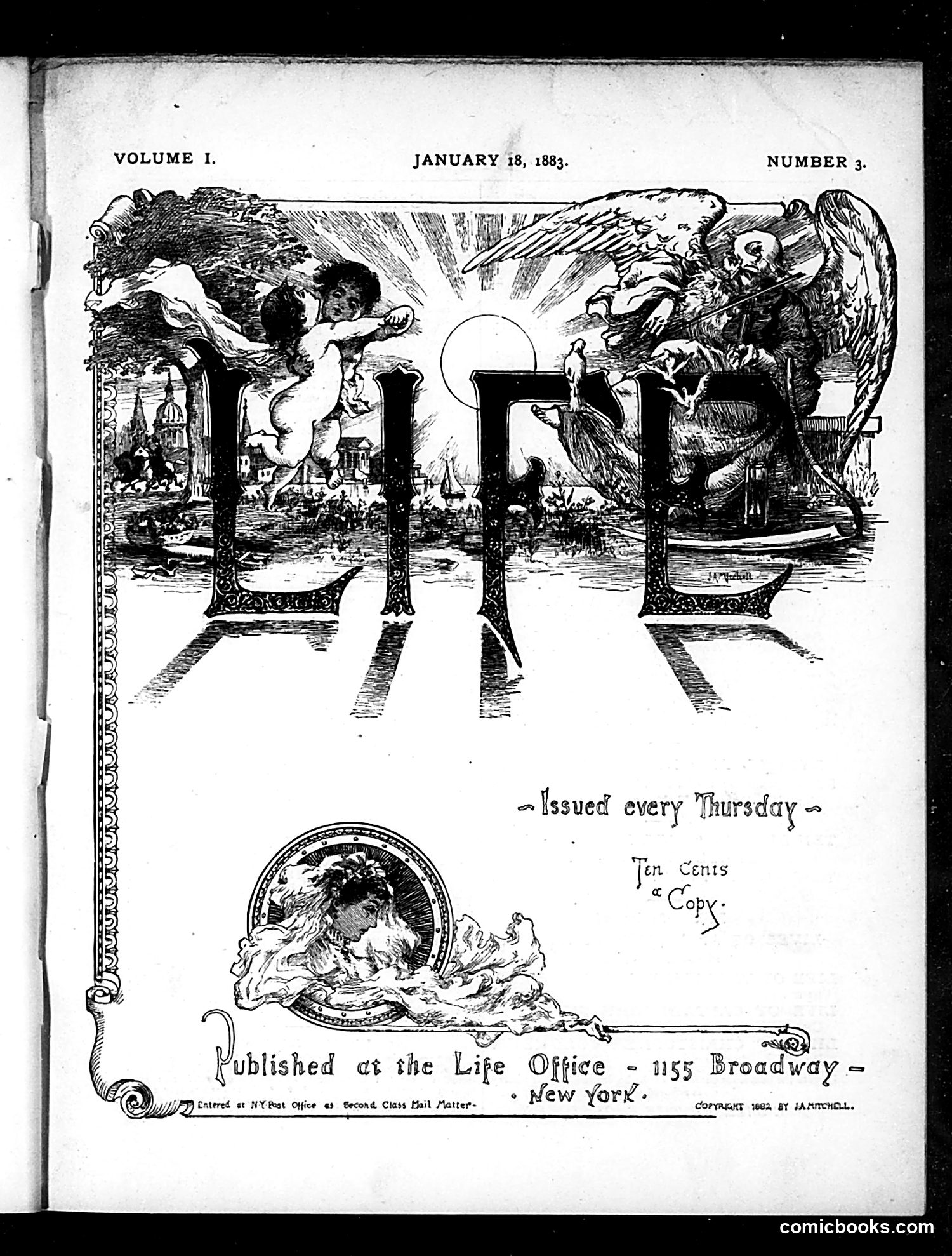
This is the cover of *Life* magazine's first volume, issue 3, published at 1155 Broadway, New York. The elaborate decorative lettering spells "LIFE" and frames a fantastical scene: allegorical figures (cherubs, angels, possibly representing classical virtues or the passage of time) oversee an earthly landscape below with buildings and a sunset. The ornate Victorian design is typical of 1880s satirical publications. Without identifying specific political figures or events from this particular issue, the cover appears to establish the magazine's tone as an illustrated humor and commentary publication. The classical imagery suggests aspirations toward cultural sophistication and wit. The magazine cost ten cents per copy and was issued weekly on Thursdays.
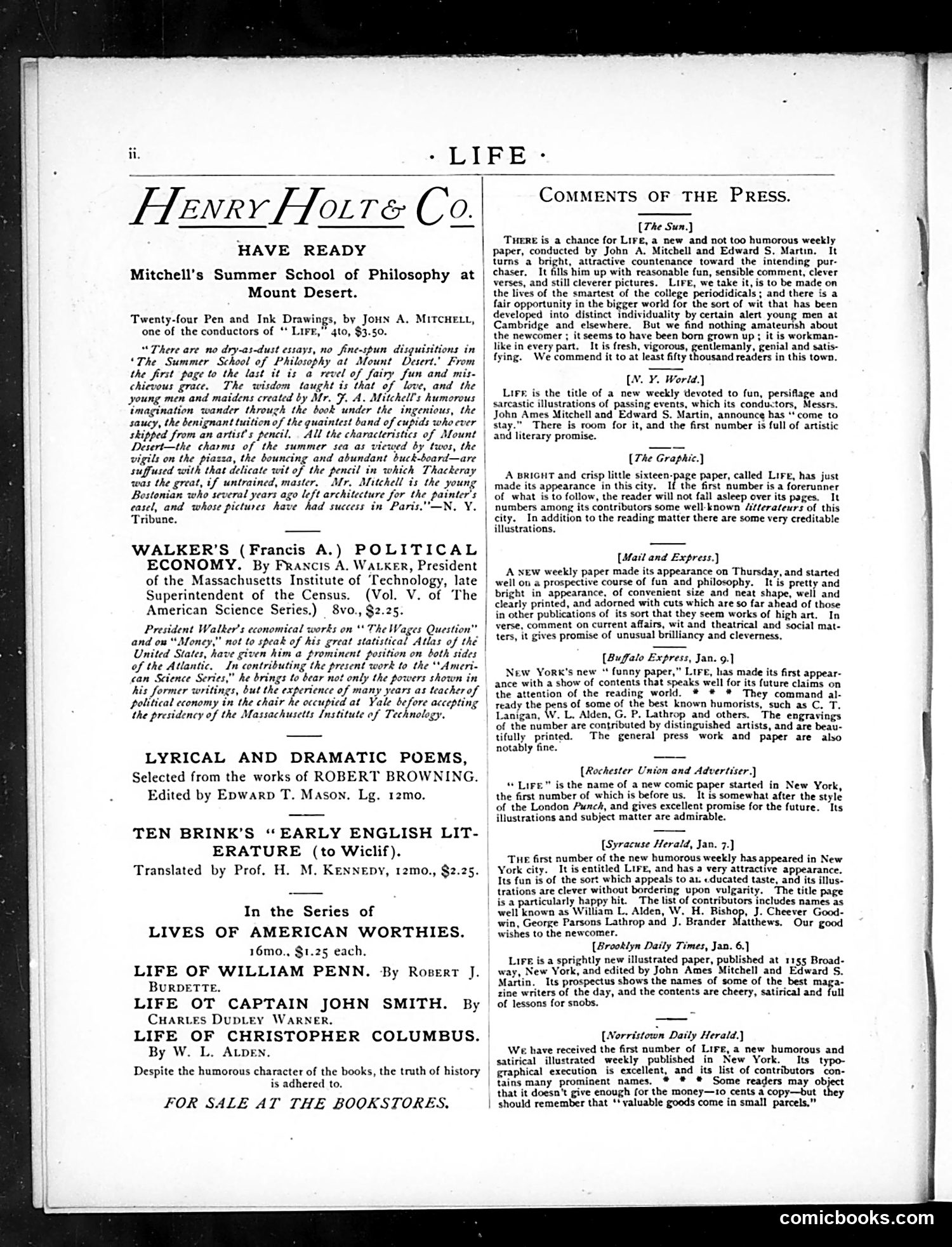
This page is primarily **advertising and book reviews**, not political cartoons. It showcases Henry Holt & Company's new publications, including: - Mitchell's *Summer School of Philosophy at Mount Desert* (with pen drawings) - Walker's *Political Economy* - Collections of poems and dramatic works - Historical biographies (*Life of William Penn*, *Life of Captain John Smith*, *Life of Christopher Columbus*) The "Comments of the Press" section contains **favorable reviews** from publications like *The Sun*, *N.Y. World*, *The Graphic*, and *Buffalo Express*, praising a new weekly publication called *Life* for its artistic quality, humor, and literary promise. **No political satire is present** on this page—it's a commercial advertisement section typical of 19th-century magazines.
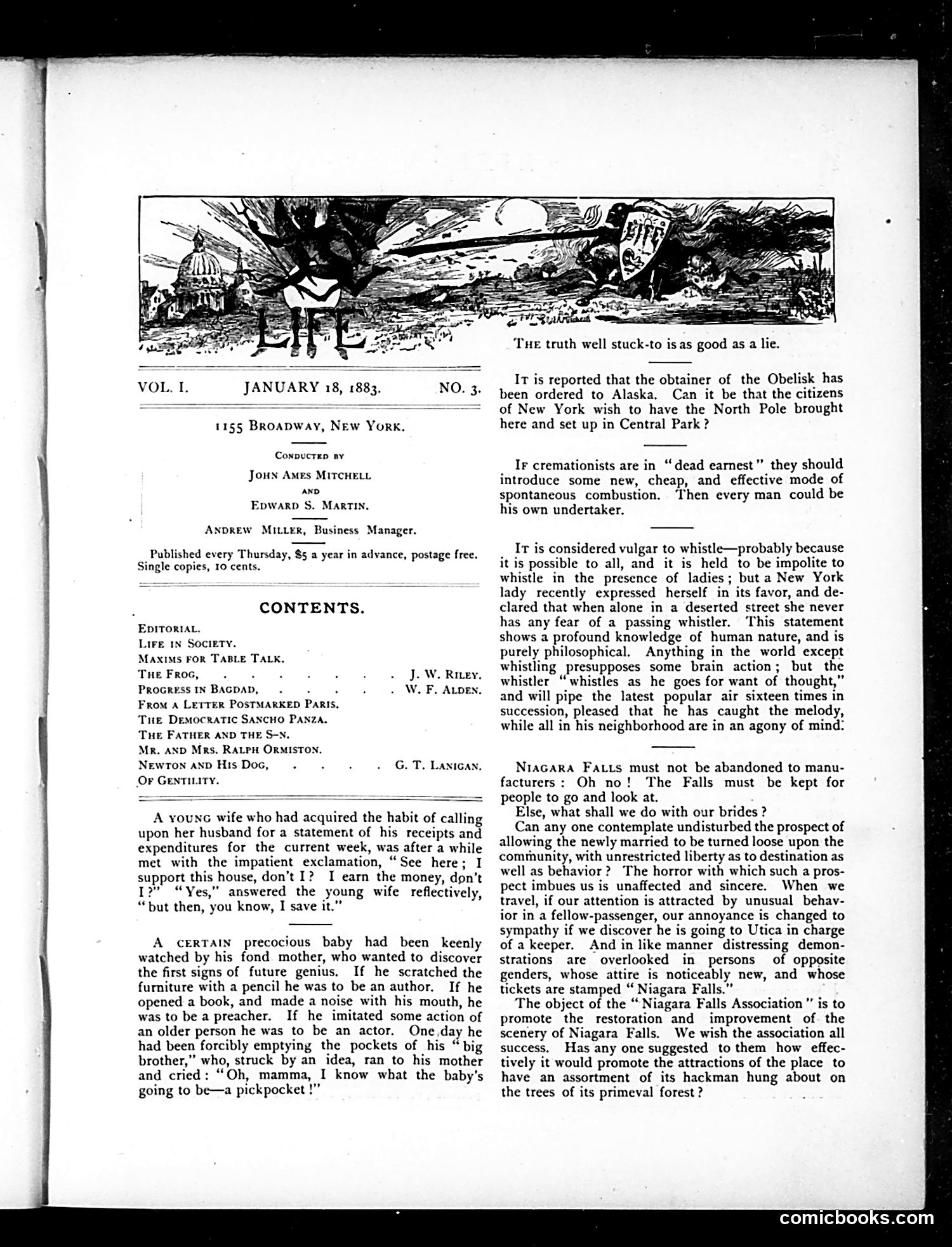
The masthead cartoon depicts a nighttime scene with a grim reaper figure looming over a landscape with a church and moon. The accompanying caption—"The truth well stuck-to is as good as a lie"—suggests cynicism about honesty and deception. The page contains editorial commentary and humorous anecdotes rather than explicit political cartoons. Notable pieces include satirical observations about wealthy New Yorkers, cremation practices, and the propriety of whistling around ladies. A substantial section critiques plans to develop Niagara Falls commercially, arguing that natural scenery should be preserved for public enjoyment rather than exploited by manufacturers or turned into a tourist spectacle with "unrestricted access" for newlyweds. The overall tone reflects Victorian-era social satire targeting wealth, commercialism, and changing social mores.
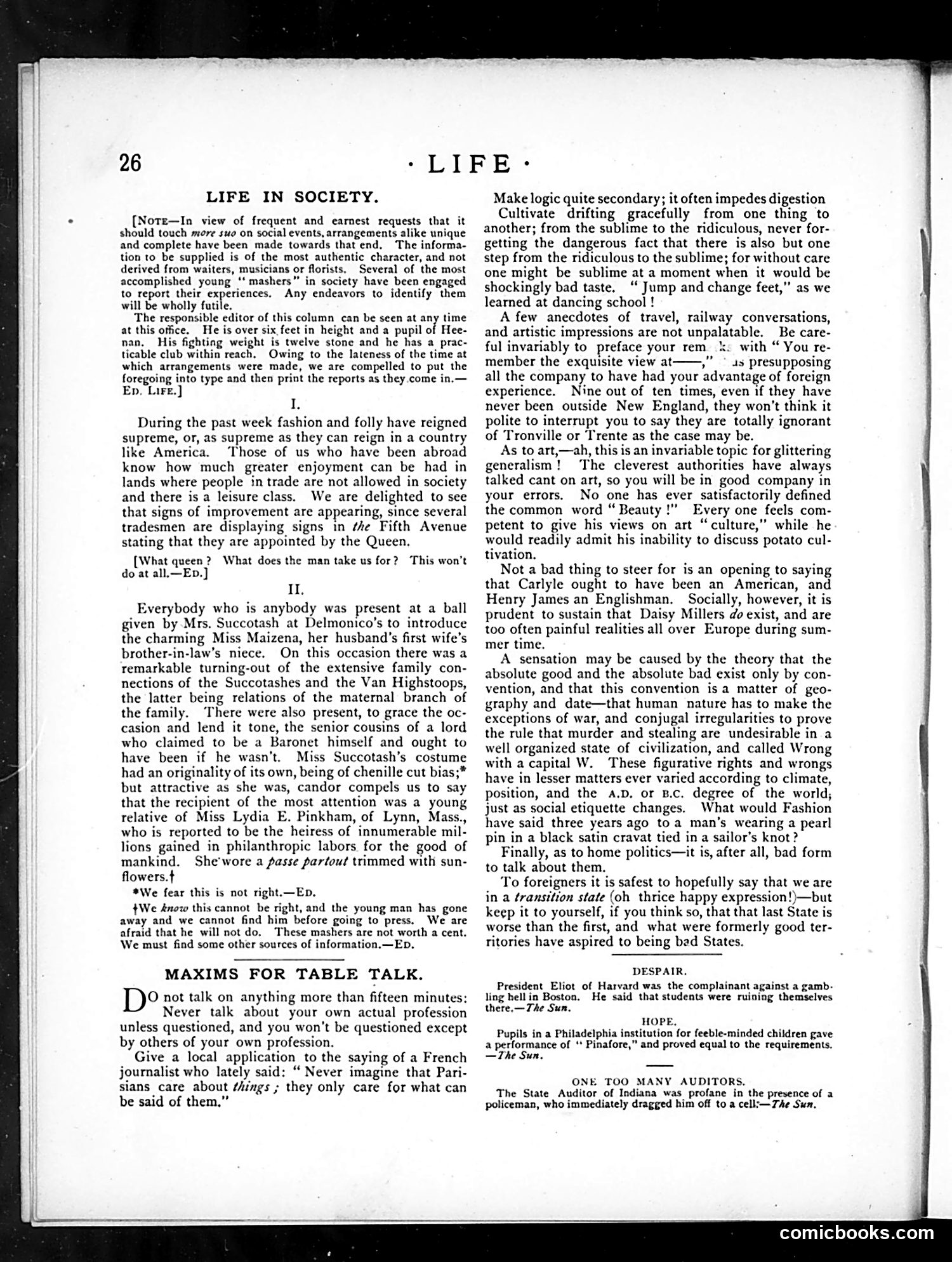
This page contains social commentary rather than political cartoons. The main article, "Life in Society," offers satirical advice on etiquette and social behavior for American high society. Key points of satire include: - **Mocking pretension**: Criticism of wealthy Americans who traveled abroad and returned acting superior about European culture and manners - **Art world snobbery**: Satire of how people use vague praise like "Beauty!" to mask ignorance about art - **Social climbing**: References to the Succotash and Van Ringshoops families suggest mockery of nouveau riche attempting to establish social prominence - **Conversation rules**: Humor in prescriptive etiquette about avoiding discussing one's profession or travel experiences for more than fifteen minutes The tone is consistently ironic, deflating pretentiousness while exposing the arbitrary rules governing American elite society.
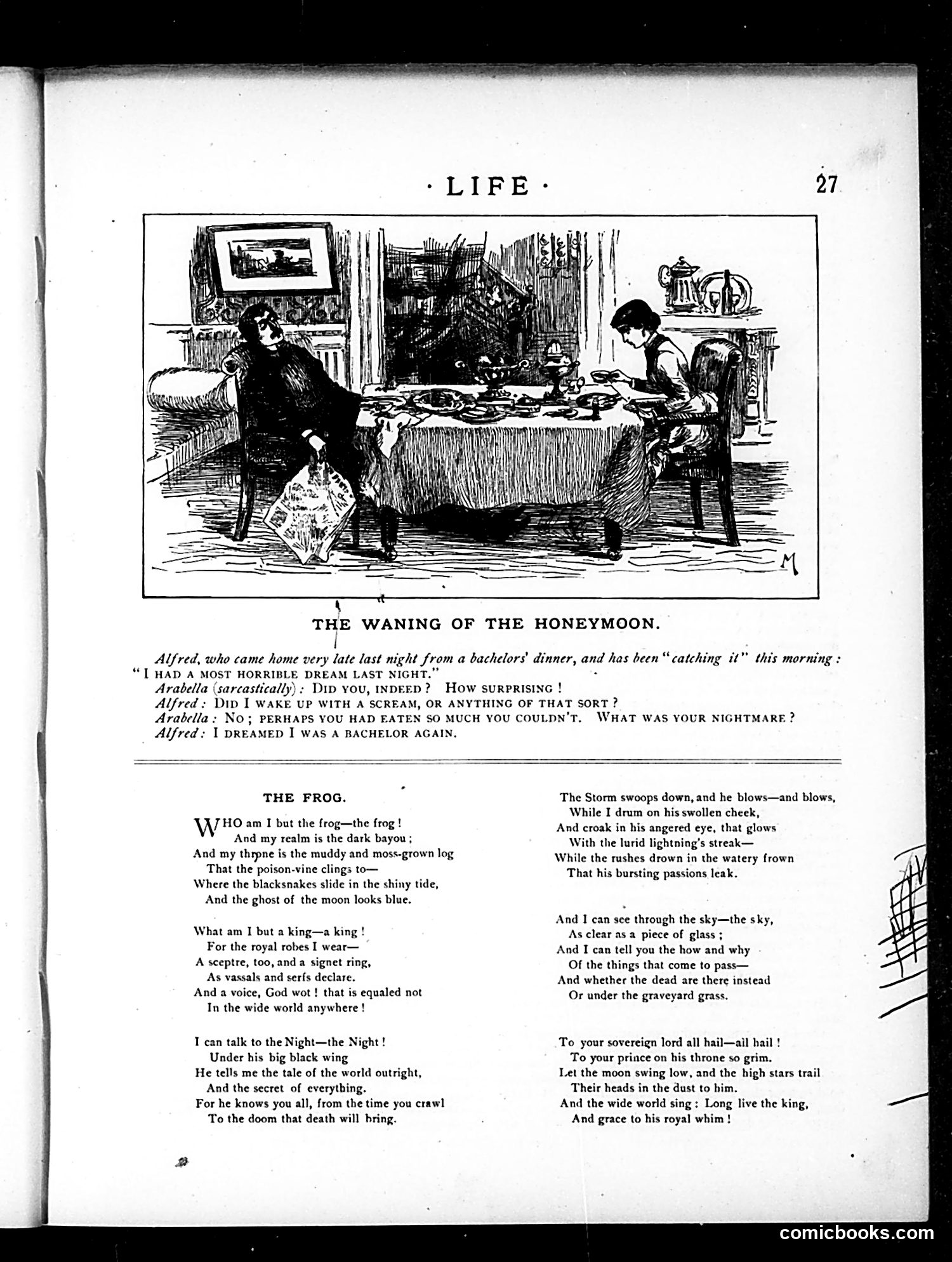
**"The Waning of the Honeymoon"** cartoon satirizes newlywed disillusionment. Alfred returns home exhausted from a bachelor's dinner, and his wife Arabella expresses concern. Alfred reveals he had a nightmare about being a bachelor again—the joke being that marriage has already become so burdensome he dreams of escape. This reflects early-20th-century satirical commentary on marriage's transition from romantic idealization to domestic routine and spousal conflict. **"The Frog"** is a standalone poem personifying a frog as a philosophical "king" trapped in the bayou, contemplating mortality and cosmic significance. The romantic, somewhat grandiose tone contrasts with the frog's lowly status, creating gentle satire about pretension and self-importance—a common literary theme of the era.
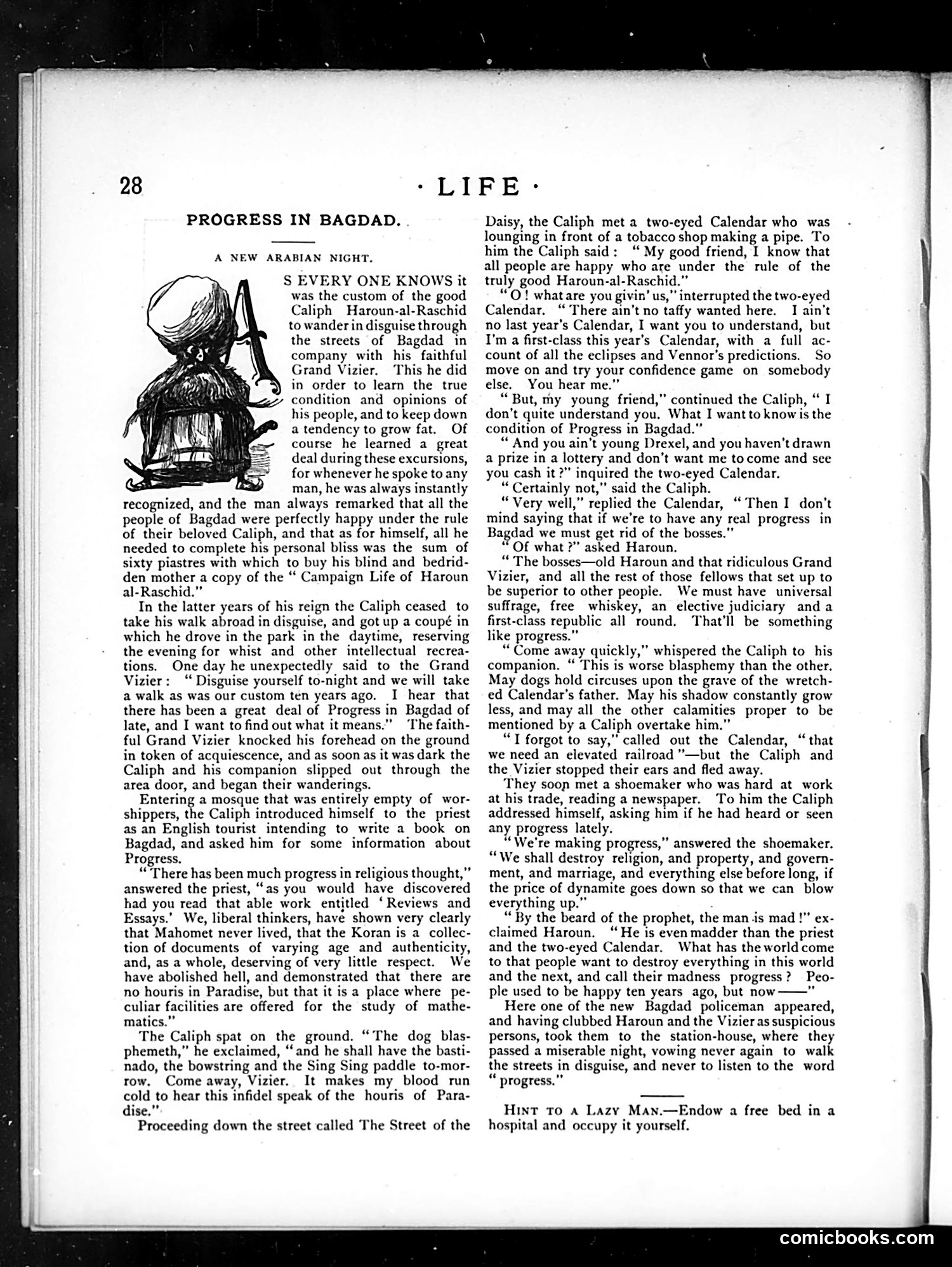
This satirical story mocks early 20th-century claims of "progress" in the Middle East, particularly regarding modernization and colonial influence. The Caliph Haroun-al-Raschid (a legendary Islamic ruler) wanders disguised through Bagdad seeking evidence of Progress—a concept presented as hollow and destructive. The satire targets Western ideas of advancement: a shoemaker claims progress means destroying religion, property, marriage, and tradition to achieve dynamite and explosives. The two-eyed Calendar character dismisses old wisdom as inferior to modern calendars. The story suggests that so-called "progress" imposed on traditional societies amounts to cultural destruction masquerading as civilization. The Caliph and Vizier flee in disgust, rejecting this destructive modernization—clearly Life magazine's critique of Western imperialism and forced "civilization" in the Islamic world.
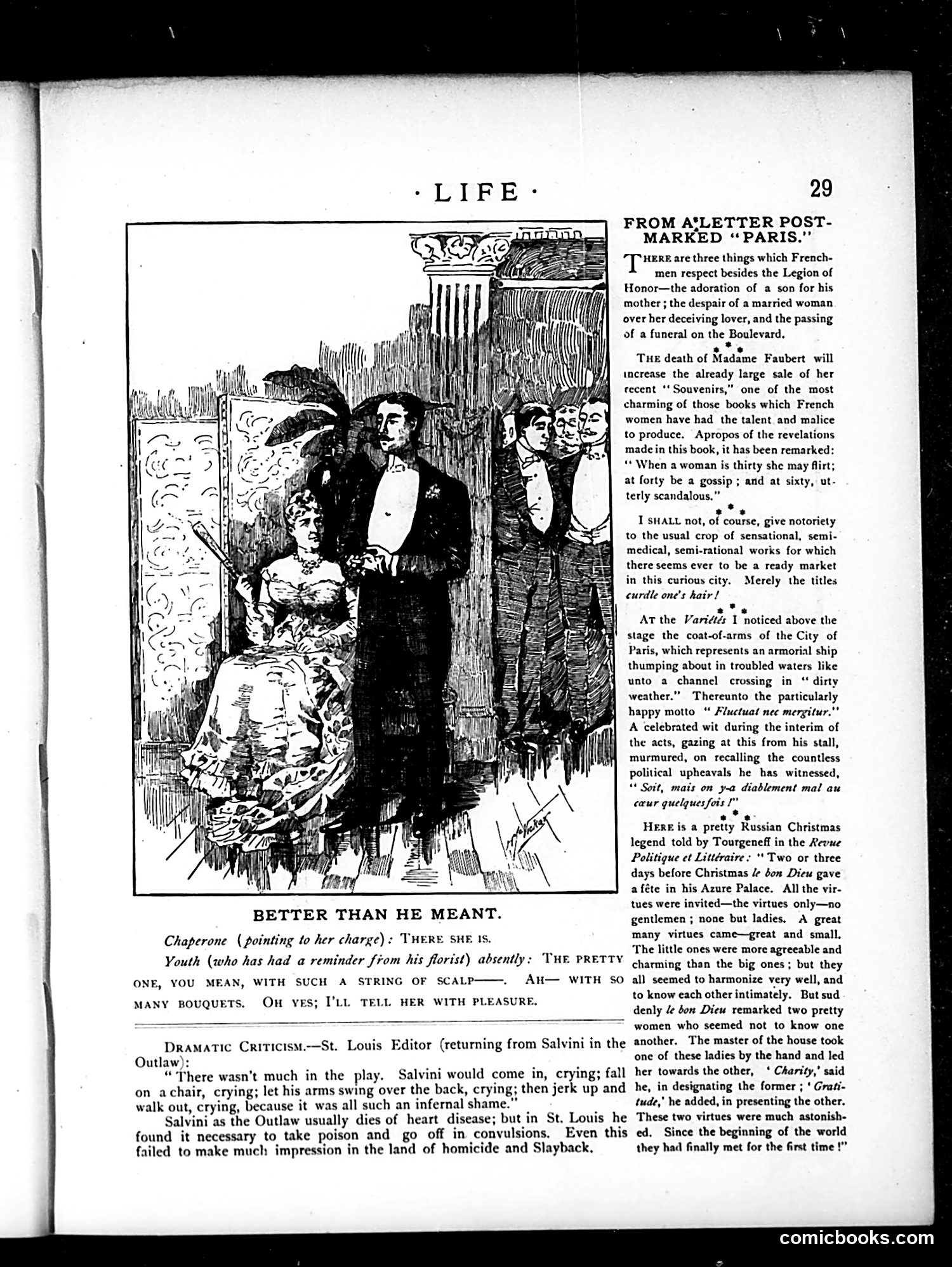
The main illustration titled "Better Than He Meant" depicts a scene at what appears to be a Parisian venue. A well-dressed man in formal attire points to a woman seated, while other figures observe. The caption indicates this is "Chaperone" addressing "Youth," with dialogue about a woman having "a string of scalp" and "many bouquets." This appears to satirize Parisian social dynamics and romantic entanglements—specifically, a woman's dubious reputation or romantic history being presented as a matter of pride. The "scalp" reference humorously compares her conquests to trophies. The surrounding text discusses Madame Paulbert's memoir and French social scandals, providing context for satirizing French attitudes toward romance, infidelity, and social reputation. The cartoon mocks both the woman's dubious status and the man's tone-deaf pride in presenting it.
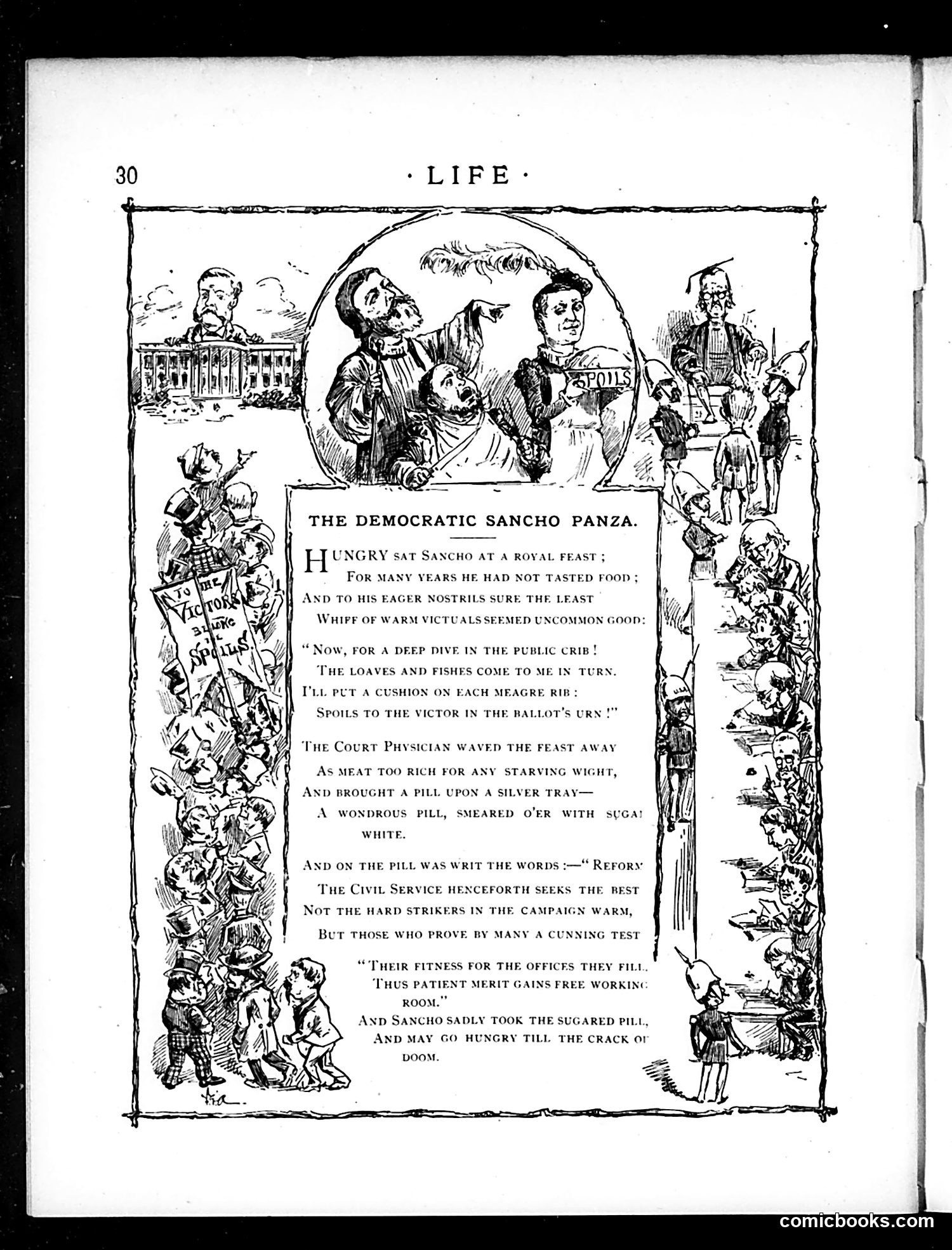
This satirical poem mocks a Democratic politician (likely a civil service reformer) through a Don Quixote reference. The verse describes "Sancho" as starving despite promises of democratic reform—he's given only a sugared pill labeled "Reform" instead of real food. The satire targets the gap between Democratic campaign rhetoric about civil service improvement and actual governance. The "Court Physician" represents party leadership offering empty symbolic gestures ("sugar") rather than substantive change. The poem ridicules Democrats for claiming to seek the "best" candidates through merit while actually maintaining patronage systems ("hard strikers in the campaign warm"). The ornamental border illustrations depict various figures engaged in political activity, reinforcing the theme of political theater versus practical reform.
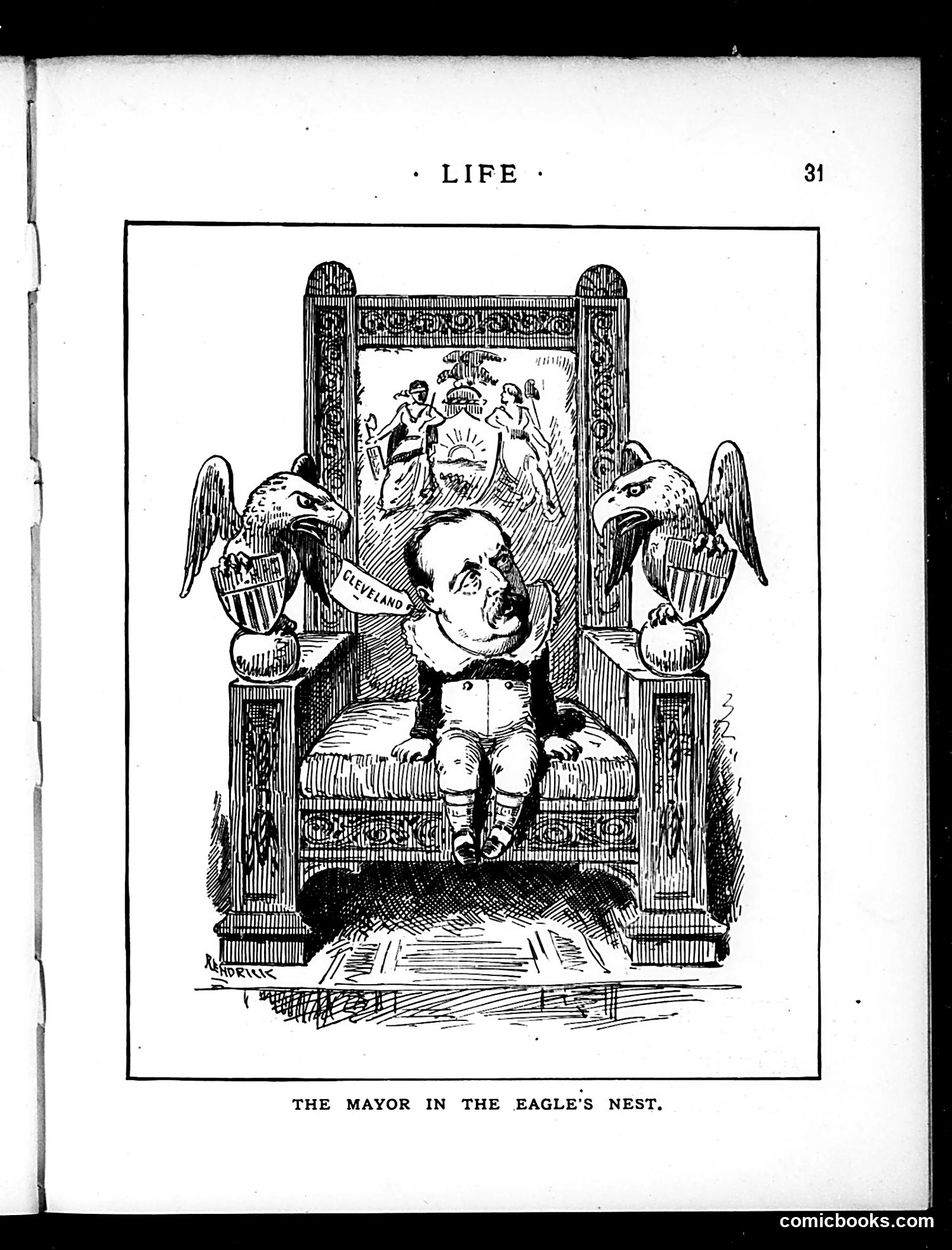
This political cartoon depicts a figure labeled "Cleveland" (visible on a banner) seated in an enormous throne-like chair, flanked by two American eagles holding shields. Above him is a framed scene showing figures in what appears to be classical or mythological dress. The satire likely comments on Cleveland's executive power or presidential authority—the "eagle's nest" referencing the presidential seal and American symbolism. The grandiose throne and elaborate setting mock what the cartoonist saw as inflated executive pretension or overreach. The classical scene in the frame above may reference historical or mythological precedent, suggesting the cartoon critiques Cleveland's claims to authority or his administration's actions. Without the article's text, the specific political dispute remains unclear.
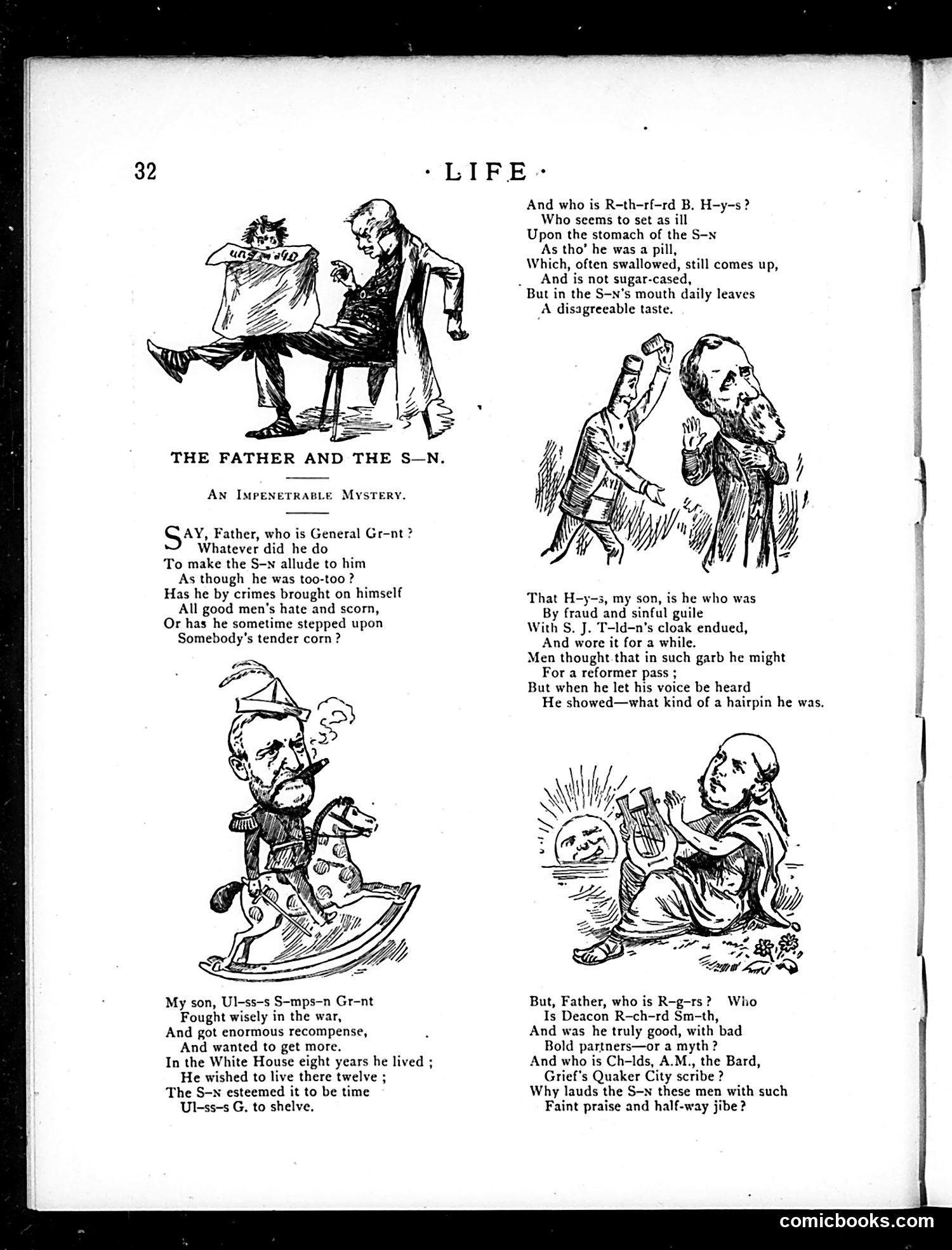
This is a satirical dialogue about Reconstruction-era politics, using vowel-deletion to obscure identities while remaining recognizable to contemporary readers. **Key figures identified through the blanks:** - **R-th-rf-rd B. H-y-s**: Rutherford B. Hayes (Republican presidential candidate) - **Gr-nt**: Ulysses S. Grant (sitting president) - **S-n**: The Sun (a newspaper, likely the New York Sun) - **T-Id-n**: Samuel Tilden (Democratic candidate) - **R-g-rs**: Rogers; **R-ch-rd Sm-th**: Richard Smith; **Ch-Ids**: Childs **The joke:** Life ridicules *The Sun* newspaper for its contradictory coverage—praising Republican figures with "faint praise and half-way jibe" while Hayes causes political indigestion. The "Father" (presumably representing reason or the reader) questions why *The Sun* endorses these politicians so tepidly. The satire mocks the newspaper's equivocal stance on the 1876 presidential election and Reconstruction politics.
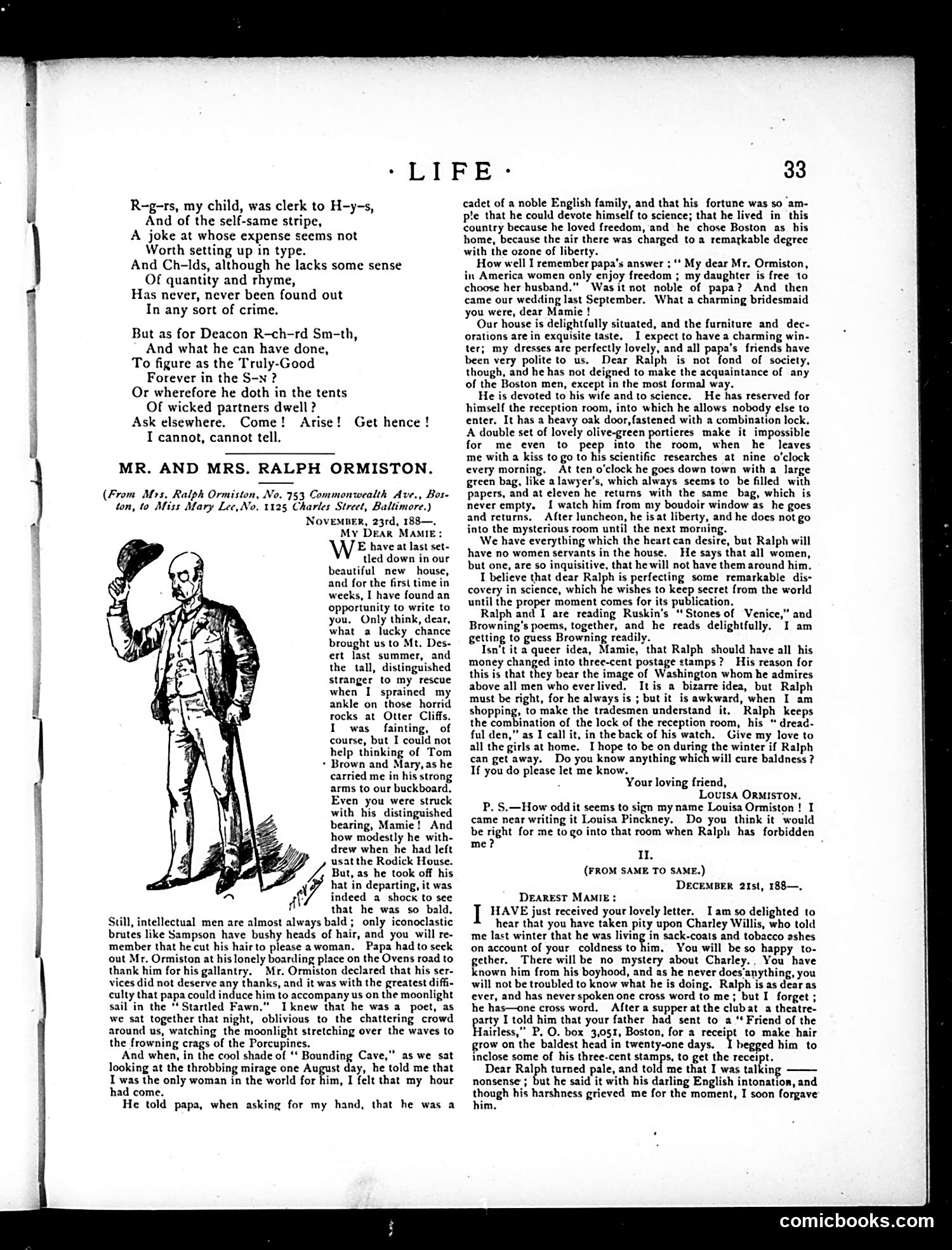
This page contains a satirical letter about a woman named Mamie describing her recent marriage to Ralph Ormiston, a supposedly distinguished English gentleman she met at Mount Desert Island. The satire lies in the contrast between Ormiston's romantic presentation (a cultured, intellectual poet devoted to science) and the suspicious details that emerge: he's unusually bald, refuses to socialize with Boston society, keeps a locked reception room where no one—including his wife—can enter, and claims to devote himself to secret scientific research. The opening poem mocks politicians with redacted names (R-g-rs, H-y-s, Ch-lds, Deacon R-ch-rd Sm-th), suggesting they're too prominent or litigious to name openly. The overall joke appears to be satirizing both gullible women seduced by smooth-talking foreigners and the pretensions of self-proclaimed "men of science" who use intellectual cover for dubious activities. Ormiston's locked room hints at possible fraud or deception beneath his refined exterior.
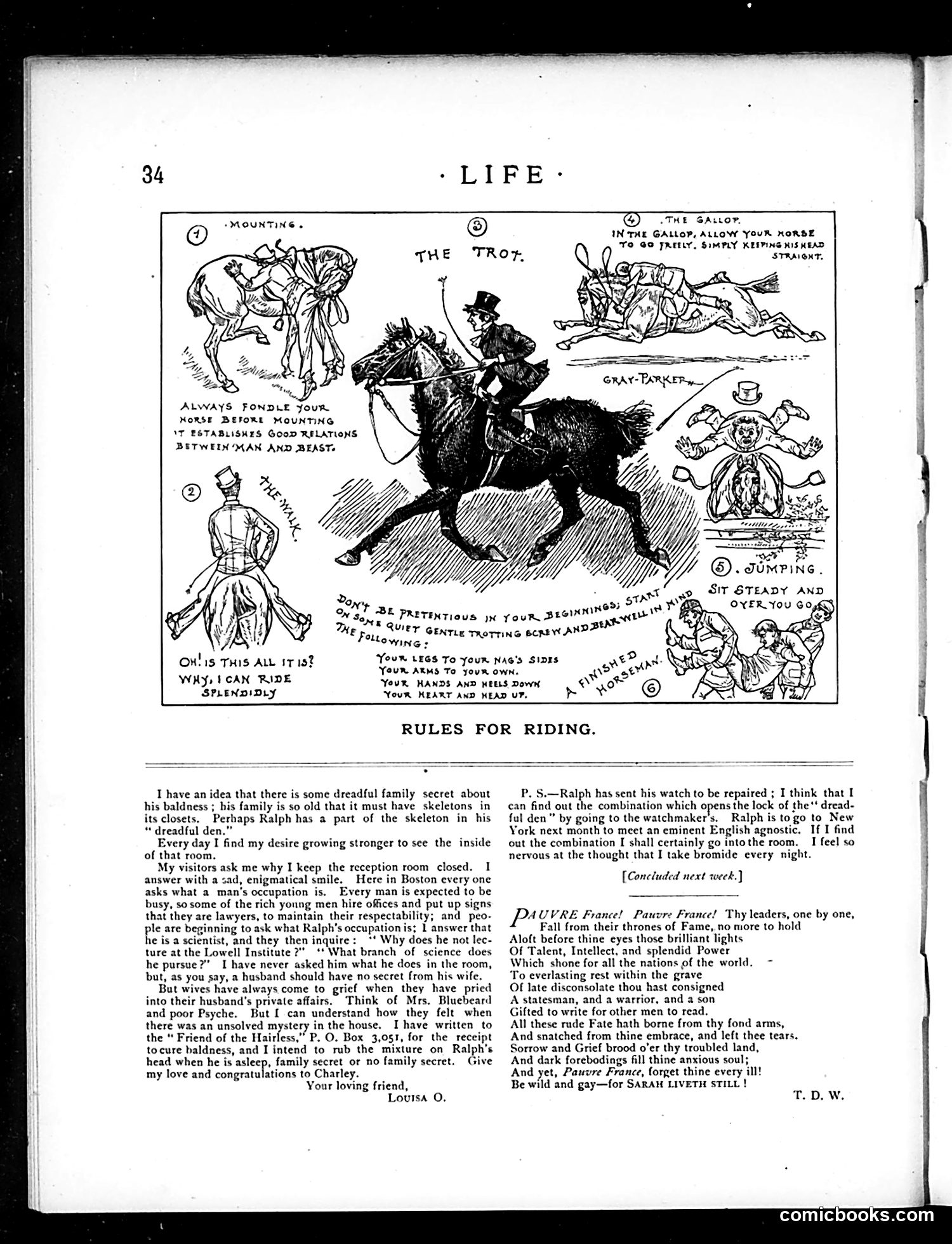
This page satirizes Victorian-era horseback riding etiquette through numbered instructional panels. The cartoon mocks the excessive formality and rigid rules governing proper riding technique—positioning of hands, legs, posture, and emotional restraint ("Your Heart and Head Up"). The accompanying letter from "Louisa O." provides comedic context: a wife obsessed with discovering her husband Ralph's "dreadful secret"—his baldness and mysterious locked study. She humorously seeks a baldness cure, plans to spy through his watch repair, and threatens to break into his room. This domestic farce parodies Victorian anxieties about privacy, gender relations, and household secrets. The final section references French political figures and "Sarah" (likely actress Sarah Bernhardt), lamenting France's losses while celebrating her enduring vitality—typical of Life's mix of topical and theatrical commentary. Overall, the page blends gentle social satire about rigid manners with domestic comedy, characteristic of Gilded Age American humor.
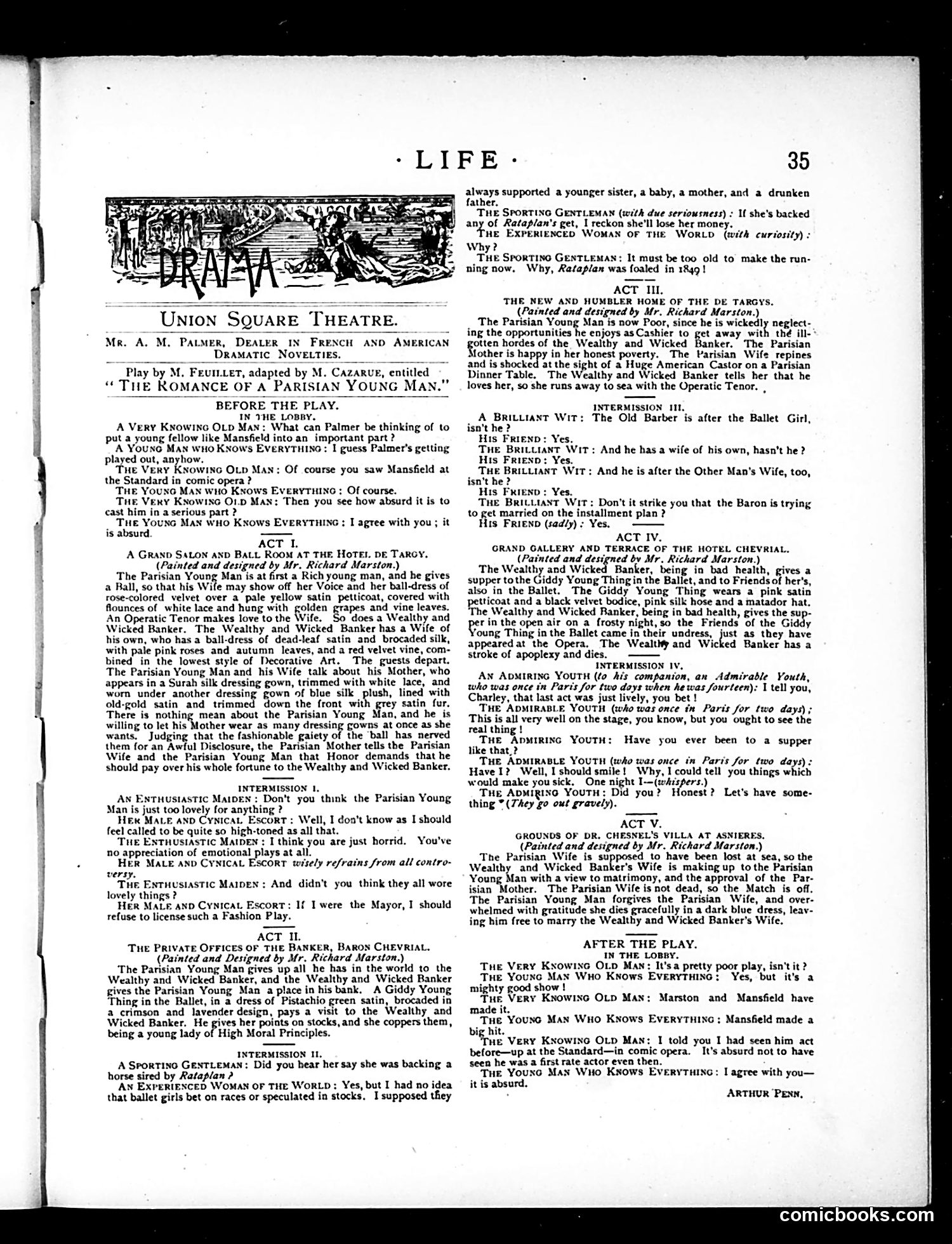
This page reviews "The Romance of a Parisian Young Man," a French play adapted for American audiences at Union Square Theatre. The satire targets both the play itself and theater-going pretension. **The Play's Plot:** A wealthy Parisian man sacrifices his fortune to a corrupt banker for "honor," while his wife attracts various suitors. The detailed descriptions of elaborate costumes mock the production's emphasis on spectacle over substance. **The Satire:** Pre-play and intermission conversations ridicule audience types—particularly the "Young Man Who Knows Everything" (a know-it-all critic), an "Enthusiastic Maiden" who gushes over sentiment, and her "Cynical Escort" who tolerates her pretension. A final joke reveals a *ballet girl* casually discusses horse-racing and stock speculation, contradicting the era's assumption that dancers came from desperately poor families supporting dependents. **The Point:** Life mocks both the melodramatic French play and American audiences' affected enthusiasm for imported European drama, exposing class assumptions about performers' lives.
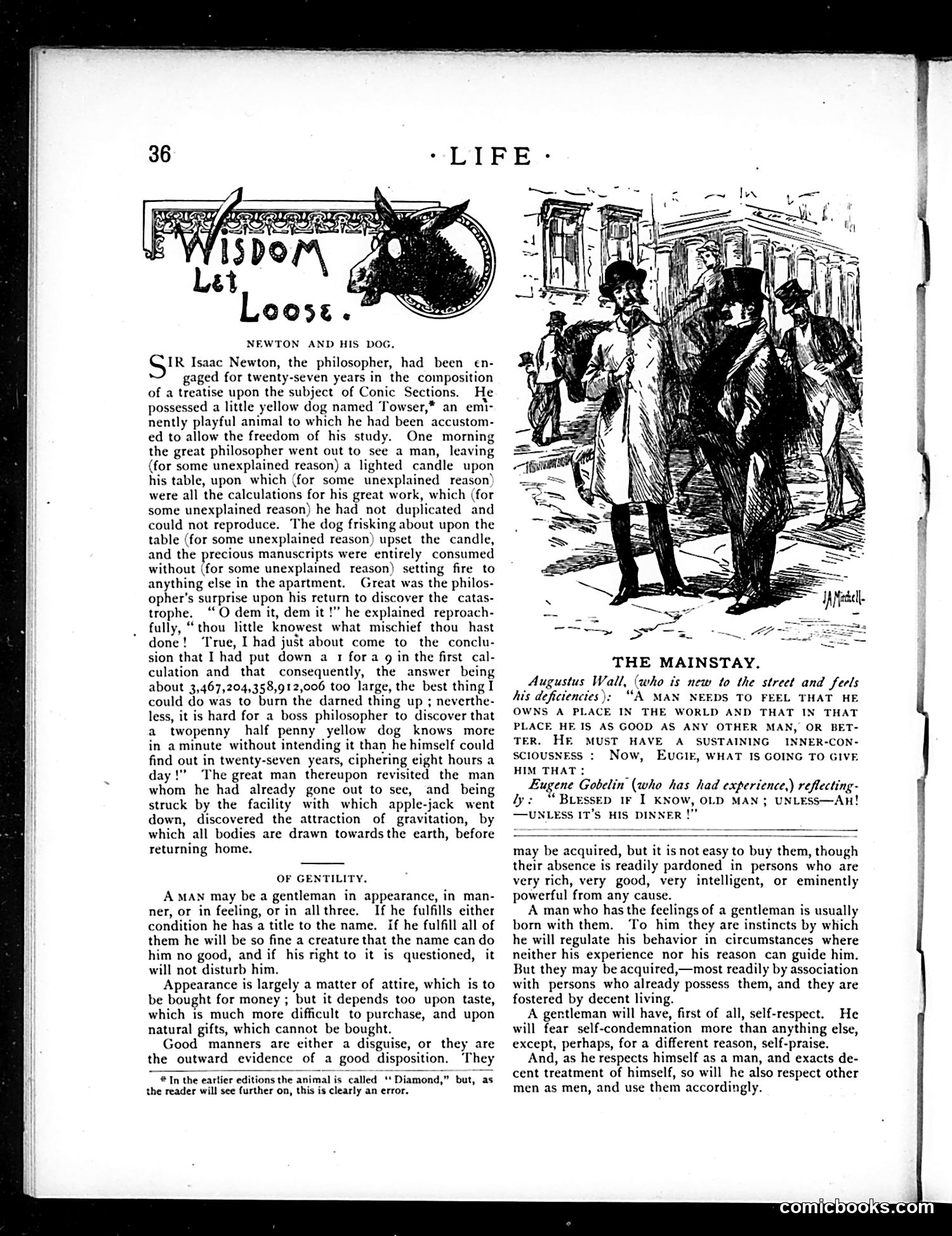
This page contains two satirical pieces about human nature and social behavior. **"Newton and His Dog"** is a humorous anecdote mocking intellectual pretension. It describes philosopher Isaac Newton spending 27 years calculating a treatise on conic sections, only to have his dog accidentally burn the manuscript. The punchline: Newton discovers through drunken accident (not rigorous calculation) the law of gravitation—suggesting that intuition or luck trumps exhaustive scholarship. **"The Mainstay"** is a brief dialogue between two characters—Augustus Wall (newly arrived on the street, insecure) and Eugene Gobelin (experienced). When Augustus asks what will give him inner confidence and a sense of belonging, Eugene's cynical answer is simply "his dinner"—implying that basic physical satisfaction, not gentility or philosophy, is what truly sustains people. Together, these pieces satirize Victorian pretensions to intellectual and social superiority, suggesting that practical reality (appetite, accident, chance) matters more than learned cultivation.
This is primarily a **advertisements page** from Life magazine, not a political cartoon or satirical content page. The page features various commercial advertisements for late 19th-century products and services: insurance, art galleries, books (including Charlotte Brontë's poems), merchant tailoring, banking services, and steel pens. There is **one illustrated element**: "College Cuts," described as "a collection of humorous and well-drawn sketches" depicting amusing college and society life episodes. The text claims it surpasses even British *Punch* magazine in quality. However, the actual cartoon illustrations are not visible in this image—only the advertisement for the collection appears. The page is essentially a commercial compilation rather than editorial satire, typical of Life's revenue model blending advertising with humorous content.
This page contains no cartoon or satirical content—it is purely **advertising**. It showcases period product and business advertisements from late 19th-century New York, including: - **W. & J. Sloane**: High-end carpet and rug merchant - **Fairbanks Scales**: Industrial weighing equipment - **James Pyle's Pearline**: A laundry cleaning product marketed as superior to soap - **Hope's Chocolate**: Affordable breakfast chocolate sold in grocery stores - **Renner & Company**: Picture frame manufacturers - **Fine arts dealers and retailers** The ads reflect consumer goods targeting both wealthy households (luxury carpets, fine art frames) and middle-class consumers (cheap chocolate, cleaning products). The Pearline advertisement notably warns against "vile imitations," suggesting competitive market concerns. This is a straightforward commercial page typical of *Life* magazine's revenue model—advertising funded the publication's satirical content published elsewhere.