
Life, 1883-01-18 · page 14 of 16
Life — January 18, 1883 — page 14: what you’re looking at
What you’re looking at
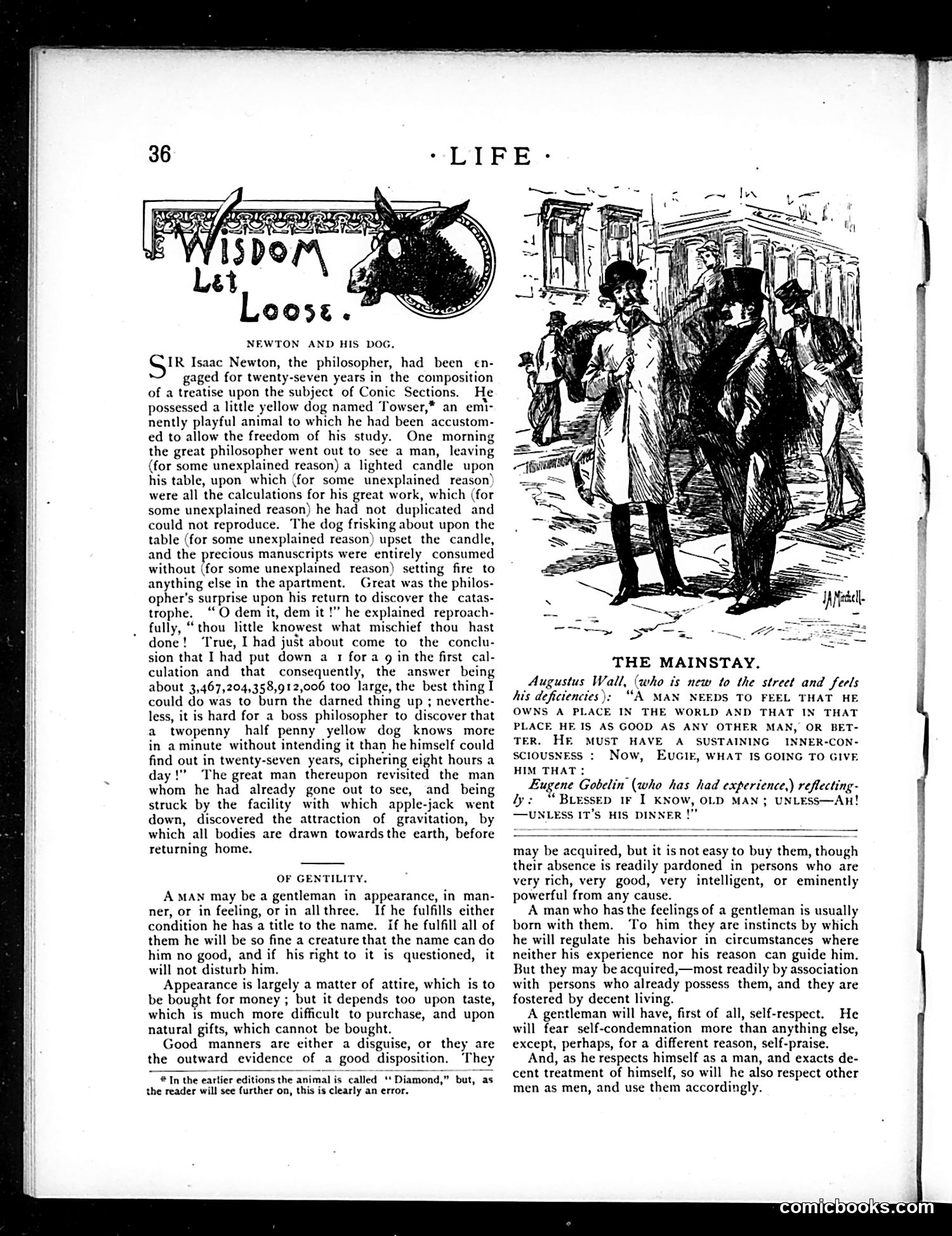
This page contains two satirical pieces about human nature and social behavior. **"Newton and His Dog"** is a humorous anecdote mocking intellectual pretension. It describes philosopher Isaac Newton spending 27 years calculating a treatise on conic sections, only to have his dog accidentally burn the manuscript. The punchline: Newton discovers through drunken accident (not rigorous calculation) the law of gravitation—suggesting that intuition or luck trumps exhaustive scholarship. **"The Mainstay"** is a brief dialogue between two characters—Augustus Wall (newly arrived on the street, insecure) and Eugene Gobelin (experienced). When Augustus asks what will give him inner confidence and a sense of belonging, Eugene's cynical answer is simply "his dinner"—implying that basic physical satisfaction, not gentility or philosophy, is what truly sustains people. Together, these pieces satirize Victorian pretensions to intellectual and social superiority, suggesting that practical reality (appetite, accident, chance) matters more than learned cultivation.
📄 Transcribed text from this page (OCR, searchable)
Machine-transcribed from the original scan — historical spelling and the odd misread are preserved.
NEWTON AND HIS DOG, ~IR Isaac Newton, the philosopher, had been en- gaged for twenty-seven years in the composition of a treatise upon the subject of Conic Sections. He possessed a little yellow dog named Towser,* an em\- nently playful animal to which he had been accustom- ed to allow the freedom of his study. One morning the great philosopher went out to see a man, leaving (for some unexplained reason) a lighted candle upon his table, upon which (for some unexplained reason) were all the calculations for his great work, which (for some unexplained reason) he had not duplicated and could not reproduce. The dog frisking about upon the table (for some unexplained reason) upset the candle, and the precious manuscripts were entirely consumed without (for some unexplained reason) setting fire to anything else in the apartment. Great was the philos- opher’s surprise upon his return to discover the catas- trophe. ‘“O dem it, dem it!” he explained reproach- fully, “thou little knowest what mischief thou hast done! ‘True, I had just about come to the conclu- sion that I had put down a 1 fora 9 in the first cal- culation and that consequently, the answer being about 3,467,204,358,912,006 too large, the best thing I could do was to burn the darned thing up ; neverthe- less, it is hard for a boss philosopher to discover that a twopenny half penny yellow dog knows more in aminute without intending it than he himself could find out in twenty-seven years, ciphering eight hours a day!" The great man thereupon revisited the man whom he had already gone out to see, and being struck by the facility with which apple-jack went down, discovered the attraction of gravitation, by which all bodies are drawn towards the earth, before returning home. OF GENTILITY. A MAN may be a gentleman in appearance, in man- ner, or in feeling, or in allthree. If he fulfills either condition he has a title to the name. if he fulfill all of them he will be so fine a creature that the name can do him no good, and if his right to it is questioned, it will not disturb him. Appearance is largely a matter of attire, which is to be bought for money ; but it depends too upon taste, which is much more difficult to purchase, and upon natural gifts, which cannot be bought. Good manners are either a disguise, or they are the outward evidence of a good disposition. They # In the earlier editions the animal is called ‘* Diamond,” but, as the reader will see further on, this is clearly an error. THE MAINSTAY. Augustus Wall, (who is new to the street and feels his deficienctes): “. NEEDS TO FEEL THAT HE OWNS A PLACE IN THE WORLD AND THAT IN THAT PLACE HE IS AS GOOD AS ANY OTHER MAN, OR BET- TER. Hk MUST HAVE A SUSTAINING INNER-CON- sciousness : Now, EvuGir, WHAT Is GOING TO GIVE HIM THAT; Eugene Gobelin (who has had experience,) reflecting- fy: “Bre D IF I KNOW, OLD MAN; UNLESS—AH! —UNLESS IT’S HIS DINNER !” may be acquired, but it is not easy to buy them, though their absence is readily pardoned in persons who are very rich, very good, very intelligent, or eminently powerful from any cause. A man who has the feelings of a gentleman is usually born with them. ‘To him they are instincts by which he will regulate his behavior in circumstances where neither his experience nor his reason can guide him. But they may be acquired,—most readily by association with persons who already possess them, and they are fostered by decent living. A gentleman will have, first of all, self-respect. He will fear self-condemnation more than anything else, except, perhaps, for a different reason, self-praise. And, as he respects himself as a man, and exacts de- cent treatment of himself, so will he also respect other men as men, and use them accordingly.