
Life, 1883-01-18 · page 7 of 16
Life — January 18, 1883 — page 7: what you’re looking at
What you’re looking at
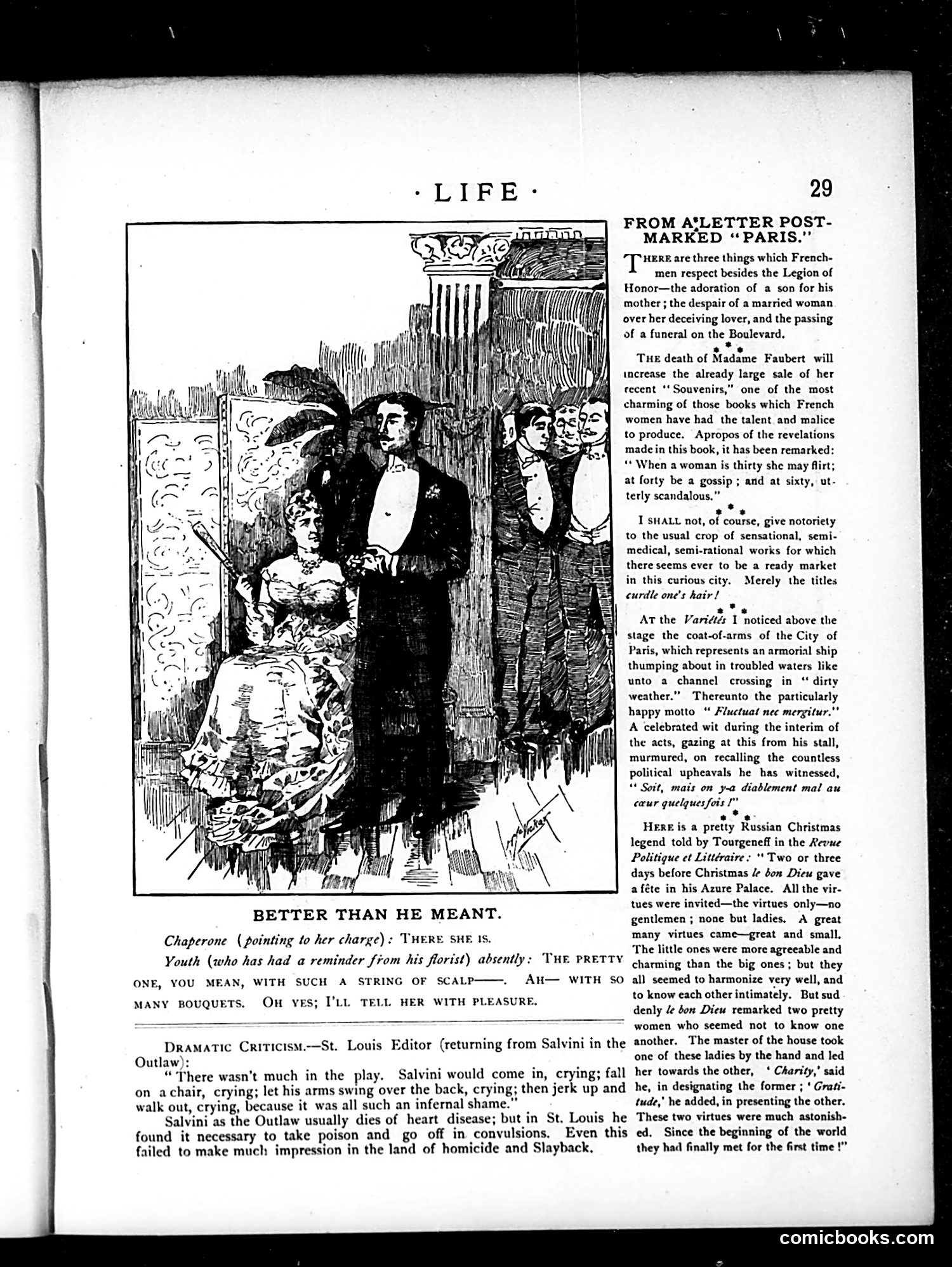
The main illustration titled "Better Than He Meant" depicts a scene at what appears to be a Parisian venue. A well-dressed man in formal attire points to a woman seated, while other figures observe. The caption indicates this is "Chaperone" addressing "Youth," with dialogue about a woman having "a string of scalp" and "many bouquets." This appears to satirize Parisian social dynamics and romantic entanglements—specifically, a woman's dubious reputation or romantic history being presented as a matter of pride. The "scalp" reference humorously compares her conquests to trophies. The surrounding text discusses Madame Paulbert's memoir and French social scandals, providing context for satirizing French attitudes toward romance, infidelity, and social reputation. The cartoon mocks both the woman's dubious status and the man's tone-deaf pride in presenting it.
📄 Transcribed text from this page (OCR, searchable)
Machine-transcribed from the original scan — historical spelling and the odd misread are preserved.
BETTER THAN HE MEANT. Chaperone ( pointing to her charge): THERE SHE 1S. Youth (who has had a reminder fiom his florist) absently:; THE PRETTY ONE, YOU MEAN, WITH SUCH A STRING OF SCALP——. AH— WITH SO MANY BOUQUETS. OH YES; I'LL TELL HER WITH PLEASURE. Dramatic Criticism.—St. Louis Editor (returning from Salvini in the Outlaw): .. : . “There wasn’t much in the play. Salvini would come in, crying; fall on achair, crying; let his arms swing over the back, crying; then jerk up and walk out, crying, because it was all such an infernal shame.” | . Salvini as the Outlaw usually dies of heart disease; but in St. Louis he found it necessary to take poison and go off in convulsions. Even this failed to make much impression in the land of homicide and Slayback. 29 FROM AtLETTER POST- MARKED “PARIS.” HERE are three things which French- men respect besides the Legion of Honor—the adoration of a son for his mother ; the despair of a married woman over her deceiving lover, and the passing of a funeral on the Boulevard, a*e Tue death of Madame Faubert will increase the already large sale of her recent ‘* Souvenirs,” one of the most charming of those books which French women have had the talent and malice to produce. Apropos of the revelations made in this book, it has been remarked: ‘* When a woman is thirty she may flirt; at forty be a gossip ; and at sixty, ut- terly scandalous.” * I SHALL not, of course, give notoriety to the usual crop of sensational, semi- medical, semi-rational works for which there seems ever to be a ready market in this curious city. Merely the titles curdle one’s hair! a*e AT the Varidtés I noticed above the stage the coat-of-arms of the City of Paris, which represents an armorial ship thumping about in troubled waters like unto a channel crossing in ‘ dirty weather.” Thereunto the particularly happy motto “ Fluctuat nec mergitur.’” A celebrated wit during the interim of the acts, gazing at this from his stall, murmured, on recalling the countless political upheavals he has witnessed, “* Soit, mais on y-a diablement mal au caur quelques fois ” Hereis a pretty Russian Christmas legend told by Tourgeneff in the Revue Politique et Littéraire: ‘‘ Two or three days before Christmas / bon Dieu gave aféte in his Azure Palace. All the vir- tues were invited—the virtues only—no gentlemen ; none but ladies, A great many virtues came—great and small. ‘The little ones were more agreeable and charming than the big ones; but they all seemed to harmonize very well, and to know each other intimately. But sud denly /e 40n Dieu remarked two pretty women who seemed not to know one another. The master of the house took one of these ladies by the hand and led her towards the other, ‘ Charity,’ said he, in designating the former ; ‘ Grati- tude,’ he added, in presenting the other. These two virtues were much astonish- ed, Since the beginning of the world they had finally met for the first time !” comicbooks.com