
Life, 1883-01-18 · page 11 of 16
Life — January 18, 1883 — page 11: what you’re looking at
What you’re looking at
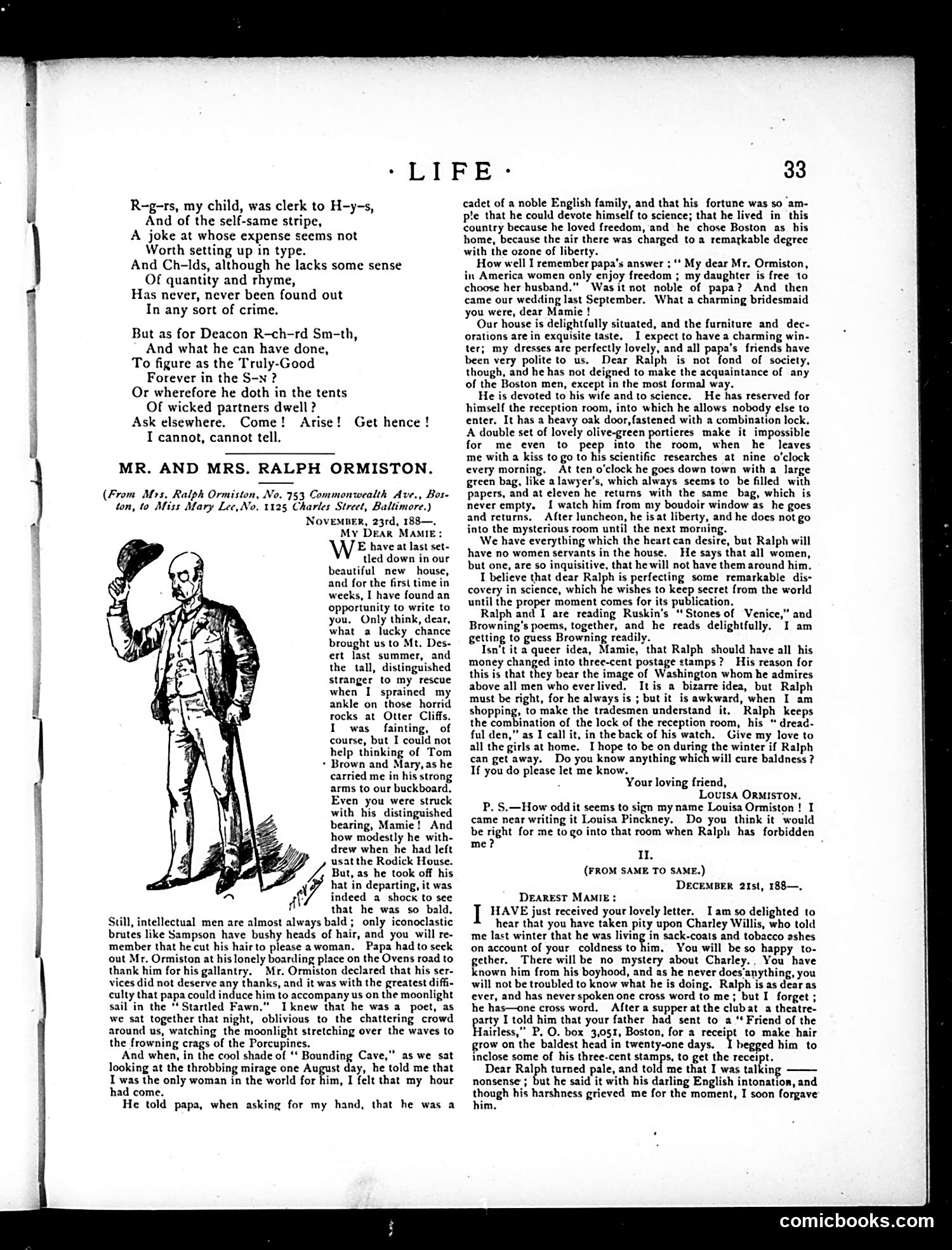
This page contains a satirical letter about a woman named Mamie describing her recent marriage to Ralph Ormiston, a supposedly distinguished English gentleman she met at Mount Desert Island. The satire lies in the contrast between Ormiston's romantic presentation (a cultured, intellectual poet devoted to science) and the suspicious details that emerge: he's unusually bald, refuses to socialize with Boston society, keeps a locked reception room where no one—including his wife—can enter, and claims to devote himself to secret scientific research. The opening poem mocks politicians with redacted names (R-g-rs, H-y-s, Ch-lds, Deacon R-ch-rd Sm-th), suggesting they're too prominent or litigious to name openly. The overall joke appears to be satirizing both gullible women seduced by smooth-talking foreigners and the pretensions of self-proclaimed "men of science" who use intellectual cover for dubious activities. Ormiston's locked room hints at possible fraud or deception beneath his refined exterior.
📄 Transcribed text from this page (OCR, searchable)
Machine-transcribed from the original scan — historical spelling and the odd misread are preserved.
] i R-g-rs, my child, was clerk to H-y-s, And of the self-same stripe, A joke at whose expense seems not Worth setting up in type. And Ch-lds, although he lacks some sense Of quantity and rhyme, Has never, never been found out In any sort of crime. But as for Deacon R-ch-rd Sm-th, And what he can have done, To figure as the Truly-Good Forever in the S-n ? Or wherefore he doth in the tents Of wicked partners dwell? Ask elsewhere. Come! Arise! Get hence ! I cannot, cannot tell. MR. AND MRS. RALPH ORMISTON. (From Mos, Ralph Ormiston, No. 753 Commonwealth Ave., Bos- ton, to Miss Mary Lee, No, 1125 Charles Street, Baltimore.) NoveMBER, 23rd, 188—. My Dear MAMIE: E have at last set- tled down in our beautiful new house, and for the first time in weeks, I have found an opportunity to write to you. Only think, dear, what a lucky chance brought us to Mt, Des- ert last summer, and the tall, distinguished Stranger to my rescue when I sprained my ankle on those horrid rocks at Otter Cliffs. I was fainting, of course, but I could not help thinking of Tom Brown and Mary,as he carried me in his strong arms to our buckboard, Even you were struck with his distinguished bearing, Mamie! And how modestly he with- drew when he had left usat the Rodick House. But, as he took off his hat in departing, it was indeed a shock to see that he was so bald, Still, intellectual men are almost always bald ; only iconoclastic brutes like Sampson have bushy heads of hair, and you will re- member that he cut his hairto please awoman. Papa had to seck out Mr. Ormiston at his lonely boarding place on the Ovens road to thank him for his gallantry. Mr. Ormiston declared that his ser- vices did not deserve any thanks, and it was with the greatest diffi- culty that papa could induce him to accompany us on the moonlight sail in the ‘Startled Fawn.” Iknew that he was a poet, as we sat together that night, oblivious to the chattering crowd around us, watching the moonlight stretching over the waves to the frowning crags of the Porcupines. And when, in the cool shade of ‘* Bounding Cave,” as we sat looking at the throbbing mirage one August day, he told me that I was the only woman in the world for him, I felt that my hour had come. He told papa, when asking for my hand, that he was a - LIFE: 33 cadet of a noble English family, and that his fortune was so am- ple that he could devote himself to science; that he lived in this country because he loved freedom, and he chose Boston as his home, because the air there was charged to a remarkable degree with the ozone of liberty. How well I remember papa’s answer ; “ My dear Mr. Ormiston, in America women only enjoy freedom ; my daughter is free to choose her husband.” Wasitnot noble of papa? And then came our wedding last September. What a charming bridesmaid you were, dear Mamie ! Our house is delightfully situated, and the furniture and dec- orations are in exquisite taste. I expect to have a charming win- ter; my dresses are perfectly lovely, and all papa’s friends have been very polite to us. Dear Ralph is not fond of society, though, and he has not deigned to make the acquaintance of any of the Boston men, except in the most formal way. He is devoted to his wife and to science. He has reserved for himself the reception room, into which he allows nobody else to enter. It has a heavy oak door,fastened with a combination lock. A double set of lovely olive-green portieres make it impossible for me even to peep into the room, when he leaves me with a kiss to go to his scientific researches at nine o'clock every morning. At ten o'clock he goes down town with a large green bag, like alawyer’s, which always seems to be filled with papers, and at eleven he returns with the same bag, which is never empty. I watch him from my boudoir window as he goes and returns. After luncheon, he isat liberty, and he does not go into the mysterious room until the next morning. We have everything which the heart can desire, but Ralph will have no women servants in the house. He says that all women, but one, are so inquisitive, that he will not have them around him. I believe that dear Ralph is perfecting some remarkable dis- covery in science, which he wishes to keep secret from the world until the proper moment comes for its publication, Ralph and I are reading Ruskin’s ‘*Stones of Venice,” and Browning's poems, together, and he reads delightfully. I am getting to guess Browning readily. Isn't it a queer idea, Mamie, that Ralph should have all his money changed into three-cent postage stamps? His reason for this is that they bear the image of Washington whom he admires above all men who everlived. It is a bizarre idea, but Ralph must be right, for he always is ; but it is awkward, when I am shopping, to make the tradesmen understand it. Ralph keeps the combination of the lock of the reception room, his “ dread- ful den,” as I call it, in the back of his watch. Give my love to all the girls at home. I hope to be on during the winter if Ralph can get away. Do you know anything which will cure baldness ? If you do please let me know. 2 Your loving friend, Louisa Ormiston. P. S.—How odd it seems to sign my name Louisa Ormiston ! I came near writing it Louisa Pinckney. Do you think it would be right for me to go into that room when Ralph has forbidden me? Il. (FROM SAME TO SAME.) DECEMBER 21st, 188—. DEAREST MAMIE: J HAVE just received your lovely letter. Iam so delighted to hear that you have taken pity upon Charley Willis, who told me last winter that he was living in sack-coats and tobacco ashes on account of your coldness to him. You will be so happy to- gether. There will be no mystery about Charley., You have Known him from his boyhood, and as he never does anything, you will not be troubled to know what he is doing. Ralph is as dear as ever, and has never spoken one cross word to me; but I forget ; he has—one cross word, After a supper at the clubat a theatre- RR, I told him that your father had sent to a ‘Friend of the airless,” P.O. box 3,051, Boston, for a receipt to make hair grow on the baldest head in twenty-one days, ed him to inclose some of his three-cent stamps, to get the receipt. Dear Ralph turned pale, and told me that I was talking nonsense ; but he said it with his darling English intonation, and though his harshness grieved me for the moment, I soon forgave him. comicbooks.com