
Life, 1883-01-18 · page 6 of 16
Life — January 18, 1883 — page 6: what you’re looking at
What you’re looking at
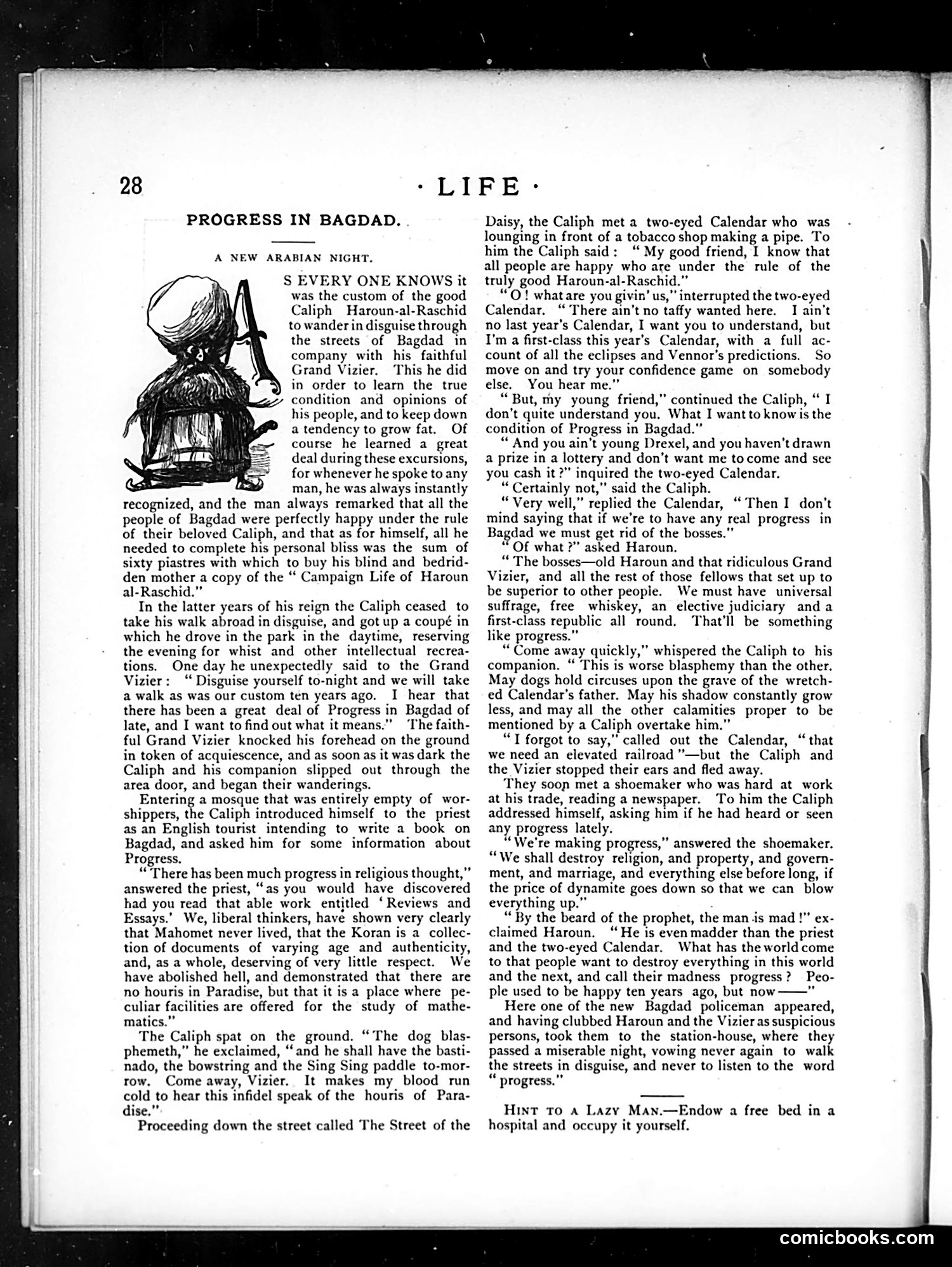
This satirical story mocks early 20th-century claims of "progress" in the Middle East, particularly regarding modernization and colonial influence. The Caliph Haroun-al-Raschid (a legendary Islamic ruler) wanders disguised through Bagdad seeking evidence of Progress—a concept presented as hollow and destructive. The satire targets Western ideas of advancement: a shoemaker claims progress means destroying religion, property, marriage, and tradition to achieve dynamite and explosives. The two-eyed Calendar character dismisses old wisdom as inferior to modern calendars. The story suggests that so-called "progress" imposed on traditional societies amounts to cultural destruction masquerading as civilization. The Caliph and Vizier flee in disgust, rejecting this destructive modernization—clearly Life magazine's critique of Western imperialism and forced "civilization" in the Islamic world.
📄 Transcribed text from this page (OCR, searchable)
Machine-transcribed from the original scan — historical spelling and the odd misread are preserved.
- LIFE: PROGRESS IN BAGDAD. A NEW ARABIAN NIGHT. S EVERY ONE KNOWS it was the custom of the good Caliph Haroun-al-Raschid to wander in disguise through the streets of Bagdad in company with his faithful Grand Vizier. This he did in order to learn the true condition and opinions of his people, and to keep down a tendency to grow fat. Of course he learned a great deal during these excursions, for whenever he spoke to any man, he was always instantly recognized, and the man always remarked that all the people of Bagdad were perfectly happy under the rule of their beloved Caliph, and that as for himself, all he needed to complete his personal bliss was the sum of sixty piastres with which to buy his blind and bedrid- den mother a copy of the “‘ Campaign Life of Haroun al-Raschid.” In the latter years of his reign the Caliph ceased to take his walk abroad in disguise, and got up a coupé in which he drove in the park in the daytime, reserving the evening for whist and other intellectual recrea- tions. One day he unexpectedly said to the Grand Vizier: “ Disguise yourself to-night and we will take a walk as was our custom ten years ago. I hear that there has been a great deal of Progress in Bagdad of late, and I want to find out what it means.” The faith- ful Grand Vizier knocked his forehead on the ground in token of acquiescence, and as soon as it was dark the Caliph and his companion slipped out through the area door, and began their wanderings. Entering a mosque that was entirely empty of wor- shippers, the Caliph introduced himself to the priest as an English tourist intending to write a book on Bagdad, and asked him for some information about Progress. “There has been much progress in religious thought,” answered the priest, “as you would have discovered had you read that able work entitled ‘Reviews and Essays.’ We, liberal thinkers, have shown very clearly that Mahomet never lived, that the Koran is a collec- tion of documents of varying age and authenticity, and, as a whole, deserving of very little respect. We have abolished hell, and demonstrated that there are no houris in Paradise, but that it is a place where pe- culiar facilities are offered for the study of mathe- matics.” The Caliph spat on the ground. “The dog blas- phemeth,” he exclaimed, “and he shall have the basti- nado, the bowstring and the Sing Sing paddle to-mor- row. Come away, Vizier. It makes my blood run cold to hear this infidel speak of the houris of Para- dise.”” Proceeding down the street called The Street of the Daisy, the Caliph met a two-eyed Calendar who was lounging in front of a tobacco shop making a pipe. To him the Caliph said: “ My good friend, I know that all people are happy who are under the rule of the truly good Haroun-al-Raschid.” “O! whatare you givin’ us,” interrupted the two-eyed Calendar. “ There ain’t no taffy wanted here. I ain't no last year’s Calendar, I want you to understand, but I'm a first-class this year’s Calendar, with a full ac- count of all the eclipses and Vennor'’s predictions. So move on and try your confidence game on somebody else. You hear me.” “But, my young friend,” continued the Caliph, “ I don’t quite understand you. What I want to know is the condition of Progress in Bagdad.” “ And you ain’t young Drexel, and you haven't drawn a prize in a lottery and don’t want me tocome and see you cash it ?” inquired the two-eyed Calendar. “ Certainly not,” said the Caliph. “Very well,” replied the Calendar, “Then I don’t mind saying that if we're to have any real progress in Bagdad we must get rid of the bosses.” “Of what ?” asked Haroun. “ The bosses—old Haroun and that ridiculous Grand Vizier, and all the rest of those fellows that set up to be superior to other people. We must have universal suffrage, free whiskey, an elective judiciary anda first-class republic all round. That'll be something like progress.” “Come away quickly,” whispered the Caliph to his companion. “ This is worse blasphemy than the other. May dogs hold circuses upon the grave of the wretch- ed Calendar’s father. May his shadow constantly grow less, and may all the other calamities proper to be mentioned by a Caliph overtake him.” “T forgot to say,” called out the Calendar, “that we need an elevated railroad "—but the Caliph and the Vizier stopped their ears and fled away. They soon met a shoemaker who was hard at work at his trade, reading a newspaper. To him the Caliph addressed himself, asking him if he had heard or seen any progress lately. “We're making progress,” answered the shoemaker. “We shall destroy religion, and property, and govern- ment, and marriage, and everything else before long, if the price of dynamite goes down so that we can blow everything up.” “ By the beard of the prophet, the man is mad !” ex- claimed Haroun. “He is even madder than the priest and the two-eyed Calendar. What has the world come to that people want to destroy everything in this world and the next, and call their madness progress? Peo- ple used to be happy ten years ago, but now Pr Here one of the new Bagdad policeman appeared, and having clubbed Haroun and the Vizier as suspicious persons, took them to the station-house, where they passed a miserable night, vowing never again to walk the streets in disguise, and never to listen to the word “ progress.” Hint to a Lazy Man.—Endow a free bed in a hospital and occupy it yourself. comicbooks.com