
Life, 1883-01-18 · page 4 of 16
Life — January 18, 1883 — page 4: what you’re looking at
What you’re looking at
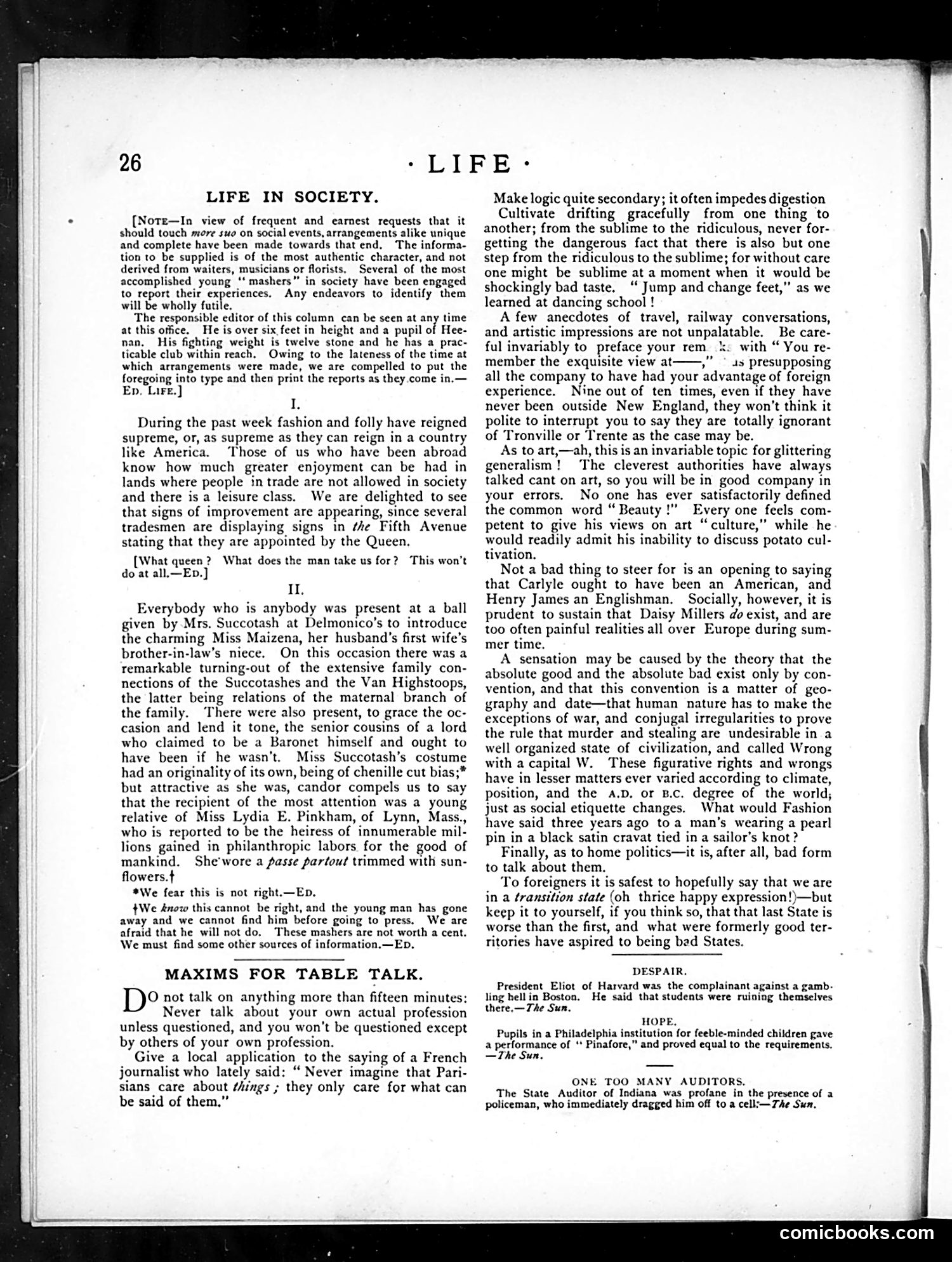
This page contains social commentary rather than political cartoons. The main article, "Life in Society," offers satirical advice on etiquette and social behavior for American high society. Key points of satire include: - **Mocking pretension**: Criticism of wealthy Americans who traveled abroad and returned acting superior about European culture and manners - **Art world snobbery**: Satire of how people use vague praise like "Beauty!" to mask ignorance about art - **Social climbing**: References to the Succotash and Van Ringshoops families suggest mockery of nouveau riche attempting to establish social prominence - **Conversation rules**: Humor in prescriptive etiquette about avoiding discussing one's profession or travel experiences for more than fifteen minutes The tone is consistently ironic, deflating pretentiousness while exposing the arbitrary rules governing American elite society.
📄 Transcribed text from this page (OCR, searchable)
Machine-transcribed from the original scan — historical spelling and the odd misread are preserved.
26 LIFE IN SOCIETY. (Notge—In view of frequent and earnest requests that it should touch more suo on social events, arrangements alike unique and complete have been made towards that end, The informa- tion to be supplied is of the most authentic character, and not derived from waiters, musicians or florists, Several of the most accomplished young ‘ mashers” in society have been engaged to report their Leaps Any endeavors to identify them will be wholly futile. The responsible editor of this column can be seen at any time at this office. He is over six feet in height and a pupil of Hee- nan. His fighting weight is twelve stone and he has a prac- ticable club within reach, Owing to the lateness of the time at which arrangements were made, we are compelled to put the foregoing into type and then print the reports as they.come in.— Ep. Lire.) I, During the past week fashion and folly have reigned supreme, or, as supreme as they can reign in a country like America. Those of us who have been abroad know how much greater enjoyment can be had in lands where people in trade are not allowed in society and there is a leisure class. We are delighted to see that signs of improvement are appearing, since several tradesmen are displaying signs in ¢he Fifth Avenue stating that they are appointed by the Queen. [What queen? What does the man take us for? This won't do at all—Ep.] Il. Everybody who is anybody was present at a ball given by Mrs. Succotash at Delmonico’s to introduce the charming Miss Maizena, her husband's first wife's brother-in-law’s niece. On this occasion there was a remarkable turning-out of the extensive family con- nections of the Succotashes and the Van Highstoops, the latter being relations of the maternal branch of the family. ‘There were also present, to grace the oc- casion and lend it tone, the senior cousins of a lord who claimed to be a Baronet himself and ought to have been if he wasn’t. Miss Succotash’s costume had an originality of its own, being of chenille cut bias;* but attractive as she was, candor compels us to say that the recipient of the most attention was a young relative of Miss Lydia E. Pinkham, of Lynn, Mass., who is reported to be the heiress of innumerable mil- lions gained in philanthropic labors for the good of mankind. She'wore a passe partout trimmed with sun- flowers.t *We fear this is not right.—Ep. tWe Anow this cannot be right, and the young man has gone away and we cannot find him before going to press. We are afraid that he will not do. These mashers are not worth a cent. We must find some other sources of information.—Ep. MAXIMS FOR TABLE TALK. De not talk on anything more than fifteen minutes: Never talk about your own actual profession unless questioned, and you won't be questioned except by others of your own profession. Give a local application to the saying of a French journalist who lately said: “ Never imagine that Pari- sians care about ¢hings ; they only care for what can be said of them,” ‘LIFE: Make logic quite secondary; it often impedes digestion Cultivate drifting gracefully from one thing to another; from the sublime to the ridiculous, never for- getting the dangerous fact that there is also but one step from the ridiculous to the sublime; for without care one might be sublime at a moment when it would be shockingly bad taste.‘ Jump and change feet,” as we learned at dancing school ! A few anecdotes of travel, railway conversations, and artistic impressions are not unpalatable. Be care- ful invariably to preface your rem. with “ You re- member the exquisite view at 4s presupposing all the company to have had your advantage of foreign experience. Nine out of ten times, even if they have never been outside New England, they won't think it polite to interrupt you to say they are totally ignorant of Tronville or Trente as the case may be. As to art,—ah, this is an invariable topic for glittering generalism! The cleverest authorities have always talked cant on art, so you will be in good company in your errors. No one has ever satisfactorily defined the common word “ Beauty!” Every one feels com- petent to give his views on art “culture,” while he would readily admit his inability to discuss potato cul- tivation. Not a bad thing to steer for is an opening to saying that Carlyle ought to have been an American, and Henry James an Englishman. Socially, however, it is prudent to sustain that Daisy Millers do exist, and are too often painful realities all over Europe during sum- mer time. A sensation may be caused by the theory that the absolute good and the absolute bad exist only by con- vention, and that this convention is a matter of geo- graphy and date—that human nature has to make the exceptions of war, and conjugal irregularities to prove the rule that murder and stealing are undesirable in a well organized state of civilization, and called Wrong with a capital W. These figurative rights and wrongs have in lesser matters ever varied according to climate, position, and the a.D. or B.c. degree of the world; just as social etiquette changes. What would Fashion have said three years ago to a man’s wearing a pearl pin in a black satin cravat tied in a sailor's knot? Finally, as to home politics—it is, after all, bad form to talk about them. To foreigners it is safest to hopefully say that we are in a fransttion state (oh thrice happy expression!)—but keep it to yourself, if you think so, that that last State is worse than the first, and what were formerly good ter- ritories have aspired to being bad States. DESPAIR. President Eliot of Harvard was the complainant against a gamb- ling hell in Boston, He said that students were ruining themselves there.—The Sun. HOPE. Pupils in a Philadelphia institution for feeble-minded children gave a performance of “ Pinafore,” and proved equal to the requirements. —The Sun. ONE TOO MANY AUDITORS. The State Auditor of Indiana was profane in the presence of a policeman, who immediately dragged him off to a cell: —TZhe Sun, comicbooks.com