A complete issue · 37 pages · 1937
Judge — June 1937
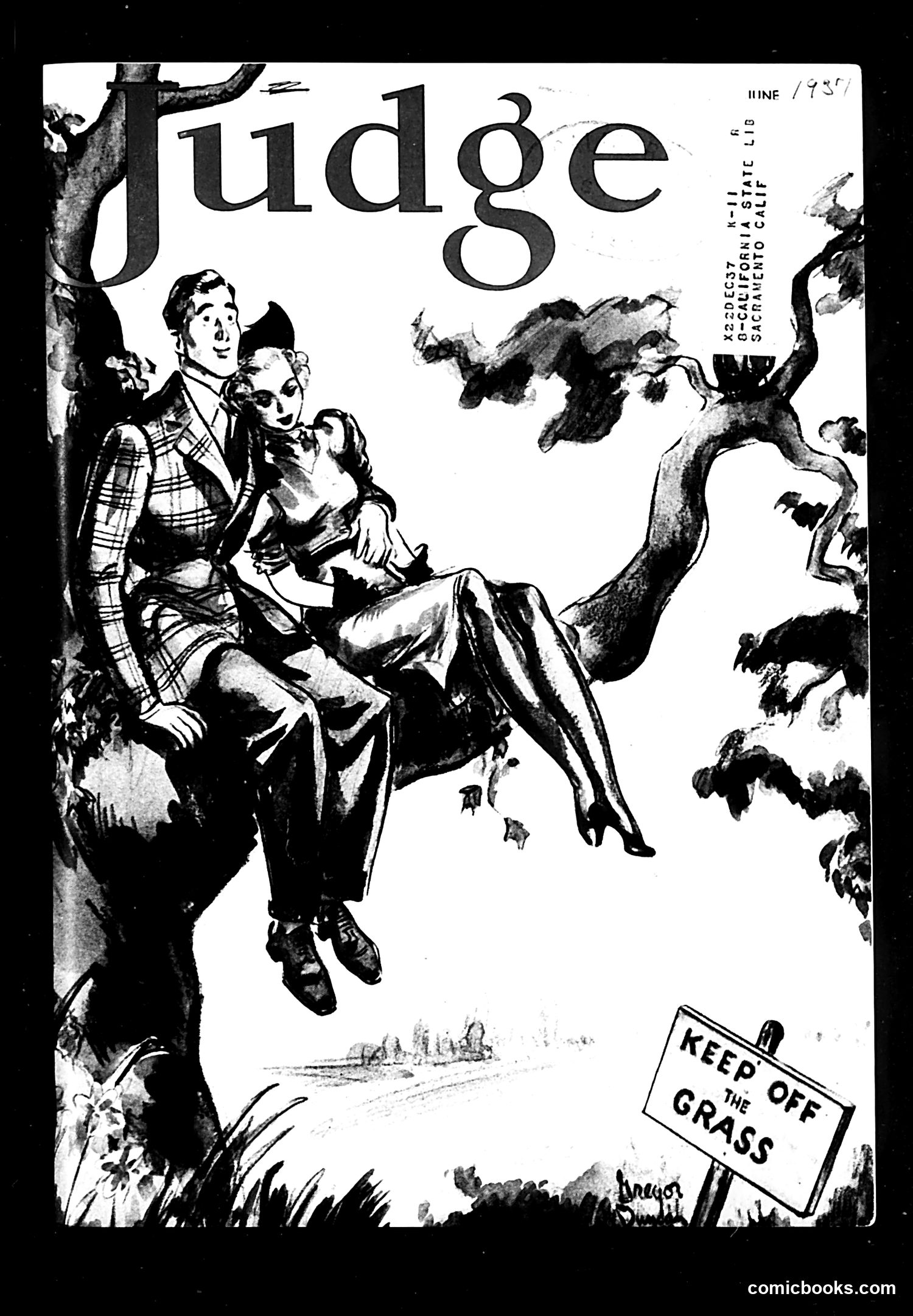
# Judge Magazine Cover Analysis This appears to be a vintage **Judge** magazine cover featuring a romantic illustration of a couple sitting on a tree branch. The man wears a plaid suit while the woman reclines in his arms, displaying her legs prominently—a somewhat risqué pose for the era. The satire likely critiques **public displays of affection or improper behavior in parks**, emphasized by the "KEEP OFF THE GRASS" sign at bottom. The couple's oblivious intimacy while literally breaking park rules suggests commentary on social propriety and courtship norms. The archival stamp indicates this is from the Bancroft Library collection. Without knowing the specific publication date, the style suggests early-to-mid 20th century. The humor relies on the tension between societal rules and romantic impulse.
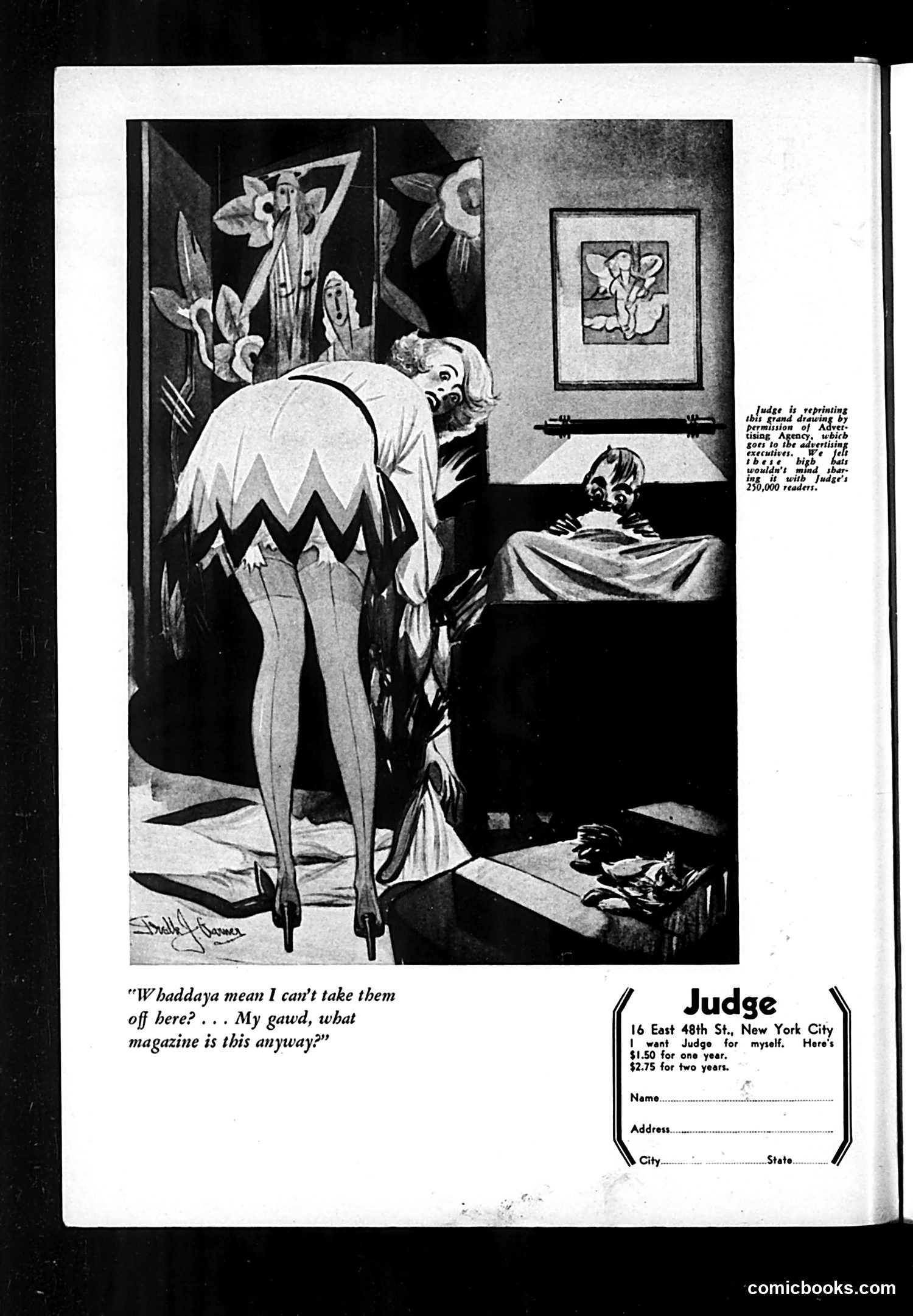
# Analysis of Judge Magazine Page This page contains a single cartoon with accompanying subscription advertisement. The illustration depicts a woman with exaggerated features examining artwork in what appears to be a gallery or studio setting. Her dialogue—"W'baddaya mean I can't take them off here? . . . My gawd, what magazine is this anyway?"—suggests satire about artistic standards or magazine content. The cartoon's target remains unclear without additional context. It may satirize either public attitudes toward modern/abstract art (the stylized paintings visible on walls), or conversely, Judge magazine's own editorial policies. The woman's shock and the emphasis on "what magazine" suggests irony about the publication's actual content versus its perceived identity. The page includes a standard subscription form for Judge magazine at 16 East 48th Street, New York City.
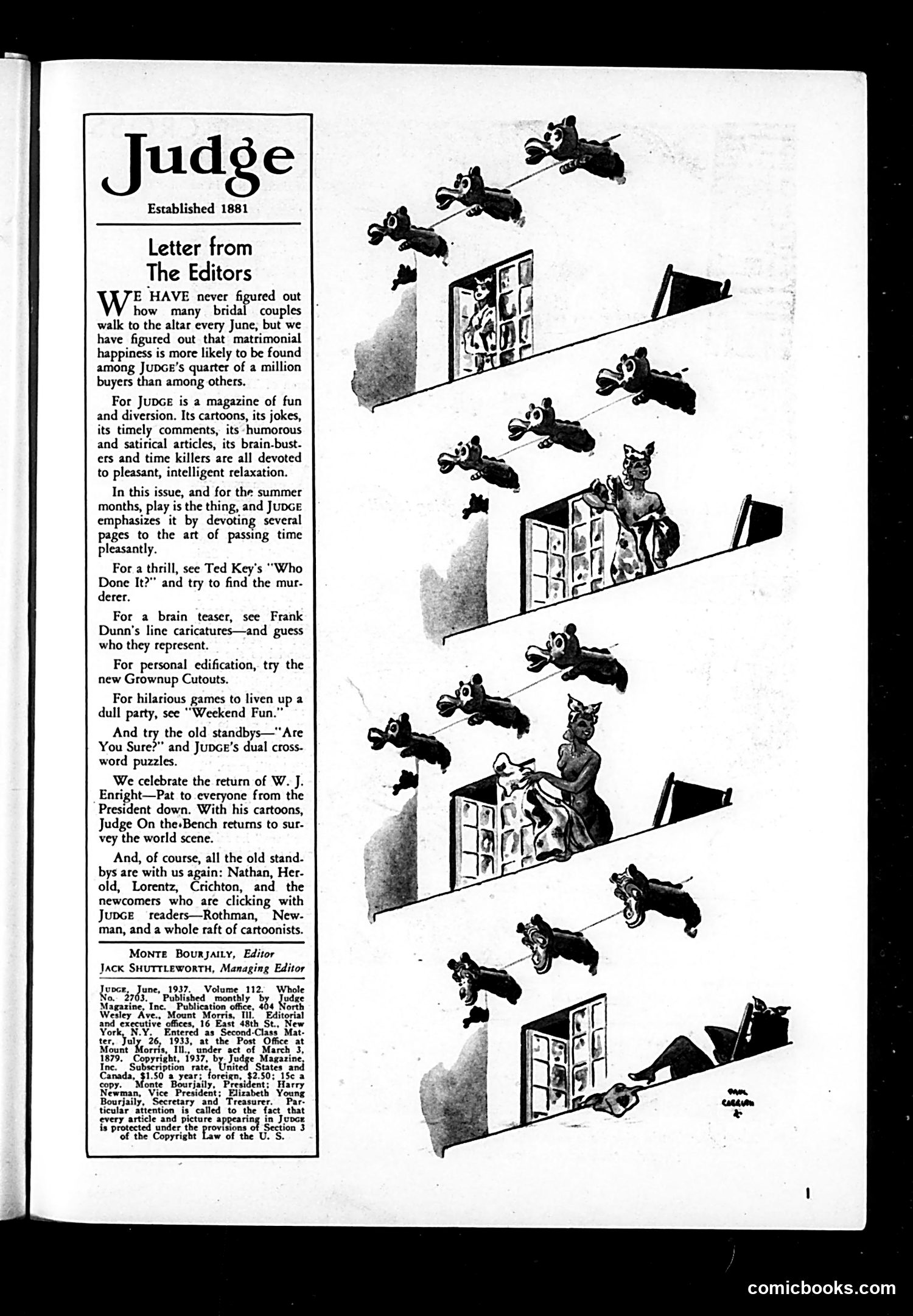
# Judge Magazine Cartoon Analysis This page from Judge (June 1917) features a satirical cartoon depicting witches flying on broomsticks emerging from windows of what appear to be buildings or structures. The cartoon likely comments on the chaos or disruption of social order during World War I or the summer season (the editor's letter mentions "play is the thing" for summer months). The repeated witches-on-broomsticks motif suggests pandemonium or supernatural mischief—a common metaphor for social upheaval. Without clearer identifying labels visible in the image, the specific targets remain unclear, though the imagery suggests criticism of some contemporary social disturbance or widespread problematic behavior among a particular group during this 1917 period.
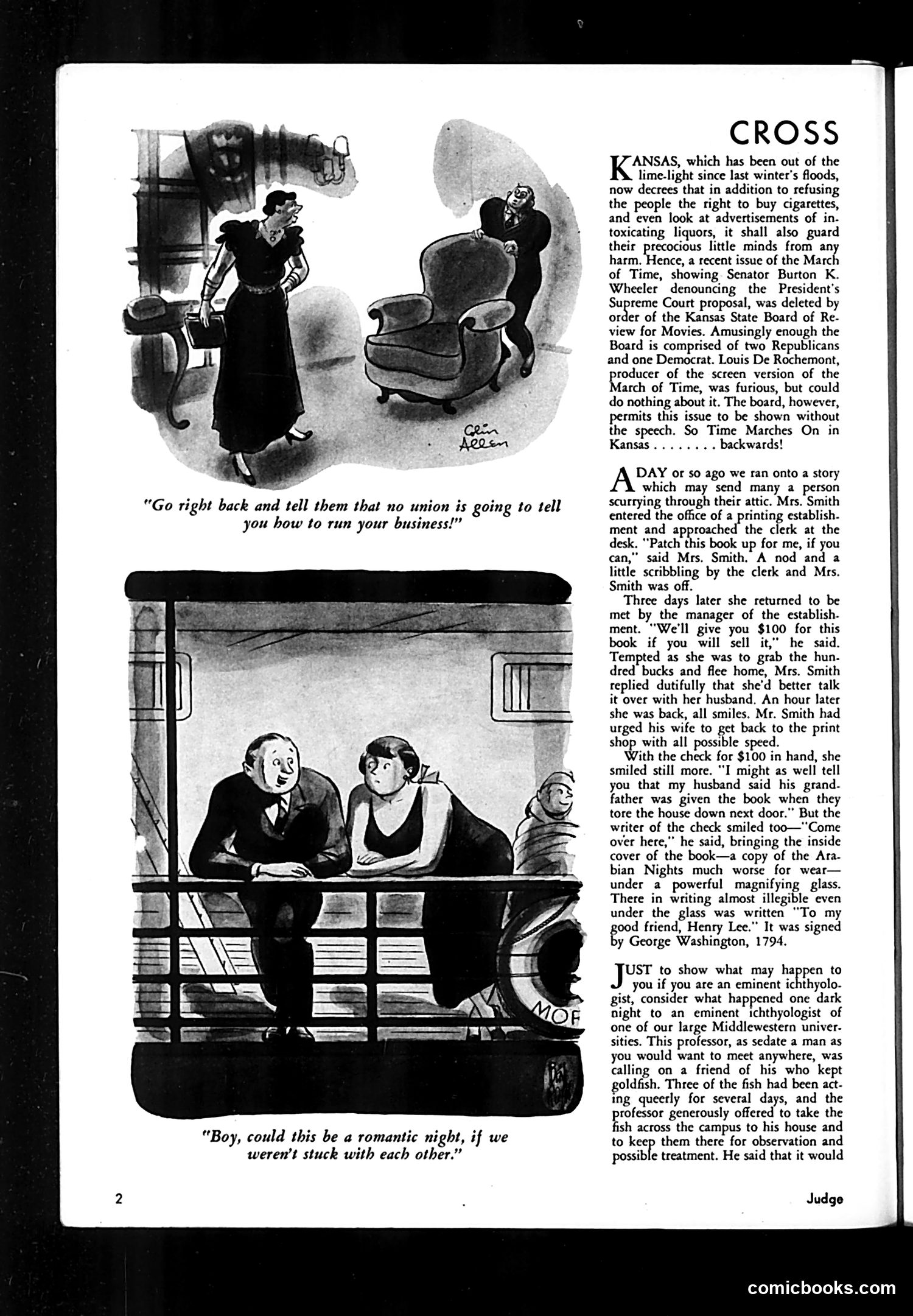
# Analysis: Judge Magazine Page - "Cross" **Top Cartoon:** Satirizes Kansas's censorship board, which banned a *March of Time* newsreel featuring Senator Burton Wheeler criticizing President Roosevelt's Supreme Court proposal. The cartoon mocks the board's heavy-handed suppression of political speech, depicting a figure being told unions won't dictate business—ironically, while censors dictate what citizens can see. **Bottom Cartoon:** Shows a couple stuck together in a train window, captioned "Boy, could this be a romantic night, if we weren't stuck with each other." This appears to be unrelated social humor about forced proximity. **Story Section:** Anecdotes about book censorship and an ichthyologist's misadventure with goldfish. Overall, the page addresses Depression-era concerns about government and institutional overreach in controlling information and behavior.
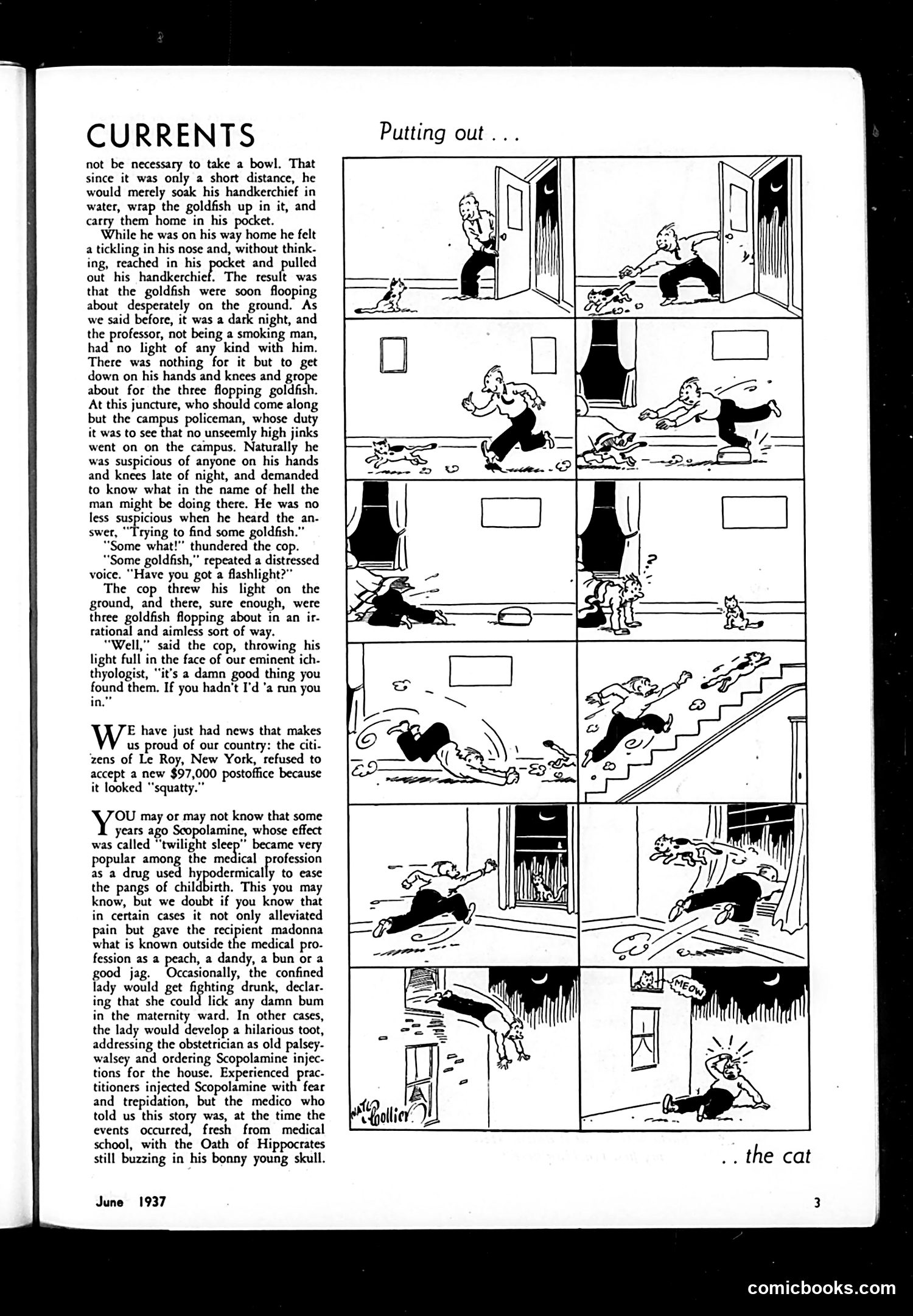
# Analysis of Judge Magazine Page (June 1937) This page contains two distinct pieces: **"Currents" (left column):** A humorous anecdote about a professor carrying a goldfish home at night. A campus policeman, suspicious of the professor's furtive behavior, confronts him. When the professor explains he's retrieving goldfish, the skeptical cop finds three fish flopping on the ground—validating the unlikely story. The humor derives from the absurdity of the situation and the cop's relief at discovering something so mundane and ridiculous. **"Putting out...the cat" (right):** A sequential comic strip showing someone repeatedly attempting to remove a cat from their home, with the cat repeatedly returning inside. The visual gag escalates through increasingly chaotic scenes. Both pieces employ slapstick humor typical of 1930s popular comedy, with no apparent political satire or social commentary.
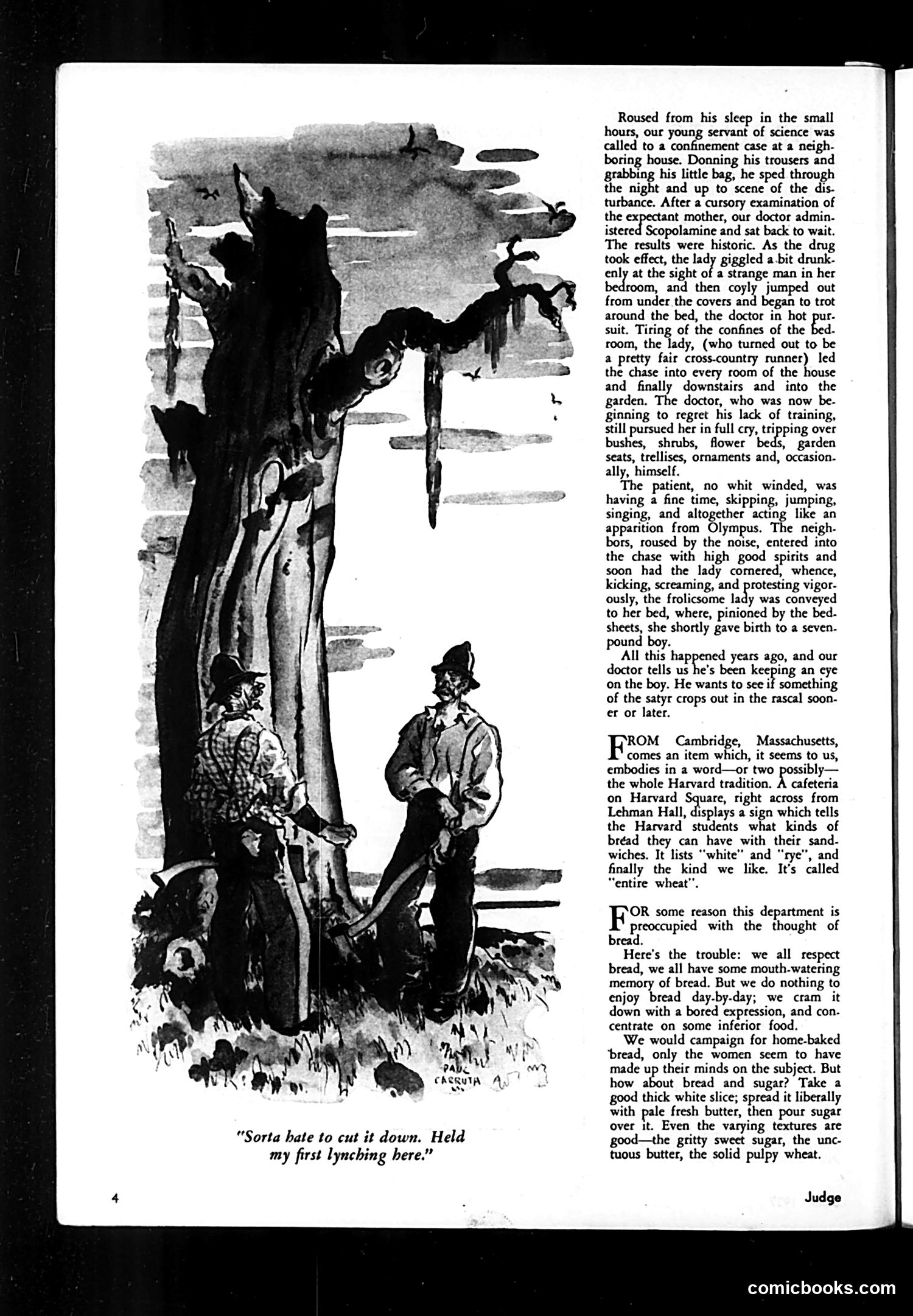
# Analysis of Judge Magazine Page This page contains two unrelated pieces: **Left illustration**: A satirical cartoon captioned "Sorta hate to cut it down. Held my first lynching here." The image depicts a tree with two figures—apparently a man and woman—standing beside it. The caption references lynching, suggesting dark satire about American racial violence. The figure appears to be nostalgically recalling a lynching as though it were a casual, unremarkable event, satirizing the casual brutality and normalization of racial murder in certain American regions during this era. **Right text**: An article mocking Harvard University's concern with bread quality in their cafeteria. It's light social satire about elite academic institutions' obsession with seemingly trivial matters while ignoring larger issues. The piece humorously catalogs different bread types available to Harvard students. The page juxtaposes serious social critique (racial violence) with trivial institutional humor.
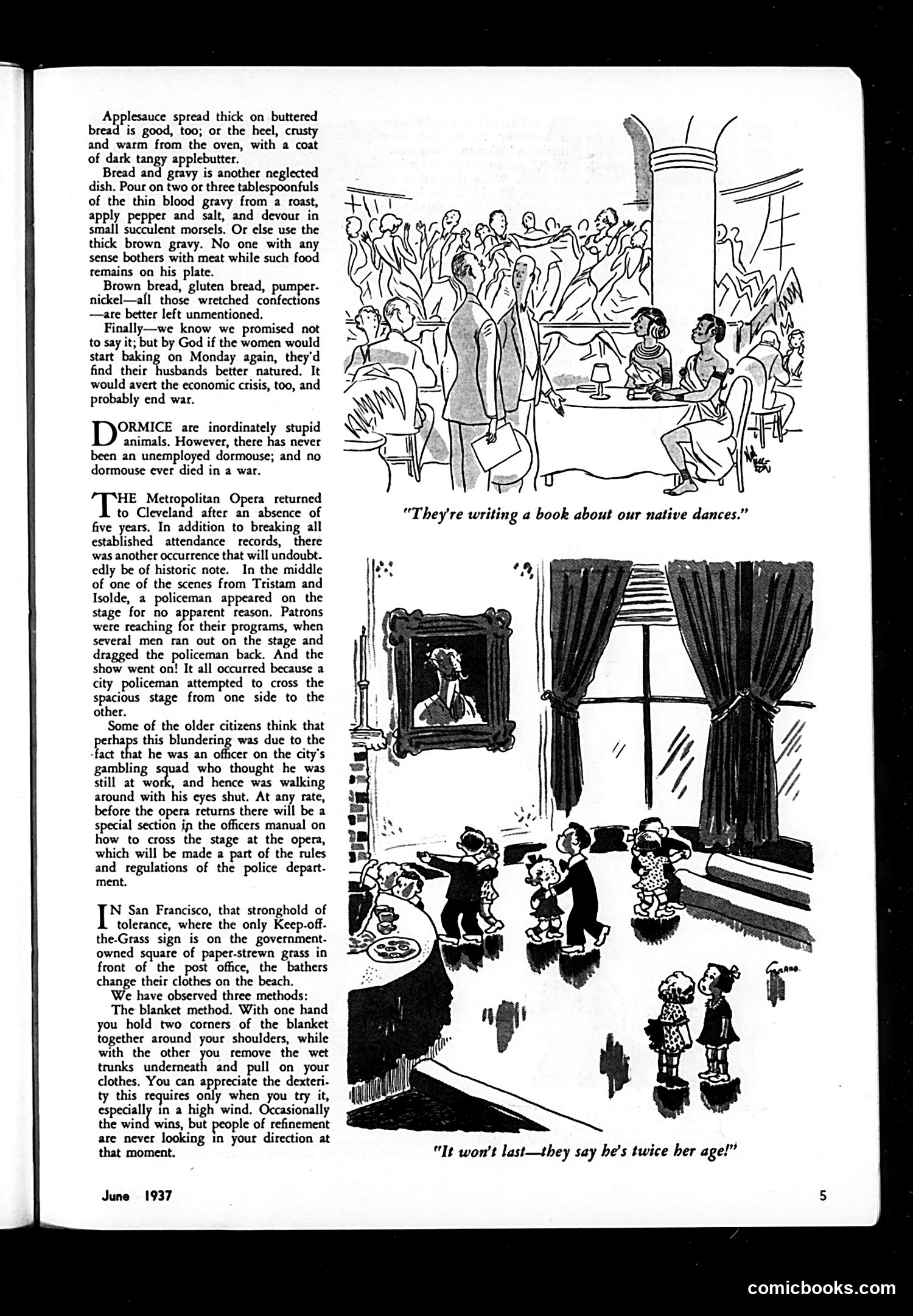
# Judge Magazine, June 1937 - Page Analysis This page contains two unrelated cartoons and prose commentary typical of Judge's satirical format. The **top cartoon** depicts a crowded gathering where someone remarks, "They're writing a book about our native dances." The satire appears to target intellectual or academic interest in American folk culture—suggesting such scholarly attention to everyday activities is pretentious or amusing. The **bottom cartoon** shows children indoors during what appears to be rain, with the caption "It won't last—they say he's twice her age!" This likely satirizes divorce or relationship gossip, making light of failed marriages by joking that an age-gap relationship is doomed. The surrounding **prose passages** offer humorous domestic advice about cooking and clothes-changing methods in San Francisco, maintaining Judge's typical blend of social commentary and household humor.
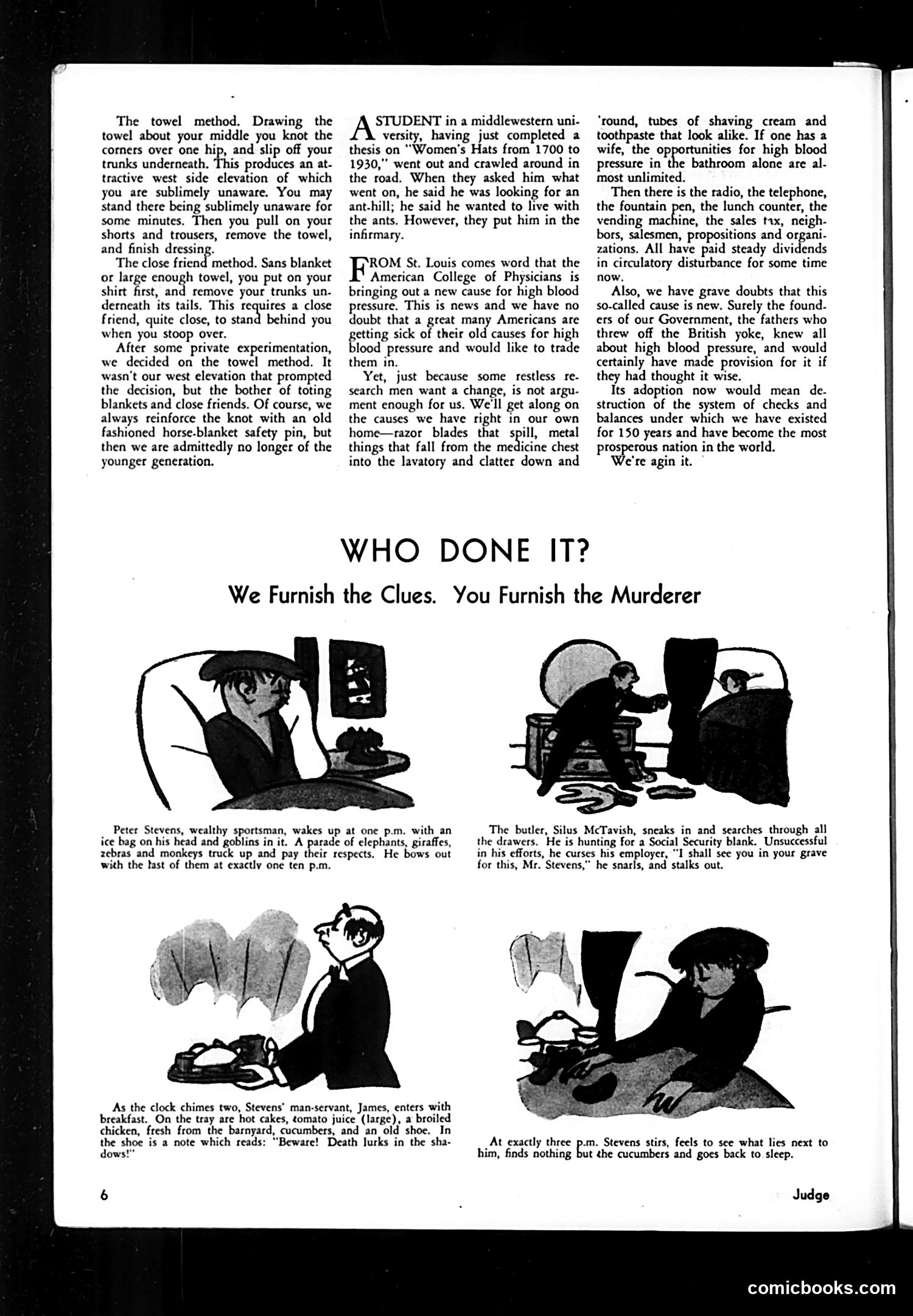
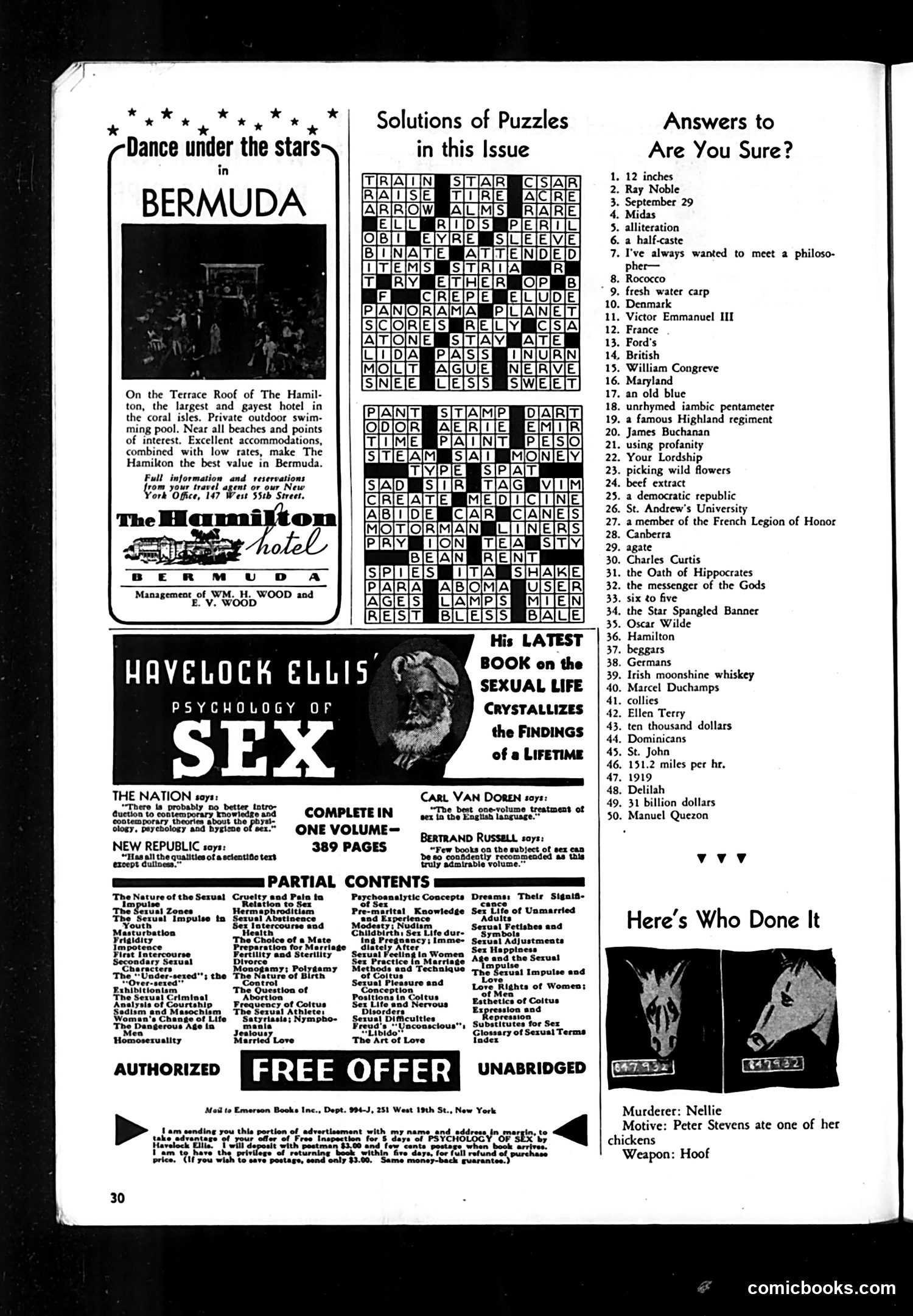
# "Who Done It?" Murder Mystery Story Page This page presents a serialized murder mystery titled "Who Done It?" with the tagline "We Furnish the Clues. You Furnish the Murderer"—inviting readers to solve the crime themselves. The story involves **Peter Stevens**, a wealthy sportsman who wakes with an ice bag on his head, then mysteriously dies by 10 p.m. His butler, **Silas McTavish**, searches unsuccessfully for a Social Security blank. Stevens's servant James delivers fresh provisions including a suspicious shoe with a note reading "Beware! Death lurks in the shadows!" At 3 p.m., Stevens checks what's beside him, finding only cucumbers. The satirical point appears to be poking fun at contemporary murder mysteries and their often absurd, contrived plot mechanics popular in 1930s-40s entertainment.
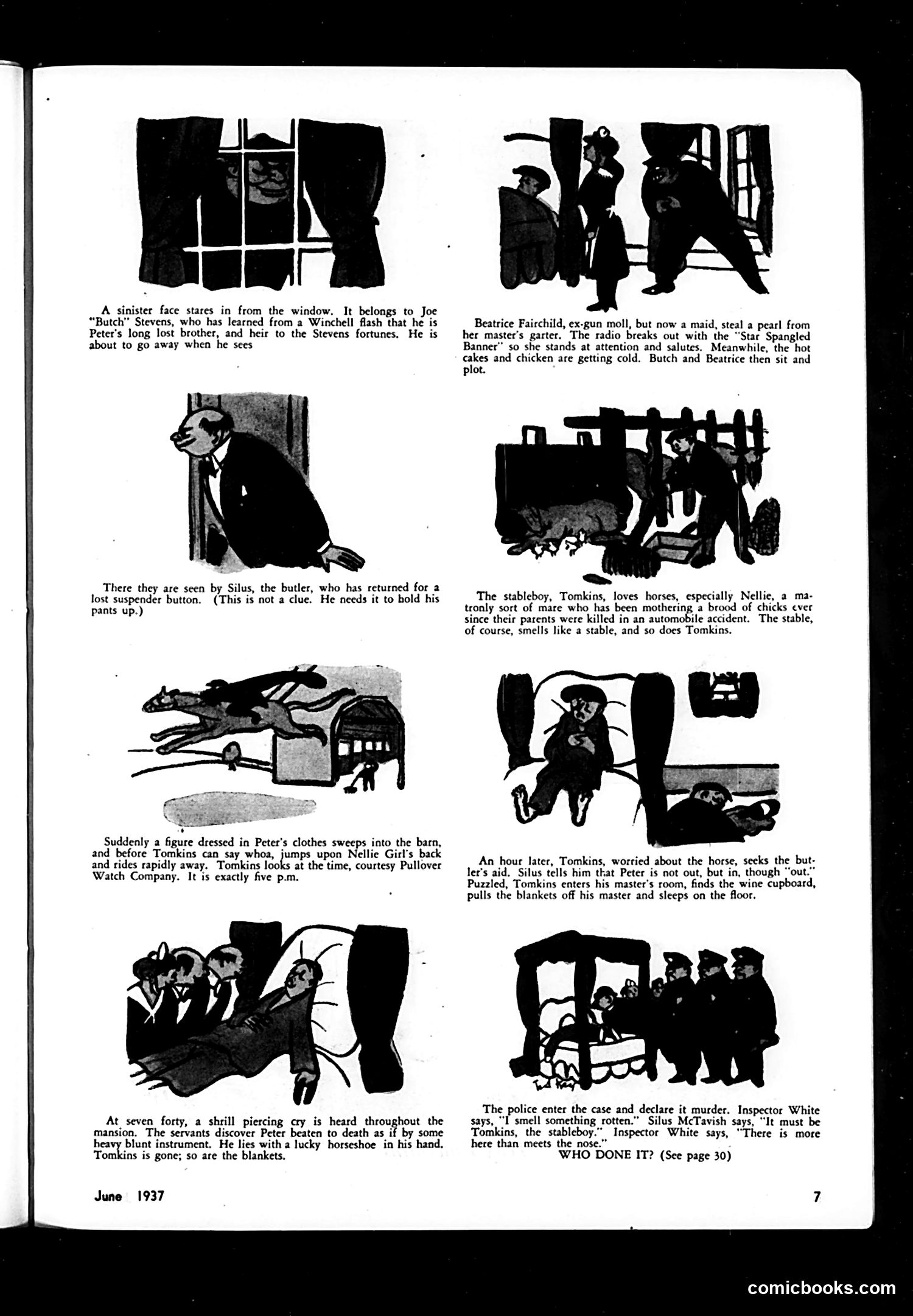
# Analysis This page is **not political satire**—it's a mystery story told through sequential illustrations, similar to a comic strip or illustrated pulp fiction. The narrative (June 1937) follows a murder investigation centered on character "Peter," whose sinister face appears in a window. Key plot points depicted include: a stolen pearl, servants discovering Peter's body in a barn, a stableboy named Tomkins finding Peter's body in his master's room, and police arriving to declare it murder. Inspector White notes something "rotten" at the crime scene. The illustrations are noir-style silhouettes typical of 1930s mystery entertainment. This appears to be serialized fiction rather than editorial commentary—a "WHO DONE IT?" concluding on page 30, as noted at bottom.
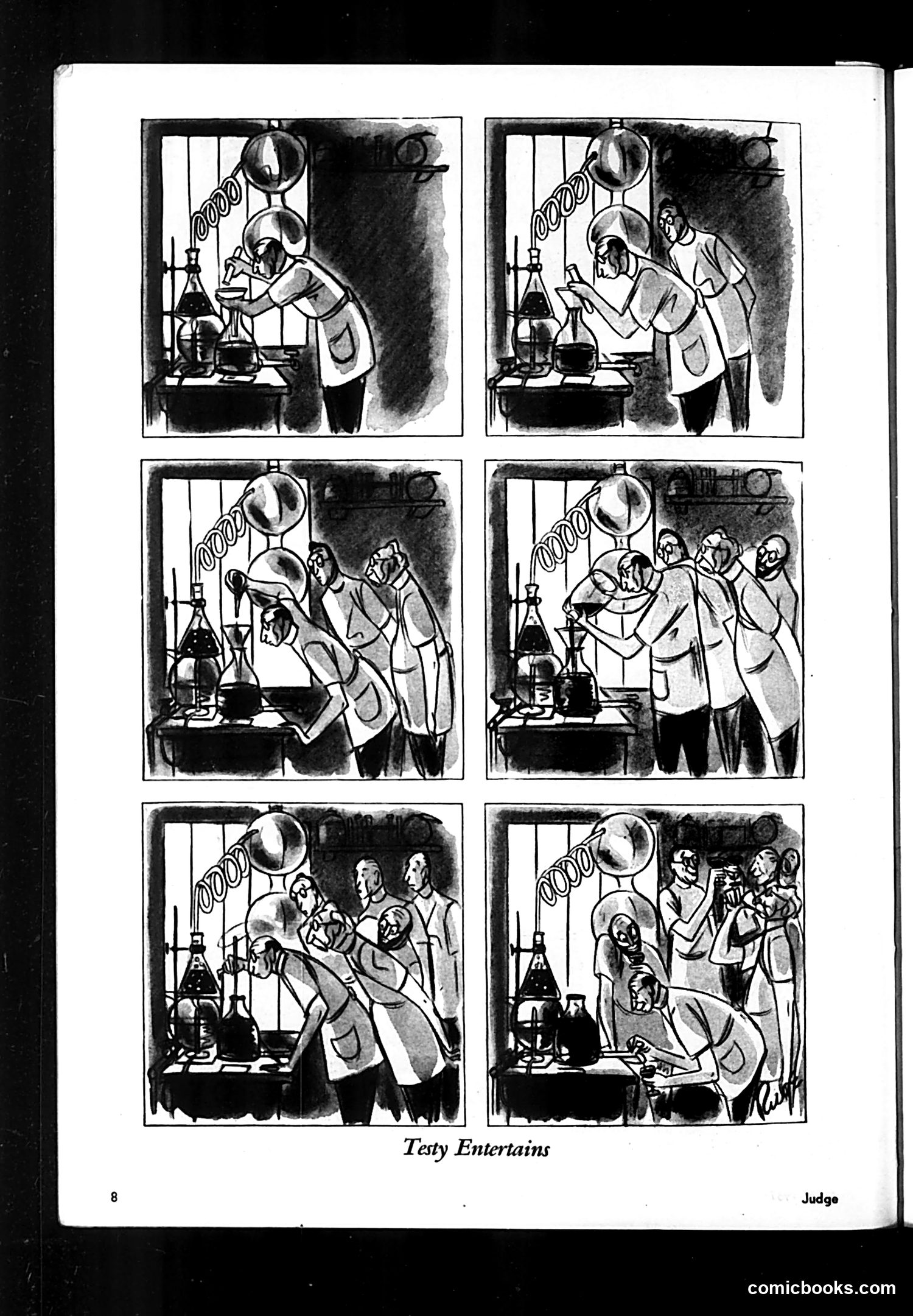
# "Testy Entertains" This six-panel comic strip depicts a laboratory scientist (labeled "Testy") conducting experiments for an increasingly large audience. Beginning alone at his workbench with suspended spheres and chemical apparatus, more observers gradually crowd in—growing from one colleague to a full room of onlookers by the final panel. The satire appears to mock the human tendency toward spectacle and showmanship in scientific demonstration. What starts as serious experimental work becomes entertainment as the audience swells, suggesting scientists may perform for crowds rather than pursue pure research. The growing chaos and crowding implies the corrupting influence of public attention on scientific integrity. The exact historical context remains unclear without additional publication date information.
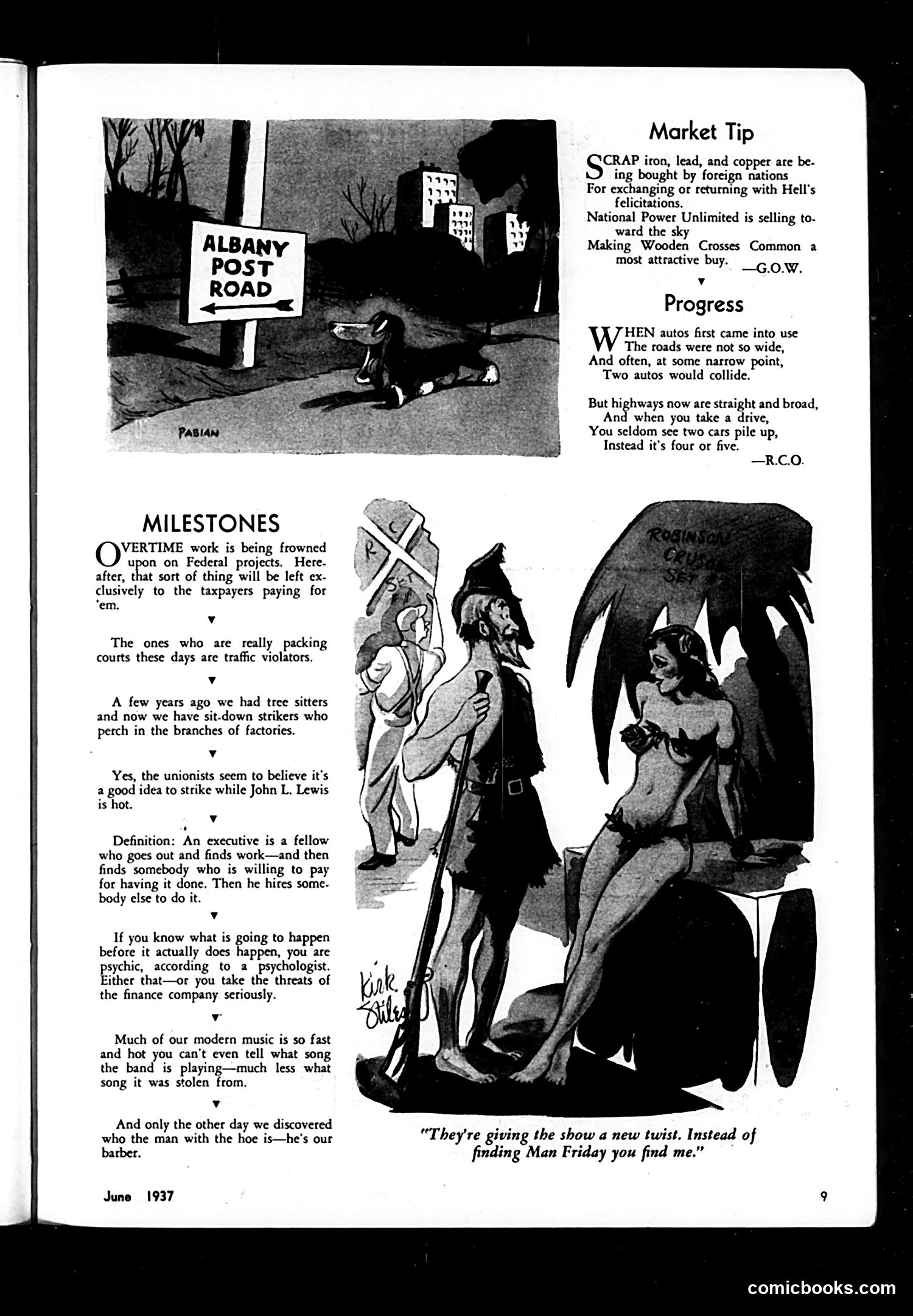
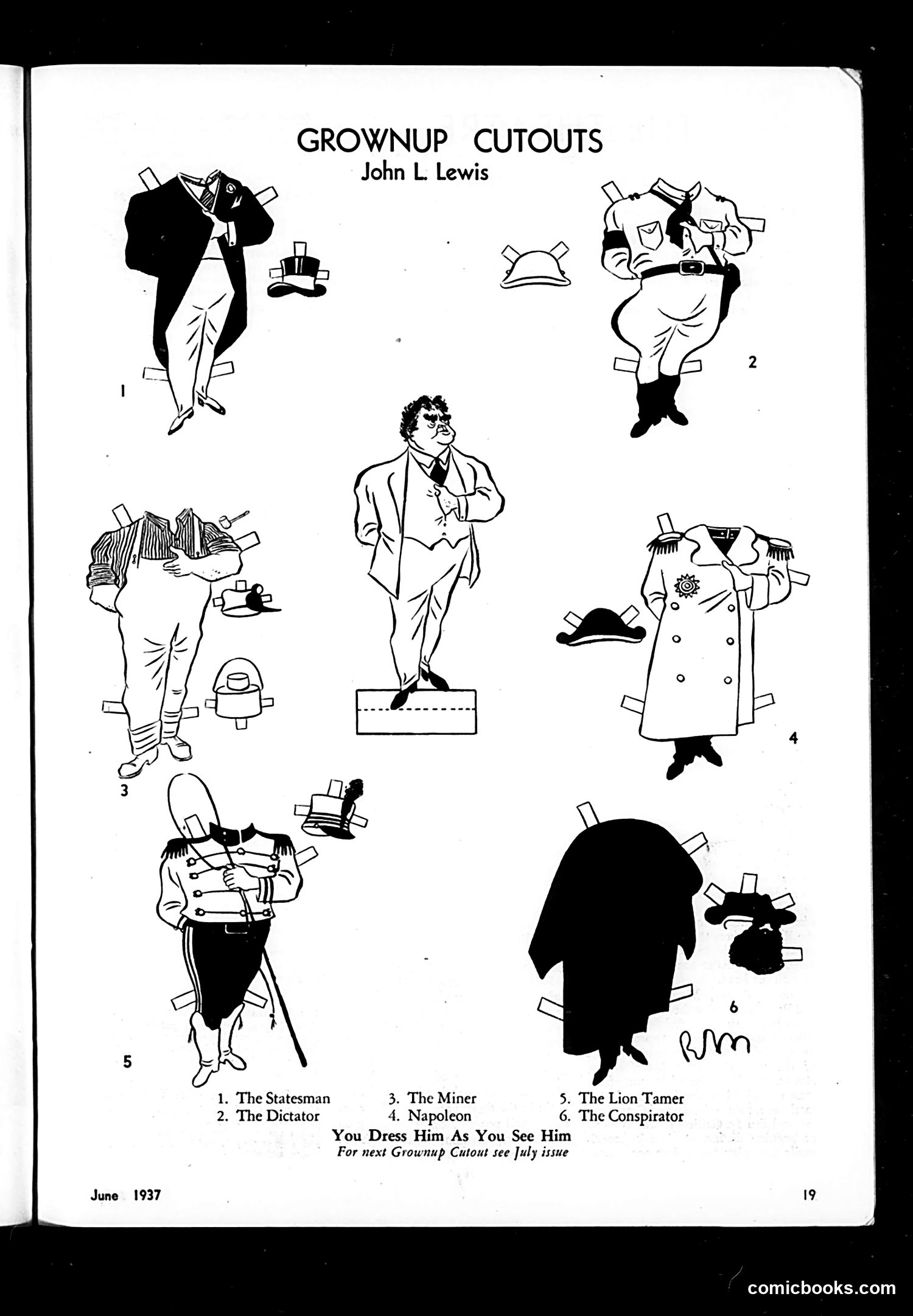
# Judge Magazine, June 1937 - Page Analysis This satirical page contains multiple commentary pieces typical of Judge's format: **"Albany Post Road" cartoon**: A dachshund lies dead on a rural road—dark humor about traffic accidents and reckless driving, a growing concern in 1930s America. **"Market Tip"**: Bitter commentary on war preparation. References to foreign nations buying scrap metal, "wooden crosses" (coffins for soldiers), and profiteering suggest anxiety about looming global conflict pre-WWII. **"Progress"**: Ironic poem about highway improvement—notes that despite better roads, multi-car pileups have increased from two cars to "four or five," mocking the unintended consequences of "progress." **"Milestones"**: A series of cynical observations on 1930s America: overtime restrictions on New Deal projects, sit-down strikes (referring to factory occupations), labor leader John L. Lewis, corporate hierarchy, and modern music. References "Man Friday" (from *Robinson Crusoe*) in the final cartoon about role reversal—unclear without seeing the illustration. The overall tone reflects Depression-era skepticism toward institutions and social change.
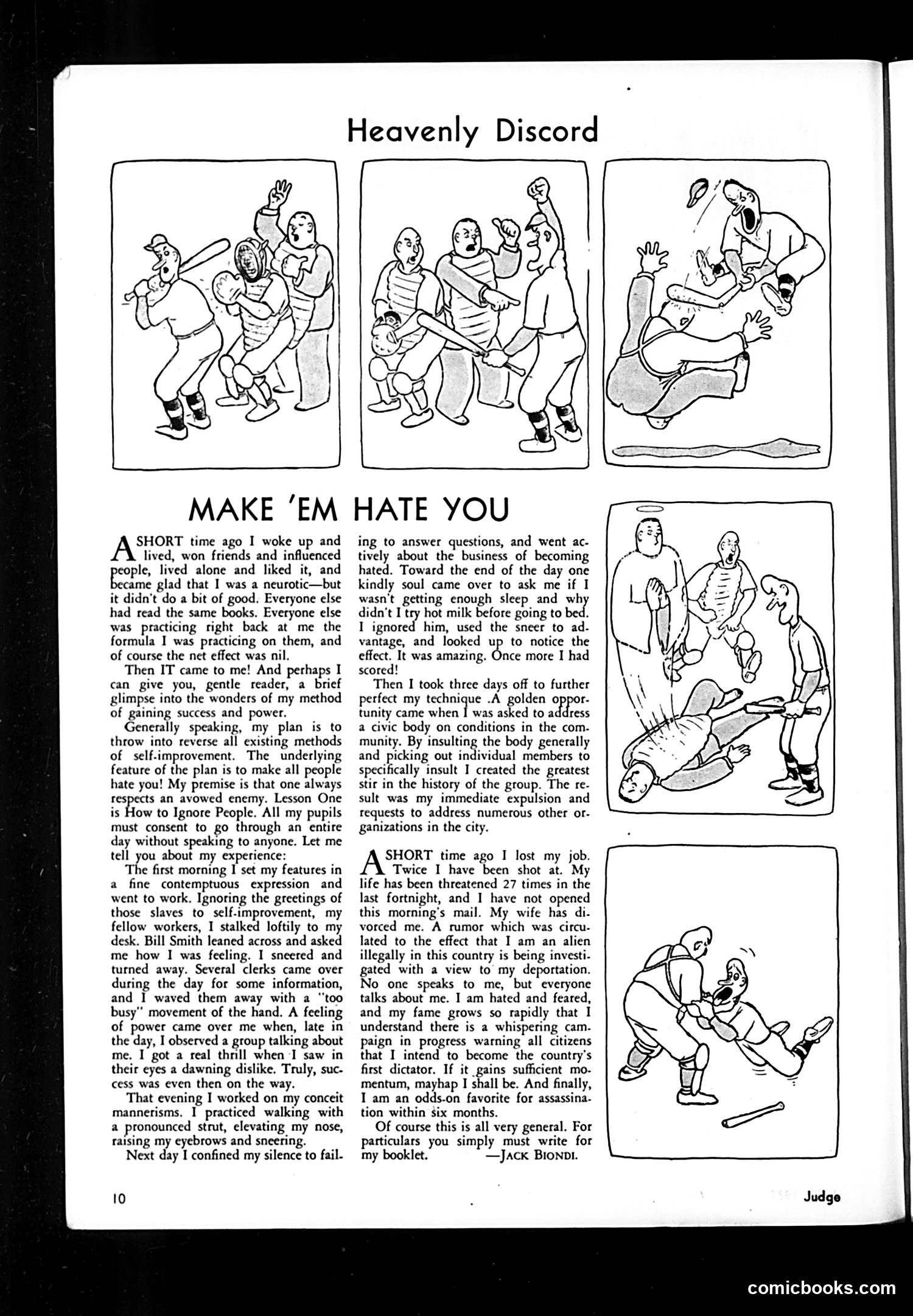
# "Make 'Em Hate You" - Judge Magazine Satire This is a satirical self-help parody by Jack Biondi mocking the 1920s-30s craze of self-improvement books (like Dale Carnegie's *How to Win Friends and Influence People*, published 1936). The narrator describes a "success method" that inverts conventional wisdom: instead of being likeable, he deliberately becomes rude, contemptuous, and insulting. The joke is that his anti-social behavior *does* work—but catastrophically. He gains notoriety rather than respect: he's fired, shot at, threatened 27 times, divorced, and faces deportation rumors. Yet he considers this a triumph, even offering a booklet to teach his "technique." The cartoons show his escalating obnoxiousness—ignoring coworkers, insulting civic groups, and generally being despicable—with people's reactions ranging from confusion to anger. The satire targets the absurdity of self-help culture and its often-contradictory promises, suggesting that following *any* rigid formula, even the opposite of traditional advice, produces ridiculous results. It's social commentary disguised as comedy.