
Judge, 1937-06 · page 4 of 37
Judge — June 1937 — page 4: what you’re looking at
What you’re looking at
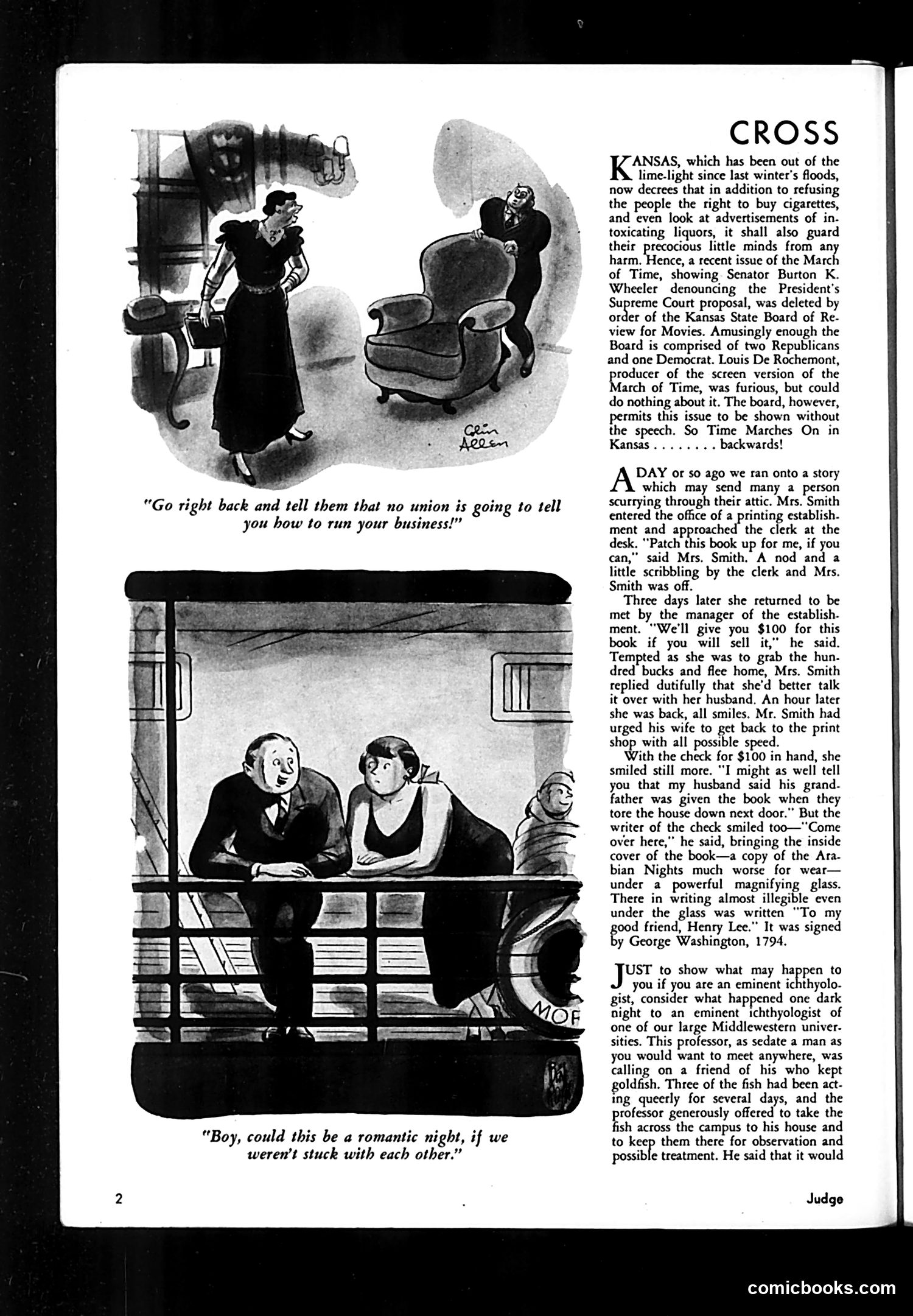
# Analysis: Judge Magazine Page - "Cross" **Top Cartoon:** Satirizes Kansas's censorship board, which banned a *March of Time* newsreel featuring Senator Burton Wheeler criticizing President Roosevelt's Supreme Court proposal. The cartoon mocks the board's heavy-handed suppression of political speech, depicting a figure being told unions won't dictate business—ironically, while censors dictate what citizens can see. **Bottom Cartoon:** Shows a couple stuck together in a train window, captioned "Boy, could this be a romantic night, if we weren't stuck with each other." This appears to be unrelated social humor about forced proximity. **Story Section:** Anecdotes about book censorship and an ichthyologist's misadventure with goldfish. Overall, the page addresses Depression-era concerns about government and institutional overreach in controlling information and behavior.
📄 Transcribed text from this page (OCR, searchable)
Machine-transcribed from the original scan — historical spelling and the odd misread are preserved.
CROSS ANSAS, which has been out of the lime.light since last winter's floods, now decrees that in addition to refusing the people the right to buy cigarettes, and even look at advertisements of in- toxicating liquors, it shall also guard their precocious little minds from an harm. Hence, a recent issue of the Marc! of Time, showing Senator Burton K. Wheeler denouncing the President's Supreme Court proposal, was deleted by order of the Kansas State Board of Re- view for Movies. Amusingly enough the Board is comprised of two Republicans and one Democrat. Louis De Rochemont, roducer of the screen version of the larch of Time, was furious, but could do nothing about it. The board, however, permits this issue to be shown without the speech. So Time Marches On in Kansas backwards! AY Or SO ago we ran onto a story which may send many a person "Go right back and tell them that no union is going to tell scurrying through their attic. Mrs. Smith * entered the office of a printing establish. you how to run your business!” ment and approached the op ae at the desk. “Patch this book up for me, if you can,” said Mrs. Smith. A nod and a little scribbling by the clerk and Mrs. Smith was off. Three days later she returned to be met by the manager of the establish. ment. “We'll give you $100 for this book if you will sell it,” he said. Tempted as she was to grab the hun. dred bucks and flee home, Mrs. Smith replied dutifully that she'd better talk it over with her husband. An hour later she was back, all smiles. Mr. Smith had urged his wife to get back to the print shop with all possible speed. With the check for $100 in hand, she smiled still more. “I might as well tell you that my husband said his grand. father was given the book when they tore the house down next door.” But the writer of the check smiled too—“Come over here,’ he said, bringing the inside cover of the book—a copy of the Ara- bian Nights much worse for wear— under a powerful magnifying glass. There in writing almost illegible even under the glass was written “To my pood friend, Henry Lee.” It was signed y George Washington, 1794. jy to show what may happen to you if you are an eminent ichthyolo- gist, consider what happened one dark night to an eminent ichthyologist of meen one of our large Middlewestern univer- sities. This professor, as sedate a man as you would want to meet anywhere, was calling on a friend of his who kept goldfish. Three of the fish had been act. ing queerly for several days, and the professor generously offered to take the a i Fa ait F fish across the campus to his house and Boy, could this be a romantic night, if we to keep thee there foc observation and weren't stuck with each other.” possible treatment. He said that it would Judge comicbooks.com