
Judge, 1937-06 · page 13 of 37
Judge — June 1937 — page 13: what you’re looking at
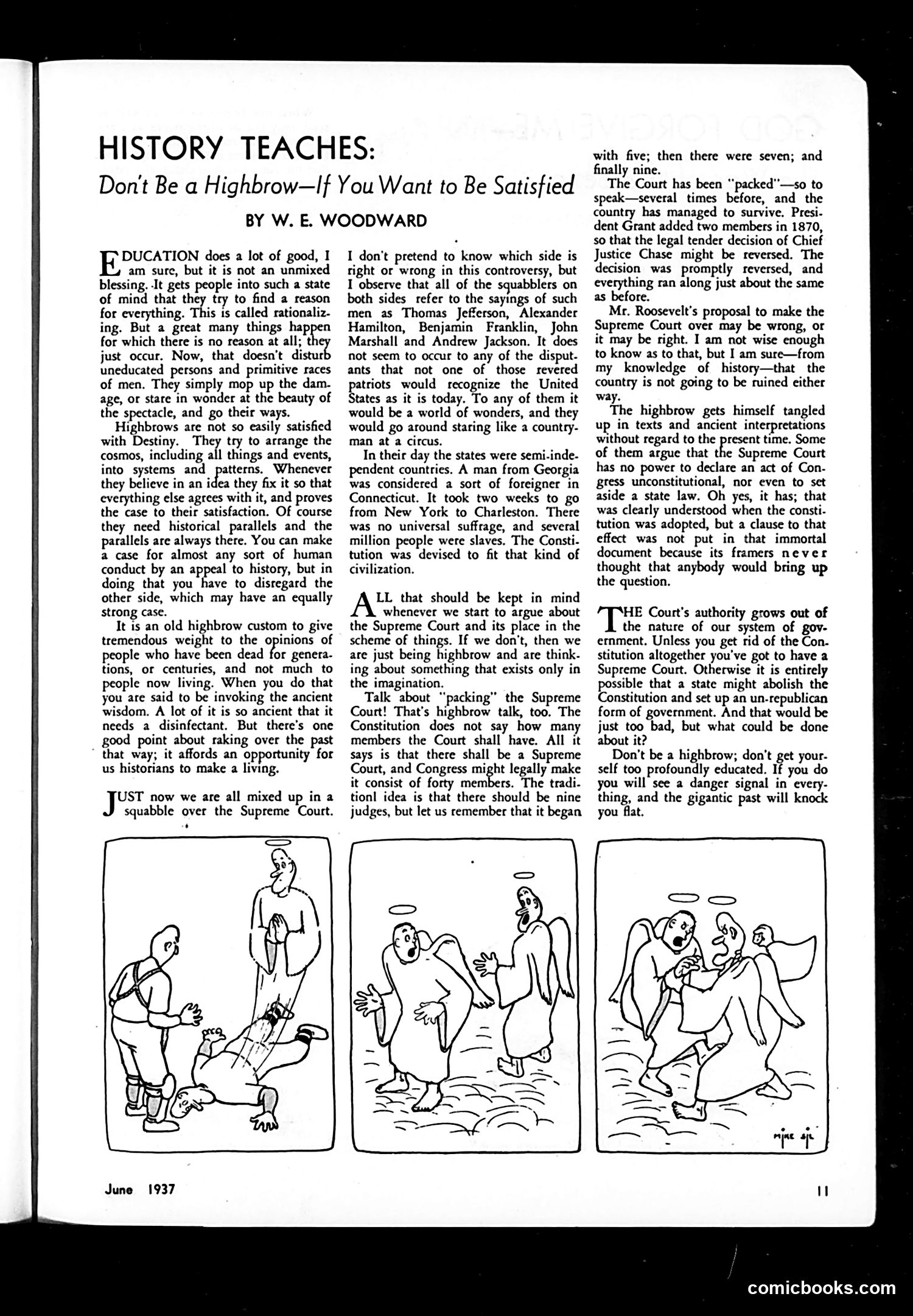
A restored page from Judge, 1937-06. Page through the whole issue in the reader above.
📄 Transcribed text from this page (OCR, searchable)
Machine-transcribed from the original scan — historical spelling and the odd misread are preserved.
HISTORY TEACHES: Don't Be a Highbrow—If You Want to Be Satisfied BY W. E. WOODWARD DUCATION does a lot of good, I am sure, but it is not an unmixed blessing. -It gets le into such a state of mind that they ty to find a reason for everything. This 1s called rationaliz- ing. But a great many things happen for which there is no reason at all; tl just occur. Now, that doesn’t disturl uneducated persons and primitive races of men. They simply mop up the dam. age, or stare in wonder at the beauty of the spectacle, and go their ways. Highbrows are not so easily satisfied with Destiny. They try to arrange the cosmos, including all things and events, into systems and patterns. Whenever they believe in an idea they fix it so that everything else agrees with it, and proves the case to their satisfaction. Of course they need historical parallels and the parallels are always there. You can make a case for almost any sort of human conduct by an appeal to history, but in doing that you have to disregard the other side, which may have an equally strong case. It is an old highbrow custom to give tremendous weight to the opinions of people who have been dead for genera- tions, or centuries, and not much to people now living. When you do that you are said to be invoking the ancient wisdom. A lot of it is so ancient that it needs a disinfectant. But there's one good point about raking over the past that way; it affords an opportunity for us historians to make a living. yet now we are all mixed up in a squabble over the Supreme Court. I don't pretend to know which side is right or wrong in this controversy, but I observe that all of the squabblers on both sides refer to the sayings of such men as Thomas Jefferson, Alexander Hamilton, Benjamin Franklin, John Marshall and Andrew Jackson. It does not seem to occur to any of the disput- ants that not one of those revered triots would recognize the United tates as it is today. To any of them it would be a world of wonders, and they would go around staring like a country- man at a circus. In their day the states were semi-inde- pendent countries. A man from Georgia was considered a sort of foreigner in Connecticut. It took two weeks to go from New York to Charleston. There was no universal suffrage, and several million people were slaves. The Consti- tution was devised to fit that kind of civilization. AX that should be kept in mind whenever we start to argue about the Supreme Court and its place in the scheme of things. If we don’t, then we are just being highbrow and are think. ing about something that exists only in the imagination. Talk about “packing” the Supreme Court! That's highbrow talk, too. The Constitution does not say how many members the Court shall have. All it says is that there shall be a Supreme Court, and Congress might legally make it consist of forty members. The tradi- tionl idea is that there should be nine judges, but let us remember that it began with five; then there were seven; and finally nine. The Court has been “packed"—so to speak—several times before, and the country has managed to survive. Presi- dent Grant added two members in 1870, so that the legal tender decision of Chief Justice Chase might be reversed. The decision was promptly reversed, and everything ran along just about the same as before. Mr. Roosevelt's proposal to make the Supreme Court over may be wrong, or it may be right. I am not wise enough to know as to that, but I am sure—from my knowledge of history—that the country is not going to be ruined either way. The highbrow gets himself tangled up in texts and ancient interpretations without regard to the present time. Some of them argue that the Supreme Court has no power to declare an act of Con- gtess unconstitutional, nor even to set aside a state law. Oh yes, it has; that was clearly understood when the consti- tution was adopted, but a clause to that effect was not put in that immortal document because its framers never thought that anybody would bring up the question. Te Court's authority grows out of the nature of our system of gov- ernment. Unless you get rid of the Con. stitution altogether you've got to have a Supreme Court. Otherwise it is entirely possible that a state might abolish the Constitution and set up an un-republican form of government. And that would be just too bad, but what could be done about it? Don't be a highbrow; don’t get your- self too profoundly educated. If you do you will see a danger signal in every- thing, and the gigantic past will knock you flat. comicbooks.com