
Judge, 1937-06 · page 6 of 37
Judge — June 1937 — page 6: what you’re looking at
What you’re looking at
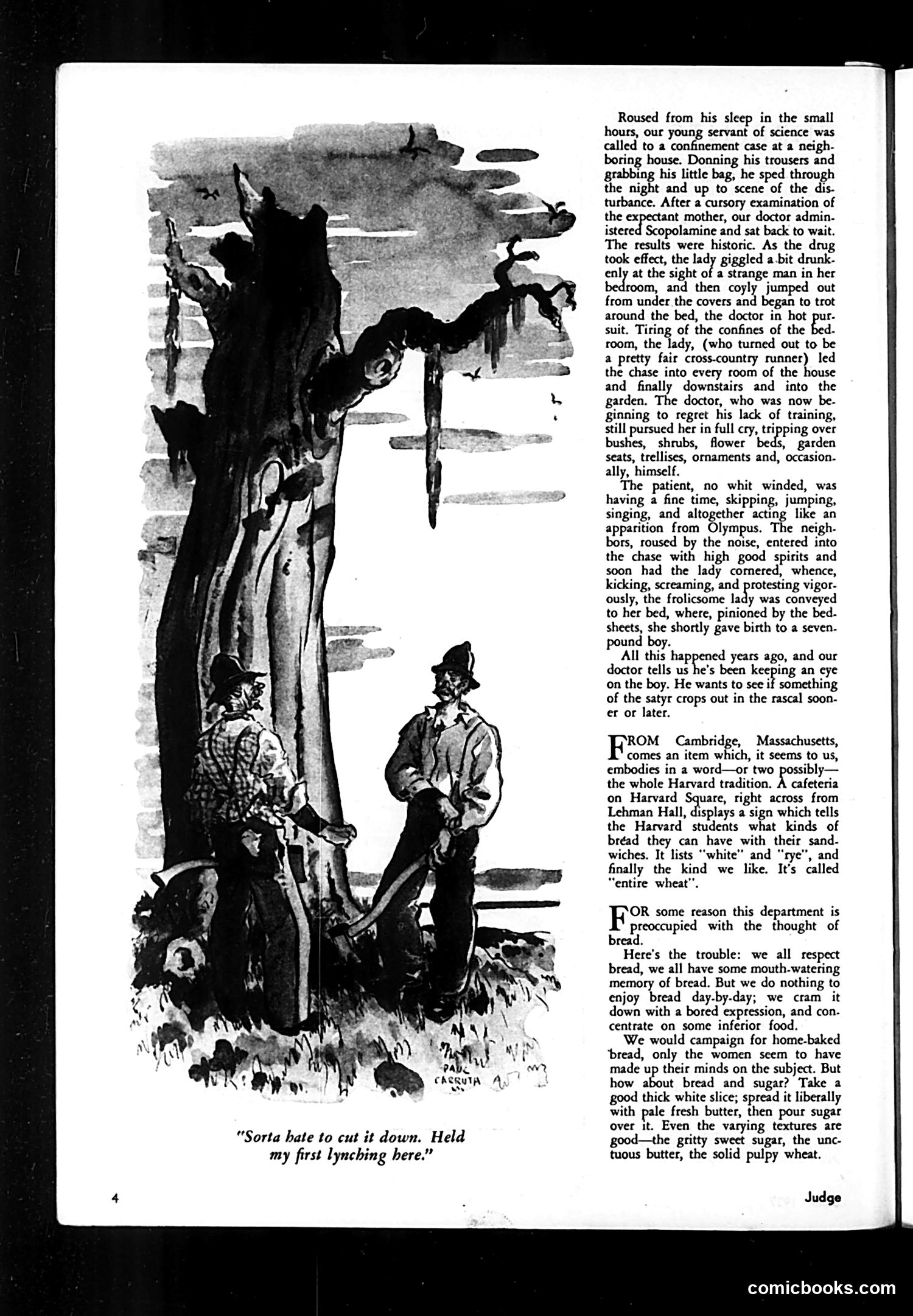
# Analysis of Judge Magazine Page This page contains two unrelated pieces: **Left illustration**: A satirical cartoon captioned "Sorta hate to cut it down. Held my first lynching here." The image depicts a tree with two figures—apparently a man and woman—standing beside it. The caption references lynching, suggesting dark satire about American racial violence. The figure appears to be nostalgically recalling a lynching as though it were a casual, unremarkable event, satirizing the casual brutality and normalization of racial murder in certain American regions during this era. **Right text**: An article mocking Harvard University's concern with bread quality in their cafeteria. It's light social satire about elite academic institutions' obsession with seemingly trivial matters while ignoring larger issues. The piece humorously catalogs different bread types available to Harvard students. The page juxtaposes serious social critique (racial violence) with trivial institutional humor.
📄 Transcribed text from this page (OCR, searchable)
Machine-transcribed from the original scan — historical spelling and the odd misread are preserved.
“Sorta hate to cut it down. Held my first lynching here.” Roused from his sleep in the small hours, our young servant of science was called to a confinement case at a neigh. boring house. Donning his trousers and grabbing his little bag, he sped through the night and up to scene of the dis- turbance. After a cursory examination of the expectant mother, our doctor admin. istered Scopolamine and sat back to wait. The results were historic. As the drug took effect, the lady giggled a.bit drunk. enly at the sight of a strange man in her room, and then coyly jumped out from under the covers and began to trot around the bed, the doctor in hot pur- suit. Tiring of the confines of the bed- room, the lady, (who turned out to be a pretty fair cross-country runner) led the chase into every room of the house and finally downstairs and into the garden. The doctor, who was now be- ginning to regret his lack of training, still pursued her in full cry, tripping over bushes, shrubs, flower beds, garden seats, trellises, ornaments and, occasion- ally, himself. The patient, no whit winded, was having a fine time, skipping, jumping, singing, and altogether acting like an apparition from Olyanpas. e neigh. bors, roused by the noise, entered into the chase with high good spirits and soon had the lady cornered, whence, kicking, screaming, and protesting vigor- ously, the frolicsome lady was conveyed to her bed, where, pinioned by the bed. sheets, she shortly gave birth to a seven. pound boy. All this happened years ago, and our doctor tells ue he's been Keeping an eye on the boy. He wants to see if something of the satyr crops out in the rascal soon- er or later. FROM Cambridge, Massachusetts, comes an item which, it seems to us, embodies in a word—or two possibly— the whole Harvard tradition. A cafeteria on Harvard Square, right across from Lehman Hall, displays a sign which tells the Harvard students what kinds of bréad they can have with their sand. wiches. It lists “white” and “rye”, and finally the kind we like. It’s called “entire wheat". Fo some reason this department is preoccupied with the thought of bread. Here's the trouble: we all respect bread, we all have some mouth-watering memory of bread. But we do nothing to enjoy bread day-by-day; we cram it down with a bored expression, and con. centrate on some inferior food. We would campaign for home-baked ‘bread, only the women seem to have made up their minds on the subject. But how about bread and sugar? Take a thick white slice; spread it liberally with pale fresh butter, then pour sugar over it. Even the varying textures are good—the gritty sweet sugar, the unc- tuous butter, the solid pulpy wheat. Judge comicbooks.com