
Judge, 1937-06 · page 22 of 37
Judge — June 1937 — page 22: what you’re looking at
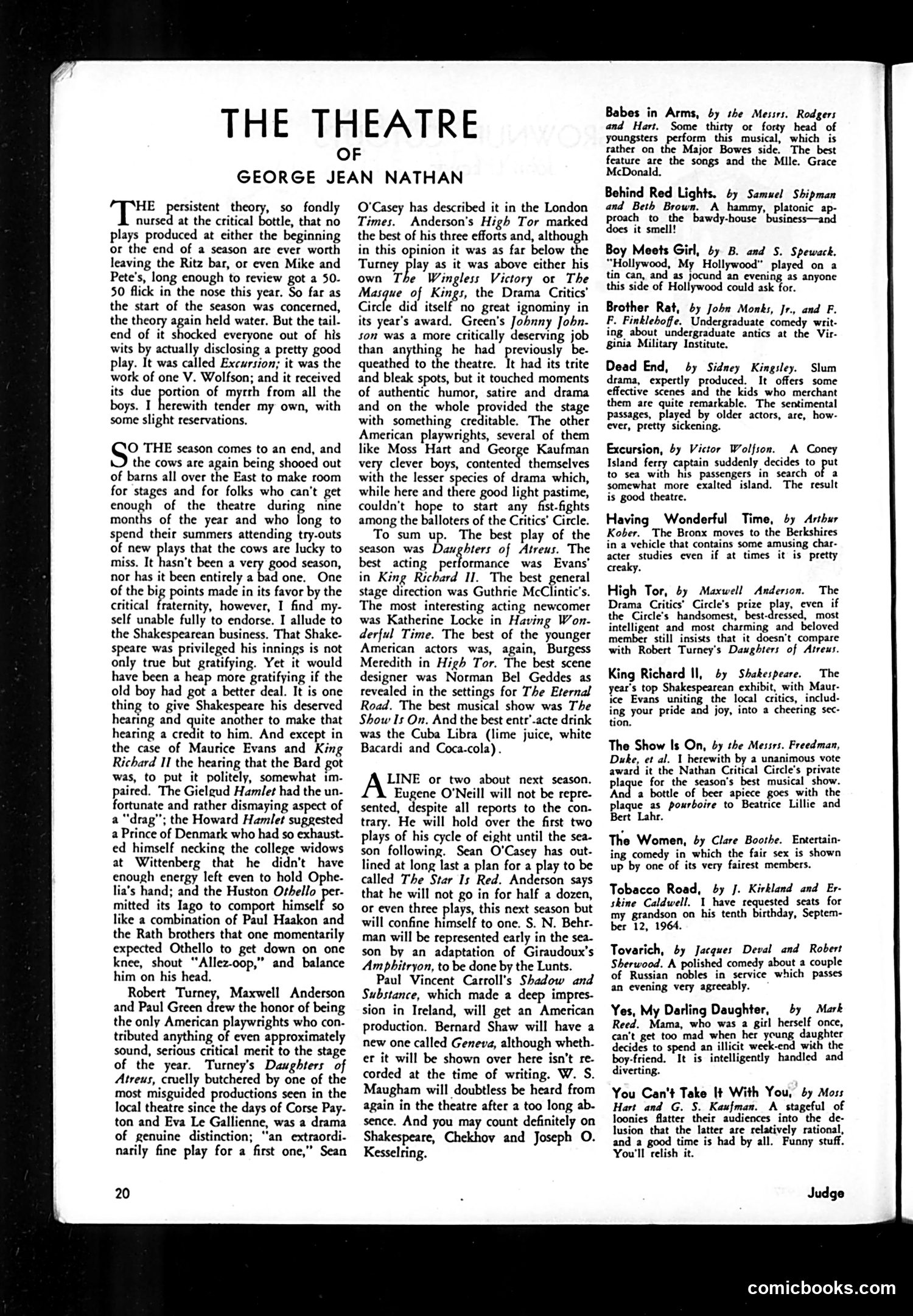
A restored page from Judge, 1937-06. Page through the whole issue in the reader above.
📄 Transcribed text from this page (OCR, searchable)
Machine-transcribed from the original scan — historical spelling and the odd misread are preserved.
THE THEATRE GEORGE JEAN NATHAN Te persistent theory, so fondly nursed at the critical bottle, that no plays produced at either the beginning or the end of a season are ever worth leaving the Ritz bar, or even Mike and Pete's, long enough to review got a 50- 50 flick in the nose this year. So far as the start of the season was concerned, the theory again held water. But the tail- end of it shocked everyone out of his wits by actually disclosing a pretty good play. It was called Excursion; it was the work of one V. Wolfson; and it received its due portion of myrrh from all the boys. I Rerewith tender my own, with some slight reservations, 'O THE season comes to an end, and the cows are again being shooed out of barns all over the East to make room for stages and for folks who can’t get enough of the theatre during nine months of the year and who long to spend their summers attending try-outs of new plays that the cows are lucky to miss. It Facn't been a very good season, nor has it been entirely a bad one. One of the big points made in its favor by the critical fraternity, however, I find my- self unable fully to endorse. I allude to the Shakespearean business. That Shake- speare was privileged his innings is not only true but gratifying. Yet it would have been a heap more gratifying if the old boy had got a better deal. It is one thing to give Shakespeare his deserved hearing and quite another to make that hearing a credit to him. And except in the case of Maurice Evans and King Richard II the hearing that the Bard got was, to put it politely, somewhat im- paired. The Gielgud Hamlet had the un- fortunate and rather dismaying aspect of a “drag”; the Howard Hamlet suggested a Prince of Denmark who had so exhaust. ed himself necking the college widows at Wittenberg that he didn’t have enough energy left even to hold Ophe- lia's hand; and the Huston Othello pe mitted its Iago to comport himself so like a combination of Paul Haakon and the Rath brothers that one momentarily expected Othello to get down on one knee, shout “Allez-oop,” and balance him on his head. Robert Turney, Maxwell Anderson and Paul Green drew the honor of being the only American playwrights who con- tributed anything of even approximately sound, serious critical merit to the stage of the year. Turney’s Daughters of Atreus, cruelly butchered by one of the most misguided productions seen in the local theatre since the days of Corse Pay- ton and Eva Le Gallienne, was a drama of genuine distinction; “an extraordi- narily fine play for a first one,” Sean 20 O'Casey has described it in the London Times. Anderson's High Tor marked the best of his three efforts and, although in this opinion it was as far below the Turney pisy as it was above either his own The Wingless Victory or The Masque of Kings, the Drama Critics’ Circle did itself no great ignominy in its year's award, Green's Johnny Jobn- son was a more critically deserving job than anything he had previously be- queathed to the theatre. It had its trite and bleak spots, but it touched moments of authentic humor, satire and drama and on the whole provided the stage with something creditable. The other American playwrights, several of them like Moss Hart and George Kaufman very clever boys, contented themselves with the lesser species of drama which, while here and there good light pastime, couldn't hope to start any fist-fights among the balloters of the Critics’ Circle. To sum up. The best play of the season was Daughters of Atreus. The best acting performance was Evans’ in King Richard II. The best general stage direction was Guthrie McClintic’s. The most interesting acting newcomer was Katherine Locke in Having Won- der{ul Time. The best of the younger American actors was, again, Burgess Meredith in High Tor. The best scene designer was Norman Bel Geddes as revealed in the settings for The Eternal Road. The best musical show was The Show Is On. And the best entr’-acte drink was the Cuba Libra (lime juice, white Bacardi and Coca-cola) . LINE or two about next season. Eugene O'Neill will not be repre- sented, despite all reports to the con. trary. He will hold over the first two plays of his cycle of eight until the sea- son following. Sean O'Casey has out- lined at long last a plan for a play to be called The Star Is Red. Anderson says that he will not go in for half a dozen, or even three plays, this next season but will confine himself to one. S. N. Behr- man will be represented early in the sea- son by an adaptation of Giraudoux’s Am phitryon, to be done by the Lunts. Paul Vincent Carroll's Shadow and Substance, which made a deep impres- sion in Ireland, will get an American production. Bernard Shaw will have a new one called Geneva, although wheth. er it will be shown over here isn’t re- corded at the time of writing. W. S. Maugham will doubtless be heard from again in the theatre after a too long ab- sence. And you may count definitely on Shakespeare, Chekhov and Joseph O. Kesselring. Babes in Arms, by she Messrs. Rodgers and Hart. Some thirty or forty head of youngsters perform this musical, which is rather on the Major Bowes side. The best feature are the songs and the Mlle. Grace McDonald. Behind Red Lights. 4y Samuel Shipman and Beth Brown. A hammy, platonic ap- proach to the bawdy-house business—and does it smell! Boy Meets Girl, by B. and S. Spewack. “Hollywood, My Hollywood” played on a tin can, and as jocund an evening as anyone this side of Hollywood could ask for. Brother Rat, by John Monks, Jr., and F. F. Finkleboffe. Undergraduate comedy writ- ing about undergraduate antics at the Vir- ginia Military Institute. Dead End, by Sidney Kingsley. Slum drama, expertly produced. It offers some effective scenes and the kids who merchant them are quite remarkable. The sentimental passages, played by older actors, are, how- ever, pretty sickening. Excursion, 6y Victor Wolfson. A Coney Island ferry captain suddenly decides to pet to sea with his passengers in search of a somewhat more exalted island. The result is good theatre. Having Wonderful Time, 4y Arthur Kober. The Bronx moves to the Berkshires in a vehicle that contains some amusing char- acter studies even if at times it is pretty creaky. High Tor, by Maxwell Anderson. The Drama Critics’ Circle's prize play, even if the Circle's handsomest, best-dressed, most intelligent and most charming and beloved member still insists that it doesn’t compare with Robert Turney’s Daughters of Atreus. King Richard Il, by Shakespeare. The year's top Shakespearean exhibit, with Maur- ice Evans uniting the local critics, includ- ing your pride and joy, into a cheering sec- tion. The Show Is On, by the Messrs. Freedman, Duke, et al. 1 herewith by a unanimous vote award it the Nathan Critical Circle's private plaque for the season's best musical show. And a bottle of beer apiece goes with the plaque as pourboire to Beatrice Lillie and Bert Lahr. The Women, by Clare Boothe. Entertain- ing comedy in which the fair sex is shown up by one of its very fairest members. Tobacco Road, by J. Kirkland and Er- shine Caldwell. 1 have requested seats for my grandson on his tenth birthday, Septem- ber 12, 1964. Tovarich, by Jacques Deval and Robert Sherwood. A polished comedy about a couple of Russian nobles in service which passes an evening very agreeably. Yes, My Darling Daughter, by Mark Reed. Mama, who was a girl herself once, can’t get too mad when her young daughter decides to spend an illicit week-end with the boy-friend. It is intelligently handled and diverting. You Can't Take It With You, by Moss Hart and G. S. Kaufman. A stageful of loonies flatter their audiences into the de- lusion that the latter are relatively rational, and a good time is had by all. Funny stuff. You'll relish it. Judge comicbooks.com