
Judge, 1937-06 · page 25 of 37
Judge — June 1937 — page 25: what you’re looking at
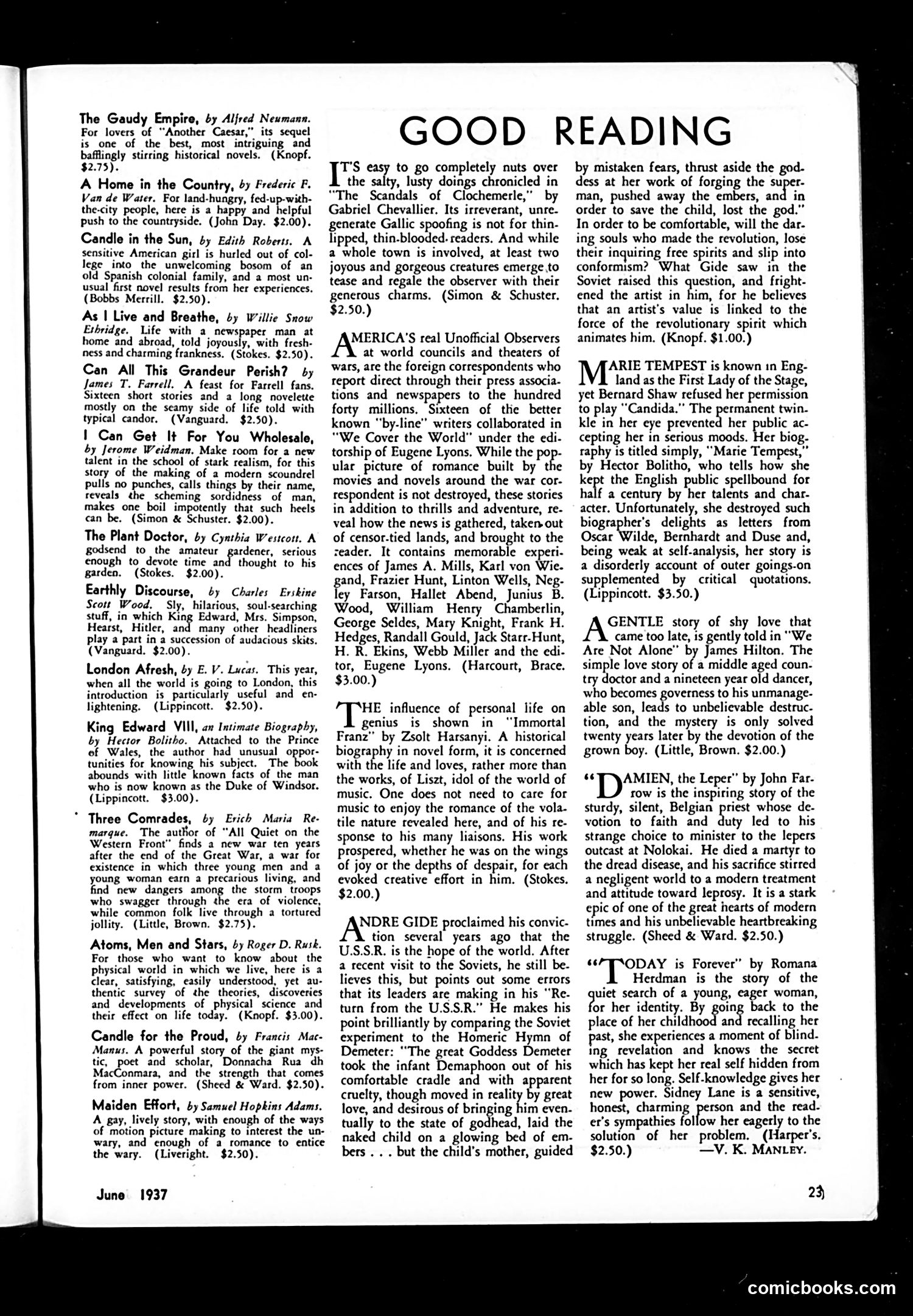
A restored page from Judge, 1937-06. Page through the whole issue in the reader above.
📄 Transcribed text from this page (OCR, searchable)
Machine-transcribed from the original scan — historical spelling and the odd misread are preserved.
The Gaudy Empire, by Alfred Neumann. For lovers of “Another Caesar,” its sequel is one of the best, most intriguing and bafflingly stirring historical novels. (Knopf. $2.75). A Home in the Country, 4y Frederic F. Van de Water. For land-hungry, fed-up-with- the-city people, here is a happy and helpful push to the countryside. (John Day. $2.00). Candle in the Sun, by Edith Roberts. A sensitive American girl is hurled out of col- lege into the unwelcoming bosom of an old Spanish colonial family, and a most un- usual first novel results from her experiences. (Bobbs Merrill. $2.50). As | Live and Breathe, by Willie Snow Ethridge. Life with a newspaper man at home and abroad, told joyously, with fresh- ness and charming frankness. (Stokes. $2.50). Can All This Grandeur Perish? by James T. Farrell. A feast for Farrell fans. Sixteen short stories and a long novelette mostly on the seamy side of life told with typical candor. (Vanguard. $2.50). 1 Can Get It For You Wholesale, by Jerome Weidman, Make room for a new talent in the school of stark realism, for this story of the making of a modern scoundrel pulls no punches, calls things by their name, reveals the scheming sonidos of man, makes one boil impotently that such heels can be. (Simon & Schuster. $2.00). The Plant Doctor, by Cynthia Westcott. A godsend to the amateur gardener, serious enough to devote time and’ thought to his garden. (Stokes. $2.00). Earthly Discourse, by Charles Erskine Scott Wood, Sly, hilarious, soul-searching stuff, in which King Edward, Mrs. Simpson, Hearst, Hitler, and many other headliners play a part in a succession of audacious skits. (Vanguard. $2.00). London Afresh, 6y E. V. Lucas. This year, when all the world is going to London, this introduction is particularly useful and en- lightening. (Lippincott. $2.50). King Edward VIII, az Intimate Biography, by Hector Bolitho. Attached to the Prince of Wales, the author had unusual oppor tunities for knowing his subject. The book abounds with little known facts of the man who is now known as the Duke of Windsor. (Lippincott. $3.00). Three Comrades, by Erich Maria Re- marque. The author of “All Quiet on the Western Front” finds a new war ten years after the end of the Great War, a war for existence in which three young men and a young woman earn a precarious living, and find new dangers among the storm troops who swagger through the era of violence, while common folk live through a tortured jollity. (Little, Brown. $2.75). Atoms, Men and Stars, 4y Roger D. Rusk. For those who want to know about the physical world in which we live, here is a clear, satisfying, easily understood, yet au- thentic survey of the theories, discoveries and developments of physical science and their effect on life today. (Knopf. $3.00). Candle for the Proud, by Francis Mac- Manus. A powerful story of the giant mys- tic, poet and scholar, Donnacha Rua dh MacConmara, and the strength that comes from inner power. (Sheed & Ward. $2.50). Maiden Effort, by Samuel Hopkins Adams. A gay, lively story, with enough of the ways of motion picture making to interest the un- wary, and enough of a romance to entice the wary. (Liveright. $2.50). June 1937 GOOD READING Ts to go completely nuts over the salty, lusty doings chronicled in “The Scandals of Clochemerle,” by Gabriel Chevallier. Its irreverant, unre. generate Gallic spoofing is not for thin- lipped, thin-blooded. readers. And while a whole town is involved, at least two joyous and gorgeous creatures emerge,to tease and regale the observer with their generous charms. (Simon & Schuster. $2.50.) MERICA’S real Unofficial Observers at world councils and theaters of wars, are the foreign correspondents who report direct through their press associa- tions and newspapers to the hundred forty millions. Sixteen of the better known “by-line” writers collaborated in “We Cover the World” under the edi- torship of Eugene Lyons, While the pop- ular picture of romance built by the movies and novels around the war cor- respondent is not destroyed, these stories in addition to thrills and adventure, re- veal how the news is gathered, taken out of censor-tied lands, and brought to the zeader. It contains memorable experi- ences of James A. Mills, Karl von Wie. pind, Frazier Hunt, Linton Wells, Neg- ley Farson, Hallet Abend, Junius B. Wood, William Henry Chamberlin, George Seldes, Marty Knight, Frank H. Hedges, Randall Gould, Jack Starr-Hunt, H. R. Ekins, Webb Miller and the edi- tor, Eugene Lyons. (Harcourt, Brace. $3.00.) Te influence of personal life on genius is shown in “Immortal Franz” by Zsolt Harsanyi. A historical biography in novel form, it is concerned with the life and loves, rather more than the works, of Liszt, idol of the world of music. One does not need to care for music to enjoy the romance of the vola- tile nature revealed here, and of his re- sponse to his many liaisons. His work prospered, whether he was on the wings of joy or the depths of despair, for each evoked creative effort in him. (Stokes. $2.00.) ANNORE GIDE proclaimed his convic- tion several years ago that the U.S.S.R. is the hope of the world. After a recent visit to the Soviets, he still be- lieves this, but points out some errors that its leaders are making in his “Re. turn from the U.S.S.R.” He makes his point brilliantly by comparing the Soviet experiment to the Homeric Hymn of Demeter: “The great Goddess Demeter took the infant Demaphoon out of his comfortable cradle and with apparent cruelty, though moved in reality by great love, and desirous of bringing him even- tually to the state of godhead, laid the naked child on a glowing bed of em. bers . . . but the child’s mother, guided by mistaken fears, thrust aside the god- dess at her work of forging the super- man, pushed away the embers, an order to save the child, lost the god.” In order to be comfortable, will the dar- ing souls who made the revolution, lose their inquiring free spirits and slip into conformism? What Gide saw in the Soviet raised this question, and fright- ened the artist in him, for he believes that an artist's value is linked to the force of the revolutionary spirit which animates him. (Knopf. $1.00.) Mam TEMPEST is known tn Eng- land as the First Lady of the Stage, yet Bernard Shaw refused her permission to play “Candida.” The permanent twin. kle in her eye prevented her public ac- cepting her in serious moods. Her biog- raphy is titled simply, “Marie Tempest,” by Hector Bolitho, who tells how she kept the English public spellbound for half a century by her talents and char- acter. Unfortunately, she destroyed such biographer’s delights as letters from Oscar Wilde, Bernhardt and Duse and, being weak at self-analysis, her story is a disorderly account of outer goings-on supplemented by critical quotations. (Lippincott. $3.50.) GENTLE story of shy love that came too late, is gently told in “We Are Not Alone” by James Hilton. The simple love story of a middle aged coun- try doctor and a nineteen year old dancer, who becomes governess to his unmanage- able son, leads to unbelievable destruc- tion, and the mystery is only solved twenty years later by the devotion of the grown boy. (Little, Brown. $2.00.) “se AMIEN, the Leper’’ by John Far- D row is the inspiting "ee of the sturdy, silent, Belgian peice whose de. votion to faith and duty led to his strange choice to minister to the lepers outcast at Nolokai. He died a martyr to the dread disease, and his sacrifice stirred a negligent world to a modern treatment and attitude toward leprosy. It is a stark epic of one of the great hearts of modern times and his unbelievable heartbreaking struggle. (Sheed & Ward. $2.50.) 66 ODAY is Forever” by Romana Herdman is the story of the juiet search of a young, eager woman, for her identity. By cing back to the place of her childhood an recalling her past, she experiences a moment of blind. ing revelation and knows the secret which has kept her real self hidden from her for so long. Self-knowledge gives her new power. Sidney Lane is a sensitive, honest, charming person and the read- er’s sympathies follow her eagerly to the solution of her problem. (Harper's. $2.50.) —V. K. MANLEY. 23, comicbooks.com