
Judge, 1937-06 · page 23 of 37
Judge — June 1937 — page 23: what you’re looking at
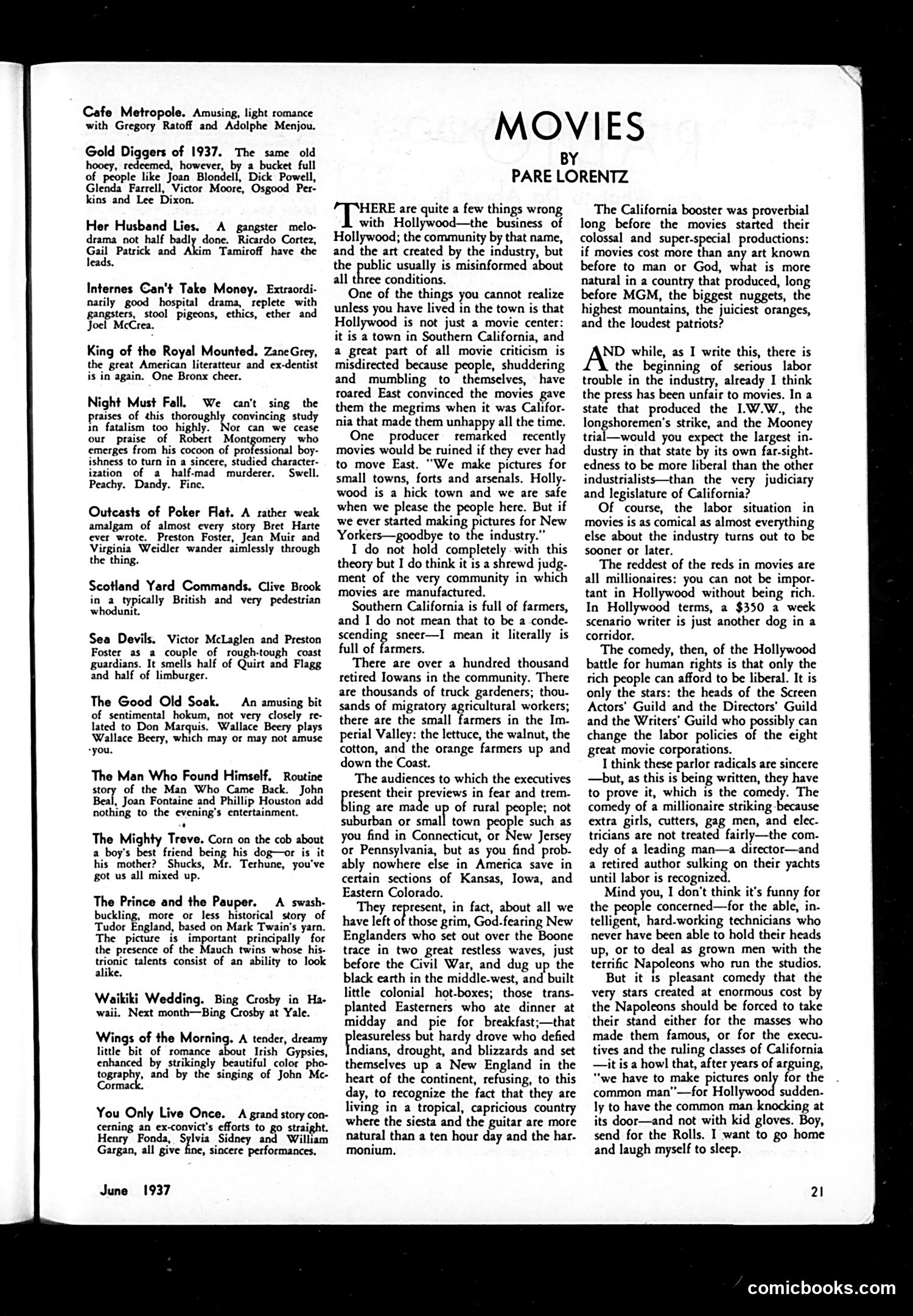
A restored page from Judge, 1937-06. Page through the whole issue in the reader above.
📄 Transcribed text from this page (OCR, searchable)
Machine-transcribed from the original scan — historical spelling and the odd misread are preserved.
Cafe Metropole. Amusing, light romance with Gregory Ratoff and Adolphe Menjou. Gold Diggers of 1937. The same old hooey, redeemed, however, by a bucket full of people like Joan Blondell, Dick Powell, Glenda Farrell, Victor Moore, Osgood Per- kins and Lee Dixon. Her Husband Lies. A gangster melo- drama not half badly done. Ricardo Cortez, ca Patrick and Akim Tamiroff have the i¢ads, Internes Can't Take Money. Extraordi- narily good hospital drama, replete with gangsters, stool pigeons, ethics, ether and Joel McCrea. King of the Royal Mounted. ZaneGrey, the great American literatteur and ex-dentist is in again. One Bronx cheer. Night Must Fall. We can't sing the praises of this thoroughly convincing study in fatalism too highly. Nor can we cease our praise of Robert Montgomery who emerges from his cocoon of professional boy- ishness to turn in a sincere, studied character- ization of a half-mad murderer. Swell. Peachy. Dandy. Fine. Outcasts of Poker Flat. A rather weak amalgam of almost every story Bret Harte ever wrote. Preston Foster, Jean Muir and Virginia Weidler wander aimlessly through the thing. Scotland Yard Commands. Clive Brook in a typically British and very pedestrian whodunit. Sea Devils. Victor McLaglen and Preston Foster as a couple of rough-tough coast guardians. It smells half of Quirt and Flagg and half of limburger. The Good Old Soak. An amusing bit of sentimental hokum, ‘not very closely re- lated to Don Marquis. Wallace Beery plays ‘Wallace Beery, which may or may not amuse “you. The Man Who Found Himself. Routine story of the Man Who Came Back. John Beal, Joan Fontaine and Phillip Houston add nothing to the evening's entertainment. The Mighty Treve. Corn on the cob about a boy's best friend being his dog—or is it his mother? Shucks, Mr. Terhune, you've got us all mixed up. The Prince and the Pauper. A swash- buckling, more or less historical story of Tudor England, based on Mark Twain's yarn. The picture is important principally for the presence of the Mauch twins whose his- ionic talents consist of an ability to look ike. Waikiki Wedding. Bing Crosby in Ha- waii. Next month—Bing Crosby at Yale. Wings of the Morning. A tender, dreamy little bit of romance it Irish Gypsies, enhanced by strikingly beautiful color pho. tography, and by the singing of John Mc- Cormad You Only Live Once. A grand story con- cerning an ex-convict's efforts to go straight. Henry Fonda, Sylvia Sidney and William Gargan, all give fine, sincere performances, June 1937 MOVIES PARE LORENTZ 4 Prteee are quite a few things wrong with Hollywood—the business of Hollywood; the community by that name, and the art created by the industry, but the public usually is misinformed about all thie conditions. One of the things you cannot realize unless you have lived in the town is that Hollywood is not just a movie center: it is a town in Southern California, and a great part of all movie criticism is misdirected because people, shuddering and mumbling to themselves, have roared East convinced the movies gave them the megrims when it was Califor- nia that made them unhappy all the time. One producer remarked recently movies would be ruined if they ever had to move East. “We make pictures for small towns, forts and arsenals. Holly- wood is a hick town and we are safe when we please the people here. But if we ever started making pictures for New Yorkers—goodbye to the industry.” I do not hold completely with this theory but I do think it is a shrewd judg- ment of the very community in which movies are manufactured. Southern California is full of farmers, and I do not mean that to be a-conde- scending sneer—I mean it literally is full of farmers. There are over a hundred thousand retired Iowans in the community. There are thousands of truck gardeners; thou- sands of migratory agricultural workers; there are the small farmers in the Im- perial Valley: the lettuce, the walnut, the cotton, and the orange farmers up and down the Coast. The audiences to which the executives present their previews in fear and trem. ling are made i of rural people; not suburban or small town people such as you find in Connecticut, or Krew Jersey or Pennsylvania, but as you find prob. ably nowhere else in America save in certain sections of Kansas, Iowa, and Eastern Colorado. They Represent, in fact, about all we have left of those grim, God-fearing New Englanders who set out over the Boone trace in two great restless waves, just before the Civil War, and dug up the black earth in the middle-west, and built little colonial hot-boxes; those trans- planted Easterners who ate dinner at midday and pie for breakfast;—that leasureless but hardy drove who defied ndians, drought, and blizzards and set themselves up a New England in the heart of the continent, refusing, to this day, to recognize the fact that they are living in a tropical, capricious country where the siesta and the guitar are more natural than a ten hour day and the har- monium. The California booster was proverbial long before the movies started their colossal and super-special productions: if movies cost more than any art known before to man or God, what is more natural in a country that produced, long before MGM, the biggest nuggets, the highest mountains, the juiciest oranges, and the loudest patriots? ND while, as I write this, there is the beginning of serious labor trouble in the industry, already I think the press has been unfair to movies. In a state that produced the I.W.W., the sopeeporemess strike, and the Mooney trial—would you expect the largest in- dustry in that state by its own far-sight- edness to be more liberal than the other industrialists—than the very judiciary and legislature of California? Of course, the labor situation in movies is as comical as almost everything else about the industry turns out to be sooner or later. The reddest of the reds in movies are all millionaires: you can not be impor- tant in Hollywood without being rich. In Hollywood terms, a $350 a week scenario writer is just another dog in a corridor. The comedy, then, of the Hollywood battle for human rights is that only the rich people can afford to be liberal. It is only the stars: the heads of the Screen Actors’ Guild and the Directors’ Guild and the Writers’ Guild who possibly can change the labor policies of the eight great movie corporations. I think these parlor radicals are sincere —but, as this is being written, they have to prove it, which is the comedy. The comedy of a millionaire striking because extra girls, cutters, gag men, and elec. tricians are not treated fairly—the com. edy of a leading man—a director—and a retired author sulking on their yachts until labor is recognized. Mind you, I don’t think it’s funny for the people concerned—for the able, in- telligent, hard-working technicians who never have been able to hold their heads up, or to deal as grown men with the terrific Napoleons who run the studios. But it 1s pleasant comedy that the very stars created at enormous cost by the Napoleons should be forced to take their stand either for the masses who made them famous, or for the execu. tives and the ruling classes of California —it is a howl that, after years of arguing, “we have to make pictures only for the common man"”—for Hollywood sudden. ly to have the common man knocking at its door—and not with kid gloves. Boy, send for the Rolls. 1 want to go home and laugh myself to sleep. comicbooks.com