A complete issue · 36 pages · 1936
Judge — January 1936
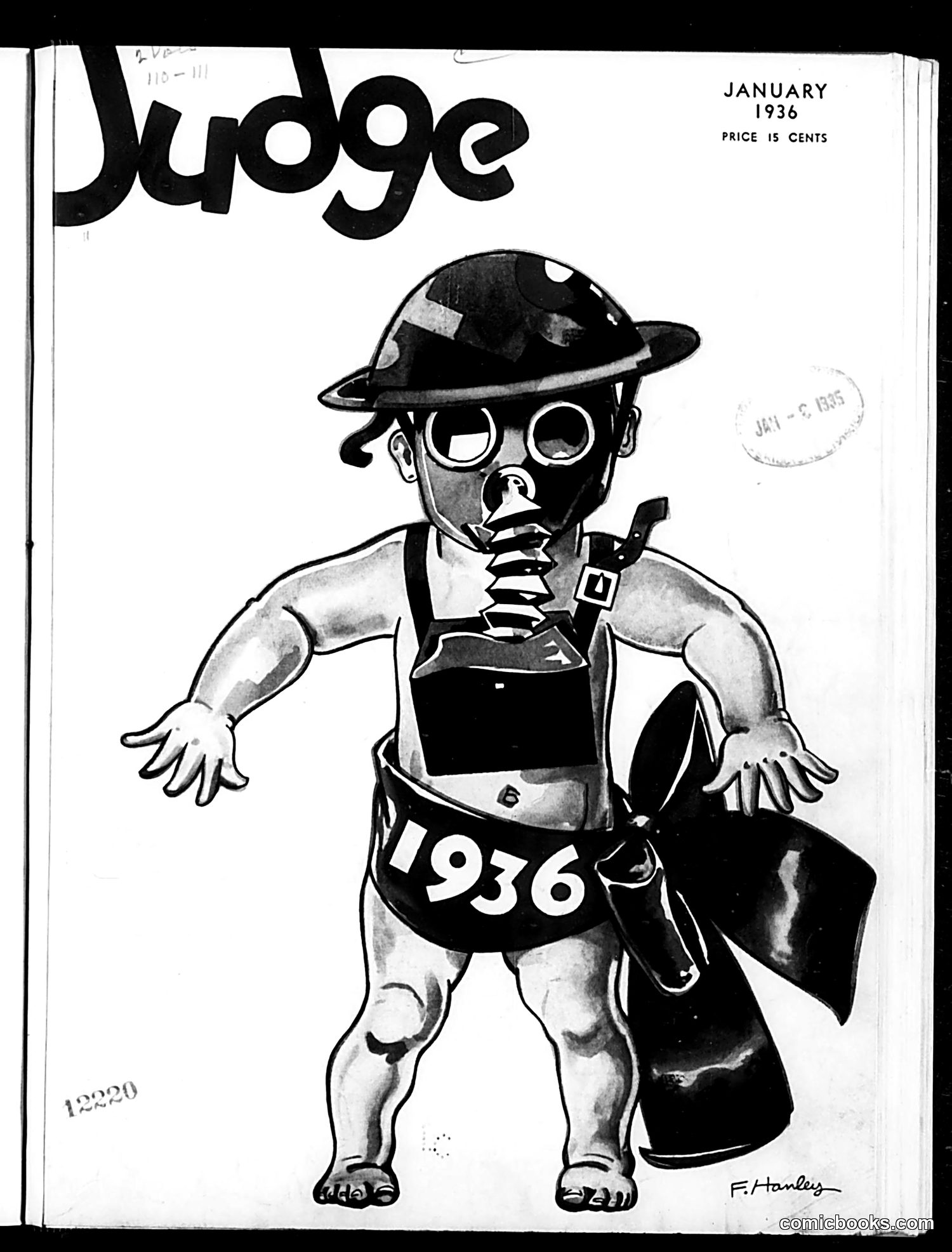
# Analysis of Judge Magazine Cover, January 1936 This cover depicts a caricatured figure wearing a gas mask and military helmet, carrying a rifle and flag marked "1936." The character represents the year 1936 itself, portrayed as a soldier or combatant. The satire likely references the growing militarization and international tensions of 1936—a pivotal year featuring the Spanish Civil War, Hitler's rearmament, and increasing fascist aggression globally. By depicting "1936" as an armed, gas-masked figure, Judge's cartoonist warns readers that the coming year will be defined by military conflict and chemical warfare threats. The ominous presentation suggests pessimism about the decade's trajectory toward World War II, presenting 1936 as dangerous and foreboding rather than hopeful.
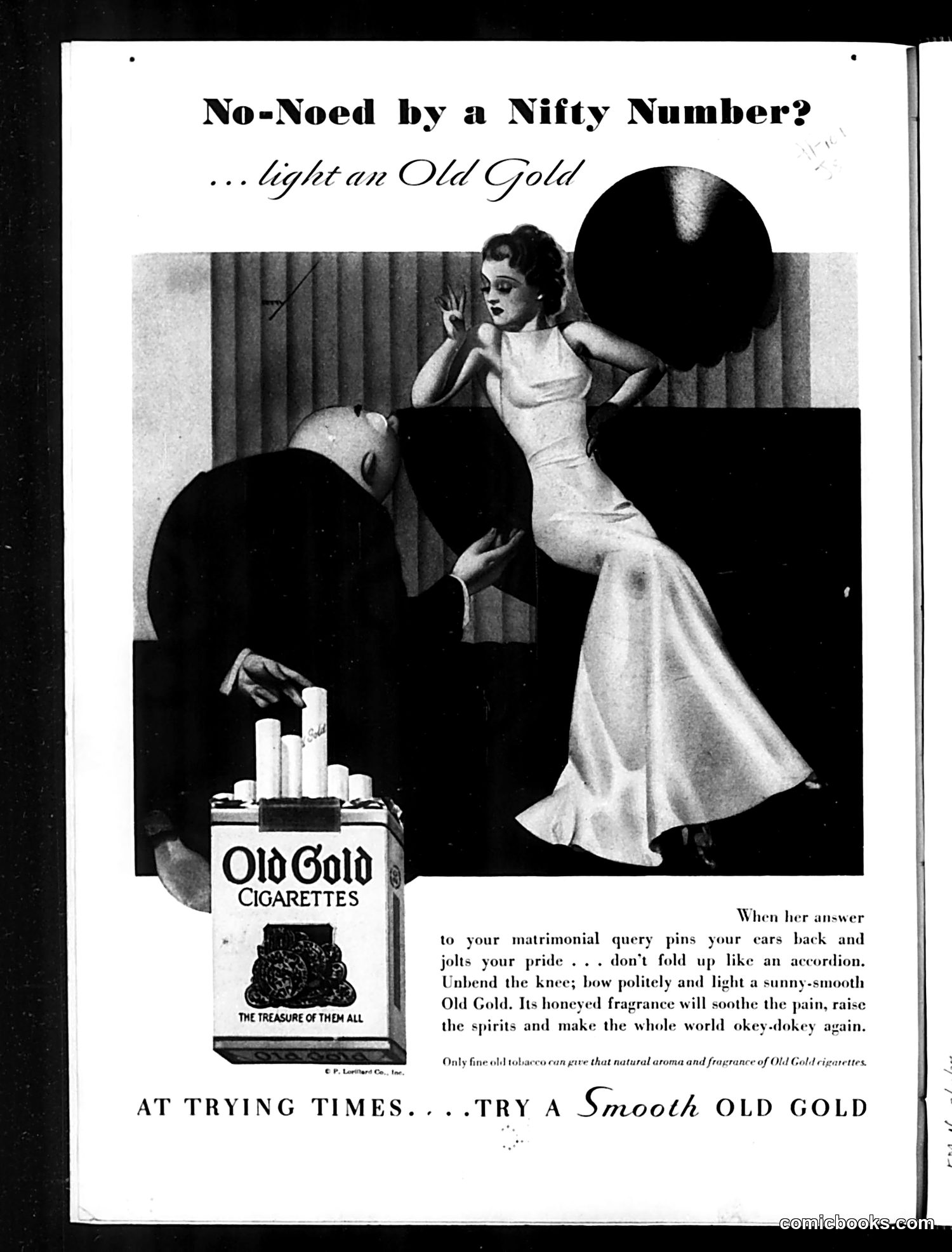
# Analysis This is a cigarette advertisement rather than satirical content. It depicts a domestic scene where a man appears dejected after receiving a negative response to a marriage proposal, while a woman stands confidently nearby. The ad's headline, "No-Noed by a Nifty Number?" suggests she has rejected him. The advertisement's humor relies on outdated gender dynamics: it recommends that the rejected man "light an Old Gold" cigarette to cope with romantic rejection. The copy claims the cigarette's "honeyed fragrance will soothe the pain" and "make the whole world okey-dokey again." This reflects early-to-mid 20th century marketing that used cigarettes as emotional comfort products and perpetuated stereotypes about masculinity and romantic disappointment. The casual trivialization of rejection would be considered tone-deaf by modern standards.
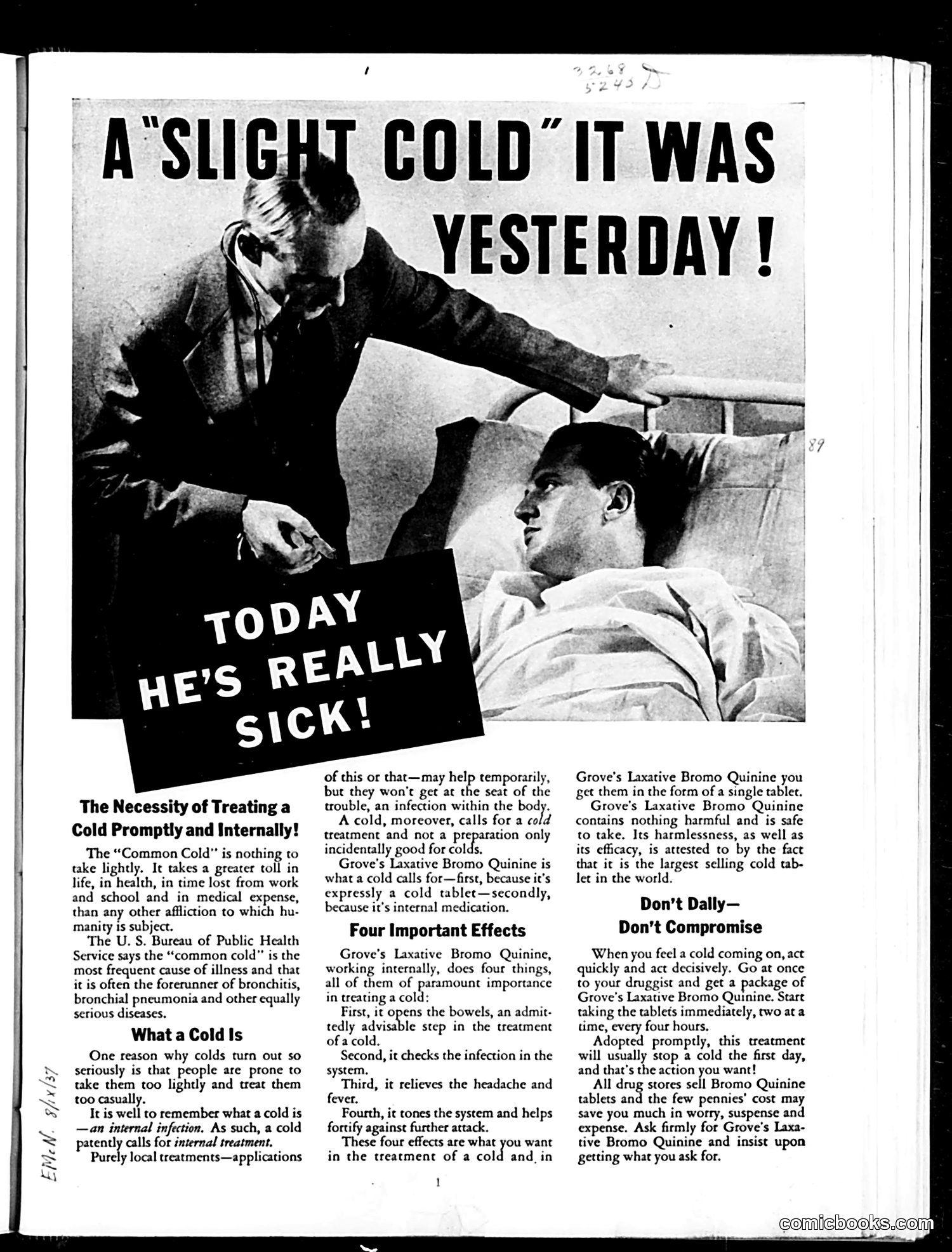
# Advertisement, Not Satire This page is primarily a **pharmaceutical advertisement** for Grove's Laxative Bromo Quinine cold tablets, not political satire. The image shows a doctor examining a sick patient in bed, with the headline playing on the common excuse "a slight cold it was yesterday"—implying the patient's condition has worsened. The advertisement argues that colds require internal medical treatment, not just local remedies. Grove's product claims four benefits: opening bowels, checking infection, relieving headache/fever, and "toning the system." The "Don't Dally—Don't Compromise" section urges immediate treatment with their tablets to prevent a cold from developing fully. This reflects early 20th-century medicine marketing, when such products made broad health claims now considered dubious or illegal.
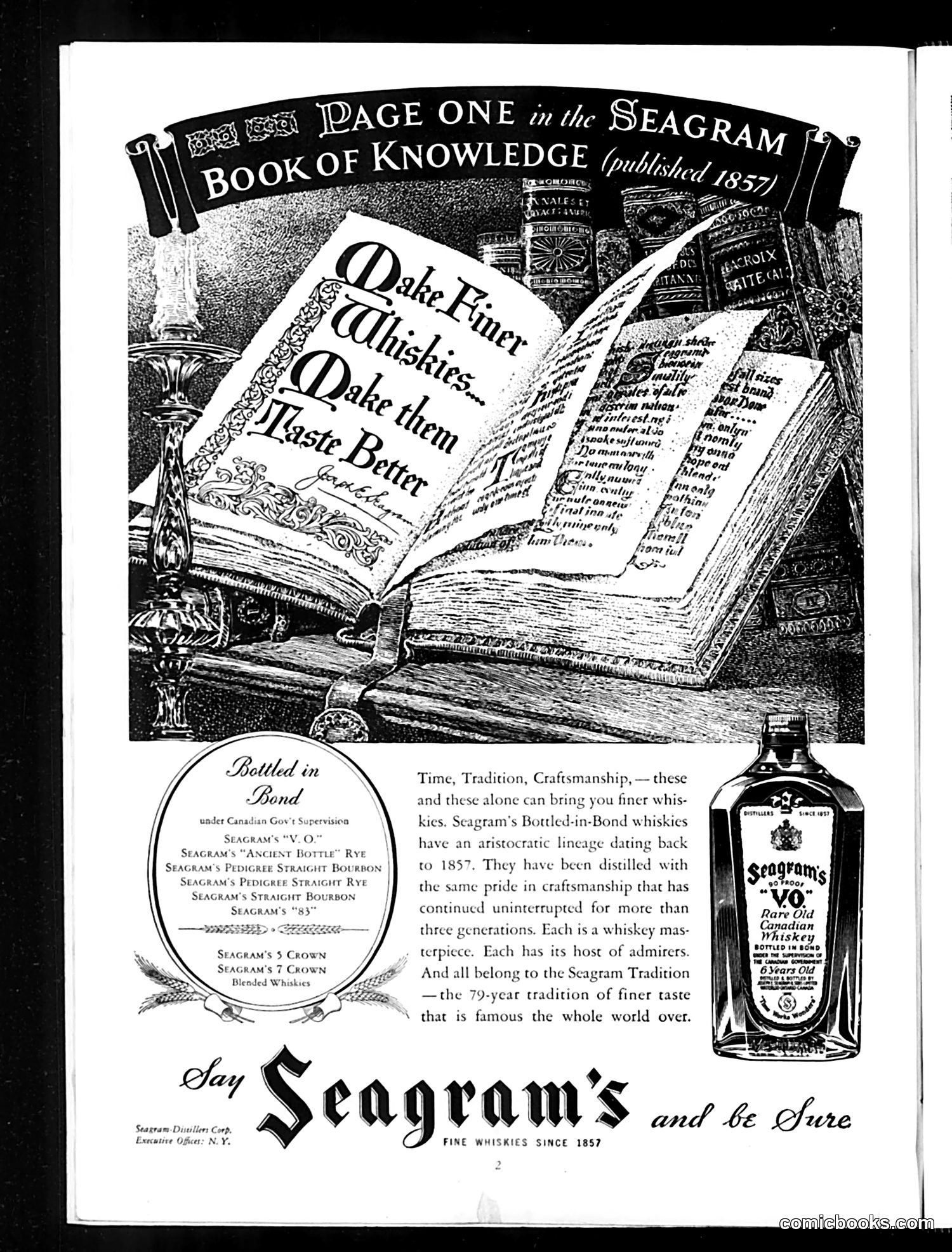
# Analysis This page is **primarily an advertisement**, not satirical content. It promotes Seagram's whisky, specifically their "Bottled-in-Bond" varieties. The ad uses a scholarly theme—featuring an open "Book of Knowledge" from 1857—to establish brand heritage and legitimacy. The text emphasizes that Seagram's whiskeys have maintained "aristocratic lineage dating back to 1857" through "Time, Tradition, Craftsmanship" and "79-year tradition of finer taste." The circular inset lists specific Seagram's products: V.O., Ancient Bottle Rye, Pedigree Straight Bourbon, and Crown Blended Whiskies. A bottle image appears on the right. The tagline "Say Seagram's and be Sure" reinforces brand trust and quality. This represents typical early-20th-century advertising strategy: linking products to established tradition and authority to appeal to consumers.
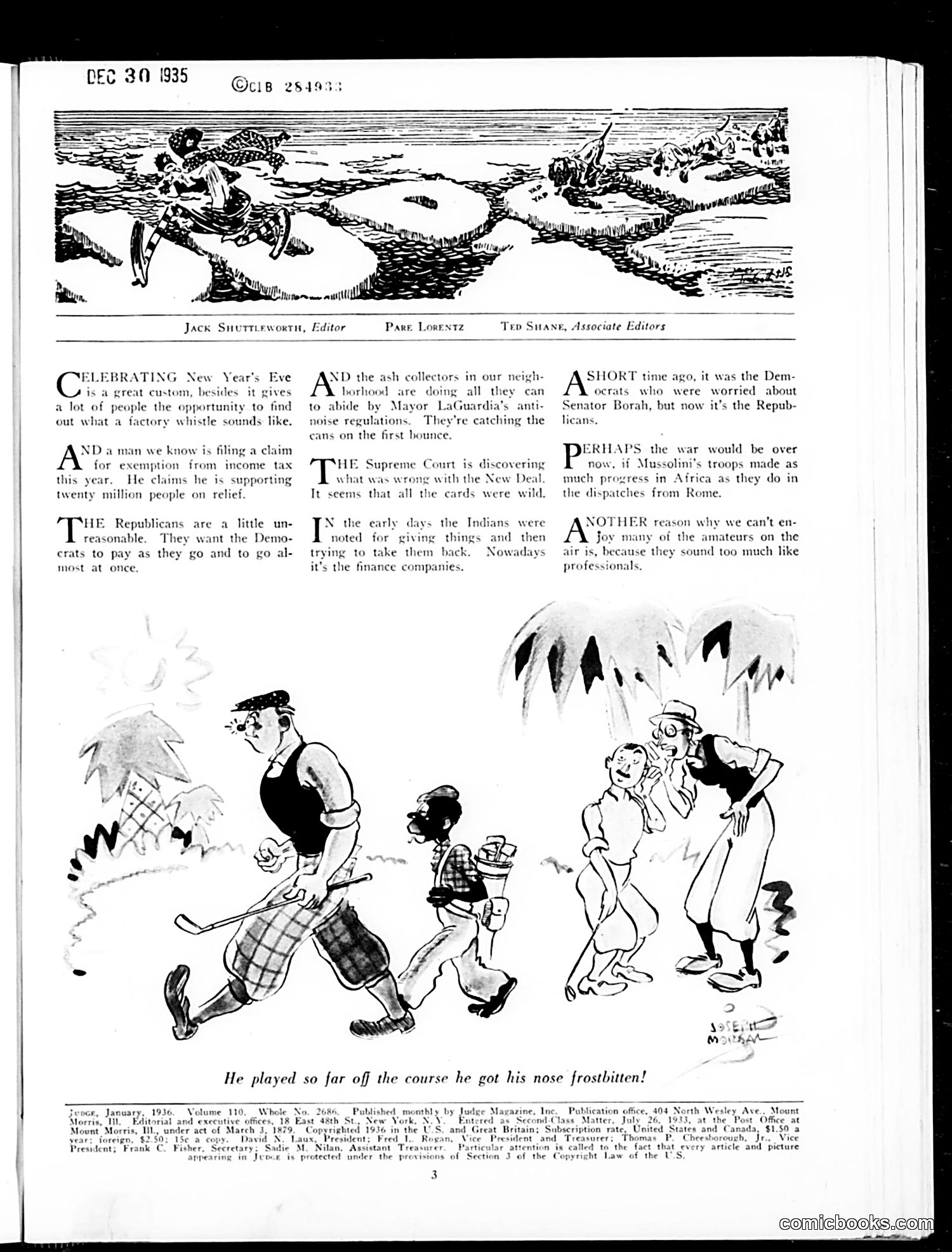
# Judge Magazine Commentary, December 30, 1935 This page contains brief political commentary rather than narrative cartoons. The editorial snippets critique: 1. **New Year's Eve noise ordinances** — mocking Mayor LaGuardia's anti-noise regulations and ash collectors enforcing them in neighborhoods. 2. **Tax exemptions** — a man claiming relief while supporting "twenty million people" through taxes. 3. **Republican criticism of Democrats** — attacking Democratic policies as unreasonable. 4. **Supreme Court vs. New Deal** — commenting on the Court "discovering what was wrong with the New Deal." 5. **Native American stereotyping** — a dated reference to Indians "giving things and then trying to take them back," apparently about finance companies. 6. **Amateur radio commentary** — dismissing amateur radio operators as unprofessional. The bottom cartoon shows someone frostbitten after playing golf too far off-course—a simple winter sport joke unrelated to the political commentary above.
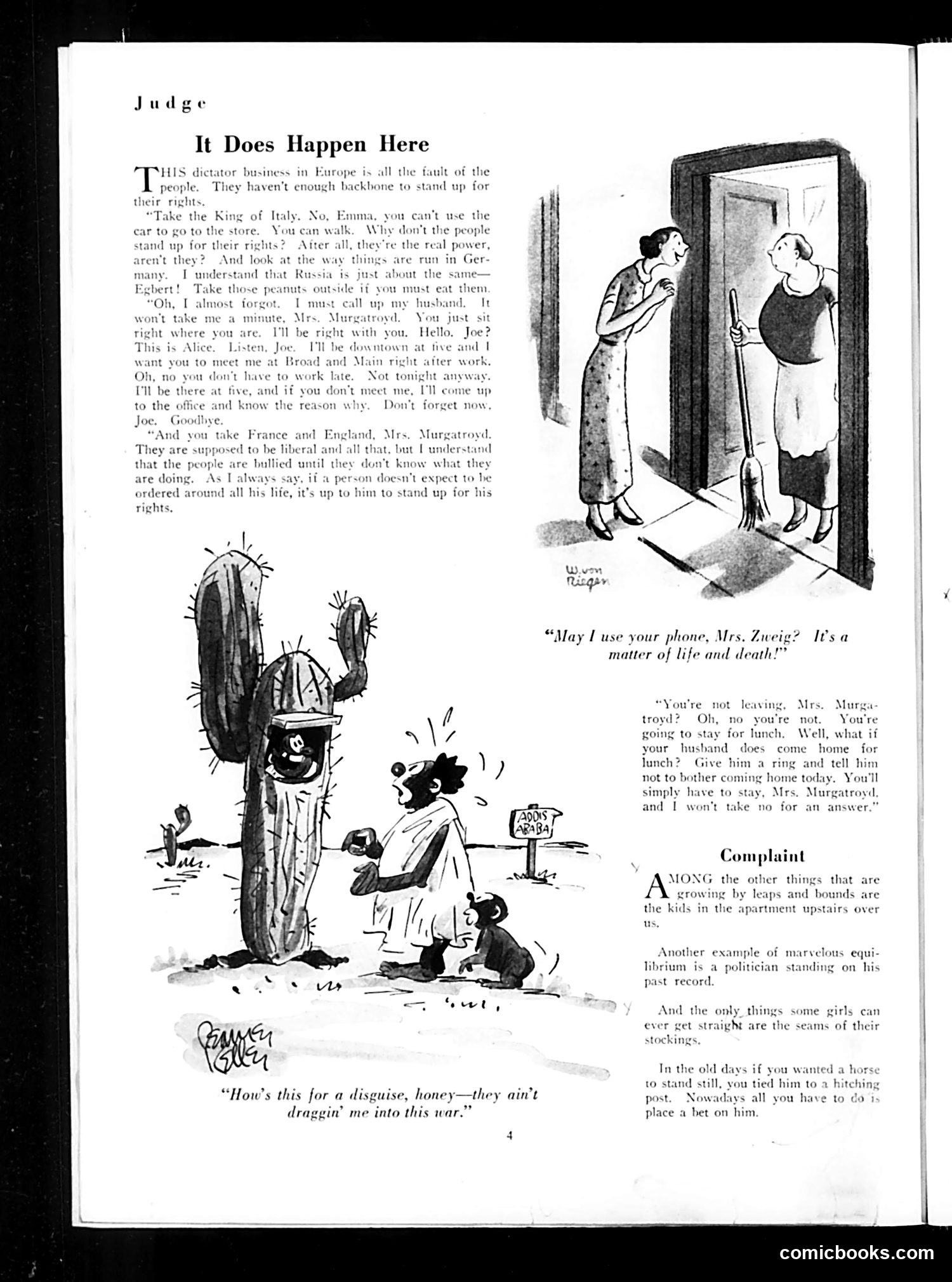
# Analysis of Judge Magazine Page This page satirizes European authoritarianism through a monologue by "Judge," criticizing dictators' suppression of citizens' rights. References to "the King of Italy," "Russia," and "Germany" suggest commentary on fascist and communist regimes of the 1920s-30s era. The top cartoon shows a woman urgently demanding phone access for a "matter of life and death"—satirizing how totalitarian regimes control even basic communications. The bottom cartoon depicts a desert scene with a cactus (likely symbolizing an inhospitable environment or Mexico), mocking disguises as ineffective ("they ain't draggin' me into this war"). The "Complaint" section critiques social decay: unruly apartment children, politicians' dishonesty, and women's limited opportunities. The page reflects American anxiety about both foreign tyranny and domestic social problems during the interwar period.
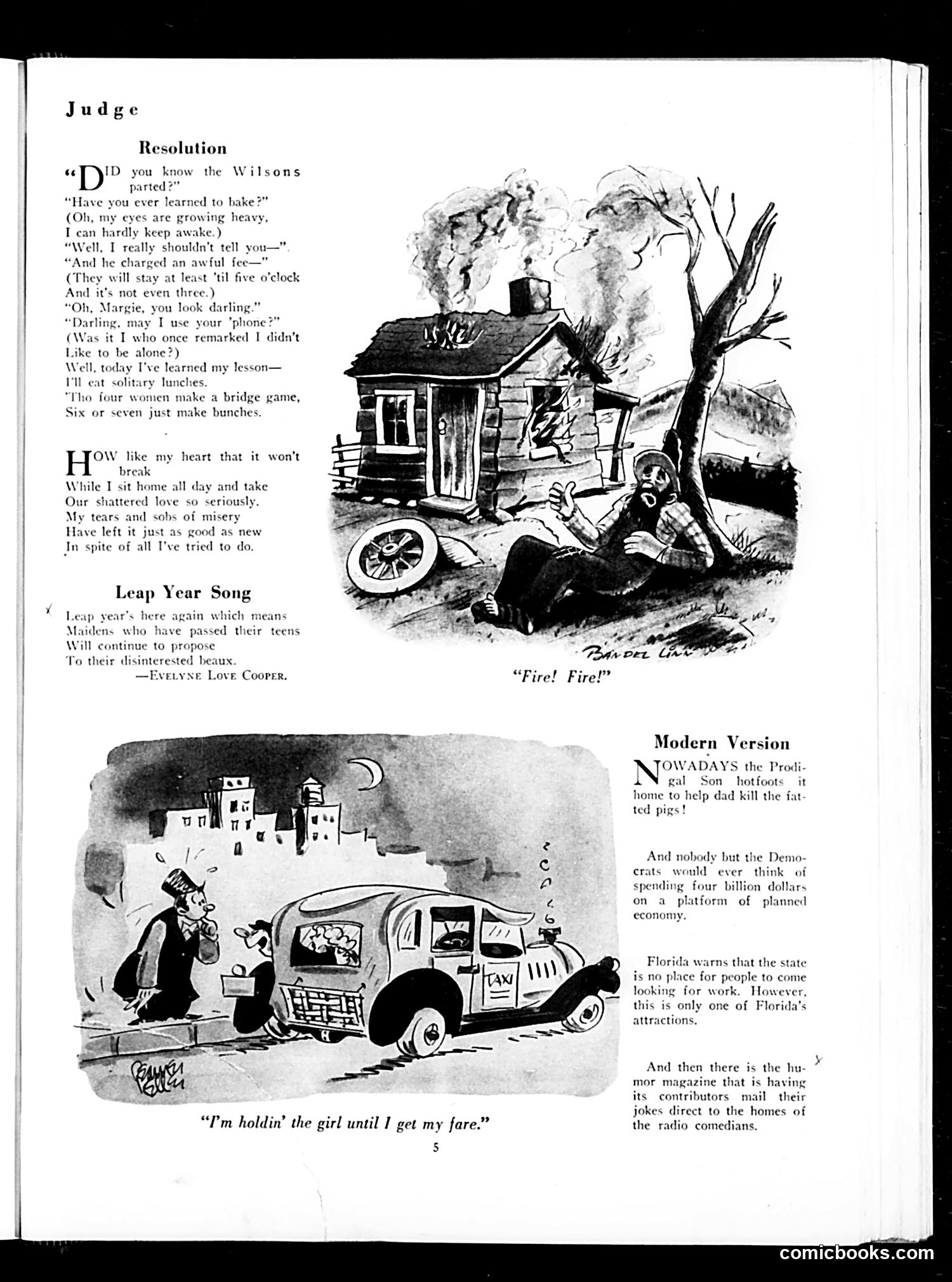
# Page Analysis: Judge Magazine, Page 5 This page contains three unrelated pieces: a poem titled "Resolution" about marital strain, a "Leap Year Song" referencing the tradition that women propose to men in leap years, and a "Modern Version" section with two cartoons. The top cartoon shows a man and woman by a burning cottage with an overturned car wheel, captioned "Fire! Fire!"—likely depicting domestic disaster, literal or metaphorical. The lower cartoon depicts a taxi driver with a woman inside, captioned "I'm holdin' the girl until I get my fare"—a play on words conflating romantic "holding" with the driver's demand for payment. The accompanying text makes political jabs at Democrats' spending and Florida's economic struggles, plus a comment about humor magazine contributors selling jokes to radio comedians.
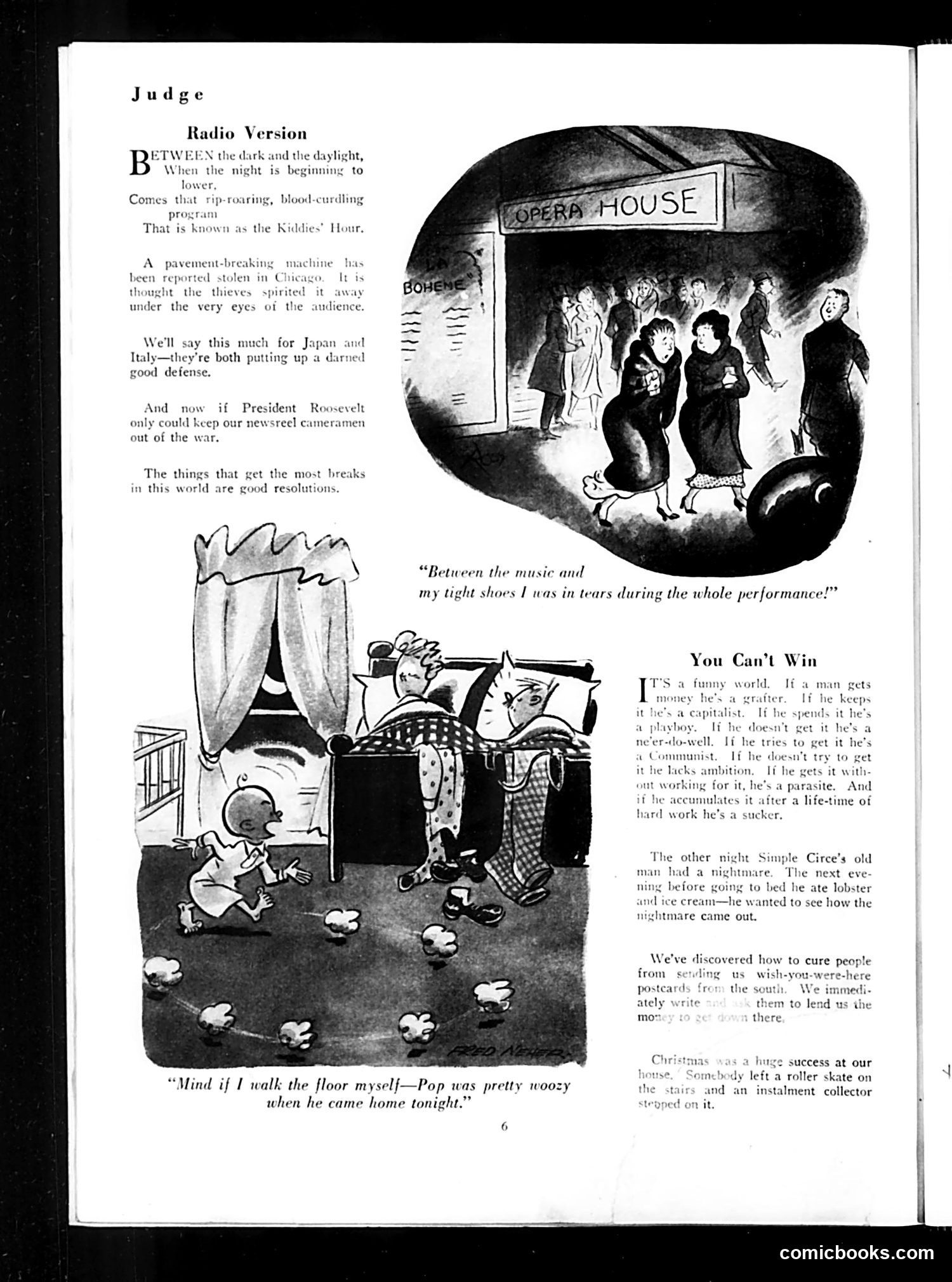
# Analysis of Judge Magazine Page This page contains two satirical pieces: **"Radio Version"** (top left) appears to critique sensationalist children's programming ("Kiddies' Hour") featuring lurid content. References include a stolen pavement-breaking machine in Chicago and mentions of President Roosevelt, suggesting commentary on crime reporting and political news coverage bleeding into youth entertainment. **"You Can't Win"** (right) is a cynical essay mocking American social mobility—arguing that regardless of financial choices (spending, saving, ambition, passivity), a man is labeled negatively. The tone suggests Depression-era frustration with contradictory societal expectations. **Bottom cartoon** depicts a messy bedroom scene with the caption about someone's intoxicated father ("Pop"), using domestic chaos for comedic effect about adult drunkenness. The page satirizes media sensationalism, economic despair, and social hypocrisy typical of mid-20th-century Judge magazine.
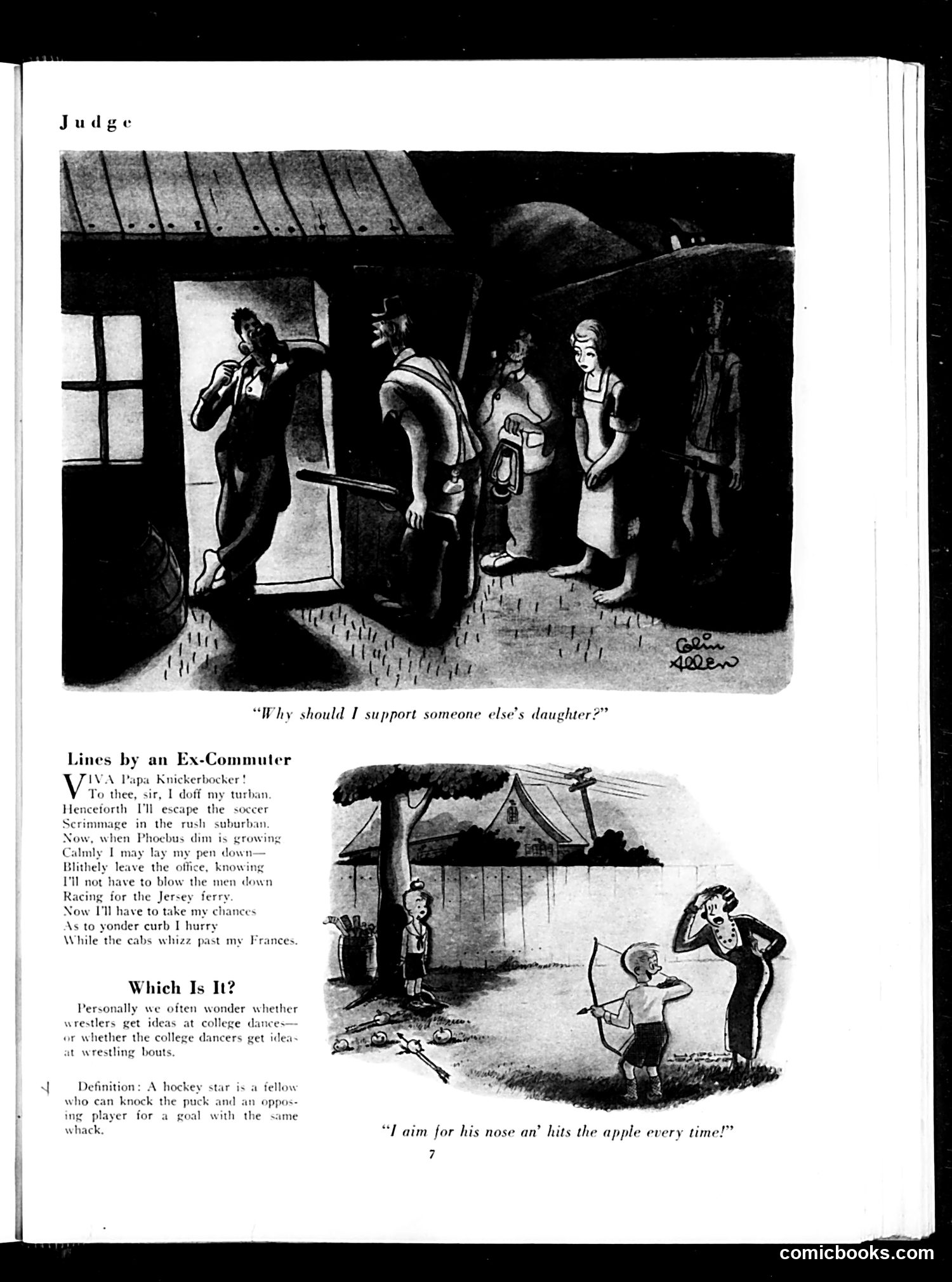
# Judge Page 7 Analysis This page contains three unrelated satirical pieces: 1. **Top cartoon "Why should I support someone else's daughter?"** depicts what appears to be a legal or marital dispute, likely satirizing men's financial obligations in alimony or child support cases—a common Judge topic of the era. 2. **"Lines by an Ex-Commuter"** is a humorous poem mocking the suburban commuter lifestyle, celebrating escape from city congestion and office work via train to the Jersey shore. 3. **"Which Is It?"** poses a rhetorical question about college life while defining a "hockey star" as someone skilled at violence. The lower cartoon shows a child playing roughly, satirizing either college athletics' brutality or childhood games mimicking adult sports culture. The page reflects early-to-mid 20th century anxieties about commuting, masculinity, and sports.
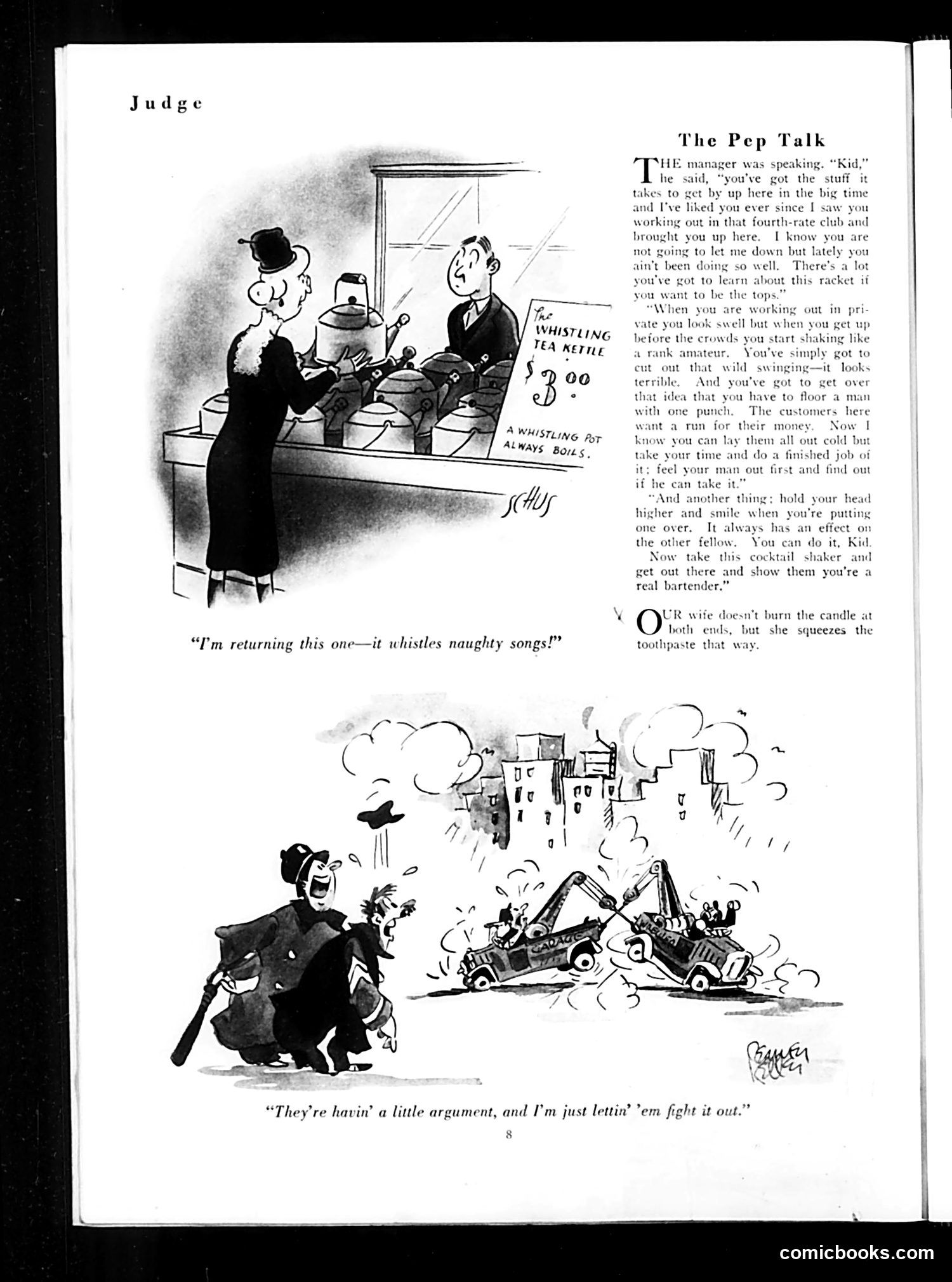
# Explanation for Modern Readers This page contains two cartoons satirizing early 20th-century American life. **Top cartoon ("I'm returning this one—it whistles naughty songs!"):** A customer returns a whistling tea kettle because it emits inappropriate sounds. The humor lies in the kettle's "naughty" whistling being treated as scandalous—reflecting period attitudes about propriety. **"The Pep Talk":** A boxing manager (or possibly a nightclub manager) lectures a young fighter/bartender named "Kid" about professional conduct. The advice mixes boxing and bartending metaphors—the manager warns against wild swinging, emphasizes showmanship ("smile when you're putting one over"), and advises proper technique over raw aggression. This satirizes the performative nature of both professions and the gap between street-level and professional behavior. **Bottom cartoon ("They're havin' a little argument"):** Construction workers "argue" while their equipment fights it out, with the boss passively watching—a visual pun on workplace conflict. The overall tone mocks working-class ambition and the "rules" of various trades.
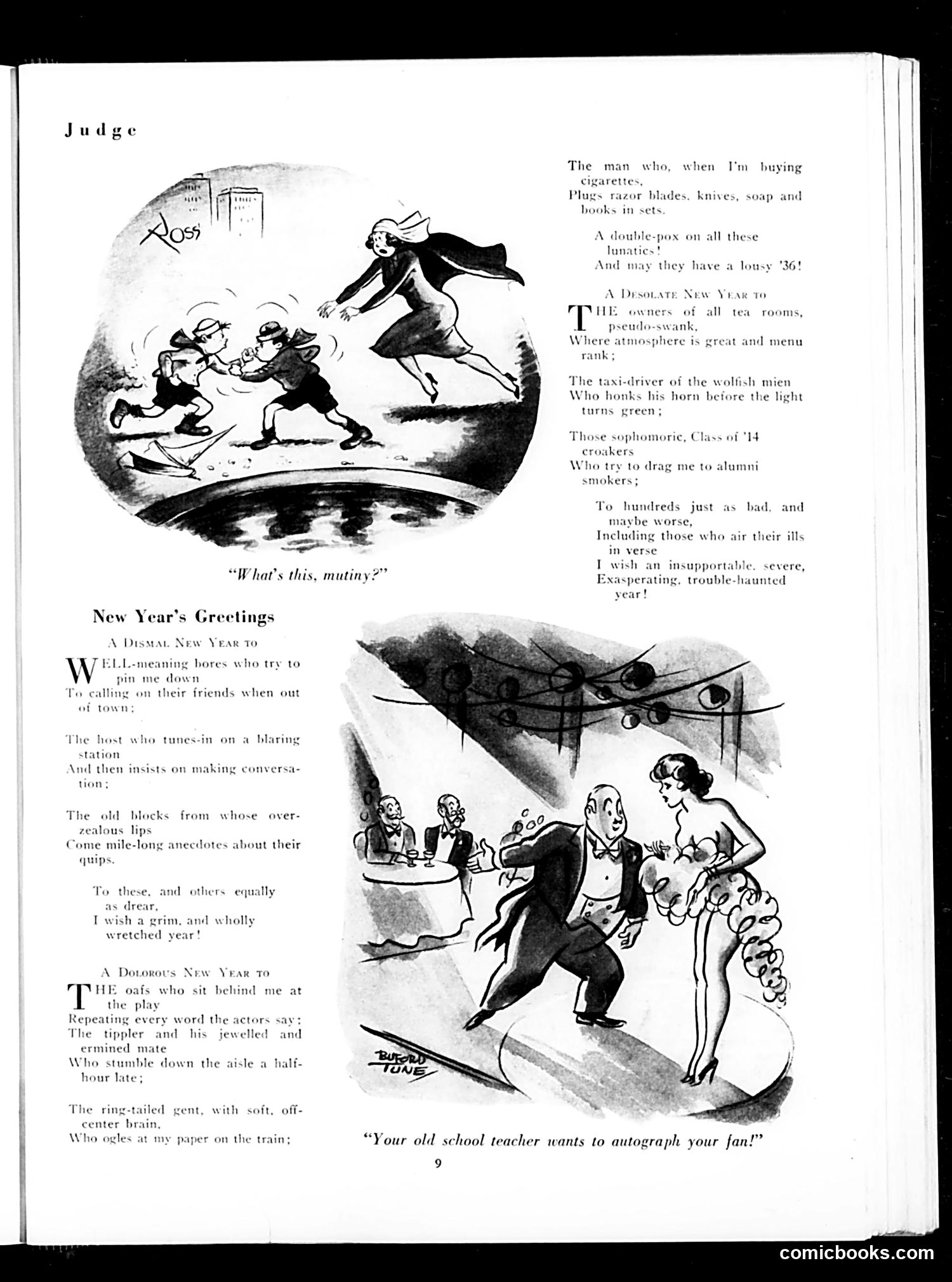
# New Year's Greetings, Judge Magazine This is a humorous New Year's editorial from Judge magazine offering mock curses on various annoying social types. The page contains two cartoons illustrating specific grievances. The top cartoon ("What's this, mutiny?") depicts a judge figure confronting two fighting men, likely satirizing workplace or social conflict. The bottom cartoon shows a waiter or servant juggling plates while managing demanding customers at what appears to be a restaurant or nightclub, captioned about an old school teacher wanting an autograph. The accompanying verse catalogs irritating people the author wishes a miserable year: boring conversationalists, loud theater patrons, cigarette salesmen, tea room owners, taxi drivers, and Class of 1914 alumni who pressure people into attending smokers. The satire targets pretentious social behavior, aggressive salesmanship, and the general annoyances of urban life—issues apparently as vexing to 1920s readers as today.
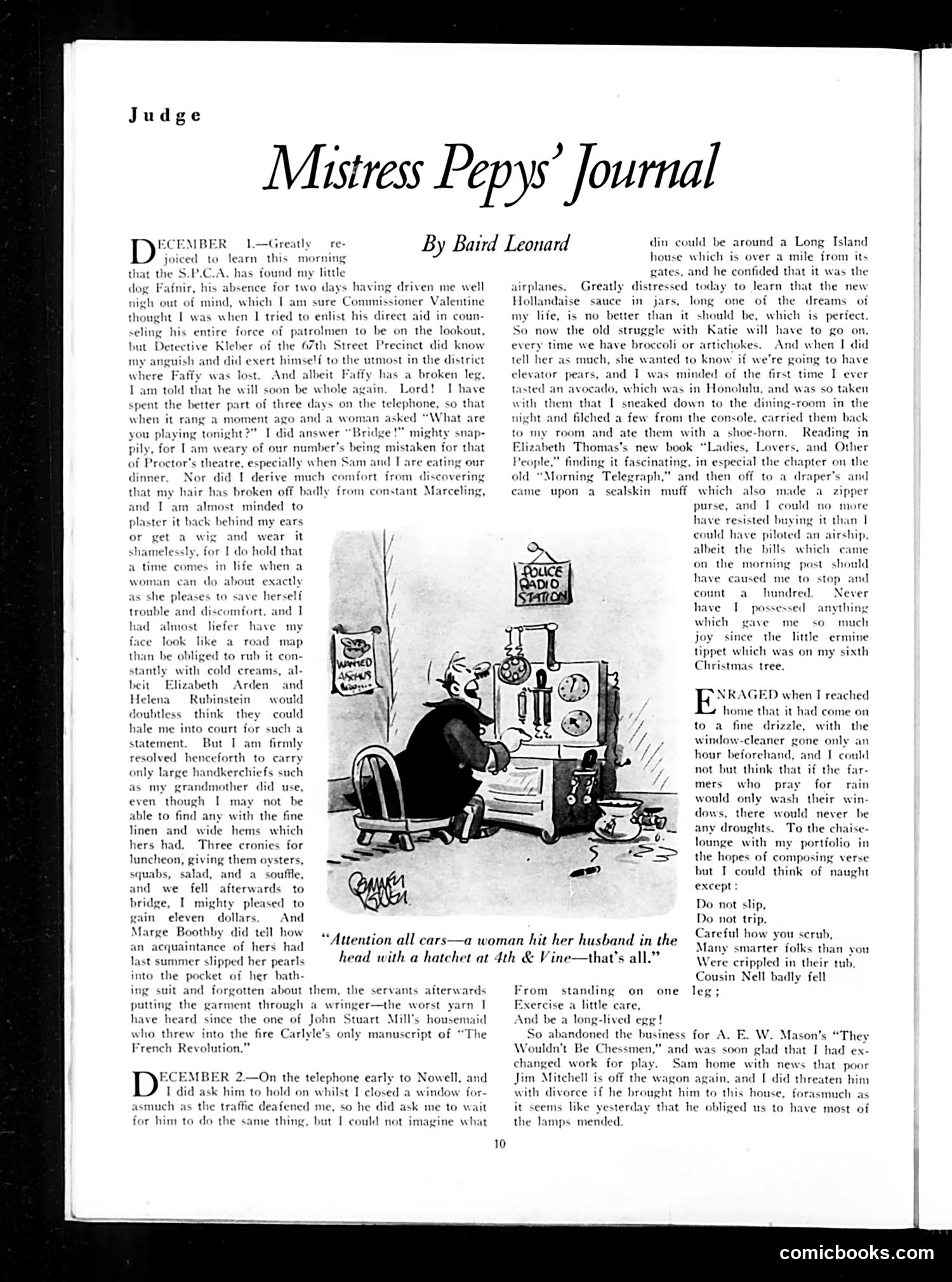
# "Mistress Pepys' Journal" - Judge Magazine This is a satirical society column by Baird Leonard, parodying the diary format of Samuel Pepys. The main cartoon illustrates a humorous police dispatch: "Attention all cars—a woman hit her husband in the head with a hatchet at 4th & Vine—that's all." The joke targets domestic violence as casual urban crime. The matter-of-fact police radio tone treating spousal assault as routine traffic is the satire—suggesting such incidents were commonplace enough to warrant deadpan dispatcher language. The column itself mocks wealthy Manhattan society women through breathless, trivial gossip: lost dogs, haircare troubles, bridge games, and culinary complaints about Hollandaise sauce. References to beauty experts (Elizabeth Arden, Helena Rubinstein) and luxury foods (oysters, avocados, pearls) establish the satirical target: privileged, materialistic socialites obsessed with appearance and consumption while oblivious to actual world concerns.