
Judge, 1936-01 · page 16 of 36
Judge — January 1936 — page 16: what you’re looking at
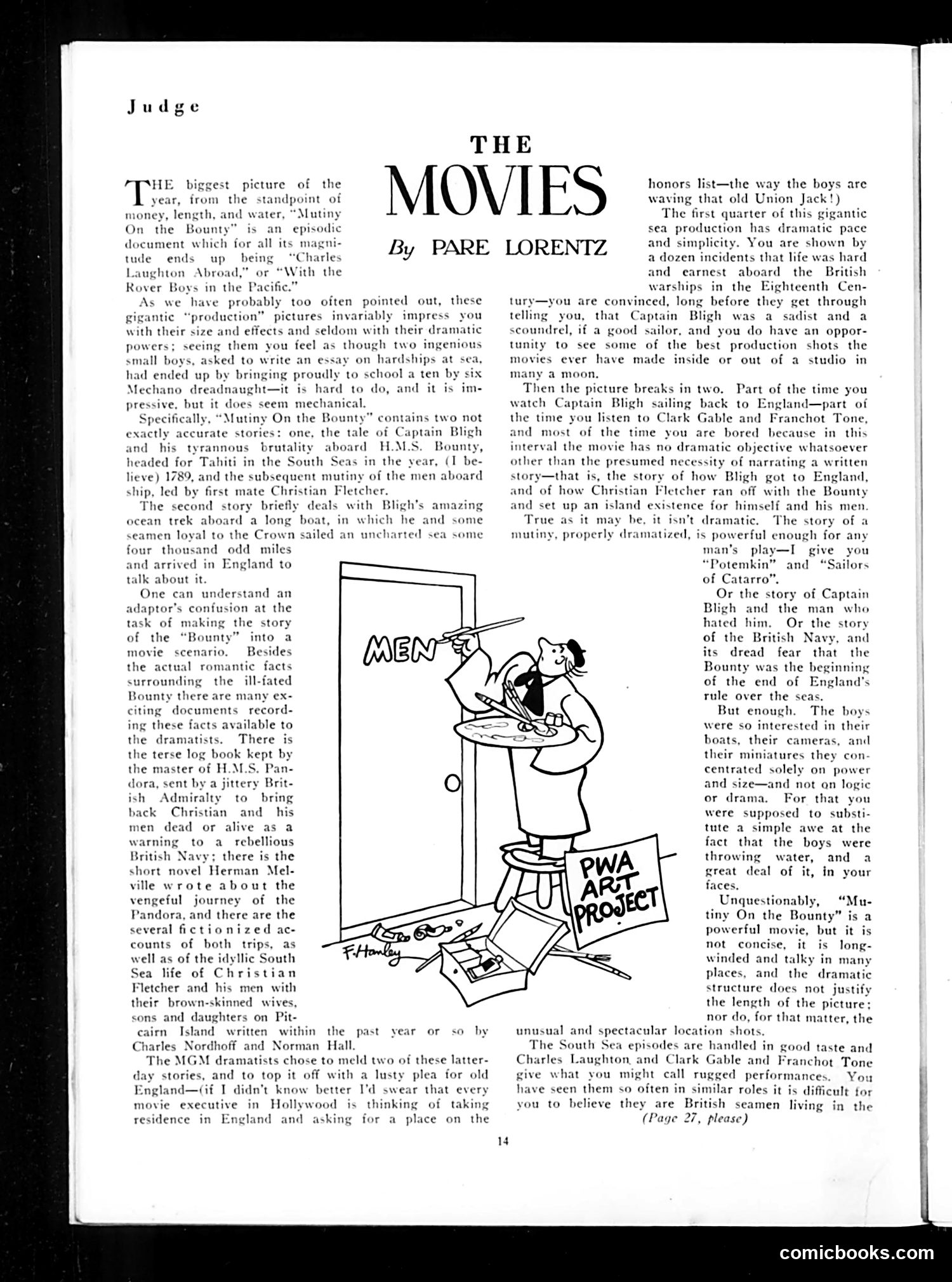
A restored page from Judge, 1936-01. Page through the whole issue in the reader above.
📄 Transcribed text from this page (OCR, searchable)
Machine-transcribed from the original scan — historical spelling and the odd misread are preserved.
Judge f=] THE MOVIES By PARE LORENTZ HE biggest picture of the year, from the standpoint of money, length, and water, “Mutiny On the Bounty” is an episodic document which for all its magni- tude ends up being “Charles Laughton Abroad,” or “With the Rover Boys in the Pacific.” As we have probably too often pointed out, these gigantic “production” pictures invariably impress you with their size and effects and seldom with their dramatic powers; seeing them you feel as though two ingenious small boys, asked to write an essay on hardships 3 had ended up by bringing proudly to school a ten by six Mechano dreadnaught—it is hard to do, and it is ir pressive, but it does seem mechanical. Specifically, “Mutiny On the Bounty” ¢ ains two not e tly urate stories: one, the tale of Captain Bligh and his tyrannous brutality aboard H.M.S. Bounty, headed for Tahiti in the South Seas in the year, (I be- lieve) 1789, and the subsequent mutiny of the men aboard ship, led by first mate Christian Fletcher, The second story briefly deals with Bligh’s amazing ocean trek aboard a long boat, in which he and some amen loyal to the Crown sailed an uncharted sea some four thousand odd miles and arrived in England to talk about it. One can understand an adaptor’s confusion at the task of making the story of the “Bounty” into a movie scenario. Besides the actual romantic facts surrounding the ill-fated Jounty there are many ex- citing documents record- ing these facts available to the dramatists. There is the terse log book kept by the master of H.M.S. Pan- ra, sent by a jittery Brit- ish Admiralty to” bring back Christian and his men dead or alive as a warning to a_ rebellious British Navy; there is the short novel Herman Mel- ville wrote about the vengeful journey of the Pandora, and there are the several fictionized ac- counts of both trips, as well as of the idyllic South Sea life of Christian Fletcher and his men with their brown-skinned wives, sons and daughters on Pit- cairn Island written within the ps “harles Nordhoff and Norman Hall The MGM dramatists chose to meld two of these latter- day stories, and to top it off with a lusty plea for old England—(if I didn’t know b r I'd swear that every movie executive in Hollywoo thinking of taking residence in nd and asking for sea, t year or so by place on the honors list—the way the boys are waving that old Union Jack!) The first quarter of this gigantic sea production has dramatic pace and simplicity. You are shown by a dozen incidents that life was hard and earnest aboard the British warships in the Eighteenth Cen- tury—you are convinced, long before they get through telling you, that Captain Bligh was a sadist and a scoundrel, if a good sailor, and you do have an oppor- tunity to see some of the best production shots the movies ever have made inside or out of a studio in many a moon, Then the picture breaks in two. Part of the time you watch Captain Bligh sailing back to England—part of the time you listen to Clark Gable and Franchot Tone, and most of the time you are bored because in this interval the movie has no dramatic objective whatsoever other than the presumed necessity of narrating a written story—that is, the story of how Bligh got to England, and of how Christian Fletcher ran off with the Bounty and set up an island existence for himself and his men True as it may be, it isn’t dramatic. The story of a mutiny, properly dramatized, is powerful enough for any —I give you and “Sailors man's p “Potemkin” of Catarro”. Or the story of Captain Bligh and the man who hated him. Or the story of the British Navy, and its dread fear that the Bounty was the beginning of the end of E rule over the seas. But enough. The boys were so interested in their boats, their came and their miniatures they con- centrated solely on power and size—and not an logic or drama. r that you were supposed to substi- tute a simple awe at the fact that the boys were throwing water, and a great deal of it, in your faces, Unquestionably, “Mu- tiny On the Bounty” is a powerful movie, but it is not concise, it is long- winded and talky in many places, and the dramatic structure does not justif the length of the picture: nor do, for that matter, the cular location shots, The South Sea episodes are handled in good taste and Charles Laughton and Clark Gable and Franchot Tone give what you might call rugged performances. You have seen them so often in similar roles it is difficult for you to believe they are British seamen living in the (Page 27, please) gland’s unusual and specta comicbooks.com