
Judge, 1936-01 · page 23 of 36
Judge — January 1936 — page 23: what you’re looking at
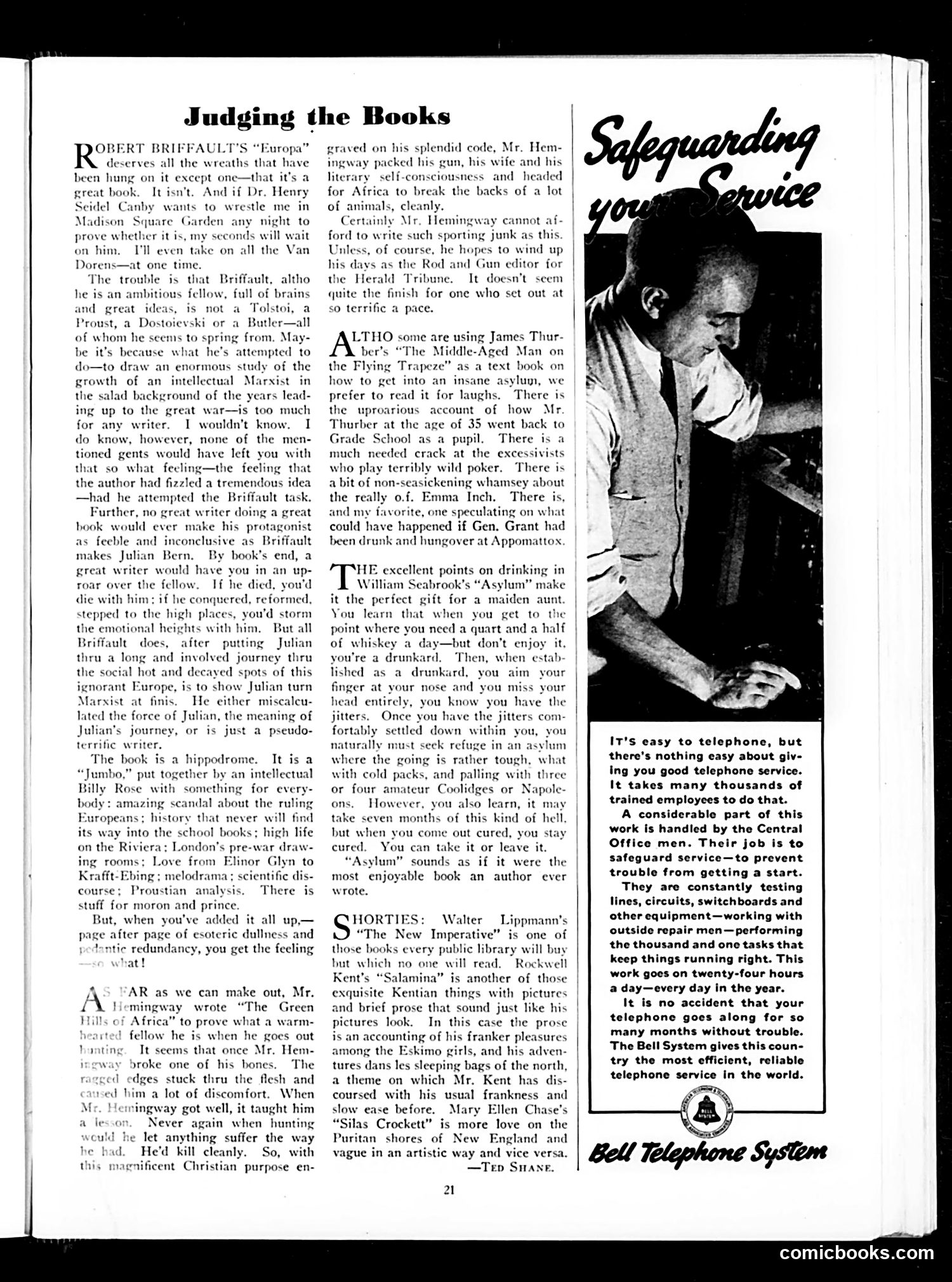
A restored page from Judge, 1936-01. Page through the whole issue in the reader above.
📄 Transcribed text from this page (OCR, searchable)
Machine-transcribed from the original scan — historical spelling and the odd misread are preserved.
OBERT BRIFFAUL’ “Europa” deserves all the wreaths that have been hung on it except one—that it’s a great book. It isn’t. And if Dr. Henry Seidel Canby wants to wrestle me in Madison Square Garden any night to prove whether it is, my seconds will wait on him, I'll even take on all the Van Dorens—at one time. The trouble is that Briffault, altho he is an ambitious fellow, full of brains and great ideas, is not a Tolstoi, a Proust, a Dostoievski or a Butler—all of whom he seems to spring from. M be it’s because what he’s attempted to do—to draw an enormous study of the growth of an intellectual Marxist in the salad background of the rs lead- ing up to the great war—is too much for any writer. I wouldn't know. I do know, however, none of the men- tioned gents would have left you with that so what feeling—the feeling that the author had fizzled a tremendous idea 1 he attempted the Briffault tas Further, no great writer doing a gr book would ever make his pro as feeble and inconclusive as Brif makes Julian Bern. By book’s end, a great writer would have you in an up- roar over the fellow. If he died, you'd die with him: if he ¢ red, reformed, stepped to the high places, you'd storm the emotional heights with him, But all Sriffault does, after putting Julian thru a long and involved journey thru the social hot and decayed spots of this ignorant Europe, is to show Julian turn Marxist at finis. He either miscaleu- lated the force of Julian, the meaning of Julian's journey, or is just a pseudo- ternihe wri * The book is a hippodrome. It is a “Jumbo,” put together by an intellectual Silly Rose with something for every body: amazing scandal about the ruling Europeans: history that never will find its way into the school books; high life on the Riviera; London's pre-war draw- ing rooms; Love from Elinor n to Krafft-Ebing ; melodrar scientific dis- course; Proustian analysis. There is stuff for moron and prince. But, when you've added it all up,— page after page of esoteric dullness and - redundancy, you get the feeling hat! A AR as we can make out, Mr. LX vemingway wrote “The Green of Africa” to prove what a warm- a fellow he is when he goes out iting. It seems that once Mr. Hem- ingway broke one of his bones. The ragged edges stuck thru the flesh and } him a lot of discomfort. When Mr. Hemingway got well, it taught him Never again when hunting let anything suffer the way had. He'd kill cleanly. So, with magnificent Christian purpose en- Judging the Books graved on his splendid code, Mr. Hem- ingway packed his gun, his wife and his literary. self-consciousness and headed for Africa to break the backs of a lot of animals, cleanly. Certainly Mr. Hemingway cannot af ford to write such sporting junk as this. Unless, of course, he hopes to wind up his days as the Rod and Gun editor for the Herald Tribune. It doesn’t seem quite the finish for one who set out at so terrific a pace. LTHO some are using James Thur- ber’s “The Middle-Aged Man on the Flying Trapeze” as a text book on how to get into an insane asylum, we prefer to read it for laughs. There is the uproarious account of how Mr. Thurber at the of 35 went back to Grade School as a pupil. There is a much needed crack at the excessivists who play terribly wild poker. There is a bit of non-seasickening whamsey about the really 0.f. Emma Inch. There is, and my favorite, one speculating on what could have happened if Gen. Grant had been drunk and hungover at Appomattox HE excellent points on drinking in William Seabrook’s “Asylum” make it the perfect gift for a maiden aunt. You learn that when you get to the point where you need a quart and a half of whiskey a day—but don’t enjoy it. you're a drunkard, Then, when estab. lished as a drunkard, you aim your finger at your nose and you miss your h ad entirely, you know you have the jitters. Once you have the jitters co: fortably settled down within you, you naturally must seek refuge in an asylum where the going is rather tough, what with cold packs, and palling with three or four amateur Coolidges or Napole- ons, However, you also learn, it may ake seven months of this kind of hell, but when you come out cured, you stay cured, You can take it or leave it. Asylum” sounds as if it were the most enjoyable book an author ever wrote. HORTIE Walter — Lippmann’s “The New Imperative” is one of those books every public library will buy but which no one will read. Rockwell Kent’s “Salamina” is another of those exquisite Kentian things with pictures and brief prose that sound just like his pictures loc In this case the prose is an accounting of his franker pleasures among the Eskimo girls, and his adven- tures dans les sleeping bags of the north, a theme on which Mr. Kent has dis- coursed with his usual frankness and slow ease before. Mary Ellen Chase's “Silas Crockett” is more love on the Puritan shores of New England and vague in an artistic way and vice versa. —Tep Snane. 21 It’s easy to telephone, but there's nothing easy about giv- Ing you good telephone service. It takes many thousands of trained employees to do that. A considerable part of this work is handled by the Central Office men. Their job is to safeguard service—to prevent trouble from getting a start. They are constantly testing lines, circuits, switchboards and other equipment—working with outside repair men—performing the thousand and one tasks that keep things running right. This work goes on twenty-four hours a day—every day in the year. It is no accident that your telephone goes along for so many months without trouble. The Bell System gives this coun- try the most efficient, reliable telephone service in the world. comicbooks.com