
Judge, 1936-01 · page 21 of 36
Judge — January 1936 — page 21: what you’re looking at
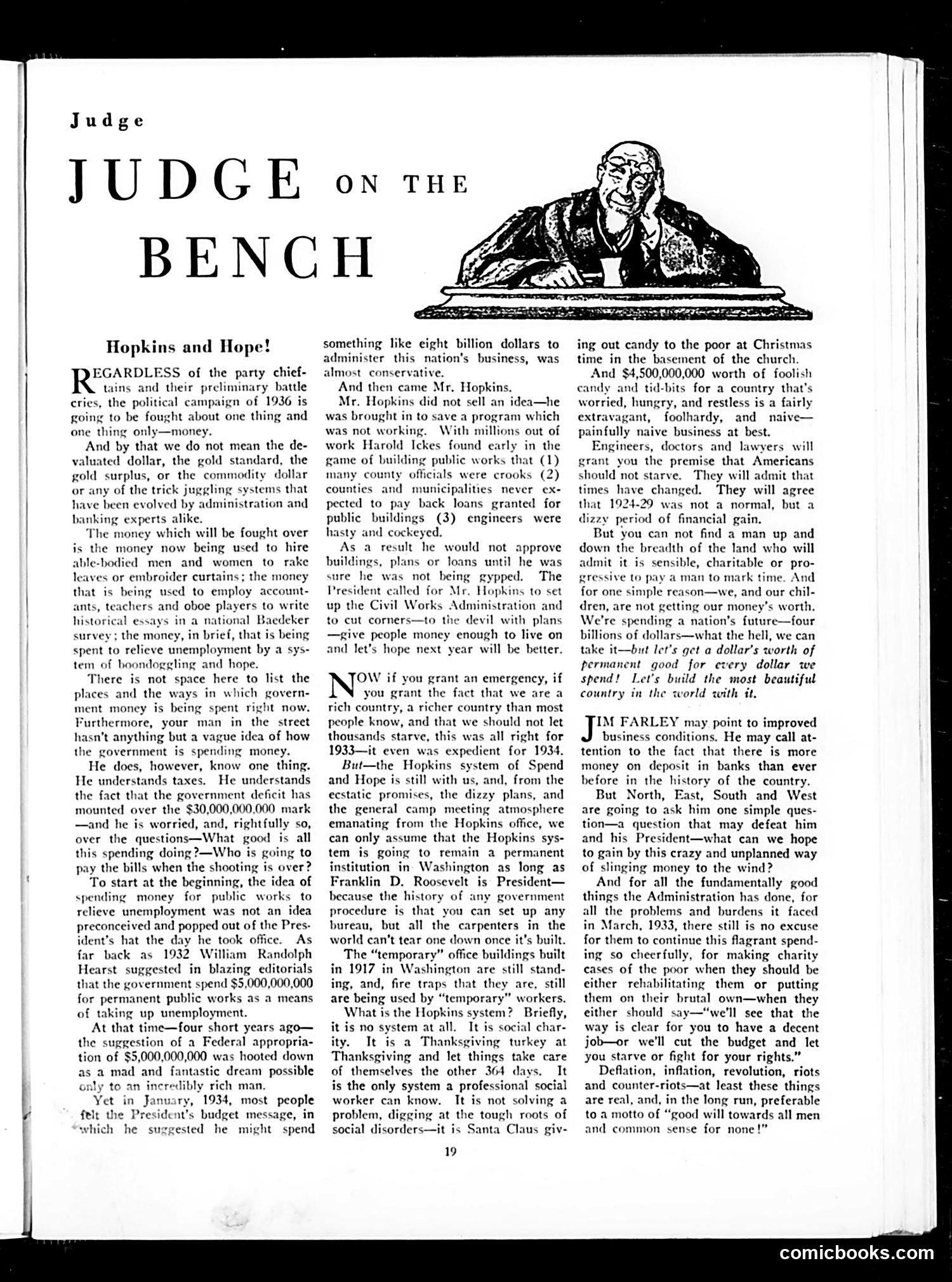
A restored page from Judge, 1936-01. Page through the whole issue in the reader above.
📄 Transcribed text from this page (OCR, searchable)
Machine-transcribed from the original scan — historical spelling and the odd misread are preserved.
Hopkins and Hope! EGARDLESS of the party chief- tains and their preliminary battle cries, the political campaign of 1936 is going to be fought about one thing and one thing only—money. And by that we do not mean the de- valuated dollar, the gold standard, the gold surplus, or the commodity dollar or any of the trick juggling systems that have been evolved by administration and banking experts alike. The money which will be fought over is the money now being used to hire able-bodied men and women to rake leaves or embroider curtains; the money that is being used to employ account- ants, teachers and oboe players to write historical essays in a national Baedeker survey; the money, in brief, that is being spent to relieve unemployment by a sys- tem of boondoggling and hope. There is not space here to list the places and the ways in which govern- ment money is being spent right now. Furthermore, your man in the street hasn’t anything but a vague idea of how the government is spending money. He does, however, know one thing. He understands taxes. He understands the fact that the government deficit has mounted over the $30,000,000,000 mark —and he is worried, and, rightfully so, over the questions—What good is all this spending doing ?—Who is going to pay the bills when the shooting is over? To start at the beginning, the idea of spending money for public works to relieve unemployment was not an idea preconceived and popped out of the Pres- ident’s hat the day he took office. As far back as 1932 William Randolph Hearst suggested in blazing editorials that the government spend $5,000,000,000 for permanent public works as a means of taking up unemployment. At that time—four short years ago— the suggestion of a Federal appropria- tion of $5,000,000,000 was hooted down mad and fantastic dream possible to an incredibly rich man. Yet in January, 1934, most people felt the President’s budget message, in which he suggested he might spend something like eight billion dollars to administer this nation’s business, was almost. conservative. And then came Mr. Hopkins, Mr. Hopkins did not sell an idea—he was brought in to save a program which was not working. With millions out of work Harold Ickes found early in the game of building public works that (1) many county officials were crooks (2) counties and municipalities never ex- pected to pay back loans granted for public buildings (3) engineers were hasty and cockeyed. As a result he would not approve buildin plans or loans until he was sure he was not being gypped. The President called for Mr. Hopkins to set up the Civil Works Administration and to cut corners—to the devil with plans —ive people money enough to live on and let’s hope next year will be better. OW if you grant an emergency, if ant the fact that we are a rich country, a richer country than most people know, and that we should not let thousands starve, this was all right for 1933—it even expedient for 1934, But—the Hopkins system of Spend and Hope is still with us, and, from the ecstatic promises, the dizzy plans, and the general camp meeting atmosphere emanating from the Hopkins office, we can only assume that the Hopkins sys- tem is going to remain a permanent institution in Washington as long as Franklin D. Roosevelt is President— because the history of any government procedure is that you can set up any bureau, but all the carpenters in the world can’t tear one down once it’s built. The “temporary” office buildings built in 1917 in Washington are still stand- ing, and, fire traps that they are, still are being used by “temporary” workers. What is the Hopkins system? Briefly, it is no system at all. It is social char- ity. It is a Thanksgiving turkey at Thanksgiving and let things take care of themselves the other 364 days. It is the only system a professional social worker can know. It is not solving a problem, digging at the tough roots of social disorders—it is Santa Claus giv- 19 ing out candy to the poor at Christmas time in the basement of the church. And _$4,500,000,000 worth of foolish nd tid-bits for a country that’s worried, hungry, and restless is a fairly extravagant, foolhardy, and naive— painfully naive business at best. ngineers, doctors and lawyers will grant you the premise that Americans should not starve. They will admit that times have changed. They will agree that 1924-29 was not a normal, but a dizzy period of financial gain, But you can not find a man up and down the breadth of the land who will admit it is sensible, charitable or pro- gressive to pay a man to mark time. And for one simple reason—we, and our chil- dren, are not getting our money’s worth, We're spending a nation’s future—four billions of dollars—what the hell, we can take it—but let’s get a dollar’s worth of permanent good for every dollar we spend! Let's build the most beautiful country in the world with it, IM FARLEY may point to improved business conditions. He may call at- tention to the fact that there is more money on deposit in banks than ever before in the history of the country. But North, East, South and West are going to ask him one simple ques- tion—a question that may defeat him and his President—what can we hope to gain by this crazy and unplanned way of slinging money to the wind? And for all the fundamentally good things the Administration has done, for all the problems and burdens it faced in March, 1933, there still is no excuse for them to continue this flagrant spend- ing so cheerfully, for making charity cases of the poor when they should be either rehabilitating them or putting them on their brutal own—when they either should say—‘we'll see that the way is clear for you to have a decent job—or we'll cut the budget and let you starve or fight for your rights.” Deflation, inflation, revolution, riots and counter-riots—at least these things are real, and, in the long run, preferable to a motto of “good will towards all men and common sense for none!” comicbooks.com