A complete issue · 36 pages · 1934
Judge — February 1934
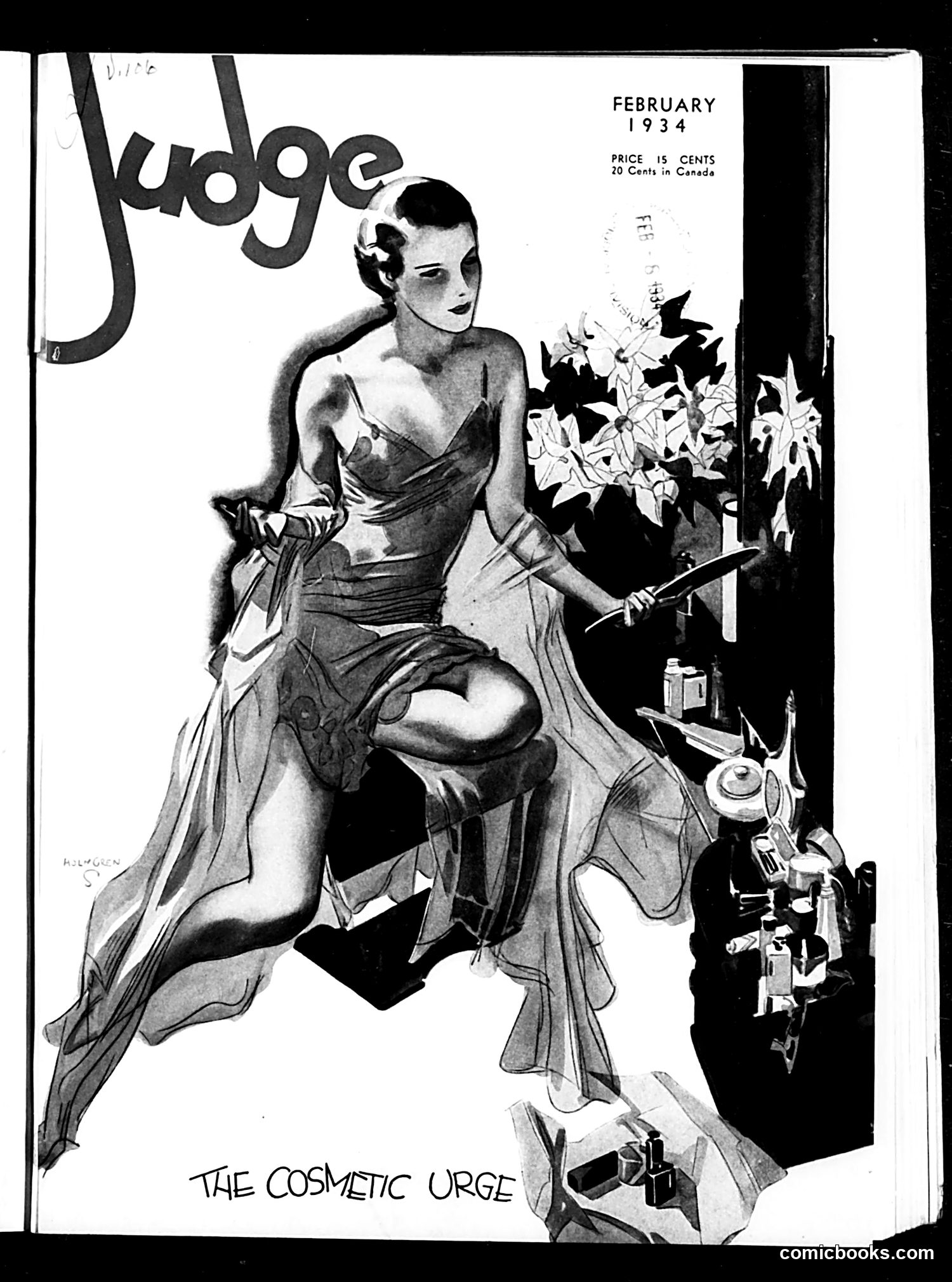
# "The Cosmetic Urge" - Judge, February 1934 This cover satirizes women's enthusiasm for cosmetics and beauty products during the Depression era. The illustration shows an elegantly dressed woman surrounded by beauty supplies—makeup, flowers, and perfume bottles—applying cosmetics with a paintbrush. The title "The Cosmetic Urge" suggests an almost compulsive drive to beautify oneself. The satire likely mocks the contradiction of Depression-era economics: despite widespread financial hardship, women continued purchasing luxury beauty products. The woman's glamorous pose and abundance of cosmetics imply vanity or frivolous spending during economically difficult times. This reflects 1930s attitudes about gender, consumption, and the perceived priorities of middle-class women.
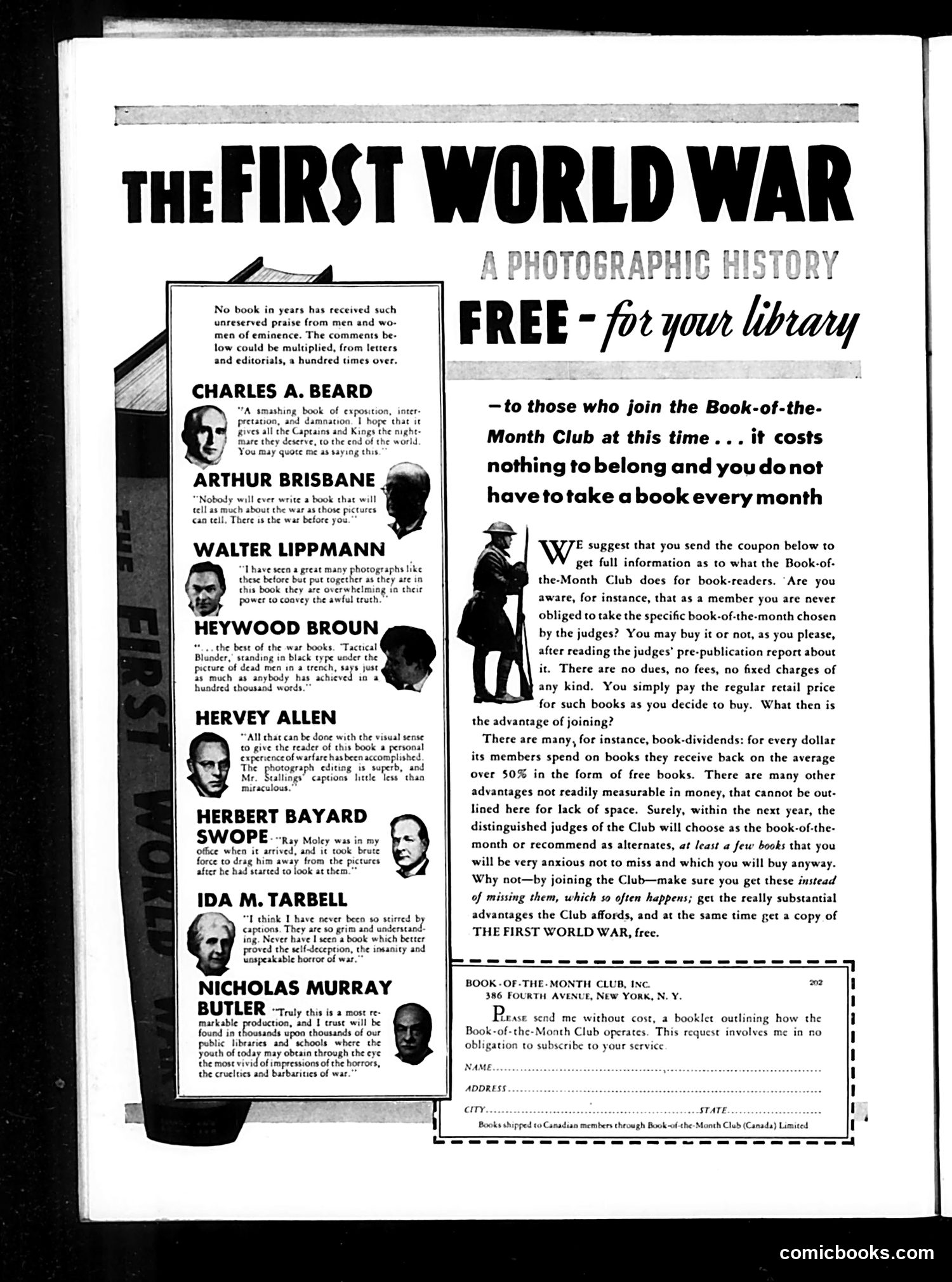
# "The First World War: A Photographic History" This page is primarily an advertisement for a Book-of-the-Month Club promotion offering a free book about WWI. The left side features endorsements from notable figures of the era—including writers Charles A. Beard, Arthur Brisbane, Walter Lippmann, and Heywood Broun—praising the book's photographic documentation and historical value. Rather than satire, this represents a straightforward marketing appeal to library patrons, emphasizing the book's cultural importance and the Club's membership benefits (dividends, no fees). The emphasis on photography's power to document war reflects 1920s-30s attitudes about visual media as an objective historical record. There is no apparent cartoon or satirical commentary on this page.
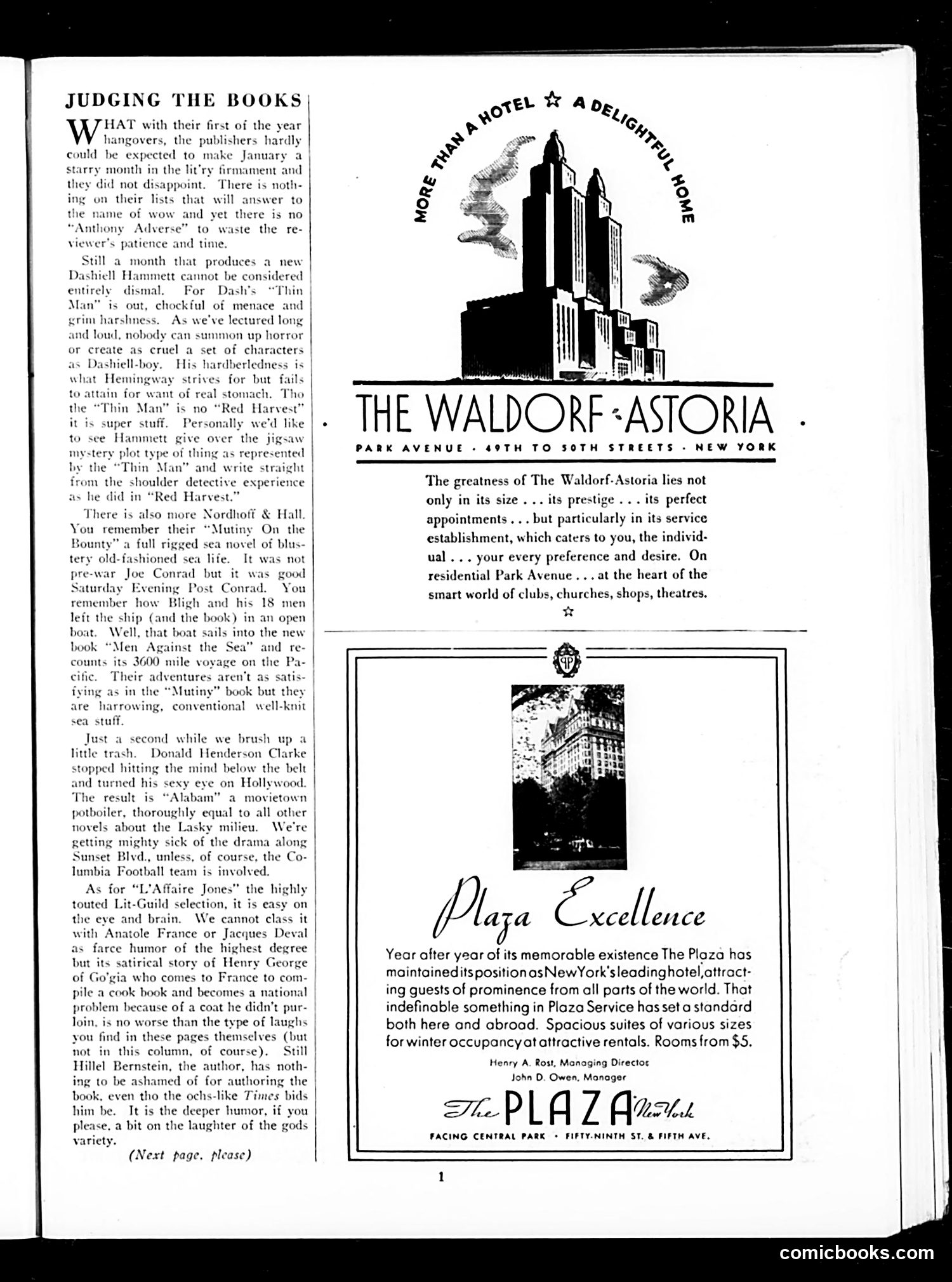
# Analysis This page is primarily **advertising**, not editorial content. The main visual elements are hotel and hospitality advertisements: 1. **The Waldorf-Astoria** (top): A luxury hotel advertisement emphasizing its service and Park Avenue location in Manhattan's elite district. 2. **The Plaza Hotel** (bottom): Another prominent NYC hotel ad highlighting its "Plaza Excellence" and year-round prominence among wealthy guests, with room rates starting at $5. The left column contains a book review section titled "Judging the Books," discussing recent literary releases. There are no political cartoons or satirical illustrations on this page—it represents Judge magazine's advertising revenue model during this era, mixing light literary commentary with upscale hotel promotions targeting affluent readers.
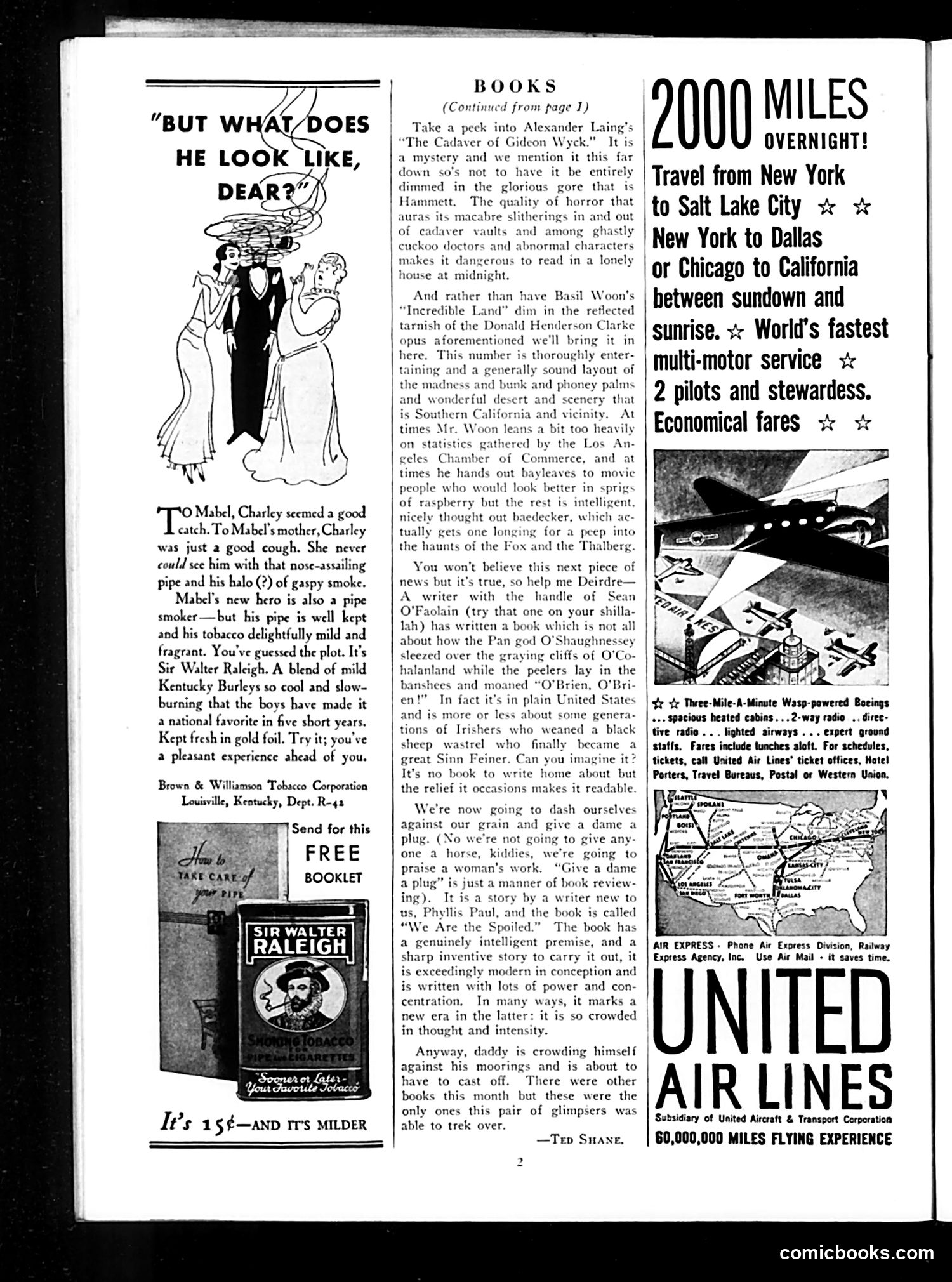
# Analysis of Judge Magazine Page This page is primarily **advertising with minimal editorial content**. The left side features a tobacco ad for Sir Walter Raleigh pipe tobacco, using the historical figure of Sir Walter Raleigh as a brand mascot. The accompanying cartoon depicts a couple discussing a pipe smoker, playing on the product's claim to be mild and fresh—typical mid-century tobacco marketing that emphasized masculine sophistication. The right side contains United Airlines advertising, promoting transcontinental overnight flights as a modern marvel. A small book review section by Ted Shane discusses recent publications but contains no discernible political satire. The page reflects **1930s-40s consumer culture** rather than political commentary, showcasing how Judge magazine balanced editorial content with revenue-generating advertisements.
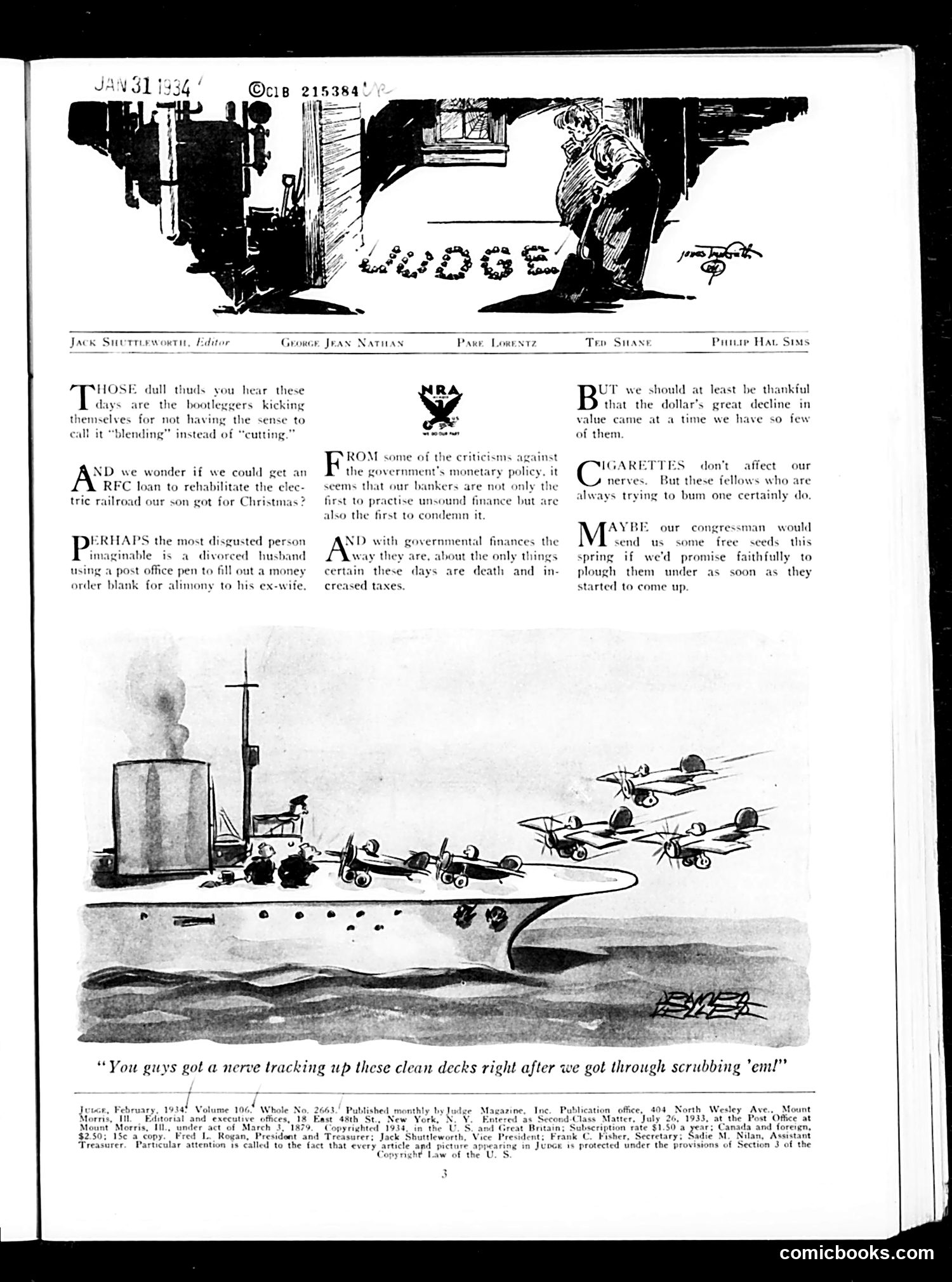
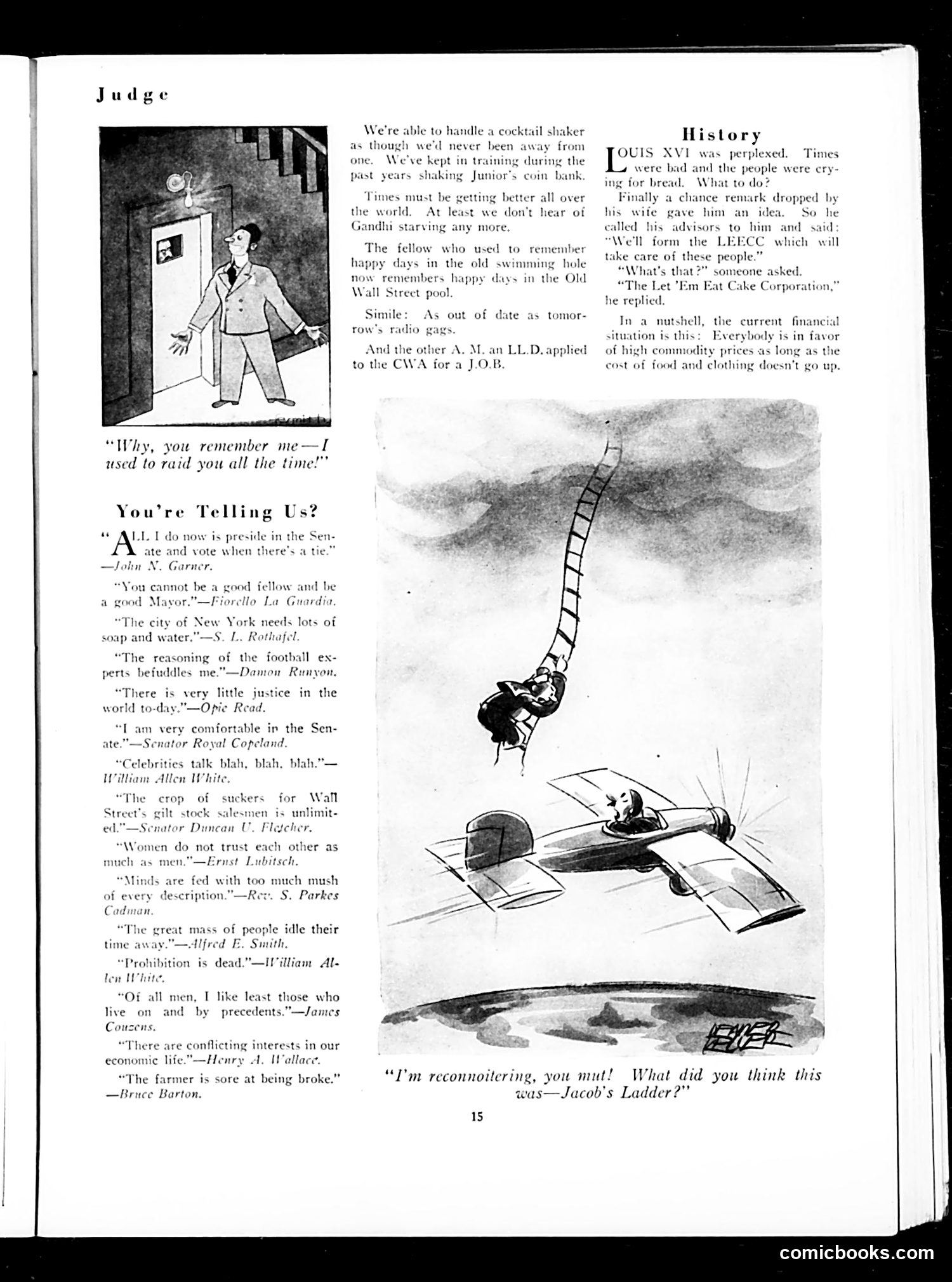
# Judge Magazine Editorial Page Analysis This February 1934 editorial page combines commentary on Depression-era economic concerns with a naval/military cartoon. The text snippets criticize contemporary issues: questionable banking practices, government monetary policy, and tax increases. One piece sarcastically suggests a congressman send "free seeds" to constituents—likely referencing agricultural relief programs. The large cartoon depicts a naval vessel with planes launching from its deck. The caption reads: "You guys got a nerve tracking up these clean decks right after we got through scrubbing 'em!" This appears to satirize military readiness or naval operations during a period of American rearmament in the early 1930s, possibly mocking either bureaucratic inefficiency or the friction between different military branches' priorities during Depression-era budget constraints.
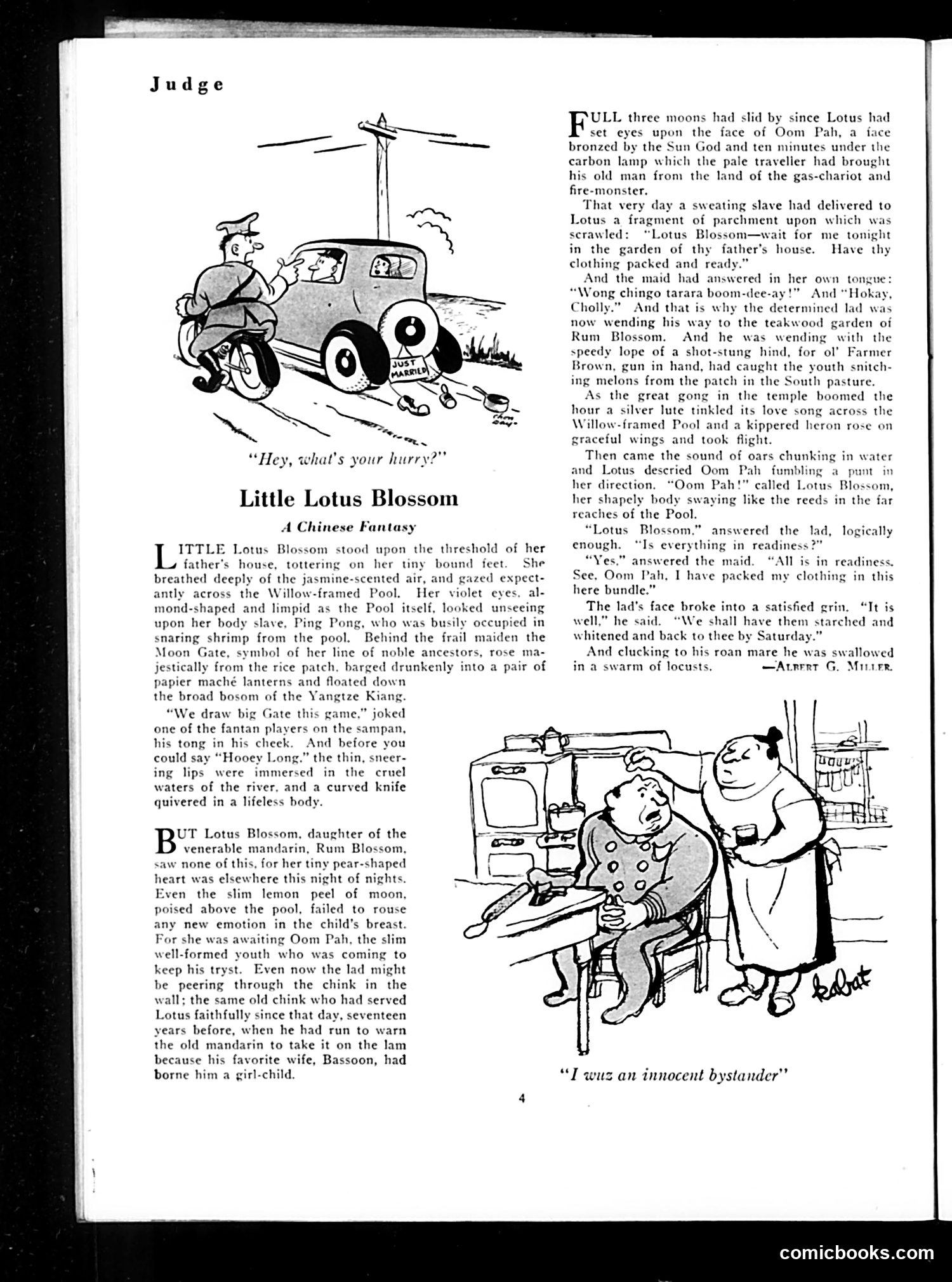
# "Little Lotus Blossom" - Judge Magazine This page presents a serialized fiction story titled "Little Lotus Blossom: A Chinese Fantasy" by Albert G. Muir, illustrated with two cartoons. The top cartoon shows a figure on a bicycle next to a broken-down car, asking "Hey, what's your hurry?" — likely satirizing early automobile reliability compared to bicycles, a common Judge subject during the automotive era. The bottom cartoon caption reads "I wuz an innocent bystander," depicting what appears to be a domestic dispute or accident scene, suggesting commentary on everyday mishaps or family conflicts. The story itself involves Asian characters and settings (Lotus Blossom, Oom Pah, Rum Blossom, Moon Gate), representing the "Orientalist" fantasy fiction popular in early 20th-century American magazines—often containing period stereotypes reflecting contemporary attitudes toward Asian cultures.
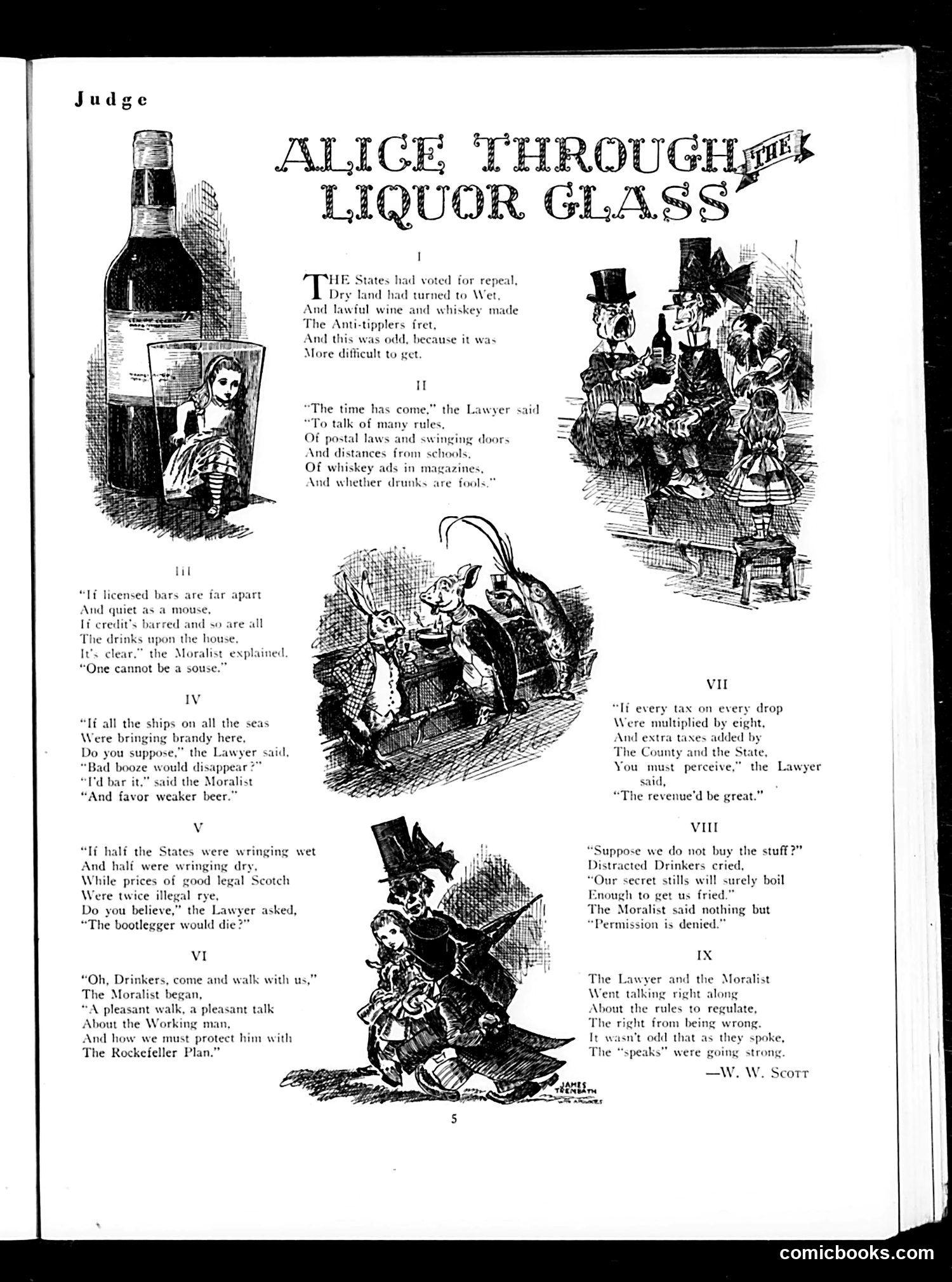
# "Alice Through the Liquor Glass" This is a satirical poem by W. W. Scott responding to Prohibition's repeal. The poem uses Alice in Wonderland imagery to mock both the preceding dry era and post-repeal chaos. **The satire targets:** - Prohibition advocates ("Moralists") and their failed logic - Lawyers and politicians debating regulation details while missing the point - The impracticality of complex tax schemes to replace lost alcohol revenues - Drinkers' resistance to government control through secret stills - The absurdity of the entire situation The bottle and Alice-like character appearing in illustrations reference Carroll's work to underscore the "through the looking glass" illogic of alcohol policy from multiple perspectives. The piece mocks everyone involved—regulators, profiteers, and consumers—for participating in what the author sees as fundamentally foolish.
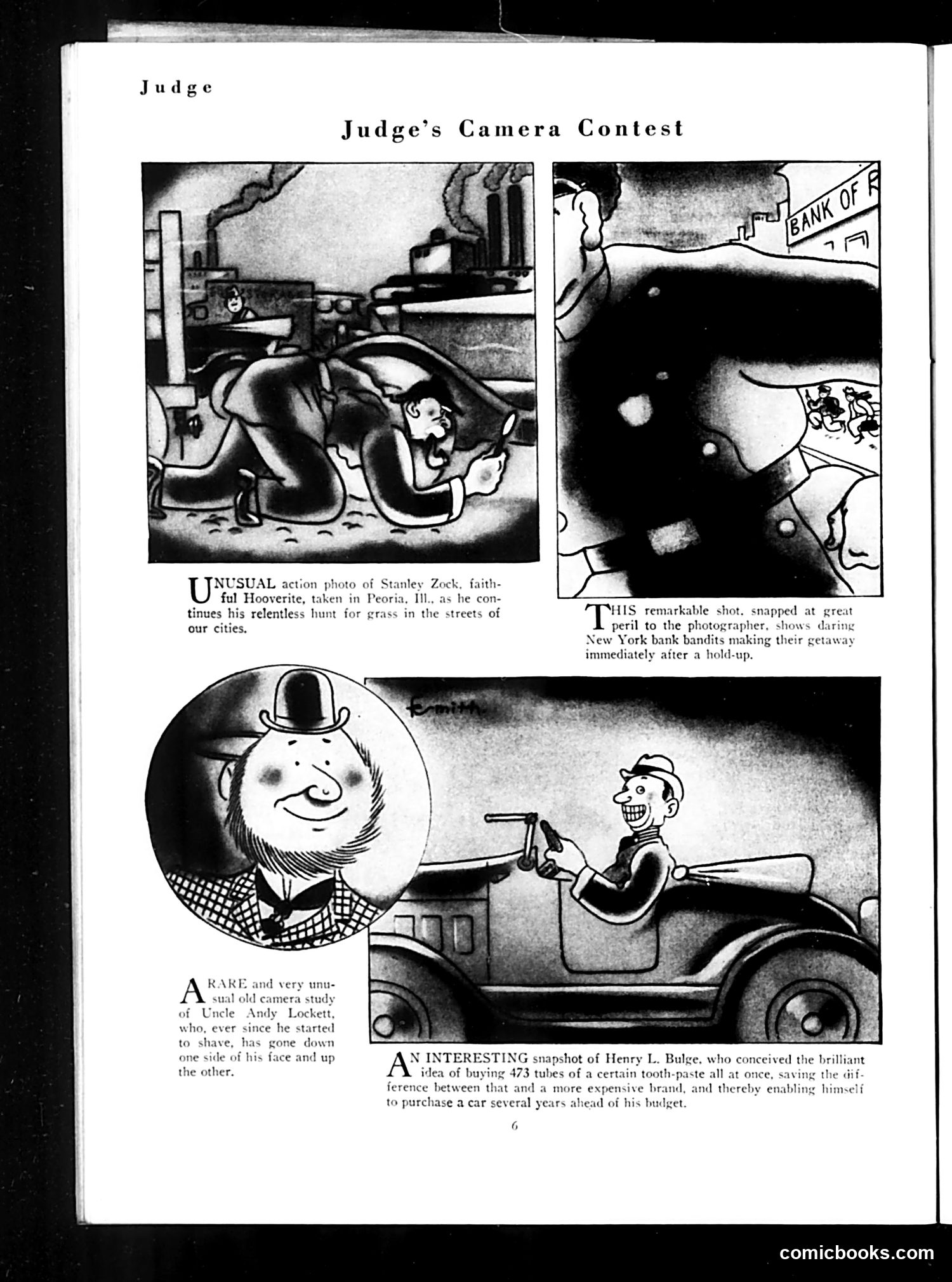
# Judge's Camera Contest - Page Analysis This page showcases humorous photographs submitted to Judge magazine's "Camera Contest." The entries feature: 1. **Stanley Zock (Peoria, Illinois)**: Photograph of a man crawling under industrial machinery, captioned as searching for grass in city streets—satirizing the absurdity of urban life and poverty. 2. **Bank robbery scene**: A daring photograph of criminals escaping after a New York bank hold-up, noted as dangerous to photograph. 3. **Uncle Andy Lockett**: An unusual old camera study showing his face split vertically—a visual joke about his shaving habits (one side shaved, one not). 4. **Henry L. Bulge**: A cartoon-style photo of a man with an exaggerated grin in a car, with text joking about buying 473 toothpaste tubes to save money for the vehicle—satirizing consumer purchasing logic and frugality. The page blends real photographs with illustrated humor.
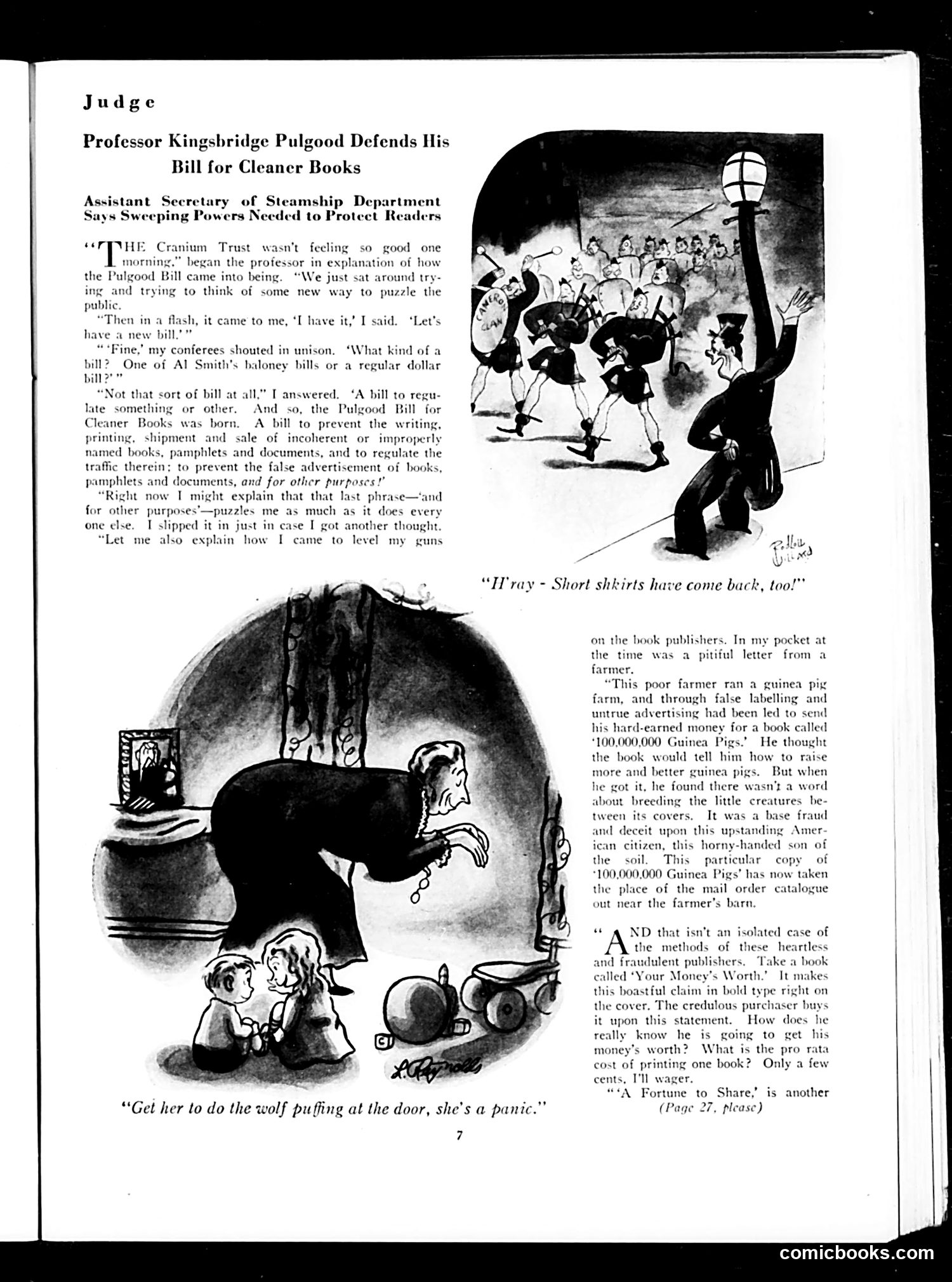
# Explanation for Modern Readers This Judge magazine article satirizes legislative overreach and self-serving politicians. Professor Kingsbridge Pulgood openly admits that he and his colleagues invented the "Pulgood Bill for Cleaner Books" simply to create *some* new regulation without genuine purpose—they cynically included vague language like "for other purposes" as a joke because they had no real agenda. The satire exposes the absurdity: Pulgood claims moral concern for a defrauded farmer who bought a guinea pig book (likely the real 1933 exposé *100,000,000 Guinea Pigs*), but this is merely a pretext. The cartoons show people confused about fashion trends and moral panic—illustrating public gullibility. The point: politicians manufacture "reform" bills not to solve actual problems but to expand power and appear virtuous. The mockery targets legislative dishonesty and the public's susceptibility to hollow moral crusades dressed up as protection.
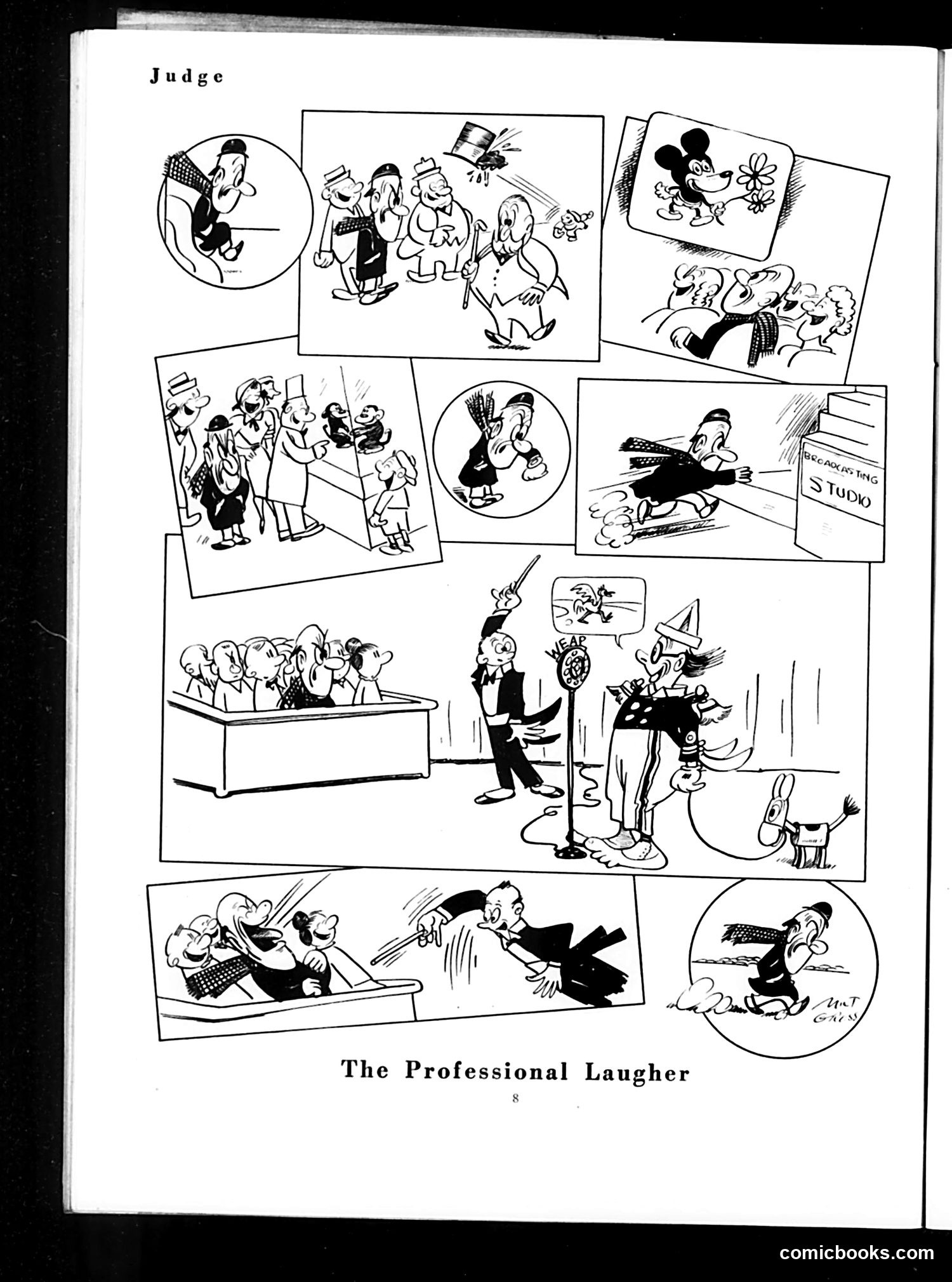
# "The Professional Laugher" This Judge satirical comic depicts a courtroom scene mocking "professional laughers"—hired audience members who artificially boosted entertainment appeal by laughing on cue. The sequence shows: 1. A judge presiding over court 2. Various scenes of a theatrical performer/entertainer with exaggerated expressions 3. A courtroom full of jurors/observers 4. The protagonist apparently being pursued or in comedic chaos The satire targets the entertainment industry practice of employing paid laughers to manipulate audience response during performances. By placing this scheme in a courtroom setting with a judge, the cartoonist suggests the practice is fraudulent or worthy of legal judgment. This was a legitimate industry concern in early-to-mid 20th century theater and radio, where "laugh tracks" and hired audience members created false impressions of a show's popularity or quality.
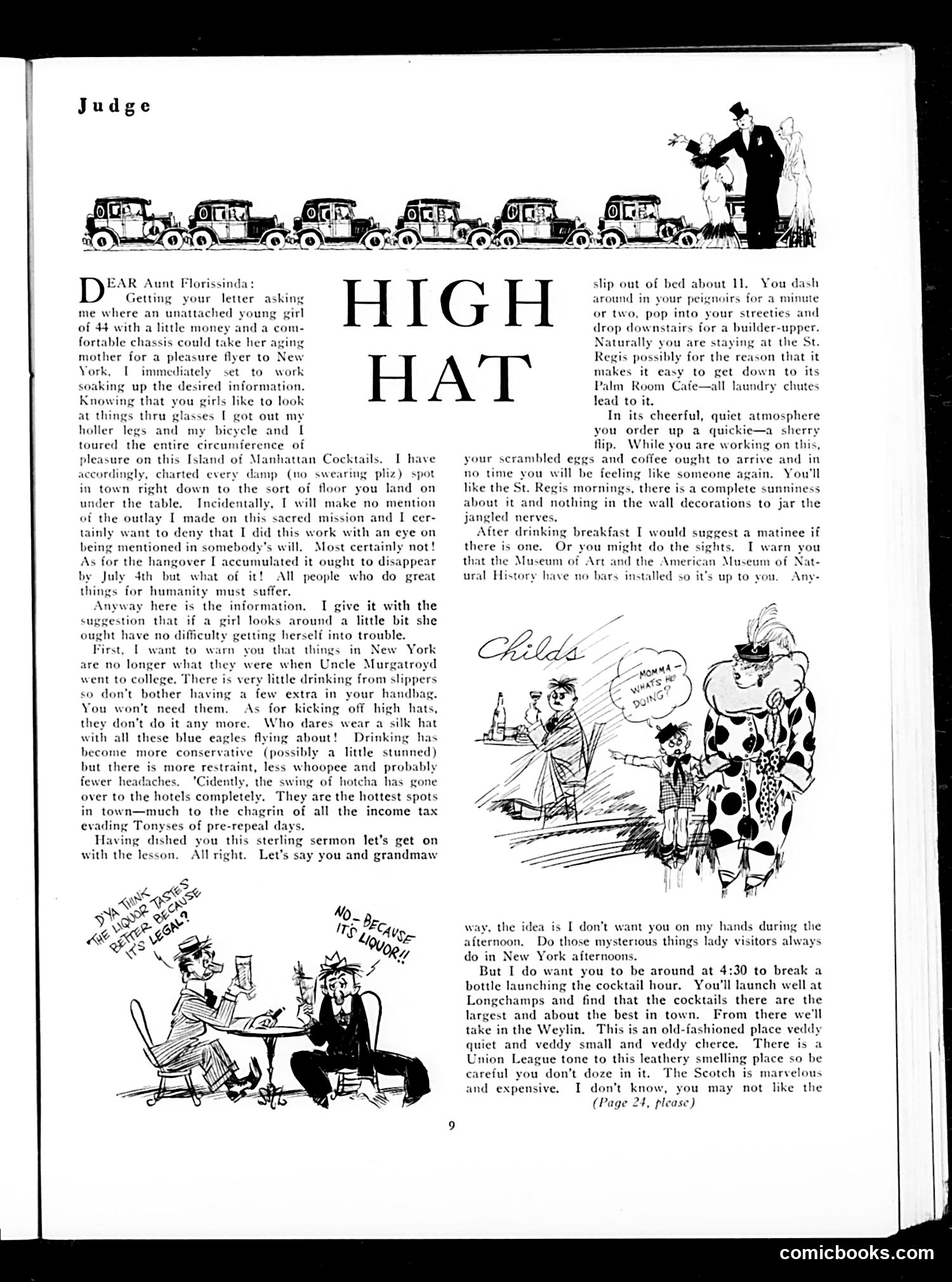
# Judge Magazine Satire Analysis This is a humorous advice column disguised as a letter from "Judge" (the magazine's persona) to "Aunt Florissinda," offering New York City tourism tips for older women with disposable income. **The Satire:** The piece mocks 1930s high society and changing social mores. It references Prohibition's repeal ("blue eagles flying about" refers to NRA codes), noting that drinking is now "conservative" but has shifted to hotels. The narrator sarcastically claims to have researched NYC's bar scene exhaustively while accumulating hangovers—a self-deprecating joke about the magazine's own indulgence. **Key References:** - "Uncle Murgatroyd" = generic old-money figure representing pre-Prohibition excess - St. Regis, Longchamps, the Weylin = actual NYC establishments - The advice to occupy visitors with museums and matinees during afternoons reflects class assumptions about leisured women's activities **The Point:** Gentle ribbing of wealthy dowagers, post-Repeal drinking culture, and New York's hotel scene as the new center of social life, replacing speakeasies.
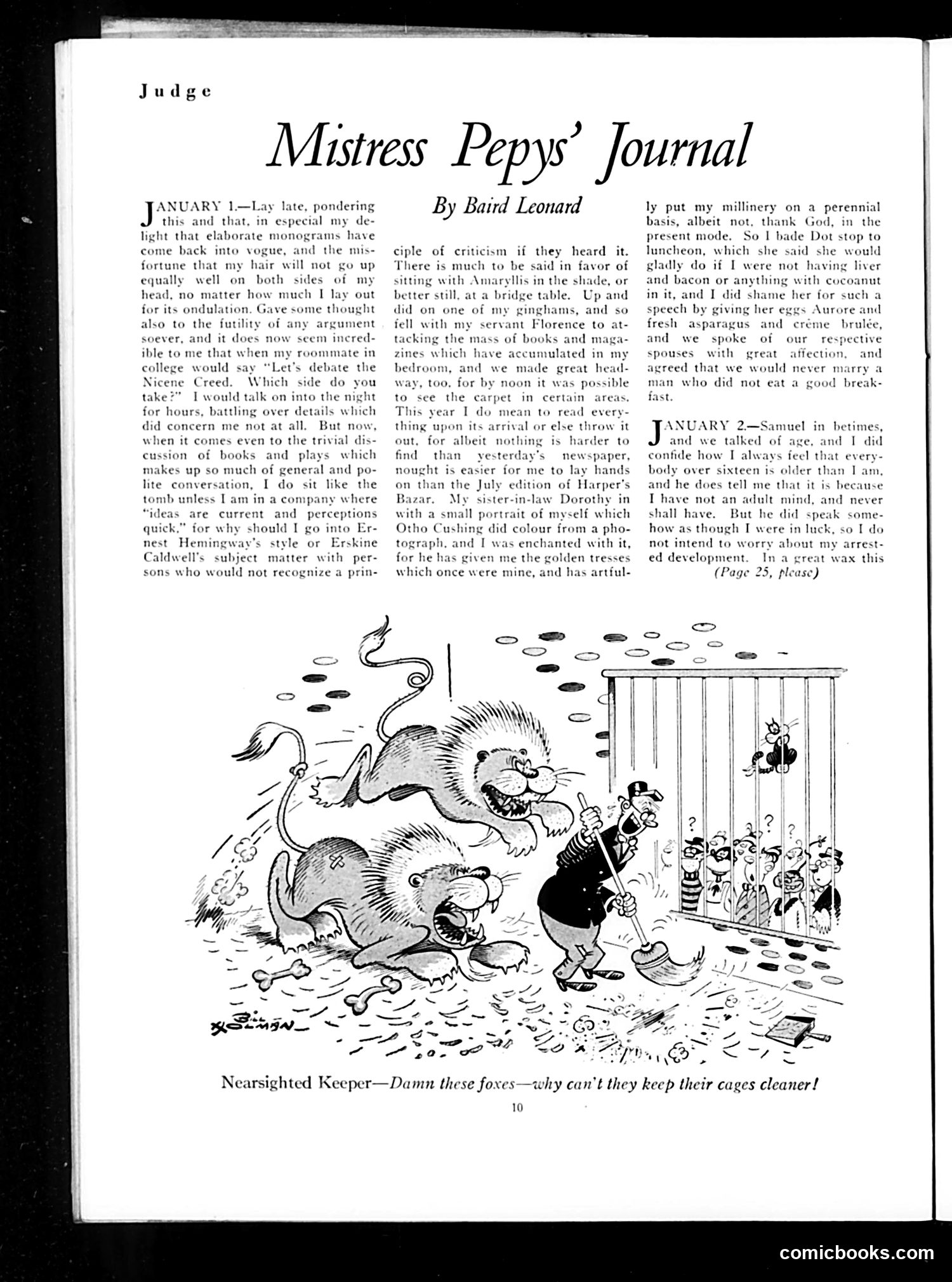
# "Mistress Pepys' Journal" & "Nearsighted Keeper" **"Mistress Pepys' Journal"** is a humorous diary column mimicking Samuel Pepys's famous 17th-century diary, but featuring a modern (1920s-30s) woman's mundane concerns: hairstyles, monograms, books, bridge games, and marital observations. The satire gently mocks both women's intellectual pretensions (debating theology they don't understand) and their shallow domestic preoccupations. **"Nearsighted Keeper"** is a separate cartoon showing a frustrated zookeeper confronting escaped foxes destroying their cage, complaining they won't keep it clean. The joke appears to be about the keeper's nearsightedness—he can't see the obvious problem: the foxes have *escaped*, making cage cleanliness irrelevant. It's an absurdist humor commenting on missing the real issue due to poor vision (literal or figurative). Both pieces exemplify Judge's satirical style: gentle mockery of domestic life and human obliviousness.