
Judge, 1934-02 · page 22 of 36
Judge — February 1934 — page 22: what you’re looking at
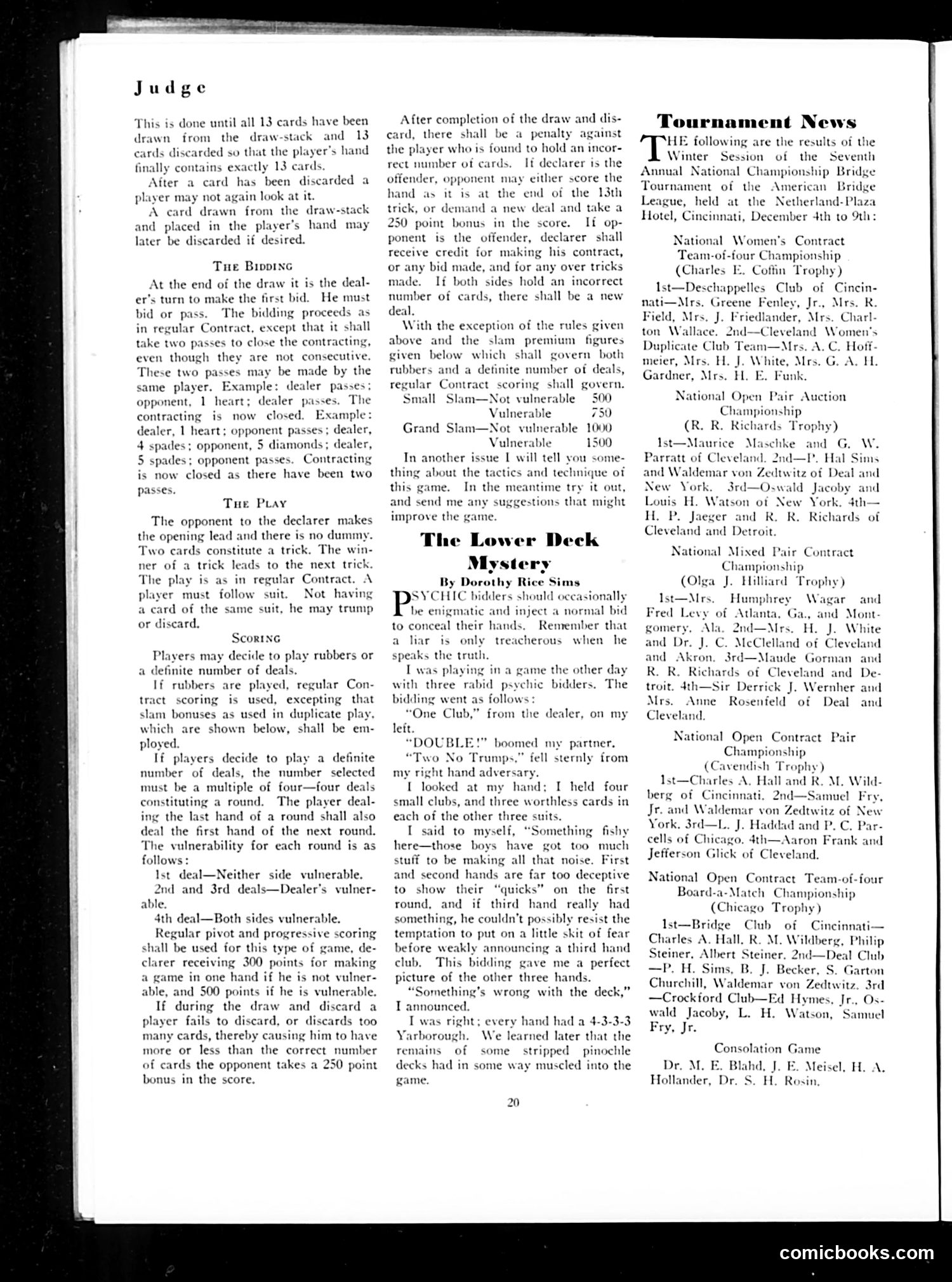
A restored page from Judge, 1934-02. Page through the whole issue in the reader above.
📄 Transcribed text from this page (OCR, searchable)
Machine-transcribed from the original scan — historical spelling and the odd misread are preserved.
Judge This is done until all 13 cards have been drawn from the draw-stack and 13 cards discarded so that the player’s hand finally contains exactly 13 cards. After a card has been discarded a player may not again look at it. A card drawn from the draw-stack and placed in the player's hand may later be discarded if desired. Tue Bipot At the end of the draw it is the deal- er’s turn to make the first bid. He must bid or pass. The bidding proceeds as in regular Contract, except that it shall take two passes to close the contracting, even though they are not consecutive. These two pa same player. opponent, 1 heart; dealer passes. The contra aler, 1 heart; opponent passes; dealer, es may be made by the =xample: dealer passes: ting is now closed. Example: 4 spades; opponent, 5 diamonds; dealer, pponent passes. Contracting closed as there have been two 5 spades is now passes. Tue Pray The opponent to the declarer makes the opening lead and there is no dummy. Two cards constitute a trick. The win- ner of a trick leads to the next trick. The play is as in regular Contract. A player must follow suit. Not having a card of the same suit, he may trump or discard, Scortnc Players may decide to play rubbers or a definite number of deals. If rubbers are played, regular Con- tract scoring is used, excepting that slam bonuses as used in duplicate play which are shown below, shall be em- ployed. lf players decide to play a definite number of deals, the number selected must be a multiple of four—four deals constituting a round. The player deal- ing the last hand of a round shall also deal the first hand of the next round. he vulnerability for each round is as follows: Ist deal—Neither side vulnerable. and 3rd deals—Dealer’s vulner- 4th deal—Both sides vulnerable. Regular pivot and progressive scoring shall be used for this type of game, de- clarer receiving 300 points for making a game in one hand if he is not vulner- able, and 500 points if he is vulnerable, If during the draw and discard a player fails to discard, or discards too many cards, therel using him to have more or less than the correct number of cards the opponent takes a bonus in the score. After completion of the draw and dis- card, there shall be a penalty against the player who is found to hold an incor- rect number of cards. If declarer is the offender, opponent may either score the the end of the 13th trick, or demand a new deal and take a 250 point bonus in the score. If op- ponent is the offender, declarer shall receive credit for mak his contract or any bid made, and for any over tricks made. If both sides hold an incorrect number of cards, there shall be a new deal. With the exception of the rules given above and the slam premium figures given below which shall govern bot rubbers and a detinite number of deals, regular Contract scoring shall g Small Slam—Not vulnerable Vulnerable Grand Slam—Not vulnerable 1000 Vulnerable 1500, In another issue [ will tell you some- thing about the tactics and technique of this game. In the meantime try it out, and send me any suggestions that might improve the game. T Lower Deck Mystery By Dorothy Rice Sims SYCHIC bidders should occasionally be enigmatic and inject a normal bid to conceal their hands. Remember that a liar is only treacherous when he speaks the truth, I was playi hand as it is at game the other d. with three rabid psychic bidders, The bidding went as follows: “One Club,” left “DOUB “Two No Trumps,” fell sternly from my right hand adversary. I looked at my hand; I held four small clubs, and three worthless cards in each of the other three suits. I said to myself, “Something fishy here—those have got too much stuff to be making all that noise. First and second hands are far too deceptive to show their “quicks” on the first round, and third hand re had something, he couldn't possibly resist the temptation to put on a little skit of fear before weakly announcing a third hand club. This bidding gave me a perfect picture of the other three hands. “Something’s wrong with the dec! I announced. I was right; every hand had a 4-3-3-3 Yarborough. We learned I some from the dealer, on my boomed my partner, boys er that the stripped _ pinochle decks had in some way muscled into the game. remains of 20 ent News 2 following are the results of the Winter Session of the Seventh Annual National Championship Bridge Tournament of the American Bridge League, held at the Netherland-Plaza Hotel, Cincinnati, December 4th to 9 ational Women’s Contract Team-of-four Championship (Charles E. Coftin Trophy) Ist—Deschappelles Club of Ci nati—Mrs. Greene Fenley, Jr., Mrs. Field, Mrs, J. Friedlander, Mrs. Charl- ton Wallace. Cleveland Women’s Duplicate Club Team—Mrs. A. C. Hoff- meier, Mrs. H. J. White, Mrs. G. A. HL. Gardner, Mrs. E. Funk, National Open Pair Auction Championship (R. R. Richards Trophy) Ist—Maurice Maschke and G, W. Parratt of Cleveland Hal Sims and Waldemar von Zedtwitz of Deal and New York. d—Oswald Louis H. Watson of New H. P. Jaeger and R, R. Cleveland and Detroit. 2nd— Jacoby and York. 4th— Richards of National Mixed Pair Contract Championship Hilliard Troy Humphrey Wagar and Adanta, Ga., and Mont- 5 Irs. He J. White and Dr. C. McClelland of Cleveland and Akre 3rd—Maude Gorman and R. R. Richards of Cleveland and De- troit. 4th—Sir Derrick J. Wernher and Mrs. Anne Rosenfeld of Deal Cleveland. Ist—Mrs. Fred Levy of gomery, Ala d— and ional Open Contract Pair Championship (Cavendish Trophy) 1st—Charles A. Hall and R. M. Wild- berg of Cincinnati, 2nd—Samuel Fr Jr. and Waldemar von Zedtwitz of New York, 3rd—L. J. Haddad and P. C. Par- cells of Chicago, 4th—Aaron Frank and Jefferson Glick of Cleveland. National Open Contract Team-of-four Board-a-Match Championship (Chicago Trophy) lst—Bridge Club of Cincinnati— les A. Hall. R. M. Wildberg, Philip Steiner, Albert Steiner, 2nd—Deal Club —P. H. Sims, B. J. Becker, S. Garton Churchill, Waldemar von Zedtwitz, 3rd —Crockford Club—Ed Hymes, Jr. Os- wald Jacoby, L. H. Watson, Samuel Fry, Jr. Consolation Game Dr. M. E. Blahd, J. E. Meisel, H. A. Hollander, Dr. S. H. Rosin, comicbooks.com