
Judge, 1934-02 · page 21 of 36
Judge — February 1934 — page 21: what you’re looking at
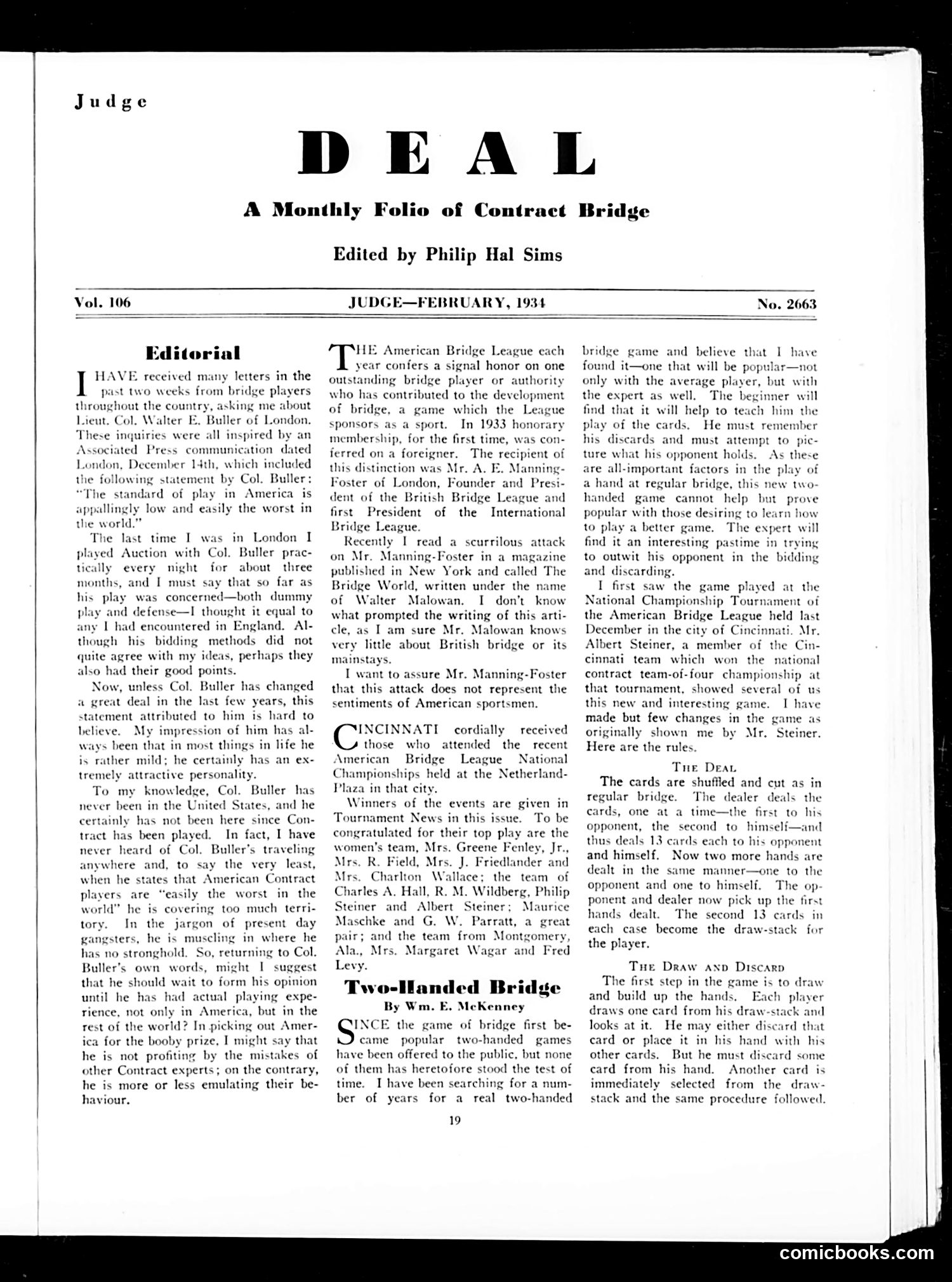
A restored page from Judge, 1934-02. Page through the whole issue in the reader above.
📄 Transcribed text from this page (OCR, searchable)
Machine-transcribed from the original scan — historical spelling and the odd misread are preserved.
Judge DEAL A Monthly Folio of Contract Edited by Philip Hal Sims Bridge Vol. 106 JUDGE—FEBRUARY, 1934 No. 2663 Editorial HE American Bridge League cach bridge game and believe that I have HAVE received many letters in the past two weeks from bridge players throughout the country, asking me about Lieut. Col. Walter Buller of London, These inquiries were all inspired by an Associated Press communication dated London, December 14th, which included the following statement by Col. Bulle “The standard of play in America is appallingly low and easily the worst in the world.” The last time I was in London I played Auction with Col. Buller prac- tically every night for about three months, and I must say that so far as his play was concerned—both dummy play and defense—I thought it equal to any I had encountered in England. Al- though his bidding methods did not quite agree with my ideas, perhaps they also had their good points. Now, unless Col. Buller has changed a great deal in the last few years, this statement attributed to him is hard to lelieve. My impression of him has al- ways been that in most things in life he is rather mild; he certainly has an ex- tremely attractive personality. To my knowledge, Col. Buller has never been in the United States, and he certainly has not been here since Con- tract has been played. In fact, I have never dof Col. Buller’s traveling anywhere and, to say the very least, when he states that American Contract players are “easily the worst in the world” he is coverir too much terri- In the jargon of present day ts, he is muscling in where he has no stronghold. So, returning to Col. Buller’s might I suggest that he should wait to form his opinion until he has had actual playing expe- rience, not only in America, but in the rest of the world? In picking out Amer- ica for the booby prize, I might say that he is not profiting by the mistakes of other Contract experts; on the contrary, he is more or less emulating their be- haviour. own words, year confers a signal honor on one outstanding bridge player or authority who has contributed to the development of bridge, a game which the League sponsors as a sport. In 1933 honorary membership, for the first time, was cc ierred on a foreigner. The recipient of this distinction was Mr. A. E. Manni Foster of London, Founder and Presi- dent of the British Bridge League and first. President of the International Bridge League. Recently I read a scurrilous attack on Mr. Manning-Foster in a n zine published in New York and called The Bridge World, written under the name of Walter Malowan. I don't know what prompted the writing of this arti- cle, as I am sure Mr. Malowan knows very little about British bridge or its mainstays. I want to assure Mr. Manning-Foster that this attack does not represent the sentiments of American sportsmen. INCINNATI cordially _ received those who attended the recent American Bridge League Natio Championships held at the Netherland- Plaza in that city, Winners of the events are given in Tournament News in this issue. To be congratulated for their top play are the women’s team, Mrs. Greene Fenley, Jr., Mrs, R. Field, Mrs. J. Friedlander and Mrs. Charlton Wallace; the team of Charles A. Hall, R. M. Wildberg, Philip einer and Albert Steiner; Maurice Maschke and G. W. Parratt, a great pair; and the team from Montgomery, Ala, Mrs. Margaret Wagar and Fred Lev Two-Handed Bridg By Wm. E. McKenney INCE the game of bridge first be- came popular two-handed games have been offered to the public, but none of them has heretofore stood the test of time. [have been searching for a num- ber of years for a real two-handed 19 found it—one that will be popular—not only with the average player, but with the expert as well. The beginner will find that it will help to teach him the play of the cards. He must remember his discards and must attempt to ture what his opponent ho! As the: are all-important factors in the play c and at regular bridge, this new two- handed game cannot help but prove popular with those desiring to learn how to play a better game. The expert will find it an interesting pastime in trying to outwit his opponent in the bidding and discarding. pie- I first saw the game played at the National Championship Tournament of the American Bridge League held last December in the city of Cincinnati. Mr. Albert Steiner, a member of the Cin- cinnati_ team which won the national contract team-of-four championship at that tournament, showed seve: this new and interesting game. made but few changes in the ally shown me by Mr. Here are the rules. al of us I have game Steiner. as Tne Deat The cards are shuffled and cut as in regular bridge. The cards, one at a time—the first to his opponent, the second to himseli—and thus deals 13 cards each to his opponent and himself. Now two more hands are dealt in the same manner—one to the opponent and one to himself. The op ponent and dealer now pick up the first hands dealt. The second 13 cards in each case become the draw-stack for the player. dealer deals the Tue Draw anv Discarp The first step in the game is to draw and build up the hands. Each player draws one card from his draw ck and looks at it. He may either discard card or place it in his hand with his other cards. But he must discard some card from his hand. Another card is immediately selected from the draw- stack and the same procedure followed. comicbooks.com